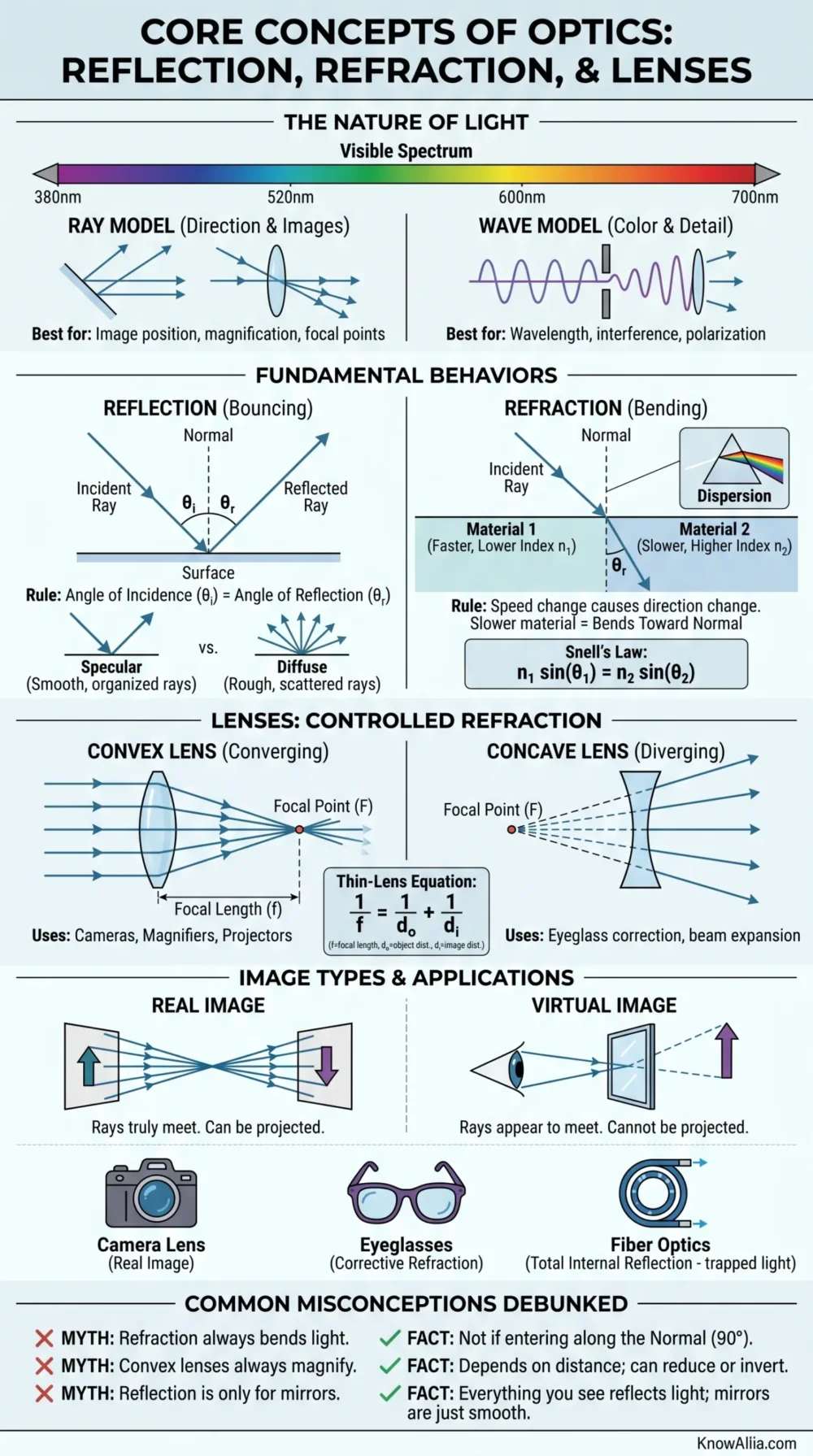
Optics is the study of how light travels, changes direction, forms images, and interacts with materials. The three ideas that explain many everyday optical effects are reflection, refraction, and lenses. Reflection is light bouncing from a surface. Refraction is light changing direction as it passes between materials. A lens uses refraction to spread light apart or bring it together. Visible light is the part of the electromagnetic spectrum the human eye can usually detect, often described as roughly 380 to 700 nanometers.[Source-a]
The Core Idea in Plain Words
Light often moves in straight lines, but its path changes when it meets a surface or enters a new material. Mirrors redirect light by reflection; transparent materials redirect light by refraction; lenses control refraction so images can be formed, enlarged, reduced, or corrected.
- Reflection: the angle in equals the angle out on a smooth surface.
- Refraction: light changes speed in a new material, so its direction can change.
- Lenses: curved transparent objects that use refraction to focus or spread rays.
What Optics Studies
Optics explains how light behaves when it travels through space, meets a surface, enters a material, or passes through a shaped transparent object. It is used in mirrors, cameras, microscopes, telescopes, eyeglasses, projectors, fiber-optic cables, sensors, and the human eye.
The most useful starting point is simple: light carries energy and can be described in more than one way. In many everyday cases, it is practical to draw light as rays. A ray is not a physical string inside light. It is a line that shows the direction light is traveling.
What You Will Learn Here
This article explains the difference between reflection and refraction, why lenses focus light, how real and virtual images work, and why the same optical rules appear in glasses, cameras, microscopes, and fiber optics. It also gives the terms needed to read basic optics diagrams without getting lost.
Light as Rays and Waves
For mirrors and lenses, ray optics is often enough. It treats light as straight-line paths that can bounce, bend, cross, or spread. This model is simple, visual, and very useful when the object is much larger than the wavelength of light.
Light is also an electromagnetic wave. The wave view explains color, interference, diffraction, polarization, and why a prism separates white light into a spectrum. A good optics explanation often switches between the two views: rays for image direction, waves for color and fine detail.
| Model | Best For | What It Explains Well | What It Does Not Fully Explain |
|---|---|---|---|
| Ray Model | Mirrors, lenses, cameras, simple diagrams | Direction, image position, magnification, focal points | Diffraction, interference, polarization |
| Wave Model | Color, thin films, diffraction, polarization | Wavelength, phase, interference patterns | Simple image diagrams can become harder to visualize |
| Photon Model | Sensors, photoelectric effect, quantum optics | Light as packets of energy | Not needed for most basic mirror and lens problems |
Reflection: When Light Bounces
Reflection happens when light meets a surface and returns into the same general material instead of passing through. On a smooth mirror-like surface, the rule is clean: the angle of reflection equals the angle of incidence, with both angles measured from the normal line, not from the surface itself.[Source-b]
Smooth Reflection and Diffuse Reflection
There are two useful forms of reflection:
- Specular reflection occurs on a very smooth surface, such as a clean mirror. Rays stay organized, so a clear image can form.
- Diffuse reflection occurs on a rough surface, such as paper or unpolished stone. Light still follows reflection rules at tiny surface points, but the surface angles vary, so rays scatter in many directions.
This is why a mirror can show your face while a white wall only looks bright. Both reflect light, but only the mirror keeps the ray pattern orderly enough to preserve an image.
The Normal Line Matters
The normal is an imaginary line drawn at a right angle to the surface. Many mistakes in optics happen because people measure the angle from the flat surface instead of from the normal. In ray diagrams, the normal is the quiet reference line that keeps the geometry honest.
Refraction: When Light Changes Direction in a New Material
Refraction is the change in direction that can occur when light crosses from one material into another, such as air into glass or water into air. The change is tied to light’s speed in the material. A material’s refractive index describes how much it slows light compared with a vacuum. OpenStax expresses this idea through the relationship between light speed in a vacuum, light speed in a material, refractive index, and Snell’s law.[Source-c]
Simple analogy: imagine a shopping cart rolling from a smooth floor onto thick carpet at an angle. One wheel slows before the other, so the cart turns. Light is not a cart, but the analogy helps explain why a change in speed at a boundary can change direction.
How Light Bends Toward or Away From the Normal
When light enters a material where it travels more slowly, its ray often bends toward the normal. When it enters a material where it travels faster, its ray often bends away from the normal. The word “often” matters because the result also depends on the entry angle. A ray that enters along the normal does not bend sideways, even though its speed changes.
Snell’s Law in Plain Meaning
Snell’s law connects four things: the first material’s refractive index, the second material’s refractive index, the incoming angle, and the refracted angle. Written in common notation, it is:
n₁ sin(θ₁) = n₂ sin(θ₂)
The formula is less mysterious when read aloud: the path of light depends on the materials and the angles. It is the math behind the bent look of a straw in water, the sparkle of cut transparent stones, the focusing of lenses, and the guiding of light in optical fibers.
Dispersion: Why White Light Can Separate Into Colors
Dispersion happens because different wavelengths of light can refract by slightly different amounts. A prism separates white light because violet, blue, green, yellow, orange, and red light do not all follow exactly the same refracted path. This is not a color trick added by the prism; it is a physical result of wavelength-dependent refraction.
Reflection, Refraction, and Lens Action
A compact map of how light changes path when it meets a mirror, crosses a transparent boundary, or passes through a curved lens.
How to Read the Diagram
The dashed line is the normal. Angles in reflection and refraction are measured from that line. The lens section shows a convex lens bringing rays toward a focus, which is the basis of many cameras, eyes, magnifiers, and projectors.
Lenses: Controlled Refraction
A lens is a transparent optical element with one or more curved surfaces. Its job is to redirect light in a planned way. A lens does not “pull” light. It changes the direction of rays through refraction at its surfaces. OpenStax describes lenses as optical elements that form images by refraction, with convex and concave lenses producing different ray behavior.[Source-d]
Convex Lenses
A convex lens is thicker near the center than at the edges. It is often called a converging lens because parallel rays entering it can bend toward a focal point. Convex lenses appear in magnifying glasses, camera lenses, projectors, microscopes, and the eye’s focusing system.
Concave Lenses
A concave lens is thinner near the center than at the edges. It is often called a diverging lens because parallel rays spread apart after passing through it. The rays can appear to come from a focal point on the same side as the incoming light.
| Lens Type | Shape | Main Ray Effect | Typical Image Behavior | Everyday Uses |
|---|---|---|---|---|
| Convex Lens | Thicker at the center | Converges parallel rays toward a focus | Can form real images or virtual magnified images, depending on object distance | Magnifiers, cameras, projectors, microscopes, telescopes |
| Concave Lens | Thinner at the center | Diverges parallel rays outward | Often forms upright virtual images in simple ray diagrams | Eyeglass correction, beam expansion, optical instruments |
Focal Point and Focal Length
The focal point is where parallel incoming rays meet after a converging lens, or where they appear to come from after a diverging lens. The focal length is the distance between the lens and that focal point. A shorter focal length bends rays more strongly; a longer focal length bends them more gently.
The thin-lens equation is often written as:
1/f = 1/dₒ + 1/dᵢ
Here, f is focal length, dₒ is object distance, and dᵢ is image distance. The equation is a simplified model, but it is very useful for thin lenses when the setup matches the assumptions.
Real and Virtual Images
An image forms when light rays either actually meet or appear to come from a point. This is one of the most common places where optics becomes confusing, because an image can be “real” in the physics sense even if it is just light on a screen.
Real Image
A real image forms where light rays truly meet. It can be projected onto a screen. Projectors and cameras use this idea.
Virtual Image
A virtual image appears to come from a place where rays do not truly meet. A flat mirror image is the familiar example.
Magnification is not only about making something larger. It also includes whether an image is upright or inverted. In simple lens notation, a negative magnification commonly indicates an inverted image, while a positive magnification commonly indicates an upright image.
Everyday Examples of Reflection, Refraction, and Lenses
Optics is not limited to lab benches. The same rules appear in familiar objects and natural scenes.
- Mirror: a smooth reflective surface sends organized rays toward your eyes, so you see a virtual image behind the mirror.
- Straw in Water: light from the submerged part bends as it passes from water into air, so the straw appears shifted.
- Camera Lens: curved glass or plastic elements focus light from a scene onto a sensor.
- Magnifying Glass: a convex lens can make a nearby object appear larger by forming a virtual magnified image.
- Eyeglasses: corrective lenses bend light so it focuses more properly on the retina; the National Eye Institute explains this same bending principle in eyeglass correction.[Source-e]
- Optical Fiber: light can stay guided inside a fiber through total internal reflection when the material conditions and angles are right.
Total Internal Reflection
Total internal reflection happens when light traveling in a material with a higher refractive index meets a boundary with a lower-index material at a large enough angle. Instead of partly exiting, the light reflects back inside. The angle where this begins is called the critical angle.
This effect explains why light can travel through glass or plastic fibers even when the fiber bends. It is also why some transparent materials can look very bright when cut with suitable surface angles. The important point is that total internal reflection is not ordinary mirror coating. It is reflection produced by refraction conditions.
Common Mix-Ups About Optics
- Mix-Up 1: “Reflection means only mirrors.”
- No. Many surfaces reflect light. Mirrors are special because their smooth surfaces preserve the ray pattern well enough to form a clear image.
- Mix-Up 2: “Refraction means light always bends.”
- Not always. If light crosses a boundary along the normal, its speed can change without a sideways change in direction.
- Mix-Up 3: “A lens magnifies because it makes light stronger.”
- A simple lens does not create extra light. It redirects rays, changing how the object’s light reaches the eye or a sensor.
- Mix-Up 4: “Convex always means bigger image.”
- A convex lens can form different image types depending on object distance. It can magnify, reduce, invert, or project an image.
- Mix-Up 5: “Real image means physical object.”
- In optics, a real image means rays truly meet there. The image can appear on a screen, but it is still made of light.
Key Terms in Optics
The terms below make mirror and lens diagrams much easier to read.
- Incident Ray
- The incoming ray that reaches a surface or boundary.
- Reflected Ray
- The ray that bounces away from a surface.
- Refracted Ray
- The ray that continues into a new material after changing direction.
- Normal
- An imaginary line drawn at 90 degrees to a surface or boundary.
- Angle of Incidence
- The angle between the incident ray and the normal.
- Angle of Reflection
- The angle between the reflected ray and the normal.
- Angle of Refraction
- The angle between the refracted ray and the normal.
- Refractive Index
- A number that describes how light travels through a material compared with a vacuum.
- Focal Point
- The point where rays meet, or appear to spread from, after interacting with a lens or curved mirror.
- Focal Length
- The distance from the lens or mirror to its focal point in a simplified optical model.
Reflection, Refraction, and Lenses Compared
| Optical Idea | What Happens to Light | Main Rule or Concept | What to Watch Closely |
|---|---|---|---|
| Reflection | Light bounces from a surface | Angle of incidence = angle of reflection | Angles are measured from the normal, not the surface |
| Refraction | Light enters a new material and may change direction | Snell’s law connects material indices and angles | A ray entering along the normal does not bend sideways |
| Convex Lens | Light is bent by two curved surfaces | Can converge rays toward a focal point | Image type depends on object distance |
| Concave Lens | Light is bent outward after passing through | Rays diverge and appear to come from a focal point | Often produces upright virtual images in basic diagrams |
| Total Internal Reflection | Light stays inside a higher-index material | Requires a boundary, a lower-index outside material, and an angle beyond the critical angle | It is caused by boundary conditions, not by a silver mirror layer |
Limits of Simple Optics
Simple ray optics is very useful, but it is not a full description of light. It works best when wavelengths are much smaller than the objects, openings, and lens sizes involved. When light passes through very small gaps, meets fine edges, or interacts with thin coatings, wave effects such as diffraction and interference may become important.
Lens behavior also depends on details that simple diagrams leave out: glass type, plastic type, surface shape, thickness, coatings, alignment, wavelength, and manufacturing accuracy. A basic convex-lens diagram can explain the main path of rays, but it cannot by itself predict every optical defect, color fringe, or loss of brightness in a real device.
One honest way to read optics is this: ray diagrams explain the main geometry; wave optics explains finer behavior; real instruments add material and design limits.
FAQ About Reflection, Refraction, and Lenses
Common Questions
What is the difference between reflection and refraction?
Reflection happens when light bounces from a surface. Refraction happens when light enters a different material and changes speed, which can also change its direction.
Why does a straw look bent in a glass of water?
Light from the underwater part of the straw changes direction as it passes from water into air. Your brain traces the light back in a straight line, so the straw appears shifted from its true position.
Do lenses work by reflection or refraction?
Most simple lenses work mainly by refraction. Light bends when it enters and leaves the lens material, and the curved surfaces control how the rays converge or diverge.
What is the normal line in optics?
The normal line is an imaginary line drawn at a right angle to the surface where light arrives. Angles of incidence, reflection, and refraction are measured from this line.
What is a focal point?
A focal point is where rays meet after passing through a converging lens, or where rays appear to come from after passing through a diverging lens.
Why can a convex lens sometimes magnify and sometimes project an image?
The result depends on the object’s distance from the lens compared with the focal length. A nearby object can appear magnified as a virtual image, while a farther object can form a real image that can be projected.
Sources
- [Source-a] NASA Science – Visible Light — Supports the definition of visible light and the commonly stated 380–700 nanometer range.
- [Source-b] OpenStax – Physics: Reflection — Supports the law of reflection, reflection terminology, and basic mirror behavior.
- [Source-c] OpenStax – Physics: Refraction — Supports refraction, refractive index, Snell’s law, dispersion, and total internal reflection.
- [Source-d] OpenStax – Physics: Lenses — Supports convex and concave lens behavior, image formation, ray diagrams, and the thin-lens equation.
- [Source-e] National Eye Institute – Eyeglasses for Refractive Errors — Supports the explanation that eyeglass lenses bend light to help it focus on the retina.
- [Source-f] MIT OpenCourseWare – Reflection and Refraction; Prisms, Waveguides, and Dispersion — Supports the broader optics context of reflection, refraction, prisms, waveguides, and dispersion.