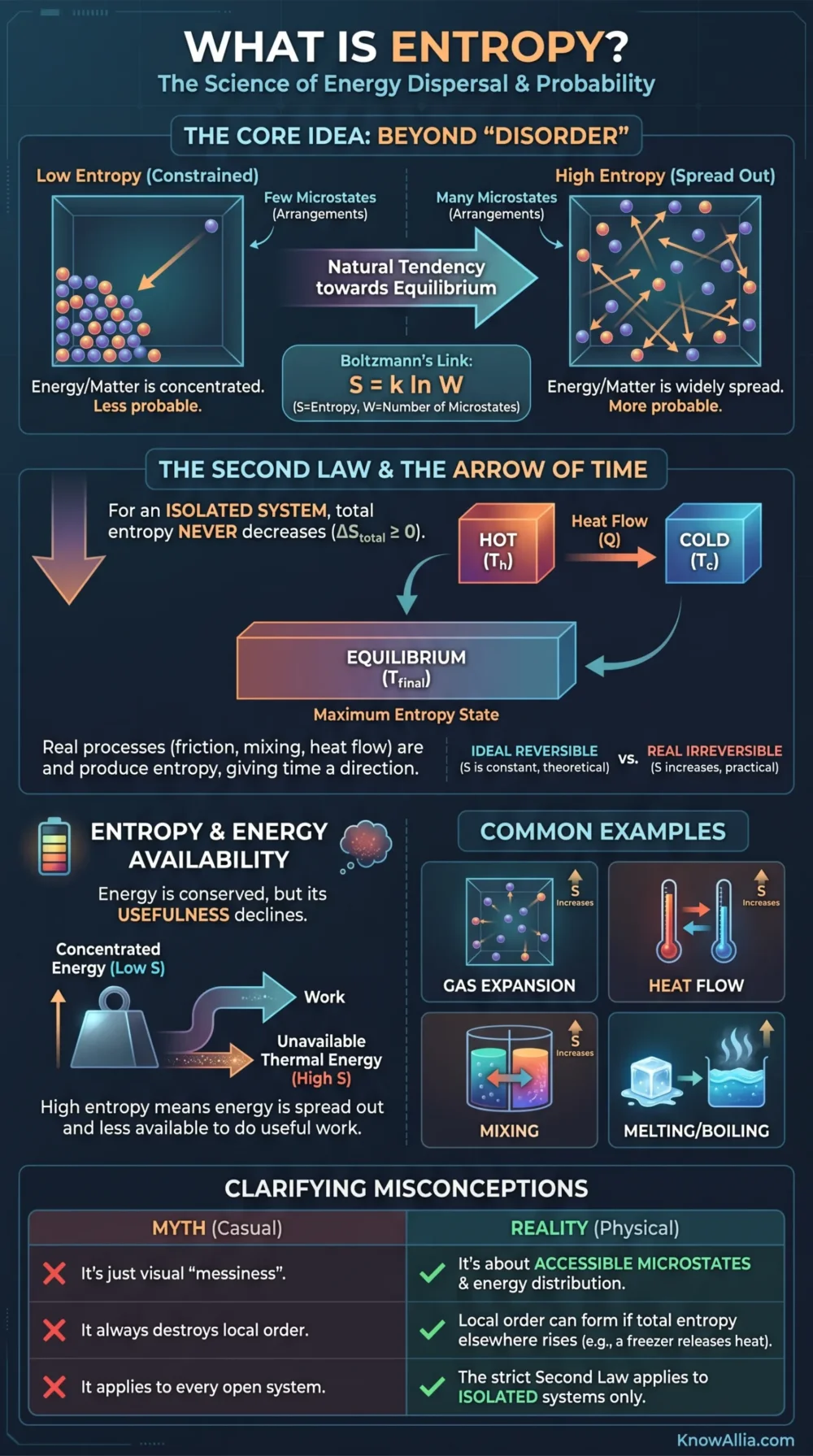
Entropy is a physical quantity that describes how widely energy and matter can be spread among possible microscopic arrangements. In everyday language it is often called disorder, but the sharper idea is energy dispersal plus probability: a high-entropy state can happen in many more microscopic ways than a low-entropy state. This is why warm and cold objects tend to reach the same temperature, gases spread through a room, and many natural processes run easily one way but not the reverse.
A Clear Starting Point
Entropy helps physics explain why nature has a direction. It does not mean that everything simply becomes “messy”; it means that isolated systems tend to move toward states with more possible microscopic arrangements and less usable energy difference.
- Symbol: usually S.
- Common unit: joule per kelvin, written J/K.[Source-b]
- Main rule: the total entropy of a system plus its surroundings cannot decrease; it stays constant for an ideal reversible process and increases for an irreversible one.[Source-a]
What This Page Makes Clear
This page explains entropy without reducing it to a vague “messiness” slogan. You will see how microstates, temperature, energy spreading, and irreversibility fit together in one idea.
- Why entropy is tied to probability, not just visual disorder.
- Why isolated systems tend toward thermal equilibrium.
- Why some processes are practically one-way even when the basic motion of particles can be described by reversible laws.
What Entropy Means
Entropy is a state property. That means it describes a system’s condition, not the exact path the system took to get there. A gas in a box, a cup of cooling coffee, or a melting ice cube can each be described by temperature, pressure, energy, and entropy.
The common word disorder is useful only if it is handled carefully. A neat room and a messy room are visual examples, but entropy is not a moral judgment about neatness. In physics, high entropy usually means more possible microscopic arrangements are compatible with the same visible condition.
Think of a library after every book has been placed in a broad “mixed books” section. To a visitor, many different shelf orders would look almost the same. That is the useful analogy: a high-entropy macrostate is like a visible arrangement that can be produced by an enormous number of hidden arrangements.
Clean definition: entropy measures how many microscopic ways a system can realize the same large-scale state, and how energy is spread across those possibilities.
Microstates, Macrostates, and Probability
A macrostate is the large-scale description: pressure, volume, temperature, amount of substance, and phase. A microstate is one exact microscopic arrangement of all the particles and their energies. Entropy rises when the number of accessible microstates rises.
Boltzmann’s statistical view connects entropy with the number of possible microstates. In simple form, it is often written as S = k ln W, where W is the number of accessible microstates and k is Boltzmann’s constant.[Source-c]
- Low Entropy
- Fewer accessible microstates. Energy or matter is more constrained. Examples: a compressed gas, a cold crystal, separated hot and cold regions.
- High Entropy
- More accessible microstates. Energy or matter is more spread out. Examples: a gas filling a container, mixed liquids, objects at a shared temperature.
- Equilibrium
- A state where large-scale change stops because the most probable distribution has been reached under the given conditions.
This probability view explains why entropy is not a mysterious pushing force. A gas does not “want” to fill a room. There are simply vastly more ways for its molecules to be spread through the room than to remain packed in one corner.
Entropy and the Second Law of Thermodynamics
The second law says that for an isolated system, entropy never decreases. It can remain the same in an ideal reversible process, but real processes with friction, diffusion, mixing, electrical resistance, and heat flow across a temperature difference produce more entropy.
The word isolated matters. A freezer can make water more ordered by turning it into ice, but the freezer releases heat to the room. The local entropy of the water can decrease while the total entropy of the water, freezer, and room increases. This is one of the most common places where people misunderstand entropy.
Why Entropy Explains Irreversibility
Many everyday processes have a clear direction. Hot coffee cools. Perfume spreads. A gas escapes a container. Food coloring disperses in water. These events are not impossible to reverse at the particle level, but a full reversal would require an incredibly precise microscopic arrangement.
That is why entropy is linked to the arrow of time. The large-scale laws of thermodynamics describe a future direction: systems spontaneously move toward equilibrium rather than away from it. Stanford’s discussion of thermodynamic time asymmetry uses familiar examples such as heat flow from hot to cold and diffusion through available space.[Source-e]
In practice, irreversibility means the original ordered difference is no longer available in a useful form. Once the energy has spread into many small motions across the surroundings, gathering it back into one neat pattern would require extra work and would produce more entropy somewhere else.
How Entropy Is Measured
Thermodynamic entropy is measured in joules per kelvin. For an ideal reversible heat transfer, the entropy change can be written as ΔS = Qrev / T, meaning reversible heat transfer divided by absolute temperature. Britannica’s thermodynamics reference describes this relation for heat entering a reservoir at constant temperature.[Source-f]
This formula does not say that all heat transfers are reversible. It gives a clean way to calculate entropy change by using a reversible path between the same states. Entropy itself is a state property, so the change can be found even when the real process is not reversible.
| Term | Plain Meaning | Physical Detail | Example |
|---|---|---|---|
| System | The part being studied | Can be open, closed, or isolated depending on matter and energy exchange | A cup of water, a gas cylinder, a metal bar |
| Surroundings | Everything outside the chosen system | May gain entropy when the system loses entropy | The room around a freezer |
| Microstate | One exact particle-level arrangement | Includes positions and energy distribution in a statistical description | One possible arrangement of gas molecules in a box |
| Macrostate | The visible large-scale state | Defined by measurable quantities such as temperature, pressure, volume, and phase | Gas at 1 atm and 300 K in a container |
| Reversible Process | An ideal process that can be undone without net change | Requires near-perfect balance at every step | A theoretical slow heat engine cycle |
| Irreversible Process | A real one-way process | Produces entropy through diffusion, friction, resistance, mixing, or heat flow | Hot and cold bars reaching the same temperature |
Everyday Examples of Entropy
Entropy becomes clearer when the examples are tied to energy distribution and microstates, not just “mess.” The examples below are simple, but the same logic appears in engines, chemistry, materials science, and climate physics.
Heat Flow
A hot object in a cooler room loses energy to the surroundings. The final state, where temperatures are closer together, has more accessible microscopic energy arrangements. MIT’s entropy teaching material uses hot and cold bars to show why spontaneous heat transfer is consistent with a positive total entropy change.[Source-d]
Gas Expansion
A gas released into a larger volume spreads out because the spread-out state has far more possible molecular arrangements. The reverse event, every molecule gathering back into one small region without assistance, is not expected on ordinary time scales.
Melting and Boiling
A solid usually has fewer accessible arrangements than its liquid form, and a gas has more freedom than a liquid. This is why melting and vaporization often involve an entropy increase for the substance, even though total spontaneity also depends on energy exchange and temperature.
Mixing
When two compatible substances mix, the particles gain more possible positions and interactions. The mixed state is not “messy” in a casual sense; it is statistically richer.
Entropy Connects Probability, Energy, and Direction
A process becomes naturally favored when the final condition can be realized by many more microscopic arrangements and when the total entropy of the system plus surroundings rises.
How a Natural Process Moves
Four Ways to Read Entropy
Entropy belongs to the condition of the system, not to the story of how it got there.
More accessible arrangements mean higher entropy for the same visible state.
Energy differences become less concentrated and less available for work.
Large systems move toward equilibrium because that condition is overwhelmingly probable.
Entropy and the Availability of Work
Entropy also tells us why not all energy can be turned into useful work. Energy is conserved, but its usefulness can decline. A warm room contains thermal energy, yet if everything in the room has the same temperature, there is no temperature difference to drive a heat engine.
This is why entropy is often linked to “unavailable energy.” The energy still exists. It is just spread in a way that cannot be fully gathered into ordered work without causing extra changes elsewhere.
Entropy in Chemistry and Materials
In chemistry, entropy helps explain why some phase changes, dissolving processes, and reactions are favored under certain conditions. A reaction is not judged by entropy alone; enthalpy, temperature, and Gibbs free energy also matter. Still, entropy is central because it tracks how matter and energy become distributed.
- Heating a substance usually raises entropy because particles can access a wider spread of energies.
- Melting often raises entropy because molecules gain more freedom of motion.
- Boiling usually raises entropy more than melting because gas particles occupy many more positions.
- Dissolving can raise entropy when particles become more dispersed, though total spontaneity depends on the full energy balance.
Entropy in Information Is Related, Not Identical
The word entropy also appears in information theory. There it measures uncertainty in a message source. A fair coin toss has more information entropy than a coin that almost always lands one way because the next result is harder to predict.
This is related by mathematics and probability, but it should not be merged carelessly with thermodynamic entropy. Thermodynamic entropy concerns physical systems, heat, temperature, work, and microscopic arrangements. Information entropy concerns possible messages or outcomes.
Common Confusion About Entropy
“Entropy Means Chaos”
Not exactly. Chaos is a loose word. Entropy is a measurable physical quantity tied to microstates, energy distribution, and temperature.
“Entropy Always Destroys Order”
Local order can form. Crystals, living organisms, refrigerators, and weather patterns can show local structure while total entropy rises in the larger system.
“Entropy Is the Same as Dirtiness”
A dirty surface may look disordered, but thermodynamic entropy is not based on human ideas of cleanliness. It is based on physical arrangements and energy spread.
“The Second Law Is About Closed Boxes Only”
The clearest statement applies to isolated systems. For open or closed systems, the surroundings must be included before judging the total entropy change.
Useful Terms Before You Leave
- Entropy
- A state quantity that measures energy dispersal and the number of microscopic arrangements compatible with a visible state.
- Second Law of Thermodynamics
- The rule that the total entropy of an isolated system cannot decrease.
- Microstate
- One exact microscopic arrangement of particles and energy.
- Macrostate
- The large-scale description of a system, such as temperature, pressure, volume, and phase.
- Reversible Process
- An ideal process that can be undone with no net change to the system and surroundings.
- Irreversible Process
- A real process that produces entropy, such as diffusion, friction, electrical resistance, or heat flow across a temperature difference.
- Thermal Equilibrium
- A condition where temperature has evened out and there is no net heat flow between parts of the system.
What We Can and Cannot Say
Entropy gives a reliable large-scale rule for ordinary physical systems with huge numbers of particles. It does not mean that every tiny fluctuation is forbidden. In very small systems, short-lived fluctuations can occur, but they do not undo the practical direction seen in large everyday systems.
There is also a deeper open discussion about why the universe began in a low-entropy condition. Entropy explains much of the observed direction of heat flow, diffusion, and equilibration, but the full origin of the thermodynamic arrow of time is still discussed in physics and philosophy.
The safe statement is this: entropy explains why large systems naturally move toward more probable macroscopic states, while the deepest cosmic starting conditions remain a separate question.
FAQ About Entropy
Questions Readers Often Ask
Is entropy the same as disorder?
Disorder is a useful first word, but it is not precise enough by itself. Entropy is better understood as a measure of accessible microstates and energy dispersal.
Can entropy ever decrease?
Yes, entropy can decrease locally. For example, water can freeze into ice. The second law says the total entropy of an isolated system cannot decrease, so the surroundings must also be counted.
Why does heat flow from hot to cold?
Heat flows from hot to cold because that direction increases the total number of accessible microscopic energy arrangements. The reverse direction would require an extremely specific microscopic arrangement and is not spontaneous in ordinary conditions.
What is the unit of entropy?
The SI unit of entropy is joule per kelvin, written J/K. Specific entropy can also be written per unit mass, such as J/(kg·K), in engineering and materials contexts.
Does entropy mean the universe is running out of energy?
No. Energy is conserved. Entropy describes how energy becomes spread out and less available for useful work. The amount of energy is not the same as the ability to use that energy.
Why are reversible processes ideal?
A reversible process must proceed through nearly balanced states with no friction, turbulence, resistance, or uncontrolled heat flow. Real processes always have imperfections, so they produce entropy.
Sources
- [Source-a] NASA Glenn Research Center – What Is Thermodynamics? — Used for the second-law statement connecting system, environment, reversible processes, and irreversible processes.
- [Source-b] NIST – Guide to the SI, Chapter 4 — Used for the SI unit statement that entropy is expressed in joules per kelvin.
- [Source-c] Chemistry LibreTexts – Entropy and Microstates — Used for the microstate explanation and the Boltzmann relation.
- [Source-d] MIT OpenCourseWare – Entropy Transcript — Used for the spontaneous heat-transfer example and the system-plus-surroundings view.
- [Source-e] Stanford Encyclopedia of Philosophy – Thermodynamic Asymmetry in Time — Used for the arrow-of-time and thermodynamic time-asymmetry discussion.
- [Source-f] Britannica – Thermodynamics: Entropy — Used for the thermodynamic relation between heat, temperature, and entropy change.