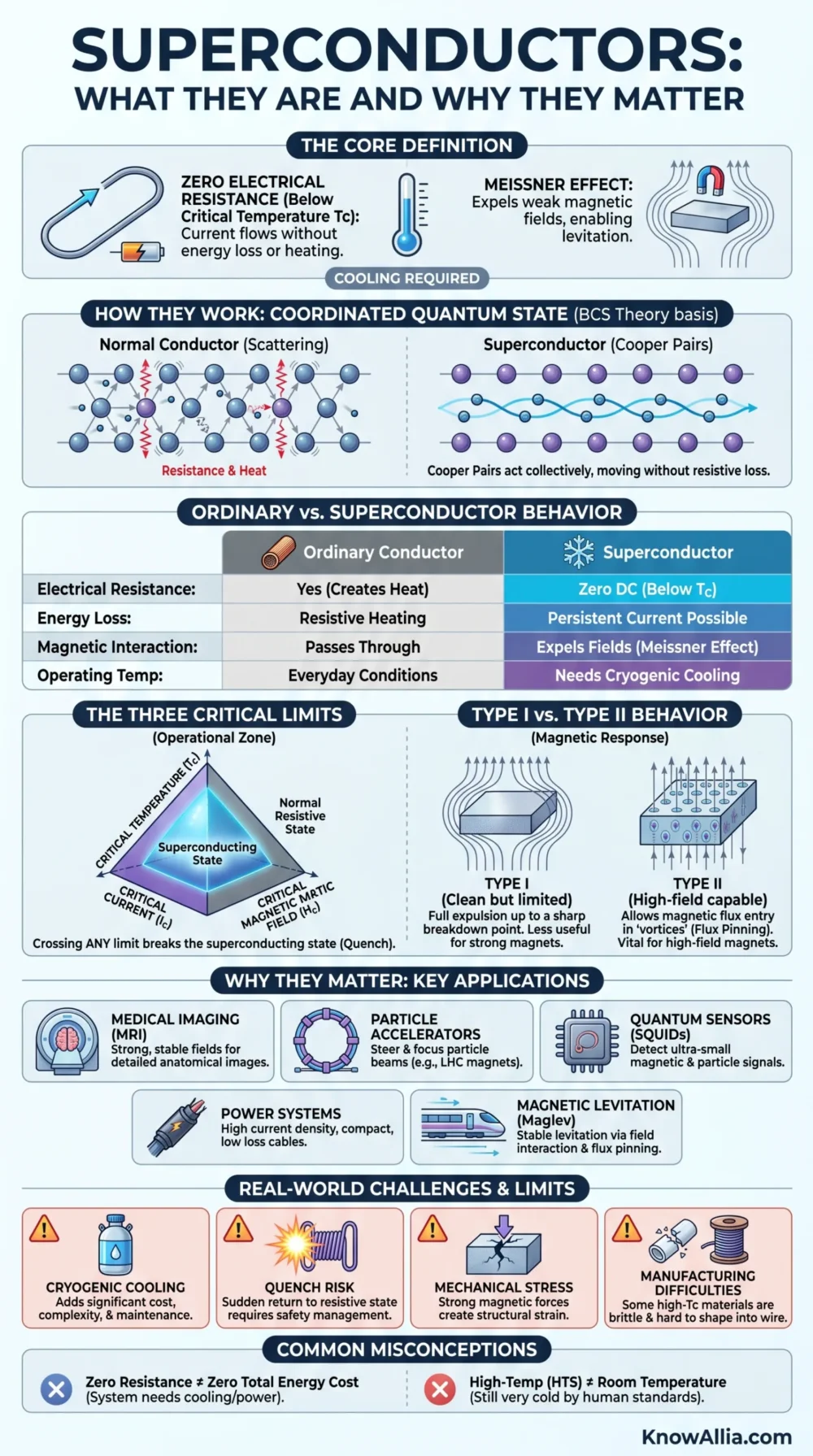
A superconductor is a material that can carry direct electric current with no electrical resistance when it is cooled below its own critical temperature. A true superconductor also pushes out weak magnetic fields as it enters that state, a behavior called the Meissner effect.[Source-a] This is why superconductors are not just “very good metals.” They are a different electrical state of matter.
The Clear Version
Superconductors matter because they make three things possible: lossless current flow, very strong magnetic fields, and ultra-sensitive measurement. They already appear in medical imaging, particle accelerators, scientific sensors, and specialized power systems.
- Zero resistance means current can move without heating the material through ordinary electrical resistance.
- Magnetic field control makes strong magnets and magnetic levitation possible under the right conditions.
- Practical use depends on limits: temperature, current, magnetic field, material strength, cooling cost, and manufacturability.
What This Page Makes Clear
You will learn what superconductors are, how they differ from ordinary conductors, why they need cooling, where they are used, and why researchers still treat room-temperature claims with care. The goal is simple: make the physics useful without turning it into dense textbook language.
What Superconductors Are
A superconductor is not defined by being cold. It is defined by what happens after cooling: its electrical resistance drops to zero, and it begins to reject weak magnetic fields from its interior. Each superconducting material has its own critical temperature, often written as Tc.
Ordinary copper wire still resists current, even though it is an excellent conductor. That resistance converts some electrical energy into heat. A superconducting wire, while it remains in the superconducting state, can carry current without that resistive heating. This is the basic reason superconductors are so attractive for magnets, sensors, and advanced electrical systems.
Ordinary Conductor
- Has electrical resistance.
- Turns some electrical energy into heat.
- Works at everyday temperatures.
- Easy to shape into wire and components.
Superconductor
- Has zero DC resistance below Tc.
- Can carry persistent current under the right conditions.
- Expels weak magnetic fields through the Meissner effect.
- Usually needs cooling, careful engineering, and material protection.
The first observed case came in 1911, when Heike Kamerlingh Onnes found that mercury lost its electrical resistance at a temperature a few degrees above absolute zero. His low-temperature work later became part of the Nobel Prize record.[Source-b]
How Superconductors Work
In a normal metal, electrons move through a lattice of atoms and keep scattering. That scattering is one reason resistance exists. In many conventional superconductors, cooling allows electrons to form paired states known as Cooper pairs. These pairs behave collectively, so the current can move through the material without ordinary resistive loss.
Think of it like a busy hallway. Single people keep bumping into shoulders and bags. A coordinated procession, moving with shared timing, can pass through the same hallway with far less interruption. That analogy is imperfect, but it helps explain why superconductivity is not just “electrons going faster.” It is a coordinated quantum state.
The best-known microscopic explanation for many conventional superconductors is BCS theory, named after John Bardeen, Leon Cooper, and John Schrieffer. CERN summarizes the idea as electrons forming pairs through interaction with lattice vibrations called phonons.[Source-c] Some high-temperature superconductors do not fit that simple phonon-based picture neatly, which is one reason the field is still active.
Why Cooling Matters
Heat shakes atoms and electrons. Too much thermal motion disrupts the ordered state that superconductivity needs. Cooling reduces that disorder. Once a material is below its critical temperature, the superconducting state can appear, provided the current and magnetic field also stay within safe physical limits.
- Low-temperature superconductors often need liquid helium temperatures.
- High-temperature superconductors work at higher temperatures than older superconductors, but “high” still usually means very cold by everyday standards.
- Room-temperature superconductivity at normal pressure remains a research target, not an everyday engineering material.
The Main Properties That Define a Superconductor
Zero Electrical Resistance
The most famous property is zero DC electrical resistance. In a closed superconducting loop, current can persist for a very long time because ordinary resistive loss is absent. This does not mean every superconducting device wastes no energy overall. The cooling system, control electronics, and protection hardware still matter.
The Meissner Effect
The Meissner effect is the expulsion of weak magnetic fields from inside a material as it becomes superconducting. This is why a superconductor is not merely a perfect conductor. A perfect conductor would resist changes in magnetic field; a superconductor actively enters a state with magnetic field exclusion under the right conditions.
Critical Temperature, Critical Current, and Critical Field
A superconductor works only inside a physical operating zone. Three limits matter most: temperature, current, and magnetic field. Cross one limit, and the material can return to a normal resistive state. Engineers often describe these connected limits as a surface rather than a single number.
- Critical temperature: the temperature below which superconductivity can appear.
- Critical current: the current level beyond which superconductivity can break down.
- Critical magnetic field: the magnetic field strength beyond which the superconducting state cannot survive.
Main Superconductor Material Families
There is no single “superconductor material.” The word covers metals, alloys, ceramics, thin films, and high-pressure compounds. Their usefulness depends not only on Tc, but also on whether they can be made into wire, whether they tolerate strong fields, and whether they stay stable in real devices.
| Material Family | Typical Traits | Where It Matters | Practical Note |
|---|---|---|---|
| Elemental superconductors | Simple elements such as mercury, lead, or niobium can become superconducting at very low temperatures. | They helped establish the science of superconductivity. | Historically vital, but not always the easiest route for modern devices. |
| Niobium alloys and compounds | Materials such as niobium-titanium and niobium-tin can be made into useful conductors for strong magnets. | Particle accelerators, research magnets, and many high-field systems. | Engineering value comes from wire-making, current capacity, and magnetic-field tolerance. |
| Copper-oxide ceramics | Often called cuprates; many work at higher temperatures than older low-temperature superconductors. | Research, power cables, magnets, and specialized devices. | Ceramic behavior can make them brittle and harder to shape than metals. |
| Magnesium diboride | A comparatively simple compound with a higher Tc than many conventional metallic superconductors. | Specialized magnets, cables, and research systems. | Useful where its temperature range and conductor form match the device. |
| Hydrides and pressure-based materials | Some show superconductivity at higher temperatures, but often only under extreme pressure. | Frontier research into higher-temperature superconductivity. | Promising as science, but not ordinary wire for homes, phones, or everyday machines. |
The 1987 Nobel Prize in Physics recognized Georg Bednorz and K. Alex Müller for the discovery of superconductivity in ceramic materials, an event that opened the high-temperature superconductor era.[Source-d]
How Superconductivity Becomes Useful
Superconductivity is valuable only when the material, cooling system, magnetic field, and device design work together.
Cool Below Tc
The material enters its superconducting state only below its own transition temperature.
Pair the Electrons
In many conventional materials, electrons form paired quantum states that move collectively.
Carry Current Cleanly
DC current can flow without ordinary resistive heating while the material stays within its limits.
Control Magnetic Fields
The Meissner effect and strong superconducting coils enable levitation, imaging, and high-field science.
Needs high current, stable cooling, and safe protection against sudden loss of superconductivity.
Needs low loss, manageable cooling, strong insulation, and a material that can be made into long conductors.
Needs low noise, precise readout, and a controlled cryogenic environment.
Why Superconductors Matter
Superconductors matter because they allow devices to do things that ordinary conductors struggle to do efficiently or precisely. Their value is not only “saving electricity.” In many cases, the bigger benefit is magnetic field strength, compact design, measurement sensitivity, or stable current flow.
Medical Imaging
Many MRI systems rely on strong magnets. MRI uses a magnetic field and radiofrequency pulses to align and detect signals from protons in body tissues, producing detailed anatomical images without ionizing x-rays.[Source-f] Superconducting magnets help create strong, stable fields for this kind of imaging.
Particle Accelerators and Research Magnets
Particle accelerators use superconducting magnets to steer and focus particle beams. CERN reports that the Large Hadron Collider contains more than 9,000 niobium-titanium superconducting magnets, including 1,232 large dipole magnets, with much of the 27 km ring cooled by superfluid helium.[Source-e]
Quantum Sensors and Precision Measurement
Superconductors can support sensors that detect extremely small signals. A well-known example is the SQUID, short for superconducting quantum interference device. NIST describes SQUIDs as magnetic-field sensors based on superconducting loops where current flows without resistance.[Source-g]
Electric Power Systems
Superconducting cables and fault-current limiters can be useful where high current density, compact equipment, or reduced resistive loss matters. The challenge is not the idea. It is the full system: cryogenic cooling, insulation, maintenance, cost, and reliability.
Magnetic Levitation
Superconductors can interact with magnetic fields in ways that support levitation and stable positioning. Demonstrations are often visually striking, but the real physics is about field exclusion, flux pinning, and the behavior of type-II superconductors in magnetic fields.
What Limits Superconductors in Real Devices
The hardest part of superconductivity is not proving that a material can work in a lab. The harder part is making it work safely, affordably, and repeatedly in a device. A superconductor that has an impressive Tc may still be difficult to use if it is brittle, unstable, hard to manufacture, or unable to carry enough current.
- Cooling
- Cryogenic systems add cost, complexity, and maintenance. A warmer superconductor is useful only if it also works well as a device material.
- Quench
- A quench happens when part of a superconductor returns to a normal resistive state. In large magnets, protection systems must safely manage the stored energy.
- Mechanical Stress
- Strong magnets create strong forces. The conductor and support structure must survive those forces.
- Wire Fabrication
- Some materials have excellent superconducting behavior but are difficult to form into long, flexible, reliable conductors.
- Magnetic Field Tolerance
- A material may superconduct at a given temperature but fail under a high magnetic field.
Why “Higher Tc” Is Not the Whole Story
A higher critical temperature is useful, but it does not automatically create a better superconductor. Engineers also care about current density, field tolerance, material cost, cooling method, long-term stability, and whether the material can be joined to other components.
Recent research continues to push the temperature record under more practical pressure conditions. In 2026, University of Houston researchers reported an ambient-pressure superconductivity record of 151 K using a pressure-quenching approach. That is colder than everyday conditions, so it should be read as scientific progress, not a room-temperature household wire.[Source-h]
Type I and Type II Superconductors
Superconductors are often grouped into Type I and Type II. The difference matters because most high-field applications need materials that can keep superconducting while magnetic fields partly enter the material in controlled patterns.
| Type | Magnetic Behavior | Typical Usefulness | Simple Reading |
|---|---|---|---|
| Type I | Shows a full Meissner state up to a critical magnetic field, then superconductivity breaks down sharply. | Useful for basic physics and some specialized cases. | Clean behavior, but often less useful for strong magnets. |
| Type II | Allows magnetic flux to enter in tiny quantized regions called vortices while the rest remains superconducting. | Used in many practical superconducting magnets and high-field systems. | More useful for strong-field engineering when vortices are controlled. |
Common Confusion About Superconductors
“Zero Resistance Means Zero Energy Cost”
Not exactly. The current in the superconducting part can avoid resistive loss, but the system may still need cooling, pumps, insulation, control electronics, and safety systems. A superconducting device must be judged as a whole machine.
“A Superconductor Is Just a Perfect Metal”
No. The Meissner effect makes superconductivity different from perfect conductivity. Magnetic behavior is part of the definition, not decoration.
“High-Temperature Means Room Temperature”
Usually no. In superconductivity, “high-temperature” often means warmer than older helium-cooled materials, not comfortable room conditions. Many high-temperature superconductors are still very cold by ordinary human standards.
“Levitation Proves Any Material Is a Superconductor”
Levitation can be a clue, but it is not enough by itself. Reliable proof needs electrical and magnetic evidence, including resistance behavior and field response.
Key Terms
- Superconductor
- A material that shows zero DC resistance and superconducting magnetic behavior below its critical temperature.
- Critical Temperature
- The transition temperature below which a material can enter the superconducting state.
- Meissner Effect
- The expulsion of weak magnetic fields from a superconductor as it enters the superconducting state.
- Cooper Pair
- A paired electron state that helps explain conventional superconductivity.
- Flux Pinning
- The trapping of magnetic flux lines in defects or structures inside a type-II superconductor, helping stabilize levitation or magnetic behavior.
- Quench
- A sudden return from superconducting behavior to normal resistive behavior in part of a device.
- Cryogenics
- The use of very low temperatures, often with liquid helium or liquid nitrogen, to operate cold materials and devices.
Examples That Show Why They Matter
- MRI scanners: superconducting magnets help create strong, stable magnetic fields for detailed medical imaging.
- Research accelerators: superconducting magnets bend and focus particle beams in large machines.
- Scientific sensors: superconducting circuits can detect tiny magnetic, photon, or particle signals.
- Power equipment: superconducting cables and fault-current limiters can be useful where high current and compact design are needed.
- Maglev systems: superconducting magnetic behavior can help support stable levitation in specialized transport and demonstration systems.
How Scientists Check a Superconductor Claim
Claims about new superconductors need careful testing because one measurement can mislead. A resistance drop can come from measurement artifacts, impurities, or a tiny superconducting fraction that is not useful as a bulk material. A serious claim needs multiple lines of evidence.
- Electrical evidence: resistance drops to zero within the limits of the instrument.
- Magnetic evidence: the material shows Meissner behavior or related superconducting magnetic response.
- Reproducibility: independent groups can make and test the material.
- Operating conditions: temperature and pressure are clearly reported.
- Useful material form: the material can be made in a shape and size that matches its proposed use.
What We Still Do Not Know
Superconductivity is well established, but not every superconducting material is fully understood. Conventional superconductors have a strong theory through Cooper pairs and phonons, while many high-temperature materials still raise open questions about pairing mechanisms, disorder, magnetism, and material structure.
The biggest practical unknown is not whether superconductivity is real. It is whether researchers can find or engineer materials that combine higher operating temperature, normal-pressure stability, high current capacity, strong-field tolerance, and easy manufacturing in one usable package.
FAQ About Superconductors
Common Questions
What is a superconductor in simple words?
A superconductor is a material that can carry direct electrical current with no resistance when it is cooled below a certain temperature. It also shows special magnetic behavior, including the Meissner effect.
Do superconductors work at room temperature?
Practical room-temperature superconductors at normal pressure are not in ordinary use. Some materials work at higher temperatures than older superconductors, and some research materials need extreme pressure. Everyday room-temperature superconducting wire remains an open goal.
Why do superconductors need to be cold?
Cooling reduces thermal motion that would disrupt the superconducting state. Each material has its own critical temperature, and it must stay below that temperature to remain superconducting.
Are superconductors used today?
Yes. They are used in MRI magnets, particle accelerators, research magnets, quantum sensors, and specialized electrical systems. Their use is limited by cooling needs, cost, material behavior, and engineering demands.
What is the Meissner effect?
The Meissner effect is the expulsion of weak magnetic fields from inside a superconductor as it enters the superconducting state. It is one of the main features that separates superconductors from ordinary perfect-conductor ideas.
What happens if a superconductor gets too warm?
If it rises above its critical temperature, it leaves the superconducting state and becomes resistive again. In large devices, this transition must be managed carefully because stored magnetic energy can be high.
Sources
- [Source-a] U.S. Department of Energy – DOE Explains…Superconductivity — Used for the core definition of superconductivity, zero resistance, critical temperature, and magnetic field expulsion.
- [Source-b] Nobel Prize – Heike Kamerlingh Onnes Facts — Used for the 1911 mercury discovery and the historical Nobel record.
- [Source-c] CERN – Superconductivity — Used for critical temperature, Meissner effect, and the Cooper pair explanation in BCS theory.
- [Source-d] Nobel Prize – The Nobel Prize in Physics 1987 — Used for the discovery of superconductivity in ceramic materials by Bednorz and Müller.
- [Source-e] CERN – Superconductors Accelerate Progress — Used for LHC superconducting magnet numbers and accelerator context.
- [Source-f] National Institute of Biomedical Imaging and Bioengineering – Magnetic Resonance Imaging — Used for the MRI explanation and magnetic-field role in imaging.
- [Source-g] NIST – Magnetic Attraction: Physicists Pay Homage to the SQUID at 50 — Used for SQUID sensors and superconducting-loop measurement behavior.
- [Source-h] University of Houston – Ambient-Pressure Superconductivity Record — Used for the 2026 ambient-pressure 151 K research update.