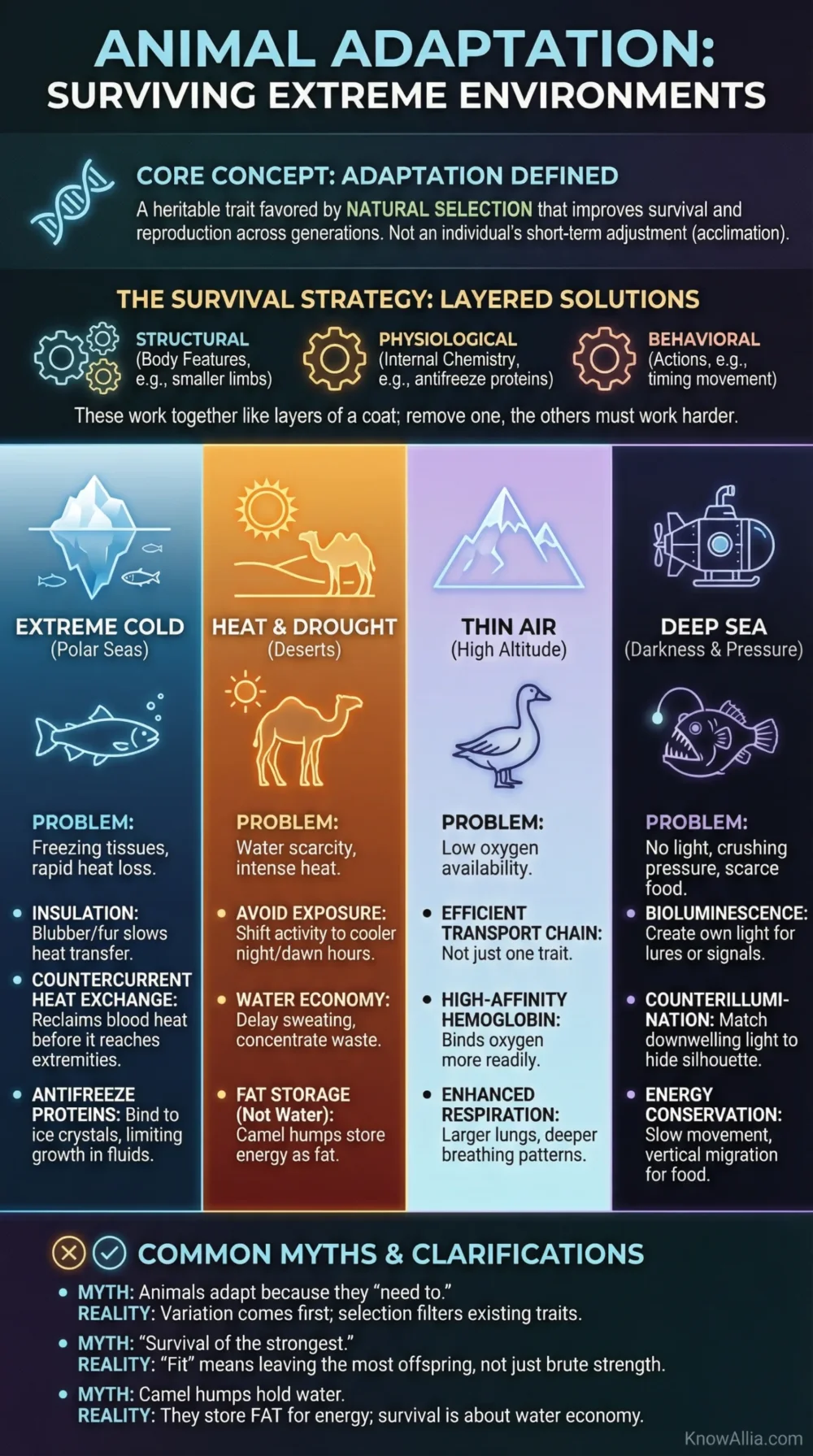
Animal adaptation is a heritable trait that helps a species survive and reproduce in a given environment. In extreme habitats, that can mean holding heat, saving water, taking up oxygen from thin air, or finding food in darkness. The part many readers miss is this: adaptation is shaped across generations, not invented by one animal on demand.[a]
Why Life Holds On at the Edge
Species that live in ice, drought, depth, and thin air do not rely on one miracle trait. They use layered solutions: body shape, body chemistry, and behavior working together. The strongest examples are not flashy. They are efficient, repeatable, and good enough to keep breeding in places that punish waste.[b]
- Cold
- Heat
- Drought
- Low Oxygen
- Pressure
- Darkness
This article follows the main survival routes used by animals in extreme settings. You will see how structural, physiological, and behavioral traits connect, where common myths go wrong, and why a species can look perfectly suited to a habitat while still living close to its limits.[a][b]
What Adaptation Means
An adaptation is not just any useful feature. It is a trait that was favored by natural selection because it improved survival or reproduction in a particular setting.[a] That definition matters because it separates real adaptation from two look-alikes: a short-term adjustment made by one organism during its own life, and a trait that happens to be present without being favored for its current job.[a]
In plain terms, animals do not “decide” to evolve thicker fur or a better way to use oxygen. Variation comes first. Selection filters that variation over time. Populations change; individuals mostly cope with what they already have.[b]
- Structural traits: body features such as smaller extremities in cold places or eye designs suited to darkness.[c][f]
- Physiological traits: internal functions such as antifreeze proteins in polar fish or altered oxygen handling at altitude.[h][e]
- Behavioral traits: choices about when to move, rest, dive, hunt, or hide, which can lower heat loss or reduce exposure.[a][f]
How Survival Solutions Stack Together
Popular pages on this topic often stop at a list of eye-catching traits. That misses the real pattern. Extreme survival usually depends on linked systems: a body shape that lowers loss, a physiology that protects cells, and behavior that cuts exposure. A desert animal that saves water but stays active at the hottest hour is still in trouble. A deep-sea fish with good vision but poor energy economy is still poorly matched to its habitat.[d][f]
There is also no perfect design. Selection has no foresight, and every trait sits inside a web of trade-offs. A body built to retain heat may be harder to cool. A system tuned for thin air may be costly to maintain. What survives is often not the “best possible” form, but the version that is fit enough to keep leaving offspring in that setting.[b]
| Environment | Main Problem | Useful Adaptations | Example Species |
|---|---|---|---|
| Polar Seas | Body fluids can freeze; heat is lost fast in cold water. | Insulation, countercurrent heat exchange, and antifreeze proteins. | Penguins, Antarctic notothenioid fish |
| Hot Deserts | Water is scarce and daytime heat can push body temperature up fast. | Activity shifted to cooler periods, delayed sweating, concentrated waste, fat stored in humps rather than water. | Camels, desert rodents |
| High Mountains | Each breath carries less oxygen. | Higher oxygen affinity in blood pigments, larger lungs, deeper ventilation, tuned metabolism. | Bar-headed goose |
| Deep Sea | Darkness, cold, high pressure, and little food. | Bioluminescence, large or specialized eyes, camouflage by light, energy-saving movement. | Midwater squid, anglerfish, snailfish |
The same habitat can still produce more than one solution. Two species may face the same stress and solve it through different anatomy, chemistry, or timing.[b][e]
Cold That Can Freeze Tissues
Cold habitats punish any leak in the system. Heat escapes faster when the temperature gap is large, and the problem is even harsher in water than in air. Many cold-adapted animals reduce that loss through body form and blood-flow design. Smaller extremities lose less heat, and some species route warm and cool blood past one another so heat is reclaimed before it escapes from feet, flippers, or other exposed parts.[c]
Polar fish face a different threat: ice crystals. In Antarctic waters, certain fish survive because they produce antifreeze proteins that bind to invading ice crystals and limit their growth. That is a subtle but powerful solution. The animal does not “heat” itself above the environment; it changes what ice can do inside its fluids.[h]
- Insulation slows heat transfer from body to environment.
- Countercurrent exchange keeps core heat from draining into extremities.
- Ice-control molecules protect fluids and tissues in freezing water.
- Behavior still matters: posture, shelter, and timing can reduce exposure.
How Extreme Habitats Filter Survival
The same question appears in different forms: keep fluids working, keep water, move oxygen, and find food without wasting energy.
Cold
Stop Heat Loss and Ice Growth
- Insulation
- Heat exchange in limbs
- Antifreeze proteins
Desert
Lower Water and Heat Stress
- Shift activity to cooler hours
- Delay sweating
- Store fat, not water, in humps
Altitude
Move Oxygen More Efficiently
- High-affinity hemoglobin
- Larger lungs
- Deeper breathing
Deep Sea
See, Hide, and Feed in Darkness
- Bioluminescence
- Counterillumination
- Energy-saving movement
One Trait Is Rarely Enough
Extreme survival usually comes from linked traits rather than one famous feature.
Trade-Offs Are Normal
A useful solution in one setting can create costs in another.
Reproduction Still Matters
Traits stay in a population only if they help genes reach the next generation.
Heat, Dry Air, and Water Loss
Deserts are not only hot. They are often dry, open, and unpredictable. For animals, that means water can be harder to replace than heat is to tolerate. A common survival pattern is to limit exposure first and spend water second. Activity shifts, shelter use, and careful heat storage can all matter as much as any body part.[d]
Camels are the classic example, but the most useful lesson is not the myth people remember. Their humps store fat, not water.[i] What really helps them in harsh heat is water economy. They can let body temperature rise over a wider daily range before they rely heavily on sweating, which reduces water loss.[d] In other words, desert adaptation is often about controlled tolerance, not endless cooling.
- Exposure control: use shade, shelter, and cooler periods.
- Water economy: lose less through sweat and waste.
- Energy storage: keep a reserve that can support long gaps between good feeding conditions.
Thin Air at High Altitude
Mountain habitats change a basic rule of breathing: every breath contains less usable oxygen. That is a transport problem, not just a “lung” problem. Oxygen has to move from air to lung surface, into blood, through circulation, and finally into active tissue. When high-altitude species do well, they usually improve more than one step in that chain.[e]
The bar-headed goose is a clean example. Studies point to hemoglobin that binds oxygen more readily than in lowland relatives, and other work shows lungs and breathing patterns that help keep oxygen moving during hard flight in thin air.[e][j] That matters because the bird is not solving one small lab problem. It is solving oxygen delivery while flapping across very high terrain.
This is one place where focusing only on genes can mislead. A molecule matters, but so do lung size, ventilation, circulation, and muscle demand. High-altitude adaptation is best understood as a whole-body solution rather than a single famous mutation.[e][j]
Darkness, Pressure, and Scarce Food in the Deep Sea
The deep sea removes everyday assumptions. By about 200 meters, light is gone to human eyes, and below the upper sunlit layer there is not enough light for photosynthesis. Many animals in the twilight zone have large eyes and use counterillumination, while deeper species often create their own light through bioluminescence.[f][g]
Pressure is the second filter. In the abyss, it can reach roughly 600 times what we experience at sea level.[f] That makes deep-sea survival more than a matter of “seeing in the dark.” Tissues, chemistry, movement, and feeding all have to keep working under compressive force and low temperature.
Food may be the least discussed part, even though it shapes daily life. Many midwater animals rise toward the surface at night to feed and drop back into darkness by day. That movement reduces exposure to predators while still giving access to richer feeding zones.[f] So deep-sea adaptation is really a four-part story: light, pressure, temperature, and energy budget.
Where Readers Often Get Mixed Up
Terms Worth Knowing
A few words make this topic much easier to read clearly.[a][c][f][h]
- Adaptation
- A heritable trait favored by natural selection because it helps survival or reproduction in a given setting.
- Natural Selection
- The sorting process through which some inherited variants leave more offspring than others.
- Countercurrent Heat Exchange
- A blood-flow arrangement that reclaims heat before it escapes from exposed body parts.
- Antifreeze Proteins
- Proteins that bind to ice crystals and limit their growth inside body fluids.
- Counterillumination
- Light produced by an animal to match faint background light and reduce its silhouette.
- Hemoglobin Affinity
- How readily hemoglobin binds oxygen, an important part of high-altitude oxygen transport.
Where the Evidence Is Still Thin
Not every adaptation story is equally complete. Deep-sea animals are hard to observe alive in their normal setting, so some explanations are built from remote imaging, recovered specimens, and lab work rather than long direct observation.[f] High-altitude performance can also be produced by more than one internal route, which means a broad label like “altitude adapted” may hide very different mechanisms in different species.[e][j]
The safest wording is often modest wording. Evidence may strongly support a trait’s role, but that does not always mean every part of the pathway is fully mapped. That is normal science, not a weakness in the topic.[b][f]
Once you see the pattern, extreme habitats stop looking like places that demand miracles. They reward small advantages that work together, hold up under stress, and keep a species functioning long enough to reproduce.[b]
FAQ
Questions Readers Usually Ask
Is adaptation the same as acclimation?
No. Adaptation is inherited and becomes common in a population across generations. Acclimation is a shorter-term adjustment within one organism’s lifetime, such as changing activity or physiology when conditions shift.
Do extreme adaptations make animals invincible?
No. They improve odds under certain conditions, but every solution has limits. A trait that helps in cold, drought, or low oxygen can still carry costs or fail outside the conditions it was shaped for.
Why do animals in the same habitat use different strategies?
Species start from different body plans, diets, and evolutionary histories. That means the same desert, mountain, or ocean zone can produce several working answers rather than one perfect design.
Do camel humps store water?
No. A camel’s hump stores fat. The animal’s real desert advantage comes from how it manages water and heat, not from carrying a water tank on its back.
Can one species have structural, physiological, and behavioral adaptations at the same time?
Yes. That is common. Extreme survival usually works best when body design, internal chemistry, and behavior reinforce one another.
Sources
- [a] UC Berkeley – Adaptation Definition of adaptation, what counts as an adaptation, and why not every trait belongs in that category.
- [b] UC Berkeley – Misconceptions About Evolution Used for the points about selection having no foresight, trade-offs, and the difference between everyday strength and evolutionary success.
- [c] Natural History Museum – Six Fascinating Ways Animals Survive the Cold Supports the cold-weather section, especially heat loss, smaller extremities, and countercurrent heat exchange.
- [d] The Open University – Animals at the Extremes: The Desert Environment Used for camel heat management, desert water economy, and the idea that exposure control matters as much as resistance.
- [e] NIH/PMC – Mechanisms of Hemoglobin Adaptation to High Altitude Hypoxia Background source for how high-altitude animals improve oxygen transport rather than relying on a single body part.
- [f] Smithsonian Ocean – The Deep Sea Used for darkness, depth zones, pressure, counterillumination, bioluminescence, and daily vertical migration.
- [g] Smithsonian Ocean – Deep Ocean Diversity Slideshow Supports the role of bioluminescence as a survival tool in deep-sea environments.
- [h] Proceedings of the National Academy of Sciences – Antifreeze Protein-Induced Superheating of Ice Inside Antarctic Fish Used for the explanation of how antifreeze proteins help polar fish avoid freezing in icy seawater.
- [i] Library of Congress – How Much Water Does a Camel’s Hump Hold? Used to correct the hump myth and tie the camel example back to real desert physiology.
- [j] NIH/PMC – Reduced Metabolism Supports Hypoxic Flight in the High-Flying Bar-Headed Goose Used in the altitude section for the bar-headed goose example and the point that high-altitude success is a whole-body performance issue.