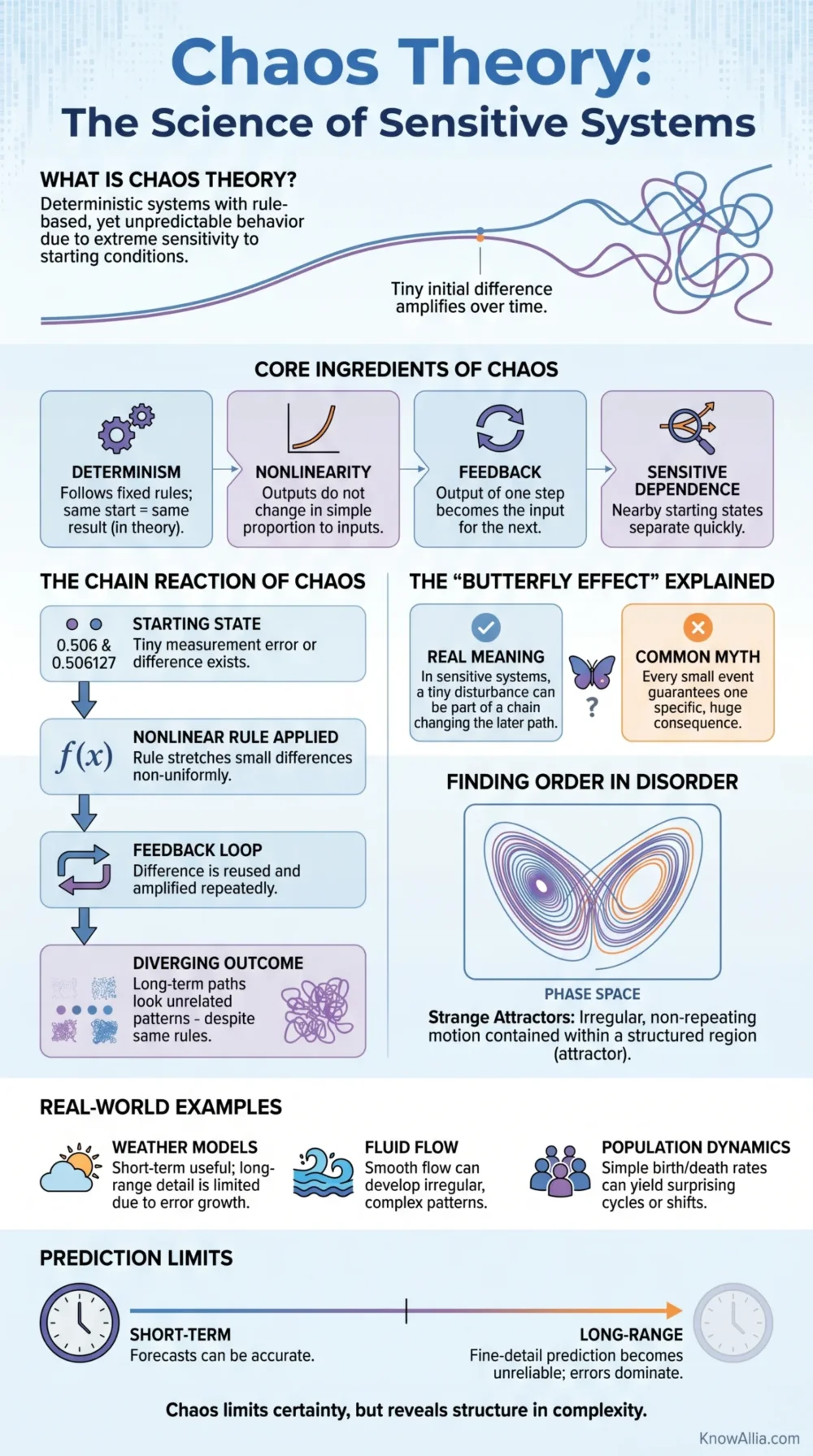
Chaos theory is the study of deterministic systems that can behave in ways that look random because they are highly sensitive to initial conditions. A tiny difference at the start can grow into a very different outcome later, not because the system has no rules, but because its rules are nonlinear. This is the real meaning behind the famous “butterfly effect”: small changes can matter deeply, yet they do not guarantee any one specific result.
The Direct Meaning
Chaos theory explains why some rule-based systems are easy to describe but hard to predict far into the future. The system may follow fixed equations, yet a rounded number, a tiny measurement error, or a slight change in starting position can send it down a different path.
- Chaos is not pure randomness: it comes from rule-based behavior.
- Small changes do not always explode: the system must have the right kind of nonlinear sensitivity.
- Prediction is still useful: chaos limits long-range certainty, not every short-term forecast.
What This Article Makes Clear
You will see how chaos theory connects determinism, nonlinearity, feedback, prediction limits, attractors, and real examples such as weather models, fluid flow, pendulums, and population models. The aim is simple: understand why a small change can sometimes become a large consequence without turning the idea into superstition or vague life advice.
What Chaos Theory Means
Chaos theory studies unstable, aperiodic behavior in systems that still follow definite rules. In plain language, it asks why a system can be lawful and unpredictable at the same time. Stanford Encyclopedia of Philosophy describes chaotic systems as deterministic, nonlinear, aperiodic, and sensitive to initial conditions.[Source-1]
The word chaos can be misleading. In everyday speech, chaos means mess or disorder. In mathematics and science, chaos usually means something more precise: a system has a rule, but that rule can stretch small starting differences into large later differences. The system is not “doing anything it wants.” It is following its own structure very tightly.
Simple way to read it: chaos is not the absence of order. It is order that becomes hard to forecast when tiny starting differences keep being amplified.
Deterministic Does Not Mean Easy to Predict
A deterministic system is one where the same starting state and the same rules produce the same result. A simple clock is deterministic. So is a basic pendulum under ideal conditions. A chaotic system can also be deterministic, but it is far more sensitive. If the starting state is measured with a small error, the later path may change sharply.
This is why chaos theory matters in prediction. The problem is not always that nature has no rule. Often the problem is that the starting information is never perfectly known. A tiny uncertainty can grow until the prediction no longer describes the real system well.
Why Small Changes Can Become Massive
Small changes become large when a system has feedback, nonlinearity, and a path where nearby states separate over time. In a linear system, doubling an input often doubles the output. In a nonlinear system, doubling an input might change the output a little, a lot, or in a totally different direction.
Think of two small toy boats released almost side by side into a narrow, twisting stream. For the first few seconds they look close together. Then one touches a small eddy, the other misses it, and their paths split. The stream has not broken its rules. The difference was just amplified by the shape of the flow.
How a Tiny Difference Grows in a Chaotic System
A chaotic path is not random noise. It is a rule-based process where nearby starting points can separate after enough steps.
Path of a Small Difference
Two states begin almost the same: for example, 0.506 and 0.506127.
The system applies a rule where outputs do not scale in a simple straight line.
Each new state becomes the next input, so the small gap can be reused again and again.
After enough steps, the two paths may no longer look related, even though both followed the same rule.
What Must Be True
A small change can fade away in a stable system.
Long-range detail may be lost even when the rule is known.
Chaotic behavior can still stay inside a shaped region called an attractor.
Rule-Based
The system follows equations or repeatable rules.
Hard to Measure Perfectly
Real starting conditions always contain some uncertainty.
Limited Forecast Window
Prediction can be useful early and weak later.
The Main Chain Reaction
- Initial condition: the system’s starting state, such as position, temperature, velocity, pressure, or population size.
- Nonlinear rule: the next state depends on the current state in a way that is not a simple straight-line relation.
- Feedback: the output of one step influences the next step.
- Sensitive dependence: close starting points can move apart quickly.
- Prediction horizon: the point where fine-detail forecasting becomes unreliable.
Lorenz and the Butterfly Effect
The best-known starting point for modern chaos theory is Edward Lorenz’s 1963 paper Deterministic Nonperiodic Flow. Lorenz used a simplified model related to atmospheric convection and found that very small changes in starting values could produce very different later states. The paper’s abstract notes that slightly differing initial states can evolve into considerably different states in bounded, nonperiodic deterministic systems.[Source-2]
The “butterfly effect” later became the popular image for this idea. It should be read carefully. It does not mean one small event always causes one huge event. It means that in some nonlinear systems, a tiny disturbance can be one part of a chain that changes the later path.
This is the scientific idea behind the butterfly effect.
That turns chaos theory into a certainty claim, which is the opposite of what the idea says.
Why Rounding Can Matter
One famous lesson from Lorenz’s work is that rounding a number can matter in a sensitive model. A value stored with more decimal places and the same value rounded for printing may look nearly identical to a person. To a nonlinear model that reuses its outputs again and again, that small gap can grow.
This does not make every rounded number dangerous. It means that precision, model structure, and time scale must be treated together. A weather model, a fluid model, or a population model may be useful even when perfect long-range detail is not possible.
The Ingredients of Chaotic Behavior
A system is not chaotic just because it is complicated. Some complicated systems are stable. Some simple systems can become chaotic. The difference sits in the system’s rule, its starting state, and how errors grow over time.
| Type of Behavior | How It Works | Prediction Style | Simple Example |
|---|---|---|---|
| Stable deterministic behavior | Rules are fixed, and nearby starting points stay close or settle down. | Longer-range prediction can often remain accurate. | A small pendulum swinging gently under ideal conditions. |
| Random behavior | The next result is modeled as uncertain or probabilistic. | Prediction focuses on probabilities, not exact paths. | A fair die roll. |
| Chaotic deterministic behavior | Rules are fixed, but nearby starting points can separate sharply. | Short-term prediction may work; fine-detail long-term prediction weakens. | A double pendulum at larger swings, or a simplified weather model. |
| Complex but not necessarily chaotic | Many parts interact, but the system may still dampen small changes. | Prediction depends on the model and available measurements. | A regulated machine with feedback controls. |
Nonlinearity
Nonlinearity means the output does not change in a neat proportion to the input. A small push may barely matter in one state and matter a great deal in another. This is why chaotic systems often have thresholds, folds, loops, and feedback effects.
Aperiodic Motion
Aperiodic behavior does not simply repeat the same cycle. A clock repeats. A simple orbit repeats. A chaotic system may move within a bounded region, yet never fall into a clean repeating pattern. It can look irregular while still obeying rules.
Sensitive Dependence
Sensitive dependence is the part most people remember. Two nearly identical starting points can stay close for a while, then separate. The Lyapunov exponent is one mathematical way to describe the rate at which nearby paths diverge; MathWorld describes it as a measure of exponential divergence from perturbed initial conditions.[Source-3]
Patterns Inside Apparent Disorder
Chaos theory does not say that everything is shapeless. A chaotic system can have a pattern in the space of possible states. This is where terms such as phase space, attractor, and strange attractor become useful.
Phase Space
Phase space is a map of all the information needed to describe a system’s state. For a moving object, that may include position and velocity. For a weather model, it may include many variables such as temperature, pressure, and wind-related values. A point in phase space represents one possible state of the system.
Attractors
An attractor is a set of states that nearby states tend to approach over time. MathWorld defines an attractor as a set of states in phase space toward which neighboring states move under the system’s dynamics.[Source-4]
A stable attractor may be simple, like a system settling into rest. A strange attractor is different. It can keep motion bounded while still producing a path that never repeats neatly. The result can look random from one moment to the next, while the overall shape remains structured.
The Lorenz Attractor
The Lorenz attractor is one of the most recognizable examples in chaos theory. MathWorld describes it as an attractor arising from a simplified system of equations for fluid flow with a temperature difference, later reduced to what are now called the Lorenz equations.[Source-5]
The familiar two-lobed shape is often shown as a butterfly-like curve. The shape is not just decoration. It shows a deep idea: a chaotic path may be trapped within a region and still never settle into a simple loop.
Real Examples Where Chaos Theory Helps
Chaos theory is used most carefully when a system has a clear model, measurable variables, and evidence that small starting differences can grow. Britannica lists areas such as turbulent fluid flow, irregular heartbeat dynamics, population dynamics, chemical reactions, plasma physics, and clusters of stars among fields where chaos-related mathematics has been used.[Source-6]
| System | What Changes at the Start | What Can Happen Later | Careful Interpretation |
|---|---|---|---|
| Weather models | Small differences in temperature, pressure, or wind estimates. | Forecast paths can separate after enough time. | Short-term forecasts can still be useful; exact long-range detail is limited. |
| Double pendulum | A slight change in starting angle or speed. | The later swing pattern may look very different. | The system follows mechanics, but the motion can be hard to forecast. |
| Population models | A small difference in growth rate or starting population. | Stable cycles, sudden shifts, or irregular values may appear. | Simple equations can produce surprising behavior. |
| Fluid flow | A small disturbance in motion or boundary conditions. | Flow may develop irregular patterns. | Not all turbulence is explained by one simple chaos model, but chaos tools help study instability. |
| Chemical oscillations | A slight change in concentration or reaction condition. | Repeating patterns may give way to irregular oscillation. | The model must match the reaction before strong claims are made. |
A Simple Example: The Logistic Map
The logistic map is a common teaching example because it is short but rich:
xn+1 = r xn(1 − xn)
Here, x is the current value, r controls growth, and the next value is calculated from the current one. For some settings, the values settle down. For others, they cycle. For other settings, they behave chaotically.
This example shows why chaos theory can feel strange at first. The formula is small. The behavior is not. A compact rule can produce a path that is hard to predict after many steps.
When Small Changes Do Not Become Massive
A common mistake is to treat chaos theory as a slogan: “everything small changes everything big.” That is not accurate. Many systems absorb small changes. A marble at the bottom of a bowl can be nudged and still roll back toward the center. A thermostat can correct small temperature changes. A well-damped system can reduce the effect of disturbance.
For a small change to become a large consequence, the system must have the right kind of sensitivity. Even then, the later consequence is often not predictable in detail. The better statement is: small differences can matter greatly in sensitive nonlinear systems.
Small Change Fades
- The system is stable.
- Feedback dampens the disturbance.
- The state returns toward an attractor.
- The prediction remains close enough.
Small Change Grows
- The system is nonlinear.
- Nearby paths separate.
- Feedback keeps reusing the difference.
- The forecast loses fine detail over time.
Common Confusion About Chaos Theory
Chaos theory is easy to misuse because the popular image is stronger than the careful meaning. The butterfly effect is memorable, but it is not a magic rule for personal events, fate, or guaranteed outcomes.
- Chaos is not the same as randomness. A chaotic system can be deterministic. The unpredictability comes from sensitivity, not from a lack of rules.
- The butterfly effect is not a promise. A small cause may matter, may fade, or may be one of many influences.
- Chaos does not make science useless. It helps explain why some forecasts have limits and why probability ranges can be more honest than exact claims.
- Complexity alone is not chaos. A system can have many parts and still be stable.
- Chaos does not mean “anything can happen.” Chaotic systems often remain inside boundaries shaped by attractors and physical limits.
Terms That Make the Idea Clear
- Deterministic
- A system where the same starting state and same rule produce the same result.
- Initial Condition
- The starting information used to run a system or model.
- Nonlinear
- A relation where outputs do not change in a simple proportion to inputs.
- Sensitive Dependence
- The tendency for nearby starting states to separate over time.
- Phase Space
- A map of all possible states of a system using the variables needed to describe it.
- Attractor
- A set of states that nearby states tend to approach as the system evolves.
- Strange Attractor
- An attractor linked with irregular, non-repeating behavior inside a bounded region.
- Bifurcation
- A change in behavior that appears when a control value passes a threshold.
- Lyapunov Exponent
- A number used to describe how fast nearby paths separate.
- Prediction Horizon
- The time range after which fine-detail prediction becomes unreliable for a given system and model.
What We Can Say and What We Cannot Know
Chaos theory gives strong tools for studying sensitive systems, but it also teaches caution. A model may show chaotic behavior, yet the real system may include measurement limits, missing variables, outside forces, or stabilizing effects not included in the model.
Honest limit: chaos theory can show that exact long-range prediction may be impossible in some systems. It usually cannot prove that one tiny named event caused one exact later event unless the chain is modeled and supported by evidence.
- We can say that deterministic systems can be unpredictable in fine detail.
- We can say that nonlinear feedback can amplify small starting differences.
- We cannot assume that every complicated system is chaotic.
- We cannot assume that every small change creates a huge outcome.
- We cannot replace evidence with a dramatic butterfly-effect story.
Why Chaos Theory Still Feels Useful
Chaos theory is useful because it gives a clean language for a common problem: some systems are not random, yet exact prediction fades. This matters in science, engineering, weather modeling, ecology, and any field where a rule-based system has feedback and sensitivity.
The most practical lesson is not “small things control everything.” It is better than that: measure carefully, model honestly, expect limits, and watch how feedback changes the path. Chaos theory turns uncertainty into something that can be studied rather than ignored.
FAQ About Chaos Theory
Questions Readers Often Ask
Is chaos theory the same as randomness?
No. Chaos theory usually deals with deterministic systems. The behavior can look random because small starting differences grow over time, but the system still follows rules.
What is the butterfly effect in simple words?
The butterfly effect means that a tiny change in the starting state of a sensitive nonlinear system can lead to a very different later outcome. It does not mean every tiny event creates a guaranteed huge result.
Why does chaos theory matter for weather?
Weather depends on many interacting variables. Small measurement errors in the current state can grow, so detailed long-range forecasts become harder. Short-term forecasts can still be useful.
Can a simple system be chaotic?
Yes. Some simple equations can produce chaotic behavior when their settings create nonlinear sensitivity. The logistic map is a common example used to show this.
Does chaos theory mean prediction is impossible?
No. It means prediction has limits. A chaotic system may be predictable for a short time, or in broad patterns, while exact long-range detail becomes unreliable.
What is an attractor in chaos theory?
An attractor is a set of states that a system tends to move toward. In chaotic systems, a strange attractor can keep motion bounded while the exact path remains irregular.
Sources
- [Source-1] Stanford Encyclopedia of Philosophy – Chaos — used for the definition of chaotic systems as deterministic, nonlinear, aperiodic, and sensitive to initial conditions.
- [Source-2] American Meteorological Society – Deterministic Nonperiodic Flow — Edward Lorenz’s 1963 paper on deterministic nonperiodic flow and sensitivity to initial states.
- [Source-3] Wolfram MathWorld – Lyapunov Characteristic Exponent — reference for exponential divergence from perturbed initial conditions.
- [Source-4] Wolfram MathWorld – Attractor — reference for attractors as sets of states in phase space.
- [Source-5] Wolfram MathWorld – Lorenz Attractor — reference for the Lorenz attractor and its relation to simplified fluid-flow equations.
- [Source-6] Encyclopaedia Britannica – Chaos Theory — used for broad field examples and the definition of deterministic chaos.