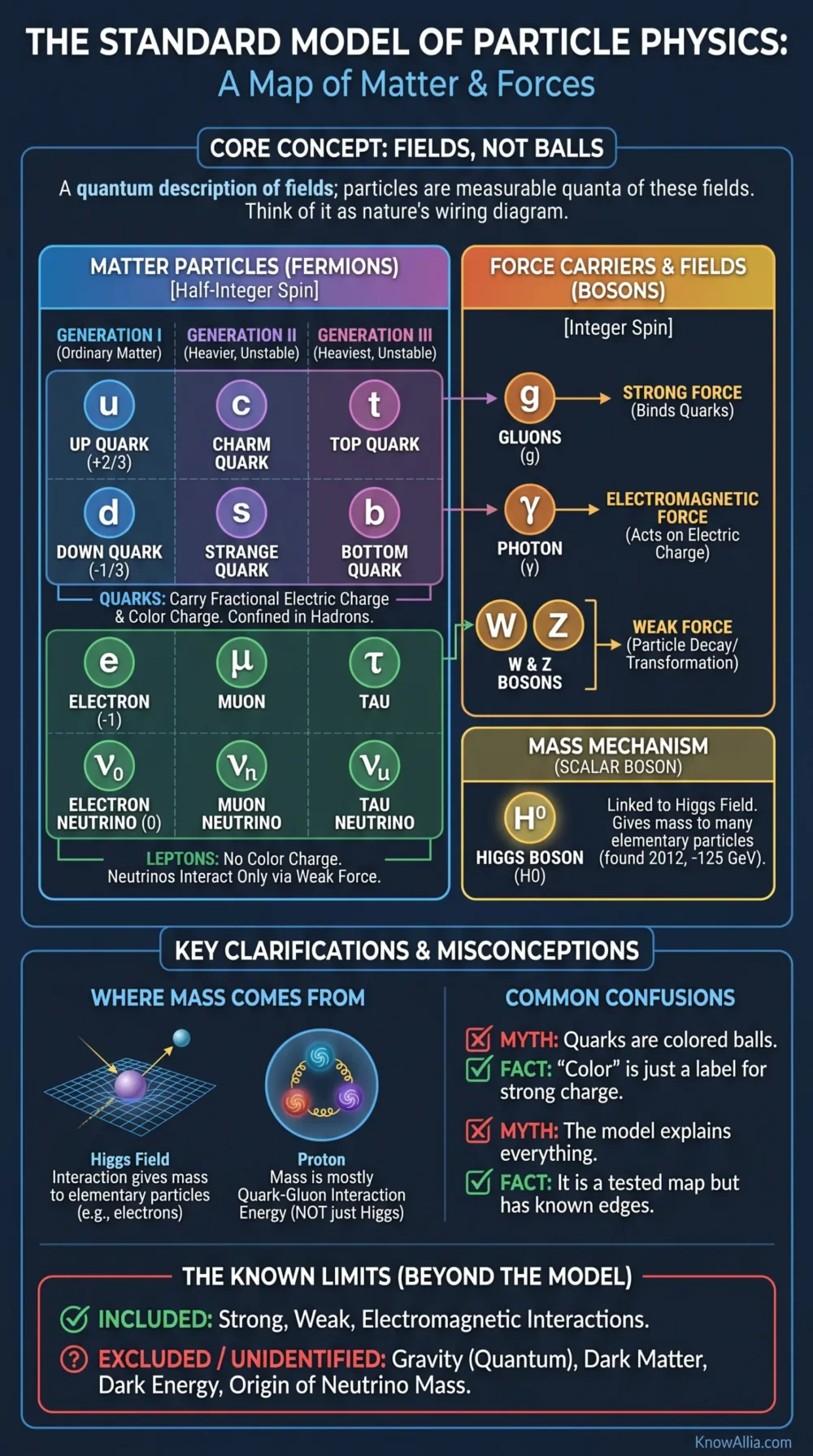
The Standard Model of particle physics is the tested theory that describes the known elementary particles and the way they interact through the electromagnetic, weak, and strong forces. It organizes matter into quarks and leptons, explains force carriers called bosons, and includes the Higgs field, which helps explain why many elementary particles have mass.[Source-1]
The Core Idea in Plain English
The Standard Model is not a list of tiny solid balls. It is a mathematical description of fields, where particles appear as measurable quanta of those fields. It explains ordinary matter very well, yet it does not give a full account of gravity, dark matter, dark energy, or the exact origin of neutrino mass.[Source-2]
- Matter particles are fermions: quarks and leptons.
- Force-carrying particles are gauge bosons: photon, gluons, W bosons, and Z boson.
- The Higgs boson is different: it is tied to the Higgs field and the mass-giving mechanism, not to a new fifth force.
What You Will Understand After Reading
This article separates the model into clear layers: what particles are, how quarks and leptons differ, what bosons actually do, why the Higgs matters, and where the model reaches its known edges. The goal is simple: to make the Standard Model readable without turning it into a slogan.
The Model Map
The Standard Model divides known elementary particles into two broad classes: fermions and bosons. Fermions are the matter-side particles. Bosons are the particles linked with interactions and fields. This split is based on a property called spin, not on size, shape, or weight.
- Fermions have half-integer spin. In the Standard Model, they include quarks and leptons.
- Bosons have integer spin. They include force carriers such as the photon, gluons, W bosons, Z boson, and the scalar Higgs boson.
- Antiparticles are partner particles with matched mass and opposite relevant charges. Every quark and lepton has an antiparticle.
A useful analogy: the Standard Model works a little like a wiring diagram. It shows which parts can connect, what signals can pass between them, and which connections are forbidden. It does not claim to be the full building plan of nature.
| Family | Main Members | Role in the Model | Important Detail |
|---|---|---|---|
| Quarks | Up, down, charm, strange, top, bottom | Make hadrons such as protons and neutrons | Carry color charge and fractional electric charge |
| Leptons | Electron, muon, tau, and three neutrinos | Include familiar particles such as the electron | Do not carry color charge; neutrinos are electrically neutral |
| Gauge Bosons | Photon, gluons, W bosons, Z boson | Carry the electromagnetic, strong, and weak interactions | The Standard Model does not include gravity as a quantum force |
| Higgs Boson | One known scalar boson | Linked to the Higgs field and mass-giving mechanism | Has spin 0 and no electric charge in the Standard Model |
Particle Families and Generations
Quarks and leptons are arranged into three generations. The first generation contains the particles that form ordinary atoms: up quarks, down quarks, electrons, and electron neutrinos. The second and third generations contain heavier relatives, such as muons, tau particles, charm quarks, and top quarks.
First Generation
Up quark, down quark, electron, electron neutrino. This is the generation most directly tied to stable ordinary matter. Protons contain two up quarks and one down quark. Neutrons contain one up quark and two down quarks.
Heavier Generations
Charm, strange, top, bottom, muon, tau, and their neutrinos. These particles appear in high-energy processes and usually decay into lighter particles. They are not useless extras; their masses and interactions test the model with fine detail.
The three-generation pattern is one of the most striking features of particle physics. The Standard Model describes it, but it does not fully explain why nature uses exactly this pattern.
Quarks: The Particles Inside Protons and Neutrons
Quarks are elementary particles that carry fractional electric charge and color charge. They are never found alone under normal conditions. Instead, they appear inside composite particles called hadrons, held together by gluons through the strong interaction.[Source-6]
The Six Quark Flavors
| Quark Flavor | Generation | Electric Charge | Common Role |
|---|---|---|---|
| Up | First | +2/3 | Part of protons and neutrons |
| Down | First | -1/3 | Part of protons and neutrons |
| Charm | Second | +2/3 | Seen in heavier hadrons and particle collisions |
| Strange | Second | -1/3 | Seen in strange hadrons and decay studies |
| Top | Third | +2/3 | Heaviest known quark; decays before forming ordinary hadrons |
| Bottom | Third | -1/3 | Used in precision tests of quark mixing and decay patterns |
Color Charge Is Not Visual Color
In particle physics, color is a charge type used by the strong interaction. It has nothing to do with red, green, or blue light. The names are labels. Quarks combine so that observed hadrons are color-neutral overall.
- Baryons are usually made of three quarks. Protons and neutrons are baryons.
- Mesons are made from a quark and an antiquark.
- Gluons carry the strong interaction and also carry color charge themselves.
A proton is often described as “two up quarks and one down quark.” That is useful, but incomplete. Inside a proton, quarks, gluons, and temporary quark-antiquark pairs form a moving quantum system. The interaction energy of quarks and gluons accounts for most of the perceived mass of protons and neutrons, so the Higgs field is not the whole story of everyday mass.
Leptons: Electrons, Muons, Taus, and Neutrinos
Leptons are elementary fermions that do not carry color charge. The most familiar lepton is the electron, which sits around atomic nuclei and shapes chemistry, electricity, and ordinary material behavior.
Charged Leptons
- Electron: stable, negatively charged, and central to atoms.
- Muon: heavier than the electron and unstable.
- Tau: heavier than the muon and also unstable.
Neutrinos
Neutrinos are electrically neutral leptons. They interact through the weak interaction, which is why they can pass through large amounts of matter with very little chance of being detected. The three known neutrino flavors are electron neutrino, muon neutrino, and tau neutrino.
Neutrinos also reveal a known edge of the original Standard Model. Neutrino oscillation shows that neutrinos have mass, even if very small. That result means the model must be extended to fully describe neutrino masses.[Source-7]
Ordinary matter uses a surprisingly small cast: up quarks, down quarks, and electrons make the atoms around us. Neutrinos are also everywhere, but they rarely interact with matter in a visible way.
Bosons: How Interactions Are Carried
In the Standard Model, force-carrying bosons are linked with interactions between particles. This does not mean they are tiny hands pushing objects around. In quantum field theory, an interaction is described through fields and exchanged quanta.
| Boson | Interaction or Field | What It Does | Mass Status |
|---|---|---|---|
| Photon | Electromagnetic interaction | Acts between electrically charged particles | Massless |
| Gluons | Strong interaction | Bind quarks inside hadrons | Massless, but confined in ordinary conditions |
| W Bosons | Weak interaction | Allow certain particle changes, including beta decay | Massive |
| Z Boson | Weak interaction | Mediates neutral weak interactions | Massive |
| Higgs Boson | Higgs field | Observable quantum of the Higgs field | Massive, spin 0 |
Photon
The photon is tied to electromagnetism. Light is made of photons, but photons also describe electromagnetic interactions more broadly. The photon has no electric charge and no rest mass.
Gluons
Gluons carry the strong interaction between quarks. Unlike photons, gluons interact with one another because they carry color charge. This self-interaction helps explain why quarks are confined inside hadrons.
W and Z Bosons
The W and Z bosons are linked with the weak interaction. The weak interaction is responsible for particle changes that do not happen through electromagnetism or the strong interaction. A classic example is beta decay, where a neutron can transform into a proton while emitting other particles.
The Higgs Field and the Higgs Boson
The Higgs field is a field present throughout space. Many elementary particles gain mass through their interaction with it. The Higgs boson is the observable particle associated with that field, rather than the field itself.[Source-4]
The Higgs boson was discovered at CERN in 2012 by the ATLAS and CMS experiments. Its measured properties match the Standard Model Higgs boson so far, including spin 0, no electric charge, and a mass near 125 GeV.[Source-5]
Important distinction: the Higgs field helps explain the masses of elementary particles such as electrons, quarks, W bosons, and Z bosons. Most of the mass of protons and neutrons comes from the energy of quark-gluon interactions, not simply from adding up the Higgs-generated masses of their quarks.
Forces in the Standard Model
The Standard Model describes three of the four fundamental interactions: electromagnetism, the weak interaction, and the strong interaction. Gravity is known and measurable, but it is not included in the Standard Model as a quantum interaction.[Source-3]
| Interaction | Carrier in the Standard Model | Acts Mainly On | Included in the Standard Model? |
|---|---|---|---|
| Electromagnetic | Photon | Electric charge | Yes |
| Strong | Gluons | Color charge | Yes |
| Weak | W and Z bosons | Weak charge and flavor-changing processes | Yes |
| Gravity | No confirmed Standard Model carrier | Mass-energy | No |
What the Standard Model Explains Well
The Standard Model is valued because it connects many experimental results with one particle-and-field description. It has predicted particles, organized observed particles, and allowed physicists to calculate interaction rates with high precision.
- Atomic matter: protons, neutrons, and electrons can be traced to quarks and leptons.
- Electromagnetic behavior: charged particles interact through photons.
- Nuclear stability: quarks are bound inside protons and neutrons by the strong interaction; the residual strong force helps bind nuclei.
- Weak decays: W and Z bosons explain particle transformations that change flavor.
- Mass of elementary particles: the Higgs field explains why many elementary particles are massive.
The Standard Model in Three Layers
Known elementary particles are organized by matter, interactions, and the Higgs field.
Matter Side
Quarks and leptons are fermions. Up quarks, down quarks, and electrons form ordinary atoms.
Interaction Side
Gauge bosons describe how particles interact through three known forces in the model.
Open Edges
Neutrino mass, dark matter, dark energy, and quantum gravity require physics beyond the basic model.
Beyond the Standard Model
“Beyond the Standard Model” does not mean the Standard Model is useless. It means the model works within its tested range while leaving real questions open. Good science keeps both statements true at once.
Gravity Is Outside the Model
Gravity is described very well by general relativity at large scales, but the Standard Model is a quantum theory of particles and fields. A fully tested quantum description of gravity is not part of the Standard Model.
Dark Matter and Dark Energy Are Not Identified
Astronomical and cosmological evidence indicates that ordinary matter is only a small part of the universe’s total energy budget. The Standard Model does not identify dark matter or dark energy as Standard Model particles. Any proposed answer must be tested, not assumed.
Neutrino Mass Needs an Extension
Neutrino oscillation shows that neutrinos have mass. The original Standard Model treated neutrinos as massless, so this is one of the clearest reasons physicists look for an extended description.
Matter and Antimatter Are Not Fully Explained
The known universe contains far more matter than antimatter. The Standard Model contains sources of matter-antimatter asymmetry, but not enough to explain the observed imbalance on its own. The exact origin remains an open research question.
Common Confusions About the Standard Model
- “The Standard Model explains everything.”
- No. It explains known elementary particles and three interactions very well, but it does not include a full quantum account of gravity, dark matter, or dark energy.
- “The Higgs boson gives all mass to everything.”
- No. The Higgs field gives mass to many elementary particles. Most of the mass of protons and neutrons comes from quark-gluon interaction energy.
- “Quarks are tiny colored balls.”
- No. Color charge is a label for strong-interaction charge. It is not visual color.
- “Bosons are always force particles.”
- Not exactly. Gauge bosons carry interactions, but the Higgs boson is a scalar boson linked to the Higgs field.
- “Beyond the Standard Model means proven new particles already exist.”
- No. It means there are open questions and testable ideas. A proposed particle becomes accepted only when evidence is strong enough.
Key Terms in Plain Language
- Elementary particle: a particle not known to be made of smaller parts.
- Fermion: a matter-side particle with half-integer spin.
- Boson: a particle with integer spin, often linked to interactions or fields.
- Quark: an elementary fermion that carries color charge.
- Lepton: an elementary fermion that does not carry color charge.
- Gluon: the boson of the strong interaction.
- Photon: the boson of the electromagnetic interaction.
- Weak interaction: the interaction that allows certain particle transformations.
- Higgs field: a field linked to the masses of many elementary particles.
- Neutrino oscillation: the change of neutrino flavor during travel, showing neutrinos have mass.
What We Know Less About
The Standard Model is precise where it applies, but honest boundaries matter. The following points are not small footnotes; they show where future physics may be needed.
- Neutrino masses: known to exist, but their exact origin is not settled.
- Dark matter: observed through gravitational effects, but not identified as a Standard Model particle.
- Dark energy: used to describe the accelerated expansion of the universe, but not explained by the particle list.
- Gravity: not included as a quantum interaction in the Standard Model.
- Why three generations: the model uses the pattern, but does not fully explain why nature chose it.
- Higgs questions: the known Higgs boson matches the Standard Model so far, but physicists still test whether it is alone or part of a larger Higgs sector.
The cleanest way to read the Standard Model is not as a finished picture of everything, but as the most tested particle map we currently have. It names the particles we know, states how they may interact, and shows where new evidence would have to fit.
FAQ
What Is the Standard Model of Particle Physics?
The Standard Model is the tested theory that describes known elementary particles and their interactions through the electromagnetic, weak, and strong forces. It includes quarks, leptons, gauge bosons, and the Higgs boson.
How Many Quarks Are in the Standard Model?
There are six quark flavors: up, down, charm, strange, top, and bottom. They are arranged in three generations, with up and down quarks forming ordinary protons and neutrons.
What Are Bosons in the Standard Model?
Bosons are particles with integer spin. Gauge bosons such as photons, gluons, W bosons, and the Z boson are linked with interactions. The Higgs boson is a scalar boson tied to the Higgs field.
Does the Standard Model Include Gravity?
No. The Standard Model describes the electromagnetic, weak, and strong interactions. Gravity is not included as a quantum interaction in the Standard Model.
Why Is the Higgs Boson Important?
The Higgs boson is the observable quantum of the Higgs field. Its discovery confirmed the presence of a field linked to the masses of many elementary particles, including electrons, quarks, W bosons, and Z bosons.
What Is Beyond the Standard Model?
Beyond the Standard Model refers to tested or proposed physics needed to answer questions the Standard Model does not fully settle, such as neutrino mass, dark matter, dark energy, and quantum gravity.
Sources
- [Source-1] CERN – The Standard Model — Supports the main definition, matter particle grouping, generations, and force overview.
- [Source-2] U.S. Department of Energy – DOE Explains: The Standard Model of Particle Physics — Supports the particle families, three included forces, and known limits involving gravity, neutrinos, dark matter, and dark energy.
- [Source-3] Fermilab – Science of Matter, Energy, Space and Time — Supports the explanation that gravity is not part of the Standard Model and that the model is a tested particle theory.
- [Source-4] CERN – The Higgs Boson — Supports the distinction between the Higgs field and Higgs boson, including how particles gain mass through field interaction.
- [Source-5] ATLAS Experiment at CERN – The Higgs Boson: A Landmark Discovery — Supports the 2012 Higgs discovery, approximate 125 GeV mass, and measured Higgs properties.
- [Source-6] U.S. Department of Energy – DOE Explains: Quarks and Gluons — Supports color charge, quark confinement, and the role of quark-gluon interactions in proton and neutron mass.
- [Source-7] Nobel Prize – 2015 Physics Press Release — Supports neutrino oscillation, nonzero neutrino mass, and why the original Standard Model needs extension.
- [Source-8] Particle Data Group – Particle Listings — Reference authority for particle names, classifications, and measured particle properties.