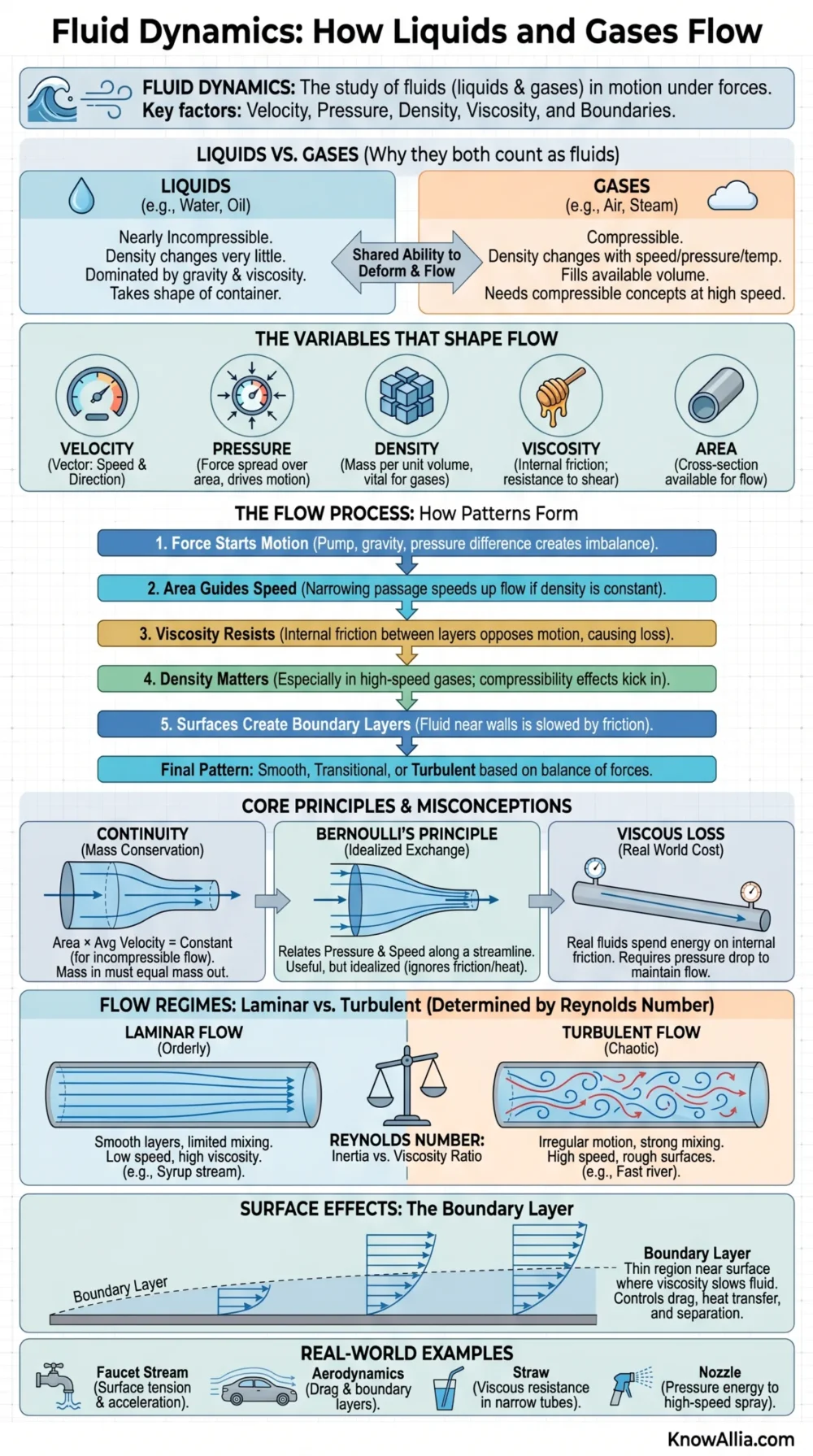
Fluid dynamics is the study of how liquids and gases move when forces, pressure differences, gravity, heat, surfaces, or moving objects act on them. A fluid can change shape and keep deforming while it flows, so water in a pipe, air around a wing, steam in a nozzle, oil in a bearing, and smoke rising from a candle all belong to the same basic subject: flow.
The Core Idea in Plain Language
A liquid or gas flows because the forces on it are not perfectly balanced. Fluid dynamics follows how velocity, pressure, density, viscosity, and boundaries change from place to place and from one moment to the next.
- Pressure differences can push a fluid from one region to another.
- Viscosity acts like internal friction and resists motion between nearby layers.
- Shape and area guide speed: a narrowing passage can make flow speed up when density stays nearly constant.
This article explains what you need to know to read fluid flow with less confusion: what counts as a fluid, why liquids and gases behave alike in some cases, why they differ in others, how laminar and turbulent flow form, where Bernoulli’s equation helps, and where simple formulas stop being enough.
What Fluid Dynamics Is
Fluid dynamics is one part of fluid mechanics. It deals with fluids in motion, while fluid statics deals with fluids at rest. The word fluid includes both liquids and gases because both can flow, change shape, and transmit forces through pressure.
The motion of any fluid can be described through conservation ideas: mass is tracked, momentum changes when forces act, and energy shifts between forms. NASA’s fluid-flow materials describe mass conservation in moving fluids with the familiar product of density, area, and velocity when flow passes through a region.[Source-1]
A Simple Analogy
Think of flow like people moving through a hallway. If the hallway narrows, the same number of people must pass through less space, so the line tends to move faster. A fluid in a narrowing tube can behave in a similar way when its density stays nearly constant. The analogy is not perfect, but it helps explain why area and velocity are tied together.
Why Liquids and Gases Count as Fluids
Liquids and gases are grouped together because neither keeps a fixed shape like a solid. A liquid keeps nearly the same volume under ordinary conditions but takes the shape of its container. A gas can expand or compress far more easily, filling available space.
This shared ability to deform is why the same subject can describe water through a pipe, air through a duct, oil between moving parts, and gas through a nozzle. The same words appear again and again: velocity, pressure, density, viscosity, temperature, flow rate, streamlines, drag, lift, vortices, and turbulence.
Liquids
- Usually treated as nearly incompressible in everyday flow problems.
- Often dominated by gravity, free surfaces, pumps, pipes, channels, and viscosity.
- Examples include water, fuel, cooking oil, blood, and hydraulic fluid.
Gases
- Can change density more noticeably when speed, pressure, or temperature changes.
- Often need compressible-flow ideas near high speeds or strong pressure changes.
- Examples include air, steam, natural gas, exhaust, and refrigerant vapor.
The Variables That Shape Flow
A flow field is not described by one number. It is a map of properties. At one point in a pipe, the fluid may be fast and low in static pressure; near the wall, it may be slow because of friction; around a bend, it may form secondary motion and swirling structures.
| Variable | Plain Meaning | Why It Matters |
|---|---|---|
| Velocity | The speed and direction of fluid motion. | Controls flow rate, momentum, drag, mixing, and pressure changes. |
| Pressure | Force spread over area inside the fluid. | Pushes flow, loads walls, and connects motion with energy. |
| Density | Mass per unit volume. | Links volume flow to mass flow and becomes vital in gas flow. |
| Viscosity | Resistance to shearing motion between fluid layers. | Controls friction, boundary layers, pressure loss, and flow regime. |
| Temperature | A measure tied to molecular motion and thermal energy. | Changes gas density and viscosity; can affect liquid viscosity too. |
| Area | The cross-section available for flow. | In a steady incompressible stream, smaller area usually means higher speed. |
Velocity Is a Field, Not Just a Speed
In fluid dynamics, velocity usually means a vector: it has size and direction. A river can move forward near the center, slow near the banks, swirl behind a rock, and reverse in a small eddy. All of that is still one connected flow.
Pressure Acts in Every Direction
Pressure is not the same as flow speed, but the two are related. A pressure difference can start motion, and motion can change pressure. In many low-speed cases, pressure and velocity trade energy along a streamline in a way described by Bernoulli’s equation.
Viscosity Is Internal Resistance
Viscosity measures how strongly a fluid resists being sheared. NASA describes dynamic viscosity through the relation between shear stress and the velocity gradient for many gases, with the coefficient often written as the Greek letter mu.[Source-3]
Low-viscosity fluids such as air or water can move with relatively little internal resistance. Thicker fluids such as syrup, heavy oil, or certain gels resist motion more strongly. Some fluids also change their apparent viscosity when stirred or sheared; these are often called non-Newtonian fluids.
How a Fluid Chooses Its Flow Pattern
The final motion comes from a balance between push, path, fluid properties, speed, and surfaces. Change one of them, and the same liquid or gas can flow in a very different way.
Pressure or Force Starts Motion
A pump, fan, height difference, moving wall, or gravity can create the imbalance that makes fluid move.
Area Guides Speed
When density is nearly constant, a smaller passage often raises velocity because the same flow must fit through less area.
Viscosity Resists Shear
Nearby layers do not slide past each other freely. Viscosity creates wall friction and pressure loss.
Density Matters More in Gases
At low speeds many gas flows can be treated almost like incompressible flow, but high-speed gas flow needs density changes.
Surfaces Create Boundary Layers
At a wall, viscosity slows the fluid near the surface, creating a thin region that strongly affects drag and separation.
The Pattern Can Shift
Flow may stay smooth, become transitional, or turn turbulent when inertia dominates over viscous damping.
Continuity, Pressure, and the Motion of Flow
Three ideas appear in many fluid-flow explanations: continuity, pressure-motion exchange, and viscous loss. They are simple to name but easy to misuse if the assumptions are ignored.
Continuity: Mass Has to Go Somewhere
Continuity is the conservation of mass applied to flow. If a steady stream enters a tube and does not leak or build up inside, the mass flow rate through each cross-section must match. For a simple incompressible case, this often appears as:
Flow rate idea: area × average velocity stays constant when density is constant and there is no accumulation. A narrow part of the tube therefore needs a higher average velocity than a wider part.
This is why water leaving a partly blocked hose can move faster, and why air speeds up in a narrowing duct. The same idea must be handled with more care when gas density changes.
Bernoulli’s Equation: Useful, but Not Magic
Bernoulli’s equation links static pressure, dynamic pressure, and total pressure in an idealized moving fluid. NASA’s explanation states that static pressure plus dynamic pressure equals total pressure in the simple form often used for low-speed flow.[Source-4]
The equation is helpful for explaining why pressure can fall where speed rises along a streamline. It is also used in devices such as pitot-static tubes. But it is not a universal shortcut. It assumes the right kind of flow, and it must be adjusted or replaced when viscosity, pumps, heat transfer, strong compression, turbulence, or large energy losses matter.
Viscous Loss: Real Fluids Spend Energy
Real fluids do not glide without cost. Viscosity turns some mechanical energy into internal energy through friction-like effects. Columbia’s fluid-dynamics lecture notes show that real pipe experiments need a head-loss term when friction is present, rather than using the simplest frictionless form alone.[Source-9]
This is why a long pipe needs a pressure drop to keep water moving, why a fan must work harder against a restrictive duct, and why a pump curve cannot be understood from geometry alone.
Liquid Flow vs Gas Flow
Liquids and gases share many flow laws, but density changes separate them. In many ordinary liquid flows, density changes are small enough to ignore. In gases, density can change noticeably when speed, pressure, and temperature shift.
| Feature | Liquids | Gases |
|---|---|---|
| Compressibility | Often treated as nearly incompressible in everyday flow. | May need compressible-flow treatment when speeds or pressure changes are high. |
| Density | Usually changes very little under moderate pressure. | Can change with pressure and temperature. |
| Free Surface | Common in rivers, tanks, channels, and waves. | Usually fills the available volume unless contained differently. |
| Typical Flow Problems | Pipes, pumps, open channels, lubrication, mixing, sprays. | Ducts, fans, compressors, nozzles, airfoils, ventilation. |
| Common Simplification | Constant density plus viscosity and gravity. | Low-speed incompressible model, or compressible model at higher speeds. |
Mach Number and Compressible Flow
For gases, the Mach number compares flow speed with the local speed of sound. NASA defines Mach number as flow speed divided by speed of sound, and notes that compressibility effects matter more as gas flow approaches the speed of sound.[Source-6]
This is why low-speed ventilation can often be studied with simpler methods, while high-speed nozzles, turbines, jets, and supersonic flows require different equations and extra care.
Laminar, Transitional, and Turbulent Flow
Flow can be smooth, mixed, or irregular. These patterns are not just visual labels. They change pressure loss, heat transfer, mixing, noise, drag, and measurement accuracy.
Laminar Flow
Laminar flow is orderly. Nearby layers slide in a smooth pattern with limited mixing between them. It appears more easily at low speed, small scale, high viscosity, or low disturbance. A slow stream of syrup or carefully controlled flow through a tiny tube can be laminar.
Turbulent Flow
Turbulent flow contains irregular motion, eddies, velocity fluctuations, and strong mixing. It is common in fast rivers, many pipes, stirred tanks, wakes behind objects, and atmospheric motion near surfaces. Turbulence is a property of the flow condition, not a permanent label attached to the fluid itself.
Reynolds Number
The Reynolds number compares inertial forces with viscous forces. NASA describes it as the ratio of inertia effects to viscous effects, which makes it one of the main ways to judge whether viscosity can calm a flow or whether inertia can feed irregular motion.[Source-2]
| Flow Pattern | Motion Style | Typical Meaning | Example |
|---|---|---|---|
| Laminar | Smooth layers with limited mixing. | Viscous effects can damp disturbances. | Slow oil flow through a small tube. |
| Transitional | Intermittent or unstable pattern. | Small changes in roughness, vibration, or inlet shape can matter. | Pipe flow near a regime change. |
| Turbulent | Irregular eddies and strong mixing. | Higher pressure loss, stronger mixing, and fluctuating velocity. | Fast water in a rough channel. |
Boundary Layers and Surface Effects
Surfaces change flow. Because of viscosity, the fluid touching a solid wall is slowed by the surface. Moving away from the wall, velocity changes until it approaches the outer flow. This near-wall region is called a boundary layer.
NASA’s boundary-layer material explains that boundary layers may be laminar or turbulent depending on Reynolds number, with lower values favoring laminar structure and higher values favoring unsteady swirling motion inside the layer.[Source-7]
Boundary layers matter because they affect drag, heat transfer, separation, pressure loss, and noise. A flow can look simple away from a wall while the thin near-wall region controls much of the real behavior.
The Equations Behind Fluid Motion
The central mathematical model for many real fluid flows is the Navier-Stokes equations. NASA describes these equations as relations among velocity, pressure, temperature, and density in a moving fluid, including the effects of viscosity.[Source-5]
The equations are hard because the fluid carries its own motion with it. A parcel of water or air is not just pushed by outside forces; it also transports momentum, heat, and other properties through the moving field. MIT’s mechanics notes show how pressure, gravity, viscosity, and acceleration enter these flow equations for idealized and viscous cases.[Source-8]
- Continuity Equation
- Tracks mass conservation in a flow field.
- Momentum Equation
- Connects acceleration with pressure forces, viscous forces, gravity, and other body forces.
- Energy Equation
- Tracks heat, work, internal energy, and kinetic energy when thermal effects matter.
- Equation of State
- Connects pressure, density, and temperature, especially in gas flow.
How Fluid Flow Is Studied
Fluid dynamics uses three main routes: measurement, theory, and computation. A good explanation usually needs more than one of them because each method sees a different part of the problem.
- Experiments measure real flow using pressure taps, flow meters, particle tracking, dye, smoke, laser methods, wind tunnels, water channels, and test rigs.
- Theory builds simplified equations for cases where assumptions are controlled: steady flow, low speed, thin boundary layers, small disturbances, or idealized geometry.
- Computation solves approximate versions of the equations on a grid. This is called computational fluid dynamics, often shortened to CFD.
None of these methods removes judgment. A beautiful simulation can still be wrong if the mesh, boundary condition, turbulence model, material property, or input data is wrong.
Everyday and Engineering Examples
Fluid dynamics is easier to understand when the same ideas are seen in ordinary objects. The following examples are not separate topics; they are different faces of the same flow principles.
Water From a Faucet
A smooth stream can become wavy and broken as speed rises and disturbances grow. Surface tension shapes the falling stream, while gravity accelerates it.
Air Around a Car
Air pressure and velocity change around the body. Boundary layers and wakes affect drag, noise, and cooling flow.
A Straw or Narrow Tube
Small passages can make viscous resistance easy to notice. The longer and narrower the passage, the more pressure difference is needed for a given flow.
A Spray Nozzle
Pressure energy becomes high-speed motion, and the liquid breaks into droplets through instability, shear, and surface effects.
Flow Vocabulary
- Fluid
- A substance that can flow and keep deforming under shear stress; liquids and gases are fluids.
- Streamline
- A curve that follows the local direction of velocity in a flow field at a given moment.
- Flow Rate
- The amount of fluid passing through a surface per unit time, measured by volume flow or mass flow.
- Viscosity
- The fluid’s resistance to relative sliding motion between nearby layers.
- Reynolds Number
- A dimensionless comparison of inertia and viscosity effects.
- Boundary Layer
- The near-wall region where viscosity strongly changes velocity.
- Compressible Flow
- Flow where density changes matter, common in high-speed gas motion.
- Turbulence
- Irregular, mixing-rich motion with fluctuating velocity and eddies.
Common Confusion Around Flow
Does faster flow always mean lower pressure?
Not always. The pressure-speed relation depends on the path, energy addition, elevation, losses, compressibility, and whether the comparison is along the same streamline. Bernoulli’s equation is useful only when its assumptions fit.
Is turbulence just “fast flow”?
No. Speed matters, but turbulence depends on Reynolds number, geometry, roughness, disturbances, viscosity, and boundaries. A small, slow, low-viscosity flow may behave differently from a large, fast one.
Are liquids always incompressible?
No. Liquids can compress slightly. They are often treated as incompressible because the density change is small in many ordinary problems, not because compression is impossible.
Does viscosity only matter in thick fluids?
No. Even low-viscosity fluids such as air and water form boundary layers near surfaces. Thin near-wall regions can control drag, pressure loss, and separation.
What We Can Say With Care
Fluid dynamics can explain a wide range of liquid and gas motion, but not every flow has a neat hand calculation. Three-dimensional turbulent flow, rough surfaces, heat transfer, moving boundaries, mixtures, and non-Newtonian fluids can become difficult quickly.
The Navier-Stokes equations are powerful, yet some mathematical questions about their full behavior remain unresolved. The Clay Mathematics Institute lists the Navier-Stokes existence and smoothness problem among its Millennium problems, noting that there is no proof for some basic questions about existence and uniqueness in the stated setting.[Source-10]
Careful wording matters: a model can be useful without being exact. A formula can explain one flow well and fail in another because the assumptions changed.
Fluid Dynamics FAQ
Questions Readers Often Ask
What is fluid dynamics in one sentence?
Fluid dynamics is the study of how liquids and gases move, including how velocity, pressure, density, viscosity, and forces change through a flow.
Why are liquids and gases both called fluids?
They are called fluids because both can flow and change shape under shear. Liquids usually keep nearly the same volume, while gases can expand and compress much more.
What makes a flow turbulent?
Turbulence forms when disturbances grow instead of being damped out by viscosity. Reynolds number, speed, size, viscosity, surface roughness, and geometry all influence this shift.
What is the difference between flow rate and velocity?
Velocity is how fast and in what direction the fluid moves at a point. Flow rate is how much fluid passes through an area per unit time.
When does gas flow need compressible-flow analysis?
Gas flow needs compressible-flow analysis when density changes become large enough to affect the result, often at high speeds, large pressure drops, nozzles, compressors, and flows near the speed of sound.
Why is viscosity so important near walls?
Viscosity slows the fluid near a solid surface and forms a boundary layer. That thin region can control drag, pressure loss, heat transfer, and flow separation.
Sources
- [Source-1] NASA Glenn Research Center – Conservation of Mass — used for the continuity and mass-flow explanation.
- [Source-2] NASA Glenn Research Center – Reynolds Number — used for the inertia-versus-viscosity explanation.
- [Source-3] NASA Glenn Research Center – Viscosity — used for viscosity, shear stress, and gas-flow context.
- [Source-4] NASA Glenn Research Center – Bernoulli’s Equation — used for pressure, dynamic pressure, and Bernoulli limitations.
- [Source-5] NASA Glenn Research Center – Navier-Stokes Equations — used for the variables and equation structure behind moving fluids.
- [Source-6] NASA Glenn Research Center – Isentropic Flow Equations — used for Mach number and compressible gas-flow context.
- [Source-7] NASA Glenn Research Center – Boundary Layer — used for laminar and turbulent boundary-layer behavior.
- [Source-8] MIT OpenCourseWare – Chapter 30: Navier-Stokes Equation — used for pressure, viscosity, and equation background.
- [Source-9] Columbia University – Principles of Fluid Dynamics — used for Bernoulli assumptions and friction/head-loss context.
- [Source-10] Clay Mathematics Institute – Navier-Stokes Equation — used for the note on unresolved mathematical questions.