Skip to content

Biology

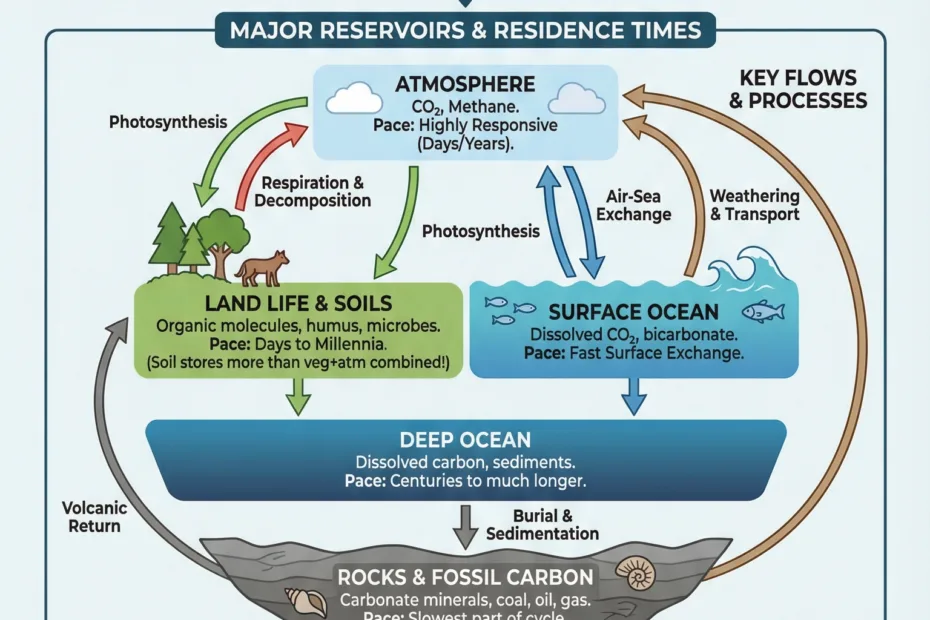
The carbon cycle explained shows how carbon moves through Earth's atmosphere, land, oceans, and living things naturally.

The Carbon Cycle: How Carbon Moves Through Earth’s Systems

The carbon cycle is the ongoing movement of carbon through the atmosphere, living things, soils, oceans, and rocks. Carbon changes form as it moves: it can be carbon dioxide in air, sugar in a leaf, organic matter in soil, bicarbonate in seawater, or carbonate minerals in sediment. The same atom can move through several of these stores, but not on one single timetable; some transfers… 

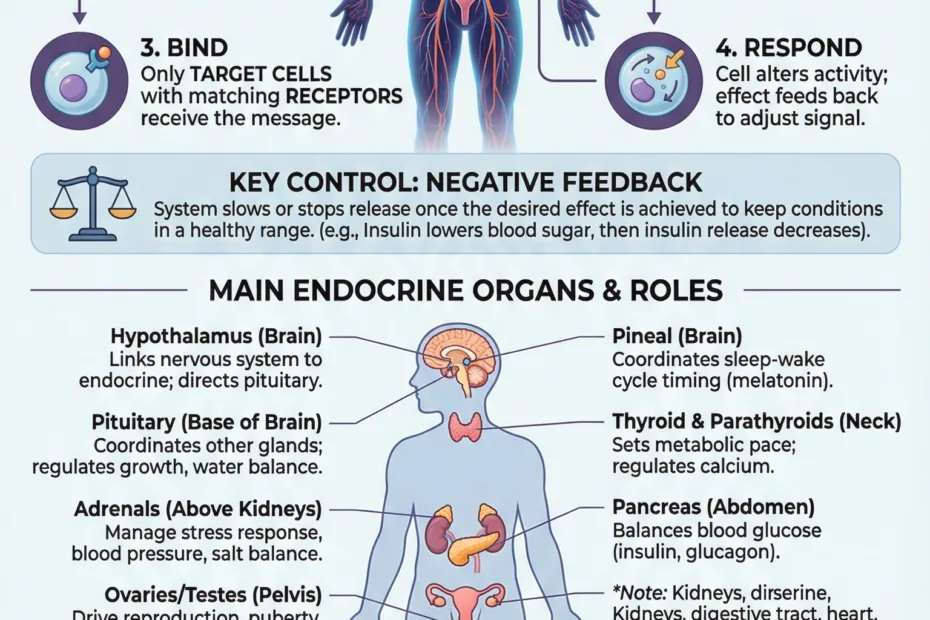
Hormones and the endocrine system help the body send signals through main organs like the brain, glands, and nerves for proper fun…

Hormones and the Endocrine System: How the Body Sends Signals

A Clear Starting Point The endocrine system is the body’s long-range signaling network. It releases hormones into the bloodstream, and those hormones change what selected cells do when the cells carry the right receptor.[a][c] That sounds simple, but the logic is elegant. A gland sends a message, blood distributes it, target cells read it, and feedback loops decide whether the message should rise, fall, or… 

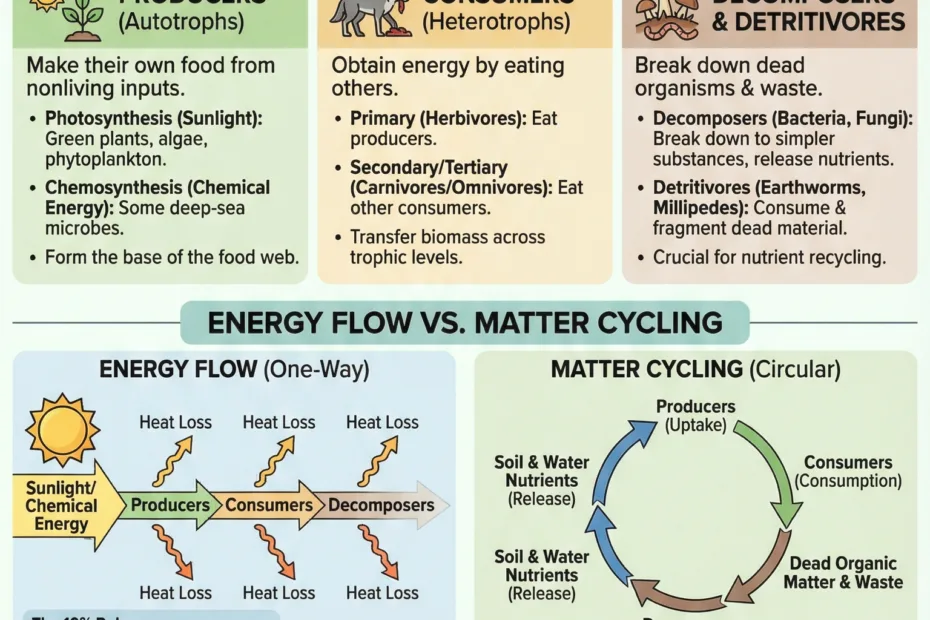
Ecosystems and food webs show how producers, consumers, and decomposers interact to sustain life in nature.

Ecosystems and Food Webs: Producers, Consumers, and Decomposers

Ecosystems are living systems made of organisms and the nonliving conditions around them, all linked by the movement of energy and matter. A food web is the feeding network inside that system: producers make biomass, consumers move it, and decomposers return usable nutrients to soil or water.[a][b] A Straight Starting Point Most ecosystems run on one repeating pattern: energy enters, biomass is built, organisms feed,… 

Cellular respiration explained through the process of ATP production, glycolysis, and the Krebs cycle in this detailed infographic…

What Is Cellular Respiration? ATP, Glycolysis, and the Krebs Cycle

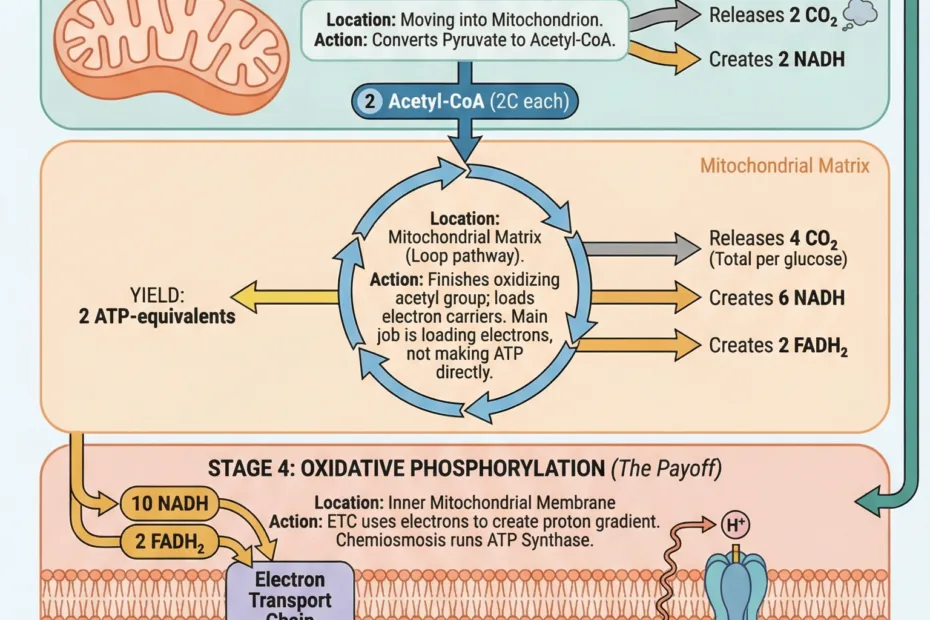
Cellular respiration is the linked set of reactions cells use to turn the chemical energy in food into ATP, the molecule that powers everyday cell work. In eukaryotes, the process starts with glycolysis in the cytosol, moves through pyruvate processing and the Krebs cycle in the mitochondrial matrix, and ends with oxidative phosphorylation on the inner mitochondrial membrane.[b][c][d] A Clear Way to Read the Process… 

The human digestive system explained, showing how food moves through the stomach, small intestine, and large intestine for digesti…

The Human Digestive System: Step-by-Step Process

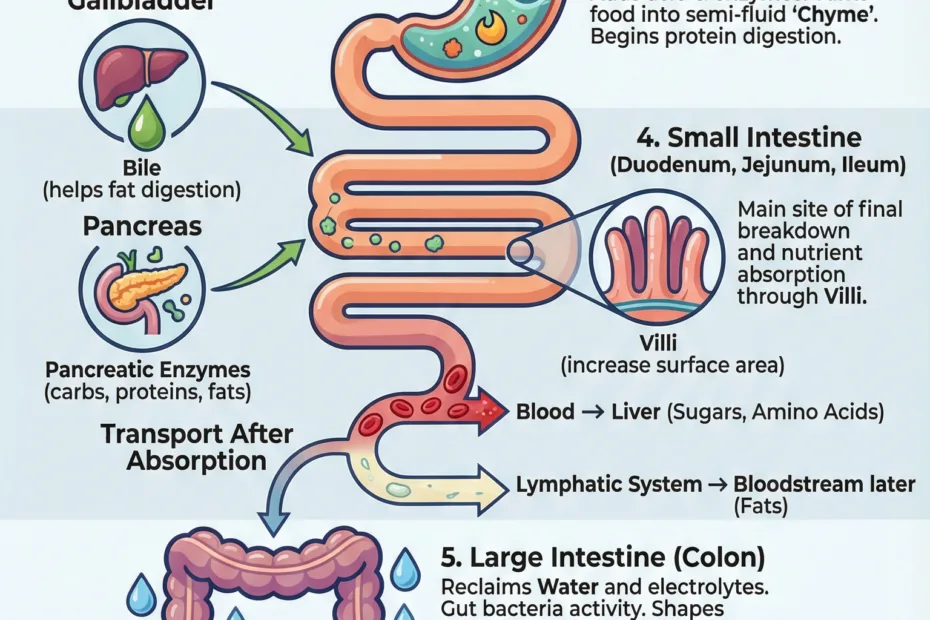
The Big Picture The human digestive system is a coordinated passage of organs and helper glands that turns food into absorbable molecules, moves those molecules into blood or lymph, and removes what the body does not use. Most short explainers stop at naming organs. The fuller story is about movement, timed chemical handoffs, selective absorption, and the quiet work of the small intestine, liver, pancreas,… 

CRISPR gene editing explained, showing how the technology alters DNA with precision and potential applications.

CRISPR Gene Editing: How It Works and What It Changes

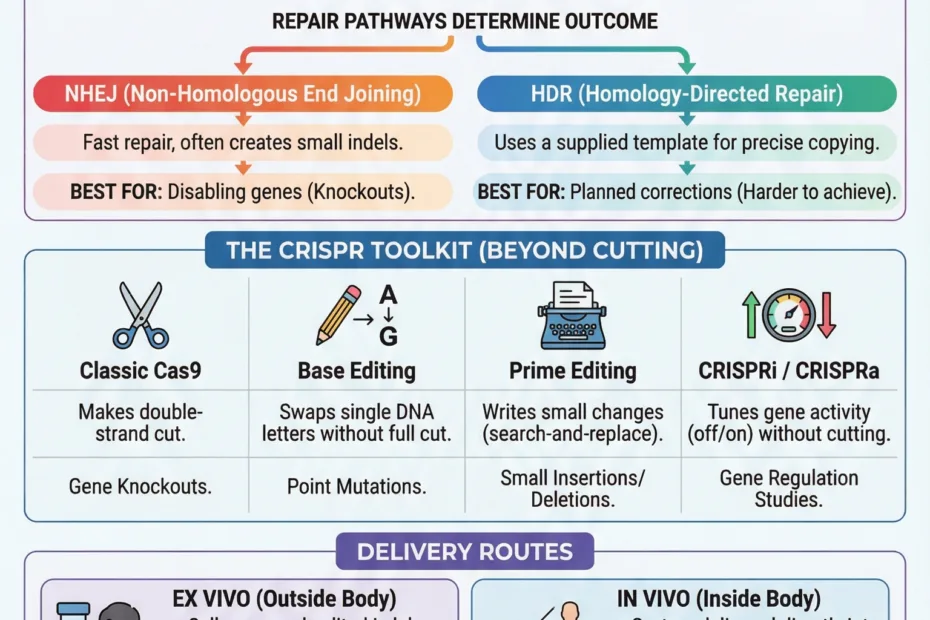
CRISPR gene editing is a way to target a chosen DNA sequence and cut, rewrite, silence, or tune it with unusual precision. The method used in labs today was adapted from a bacterial defense system, and the most familiar version pairs a guide RNA with a Cas enzyme such as Cas9 to act on a selected spot in the genome.[a] Classic Cas9 editing often depends… 

A detailed infographic explains how the human brain works, including its structure, neurons, and key functions.

How the Human Brain Works: Structure, Neurons, and Function

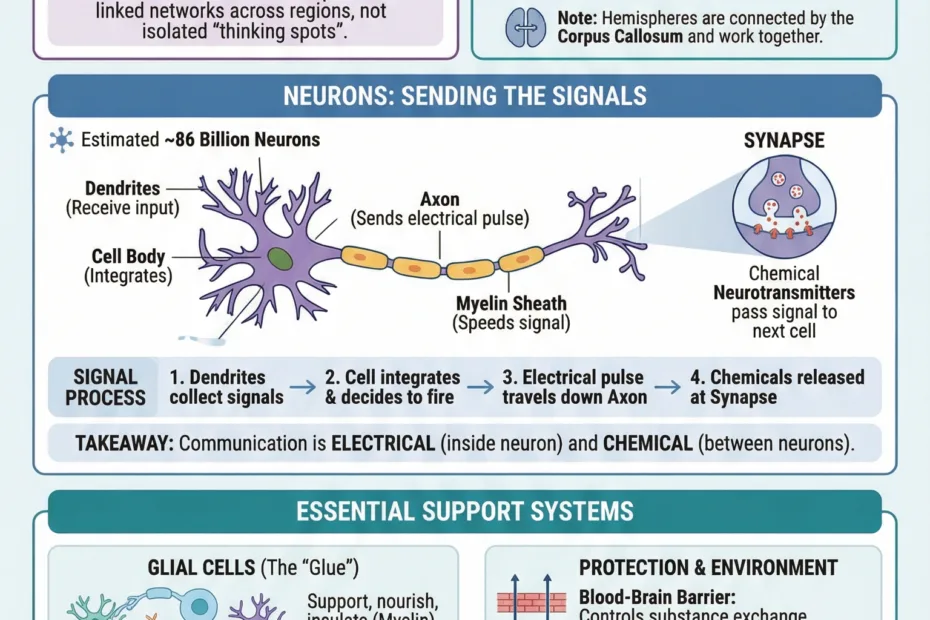
The human brain is the control organ of the nervous system. It receives signals from the body and the outside world, compares them with stored patterns, sends instructions, and keeps basic life functions running even when you are not thinking about them. It does this through connected regions, electrically active cells called neurons, and support cells that keep the whole system stable and fast.[a] Start… 

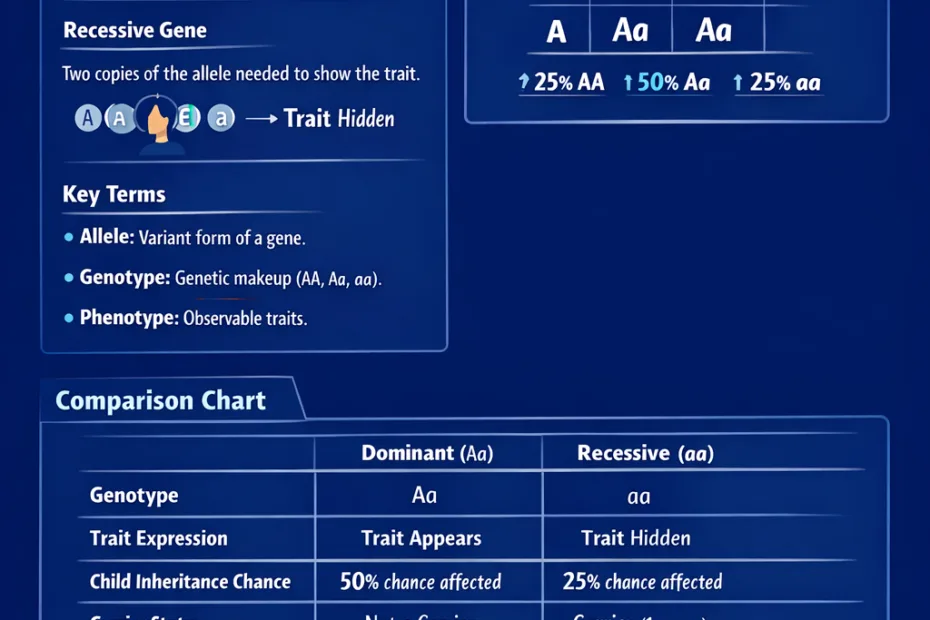
Genetics 101 infographic shows a colorful chart comparing dominant and recessive genes with letter representat…

Genetics 101: Dominant and Recessive Genes Simplified

Dominant and recessive genes describe how two versions of the same gene (alleles) show up in traits when a person inherits one version from each parent—not whether a gene is “strong,” “better,” or more common.[a]↗ A Clean Mental Model Dominant means one allele can be enough to influence the observable trait in a typical two-allele setup; recessive means the trait usually needs two copies of… 

Enzymes and temperature graph with a blue test tube, illustrating how biological catalysts speed up reactions.

Enzymes Explained: How Biological Catalysts Speed Up Life

An enzyme is a biological catalyst that speeds up a chemical reaction in living systems without being permanently used up, usually by making it easier for molecules to reach the reaction’s “go” moment (the activation energy step). [a]↗[b]↗[c]↗ A Clear Snapshot Before We Dive In Enzymes are the reason biology can run at real-world speed: digestion, muscle movement, DNA copying, and cell signaling all rely… 

A diagram showing nitrogen movement through the ecosystem with arrows linking plants, soil, and bacteria.

The Nitrogen Cycle: How Nitrogen Moves Through the Ecosystem

The nitrogen cycle is the natural way nitrogen moves between the air, living things, soil, and water by changing chemical form—most often from inert N2 into “usable” forms like ammonium and nitrate, then back again.[a] 🔗 A Clear Picture First Nitrogen is everywhere, but life can’t use most of it directly. Ecosystems rely on microbes to “translate” nitrogen into forms plants can absorb, then recycle…