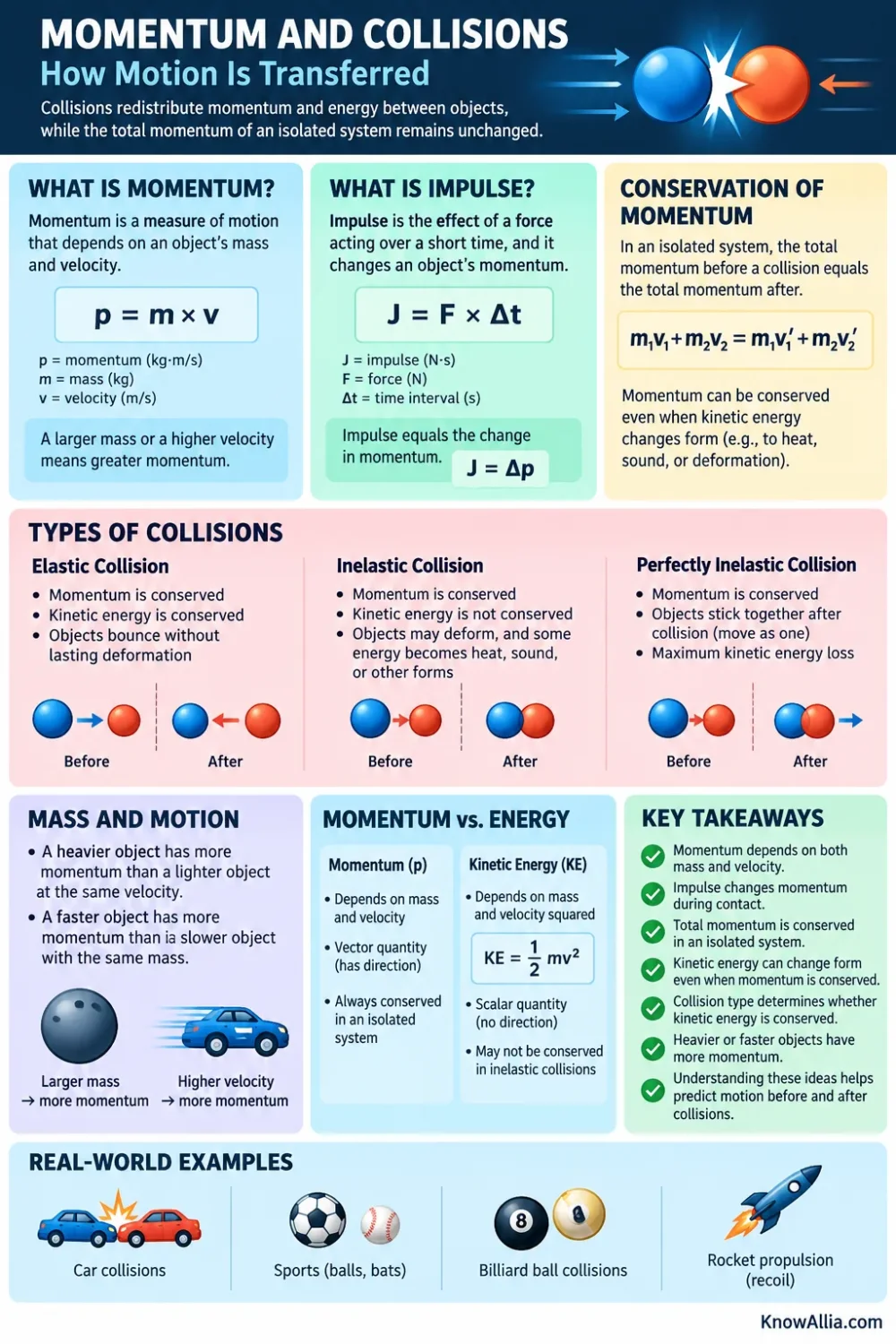
Momentum is a measure of motion that depends on both an object’s mass and velocity. In a collision, interacting objects exert forces on each other for a short time, changing their individual momenta. People often describe this as motion being transferred from one object to another. More precisely, momentum and energy are redistributed during the interaction, while the total momentum of an isolated system remains unchanged.
What This Topic Explains
Collisions connect several ideas that are often studied separately: velocity, mass, force, impulse, momentum, and kinetic energy. Understanding how they fit together makes it possible to predict motion before and after many interactions without knowing every detail of the contact forces.
- Why a heavier or faster object has more momentum.
- How impulse changes momentum during contact.
- Why momentum can be conserved even when kinetic energy changes form.
How Momentum Describes Motion
Linear momentum, usually represented by p, is the product of mass and velocity:
Momentum Equation
p = m × v
Momentum is measured in kilogram-meters per second (kg·m/s). Because velocity includes direction, momentum is a vector quantity. A 2 kg cart traveling east at 3 m/s has a momentum of 6 kg·m/s east.
Mass and velocity do not play identical roles. Doubling the mass while keeping velocity unchanged doubles momentum. Doubling the velocity also doubles momentum. Reversing the direction of velocity reverses the momentum vector even though the object’s mass has not changed. OpenStax summarizes the definition and SI unit of linear momentum in its University Physics summary.
Direction becomes especially important in collision calculations. If rightward motion is defined as positive, leftward momentum is negative. Two objects can therefore be moving rapidly while their total momentum is zero if their momenta are equal in magnitude and opposite in direction.
| Change | Effect on Momentum | Reason |
|---|---|---|
| Mass doubles | Momentum doubles | p is directly proportional to mass. |
| Speed doubles | Momentum magnitude doubles | p is directly proportional to velocity. |
| Direction reverses | Momentum changes sign | Momentum follows the direction of velocity. |
| Object stops | Momentum becomes zero | Velocity is zero, so mv = 0. |
Impulse: How Forces Change Momentum
A collision does not instantaneously replace one velocity with another. During contact, each object experiences a force over a finite interval of time. The combination of force and interaction time is called impulse.
- Impulse
- J = FavgΔt when an average force is used.
- Impulse-Momentum Relation
- J = Δp = pfinal − pinitial
- Impulse Unit
- N·s, which is dimensionally equivalent to kg·m/s.
The impulse-momentum relation says that an object’s change in momentum equals the net impulse applied to it. A larger force can create a larger momentum change, and the same is true when a force acts for a longer time. The relation applies even when the force changes throughout the collision; in that case, impulse corresponds to the area under a force-versus-time graph. OpenStax gives the derivation and physical interpretation in its Impulse and Collisions section.
This explains why collision duration matters. Two interactions can produce the same change in momentum while having different force histories. If the same momentum change occurs over a longer interval, the average force is smaller. If it occurs over a shorter interval, the average force is larger.
Each object has momentum determined by its mass, speed, and direction.
The objects exert equal-and-opposite forces on each other. Each receives an impulse.
Individual momenta may be different, but the system total is unchanged when external impulse is negligible.
Why Total Momentum Is Conserved
During a collision, object A pushes on object B while object B pushes on object A. Newton’s third law says these interaction forces are equal in magnitude and opposite in direction. Because the contact time is the same for the pair, their impulses are also equal and opposite.
If object A gains +4 kg·m/s of momentum, object B receives a change of −4 kg·m/s. Their individual momenta change, but those changes cancel when the entire two-object system is considered. This produces the familiar conservation equation:
p1,i + p2,i = p1,f + p2,f
For constant masses in one dimension: m1v1,i + m2v2,i = m1v1,f + m2v2,f.
The conservation rule applies when the net external impulse on the chosen system is zero or small enough to neglect during the interaction. Internal forces can be very large without changing the system’s total momentum. OpenStax explains this system-level condition in Conservation of Momentum.
The System Boundary Matters
Momentum conservation depends on what is included in the system. If a moving cart strikes another cart, looking at the first cart alone shows a clear momentum change because the second cart exerts an external force on that one-cart system. Draw the system boundary around both carts, and the contact forces become internal forces. If other external impulses are negligible, the total momentum of the two-cart system is conserved.
A useful analogy is a closed accounting ledger. Momentum can move from one account to another inside the ledger, but the total balance stays the same unless something crosses the boundary. The analogy is only bookkeeping—momentum is not a physical fluid—but it captures why choosing the system correctly matters.
External Forces Do Not Have to Be Literally Zero
Introductory collision problems often say that momentum is conserved even though gravity, support forces, or small friction forces exist. The useful test is the external impulse during the collision interval. A small external force acting for a very short collision time may change the system momentum so little that the change can reasonably be neglected.
Elastic, Inelastic, and Perfectly Inelastic Collisions
Momentum conservation alone does not tell us how much kinetic energy remains as kinetic energy after contact. That distinction separates the main collision types.
| Collision Type | Total Momentum | Total Kinetic Energy | Motion After Contact |
|---|---|---|---|
| Elastic | Conserved | Conserved | Objects separate after the interaction. |
| Inelastic | Conserved | Some initial kinetic energy becomes other forms | Objects may still separate. |
| Perfectly inelastic | Conserved | Maximum kinetic-energy reduction allowed by the fixed total momentum | Objects remain together and share one final velocity. |
In an elastic collision, both total momentum and total kinetic energy are unchanged. In an inelastic collision, momentum is still conserved for an isolated system, but some of the initial kinetic energy becomes internal energy, deformation, vibration, or thermal energy. A perfectly inelastic collision is the special case in which the objects remain together afterward. OpenStax discusses these distinctions in Elastic and Inelastic Collisions.
Bouncing does not automatically mean elastic. Two objects can separate after impact and still have less total kinetic energy than they had before. The collision is elastic only when the system’s total kinetic energy is unchanged.
How Mass Changes the Motion After Impact
Newton’s third law gives the colliding objects equal-magnitude, opposite-direction forces. The same contact interval therefore gives them equal-magnitude, opposite momentum changes. It does not give them equal changes in velocity.
For an object whose mass remains constant:
Δv = Δp / m
For the same magnitude of momentum change, a smaller mass undergoes a larger velocity change. A larger mass undergoes a smaller velocity change.
Suppose a 1 kg cart and a 4 kg cart each receive an impulse with magnitude 2 N·s. The 1 kg cart changes velocity by 2 m/s, while the 4 kg cart changes velocity by only 0.5 m/s. Their momentum changes have the same magnitude even though their velocity changes are very different.
Equal Masses Have a Useful Elastic-Collision Pattern
In an ideal one-dimensional elastic collision between two equal masses, the objects exchange velocities. If one object approaches at 4 m/s while the other is initially stationary, the incoming object stops and the second moves away at 4 m/s. Both momentum and kinetic energy are preserved.
This familiar result is a special case, not a rule for every collision. Different masses or nonelastic interactions produce different final velocities.
Worked Collision Examples
Example 1: Momentum of a Moving Cart
A 2 kg cart moves to the right at 3 m/s.
- Choose rightward motion as positive.
- Use p = mv.
- Calculate: p = (2 kg)(3 m/s) = 6 kg·m/s.
The cart’s momentum is +6 kg·m/s. If it moved left at the same speed, its momentum would be −6 kg·m/s under this sign convention.
Example 2: Two Carts Stick Together
A 2 kg cart travels right at 4 m/s and reaches a stationary 3 kg cart. Suppose they remain together after contact. This is a perfectly inelastic collision.
Initial momentum:
pinitial = (2 kg)(4 m/s) + (3 kg)(0 m/s) = 8 kg·m/s
The combined mass is 5 kg. Conservation of momentum gives:
8 kg·m/s = (5 kg)vf
vf = 1.6 m/s to the right.
The initial kinetic energy is 16 J. The final kinetic energy of the combined carts is 6.4 J. The remaining 9.6 J has not disappeared; it has been converted from large-scale kinetic energy into other forms within the system. Momentum is conserved even though kinetic energy is not conserved as kinetic energy.
Example 3: Equal-Mass Elastic Transfer
A 0.5 kg cart moving at 4 m/s reaches an identical stationary cart in an ideal elastic collision. The initial momentum is 2 kg·m/s and the initial kinetic energy is 4 J.
The elastic equal-mass solution is:
- The first cart changes from 4 m/s to 0 m/s.
- The second cart changes from 0 m/s to 4 m/s.
- The final total momentum remains 2 kg·m/s.
- The final total kinetic energy remains 4 J.
This is one of the clearest cases in which momentum appears to pass almost completely from one moving object to another.
Two-Dimensional Collisions
Real collisions do not have to occur along a single straight line. Pucks, balls, particles, and other moving objects can scatter at angles. Momentum conservation still applies, but it must be applied as a vector equation.
The most practical method is to split each momentum vector into perpendicular components:
- Conserve total momentum separately in the x-direction.
- Conserve total momentum separately in the y-direction.
- Use signs or vector components to preserve direction.
For a two-object isolated system:
Σpx,initial = Σpx,final
Σpy,initial = Σpy,final
A single momentum equation is therefore not enough to represent a two-dimensional event. The x and y directions provide separate equations. Additional information—such as a final speed, scattering angle, or elastic-collision condition—may still be required to determine every unknown.
The Center-of-Mass View
A useful way to understand a collision is to follow the system’s center of mass. For a constant-mass system, the center-of-mass velocity is related to total momentum by vcm = ptotal/M. If the net external force is zero, total momentum remains constant, so the center of mass continues with constant velocity even while the individual objects speed up, slow down, or reverse direction.
This separates the motion of the system as a whole from the motion occurring inside it. Yale’s Fundamentals of Physics lecture on multibody dynamics, center of mass, and momentum conservation develops this connection for interacting bodies.
Momentum and Kinetic Energy Are Not the Same
Momentum and kinetic energy both depend on mass and velocity, but they describe different properties of motion.
| Property | Momentum | Kinetic Energy |
|---|---|---|
| Equation | p = mv | K = ½mv² |
| Type of quantity | Vector | Scalar |
| Depends on direction? | Yes | No |
| Velocity dependence | Proportional to v | Proportional to v² |
| Conserved in an isolated collision? | Yes | Only as kinetic energy in an elastic collision |
Two objects can have the same momentum while carrying different amounts of kinetic energy. For a nonrelativistic object, substituting v = p/m into the kinetic-energy equation gives K = p²/(2m). At the same momentum magnitude, the lower-mass object therefore has more kinetic energy because it must be moving faster.
Direction also distinguishes the two quantities. Opposite momentum vectors can cancel when added. Kinetic energies cannot cancel simply because the objects move in opposite directions, because velocity is squared in the kinetic-energy equation.
Where Kinetic Energy Goes in an Inelastic Collision
Saying that kinetic energy is “lost” in an inelastic collision does not mean energy disappears. It means some of the system’s macroscopic kinetic energy has changed into other forms. The objects may temporarily deform, vibrate, warm slightly, or store internal energy. Total energy remains conserved when every form of energy is included.
A Reliable Way to Analyze a Collision
- Choose the system. Decide which interacting objects are included.
- Choose coordinate directions. Assign positive and negative directions before inserting velocities.
- Calculate initial momentum. Add momentum vectorially, not just by adding speeds.
- Check external impulse. Decide whether momentum conservation is a good approximation for the chosen time interval.
- Identify the collision type. Do not assume kinetic energy is conserved unless the collision is elastic or the data show that it is.
- Write momentum conservation. Use one component equation in one dimension or separate component equations in two dimensions.
- Use any additional condition. Examples include objects sticking together, known final velocity, or kinetic-energy conservation.
- Check direction and units. A negative final velocity usually indicates motion opposite the chosen positive direction rather than a negative speed.
Common Confusion About Momentum and Collisions
“Momentum Is Conserved for Every Individual Object”
No. An individual object’s momentum commonly changes during a collision because another object exerts an impulse on it. Conservation applies to the total momentum of the properly chosen isolated system.
“If Objects Bounce Apart, the Collision Is Elastic”
Objects can bounce apart while converting some kinetic energy into other forms. Separation alone does not prove that kinetic energy was conserved.
“Perfectly Inelastic Means All Kinetic Energy Becomes Zero”
A perfectly inelastic collision means the objects remain together and share one final velocity. The combined object can still be moving, so it can still have kinetic energy.
“Equal Forces Produce Equal Velocity Changes”
Equal-and-opposite collision forces acting for the same time produce equal-and-opposite momentum changes. Velocity change also depends on mass, so different masses generally undergo different changes in velocity.
“A Stationary System Has No Momentum Inside It”
A system can have zero total momentum while its parts are moving. Two equal masses traveling in opposite directions at equal speeds have momenta that cancel when added vectorially.
Terms Used in Collision Physics
- Linear Momentum
- The vector quantity p = mv, combining mass with velocity.
- Impulse
- The effect of a force acting over time; impulse equals the change in momentum.
- Isolated System
- A system for which the net external influence produces no change in total momentum during the interval being studied.
- Elastic Collision
- A collision in which both total momentum and total kinetic energy are conserved.
- Inelastic Collision
- A collision in which total momentum is conserved for an isolated system but some initial kinetic energy changes into other forms.
- Perfectly Inelastic Collision
- An inelastic collision in which the interacting objects remain together and share a final velocity.
- Center of Mass
- The mass-weighted average position of a system. Its translational motion is tied directly to the system’s total momentum.
Where the Simple Collision Model Has Limits
The equations used in elementary collision problems deliberately simplify real interactions. Actual objects can rotate, deform, vibrate, experience friction, and interact with their surroundings. A collision may involve three-dimensional motion rather than a single line, and the contact force may vary rapidly with time.
Momentum conservation by itself also does not determine every final velocity. In a one-dimensional collision between two objects, one momentum equation can contain two unknown final velocities. Another condition is then needed, such as a known final velocity, a shared final velocity, or conservation of kinetic energy for an elastic interaction.
The classical relation p = mv is appropriate for ordinary speeds. At speeds approaching the speed of light, relativistic momentum must be used instead. For the everyday and introductory mechanics situations considered here, classical momentum gives the intended description.
Despite these limits, the central pattern remains simple: interaction forces change the momentum of individual objects, while the total momentum of a suitably isolated system stays fixed. The visible outcome—stopping, rebounding, moving together, or scattering at angles—depends on how that conserved momentum is divided among the objects and on how the system’s energy is redistributed.
Frequently Asked Questions
What is actually transferred when two objects collide?
The interaction changes the momentum of each object through impulse. It is common to describe this as momentum being transferred between the objects. Energy is also redistributed, and in an inelastic collision some kinetic energy changes into other forms.
Is momentum always conserved in a collision?
Total momentum is conserved for an isolated system. If a net external impulse acts on the selected system, its total momentum can change. For many brief collision problems, external impulse is small enough to neglect during the contact interval.
Can momentum be conserved while kinetic energy decreases?
Yes. That is what happens in an inelastic collision. Total momentum remains constant for an isolated system, while some initial kinetic energy becomes internal energy, deformation, vibration, thermal energy, or other forms.
Why does a lighter object usually change speed more?
Colliding objects receive equal-magnitude, opposite momentum changes from their mutual interaction. Since Δv = Δp/m for constant mass, the same momentum change produces a larger velocity change when the mass is smaller.
Does an object with more momentum always move faster?
No. Momentum depends on both mass and velocity. A slower but much heavier object can have more momentum than a lighter, faster object.
Can two moving objects have zero total momentum?
Yes. Because momentum is a vector, equal momenta pointing in opposite directions add to zero. The objects can still have kinetic energy because kinetic energy does not cancel with direction.
What happens when two objects stick together after a collision?
The interaction is perfectly inelastic. Both objects share the same final velocity, which can be found from conservation of momentum when external impulse is negligible.
Why are signs important in momentum calculations?
Velocity and momentum have direction. Choosing one direction as positive makes motion in the opposite direction negative. Ignoring these signs can produce an incorrect total momentum even when the speed values are correct.
Is impulse the same as momentum?
No. Momentum describes an object’s current state of motion. Impulse describes the change in momentum produced by a force acting over time. Their units are dimensionally equivalent, but they represent different physical ideas.
Sources
- MIT OpenCourseWare – Classical Mechanics Readings — Sections covering momentum, impulse, isolated systems, center of mass, and conservation of momentum.
- MIT OpenCourseWare – Linear Impulse and Momentum: Collisions — Undergraduate dynamics material on impulse, momentum, and collision analysis.
- Caltech – The Feynman Lectures on Physics, Conservation of Momentum — Discussion of momentum conservation, impacts, elastic behavior, and interactions between bodies.
- University of Virginia – Momentum, Work and Energy — Explanation of equal-and-opposite momentum changes and conservation during interactions.
- Oregon State University – 1D Conservation of Momentum — Treatment of external impulse, system selection, and one-dimensional collisions.
- University of Minnesota – Linear Momentum and Collisions — Physics demonstration collection covering impulse, momentum transfer, and one- and two-dimensional collisions.