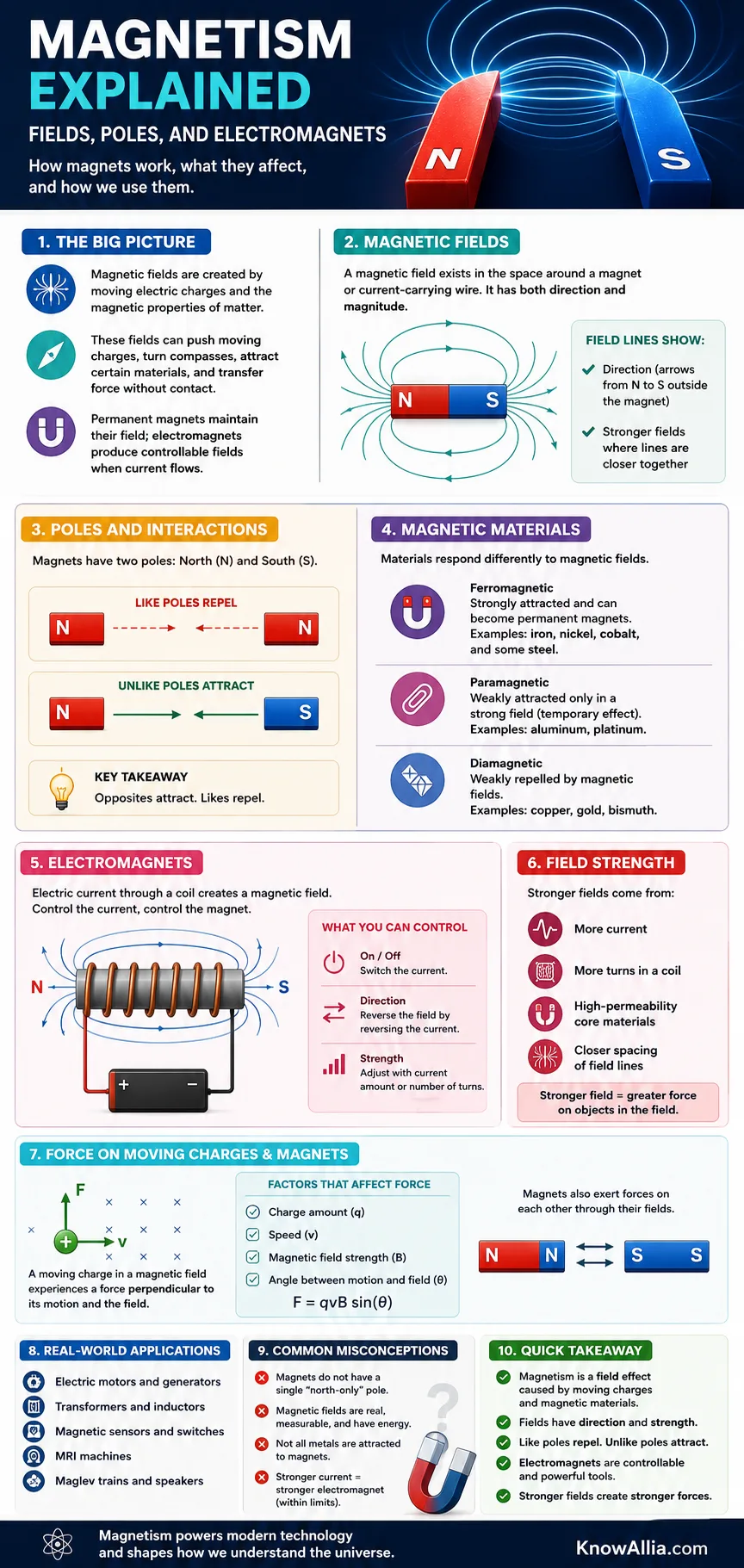
Magnetism is the set of effects produced by magnetic fields. These fields are created by electric currents, moving electric charge, and the magnetic properties of particles inside matter. A field can push a moving charge sideways, turn a compass needle, attract certain materials, or transfer force without direct contact. A permanent magnet maintains its field through the organized magnetic state of its material, while an electromagnet produces a controllable field when current flows through a wire or coil.
The Main Idea in Plain Language
A magnet does not reach outward with invisible hooks. It changes the physical conditions in the space around it, creating a field with a measurable direction and magnitude. Another magnet, a suitable material, or a moving electric charge responds when it enters that field.
- Fields describe where magnetic effects act and which way they act.
- Poles label the two ends of a magnetic dipole; like poles repel and unlike poles attract.
- Electromagnets use electric current to create fields that can be switched, reversed, and adjusted.
The sections below connect these ideas to magnetic domains, materials, force, field strength, solenoids, and real devices.
What Magnetism Actually Describes
Magnetism is part of electromagnetism, the physics linking electric charge, electric fields, magnetic fields, and electromagnetic radiation. Electric and magnetic effects are closely related, but they are not interchangeable. An electric field can act on a charge whether the charge is moving or stationary. A magnetic field exerts its familiar force on a charge when the charge is moving relative to the field.
The magnetic field is usually represented by the symbol B. It is a vector, meaning that it has both a size and a direction at every point. The SI unit of magnetic flux density is the tesla, symbol T.NIST Smaller fields are often stated in millitesla, microtesla, or nanotesla.
B and H are related but not identical. In many introductory explanations, “magnetic field” refers to B. Engineers also use H, measured in amperes per meter, for the magnetizing field associated with currents. Inside matter, B also reflects how the material itself becomes magnetized. In vacuum, the relation is B = μ0H.NIST
A useful analogy is a weather map. Wind arrows do not create the wind; they show its direction and speed at selected locations. In the same way, magnetic field arrows describe what a magnetic test object would experience. The field is physical and measurable, while the arrows and lines are representations chosen by people.
How Magnetic Fields and Field Lines Work
A magnetic field occupies three-dimensional space around its source. Near a simple bar magnet, the field outside the magnet points from the north pole toward the south pole. Inside the magnet, it continues from south toward north, forming closed paths. Field lines therefore do not begin at one pole and disappear at the other. They continue through the magnet.OpenStax
- The tangent to a field line gives the local direction of B.
- Closer spacing is used to show a larger field magnitude.
- Field lines never cross, because a field cannot point in two different directions at the same place and time.
- The number of drawn lines is arbitrary; adding more lines to a diagram does not make the real field stronger.
- Lines form closed loops in ordinary magnetic-field descriptions.
Iron filings and small compass needles can reveal a pattern associated with a field. They do not expose literal threads in space. Each filing becomes temporarily magnetized and turns in response to the local field, so a collection of filings traces a visible pattern.
Fields Do Not Always Look Like Bar-Magnet Fields
A straight wire carrying current creates circular field lines around the wire. That pattern does not have a north end and a south end like a bar magnet. When the wire is bent into a loop, the fields from different parts of the loop combine. A long coil, called a solenoid, then develops a field pattern that resembles a bar magnet, including identifiable north and south ends.
The direction follows a right-hand rule: point the right thumb in the direction of conventional current through a straight wire, and the curled fingers show the field direction around it. For a coil, curl the fingers in the current direction; the thumb points toward the coil’s magnetic north end.
North and South Poles
A magnetic pole is a region where a magnet’s external field is concentrated. A simple magnet has two poles, named north and south. Two north poles repel, two south poles repel, and opposite poles attract. The labels describe orientation, not positive and negative electric charge.
Like Poles
N–N or S–S
The magnets tend to rotate or move apart when their orientation allows it.
Unlike Poles
N–S
The magnets tend to rotate or move together because that arrangement lowers the field energy.
What Happens When a Magnet Is Cut?
Cutting a bar magnet does not isolate a north pole from a south pole. Each piece becomes a smaller dipole with its own north and south ends. The material contains magnetic moments throughout its volume, so a newly exposed surface becomes part of a new pole pair. Experiments have searched for particles carrying an isolated magnetic charge, known as magnetic monopoles, but no confirmed elementary monopole has been detected.CERN
Why a Compass Points North
A compass needle is a small magnet. Its north-seeking end turns toward the general direction of geographic north because it aligns with Earth’s magnetic field.USGS Geographic north, the geomagnetic pole, and the magnetic dip pole are not the same location. Local magnetic materials and electrical equipment can also disturb a compass reading.
The naming can seem backward. In the simplified bar-magnet picture of Earth, the region near geographic north behaves like a magnetic south pole because it attracts the north-seeking end of a compass. Geomagnetism uses its own naming conventions, so the safest statement is that a compass aligns with the direction of Earth’s local field.
Why Some Materials Respond Strongly
Magnetism in matter comes from the magnetic moments associated with electrons, including their spin and orbital behavior. The familiar picture of an electron as a tiny spinning ball is only a rough analogy; electron spin is a quantum property and should not be read as a literal ball rotating in space.
In many atoms, magnetic contributions cancel. In other materials, they do not cancel completely. The way those moments respond collectively determines whether a material is diamagnetic, paramagnetic, ferromagnetic, ferrimagnetic, or antiferromagnetic. For everyday magnets, ferromagnetism and ferrimagnetism are the most visible forms.
| Material Behavior | Response to a Field | What Happens After Removal | Familiar Examples |
|---|---|---|---|
| Diamagnetic | Develops a very weak response opposite the applied field | The induced response disappears | Copper, bismuth, water |
| Paramagnetic | Magnetic moments align weakly with the applied field | Most alignment disappears | Aluminum, magnesium, oxygen |
| Ferromagnetic | Domains can align strongly with the field | Some materials retain magnetization | Iron, cobalt, nickel, selected alloys |
| Ferrimagnetic | Opposing magnetic moments are unequal, leaving a net field | Can retain magnetization | Magnetite and many ferrites |
| Antiferromagnetic | Neighboring moments tend to align oppositely and cancel | Usually little external magnetization remains | Selected oxides and transition-metal compounds |
Magnetic Domains
A ferromagnetic material can contain regions called domains. Within each domain, many atomic magnetic moments share a preferred direction. An unmagnetized sample may still contain strongly ordered domains, but their different orientations largely cancel at the scale of the whole object. An applied field can move domain boundaries and rotate magnetization, increasing the net field.
Some materials keep much of this order after the external field is removed. They are suitable for permanent magnets. Soft magnetic materials are easier to magnetize and demagnetize, which suits transformer cores, relays, and many electromagnets. Hard magnetic materials resist reversal and are favored where a lasting magnetic state is needed.OpenStax
Not all metals are strongly attracted to magnets. Iron is a familiar magnetic material, but copper and aluminum do not behave like iron. A metal can conduct electricity well without being ferromagnetic.
How Electromagnets Produce a Controllable Field
Electric current is moving charge, and moving charge produces a magnetic field. This link was established experimentally when current in a wire was found to deflect a nearby compass. A straight wire creates a circular field; winding the wire into a coil makes the contributions from each turn reinforce one another through the coil’s interior.NIST
A coil carrying current is already an electromagnet, even with an air-filled center. Adding a suitable ferromagnetic core often makes the field much stronger because the coil magnetizes the core. The combined field comes from both the current and the material’s response.EIA
From Electric Current to Magnetic Force
The field can be switched, redirected, and shaped because its source is a controlled electric current.
Current Flows
Moving charge produces a circular magnetic field around each section of wire.
Turns Reinforce
In a coil, fields from neighboring turns add through the central region.
The Core Responds
A suitable core becomes magnetized and guides more magnetic flux through the device.
Force Appears
The shaped field can move an armature, turn a rotor, hold an object, or guide a particle beam.
| Feature | Permanent Magnet | Electromagnet |
|---|---|---|
| Field source | Retained order within magnetic material | Electric current, often assisted by a magnetic core |
| On and off control | Field is normally present | Field can be turned on or off with the current |
| Polarity | Usually fixed unless remagnetized | Reversed by reversing current direction |
| Adjustment | Limited after manufacture | Field can be adjusted over a designed operating range |
| Energy input | No continuous electrical input is needed to maintain the field | Ordinary resistive coils consume electrical energy and produce heat |
| Typical role | Holding, sensing, bias fields, compact motors | Relays, valves, lifting systems, laboratory magnets, actuators |
What Controls Electromagnet Strength?
For an ideal, long air-core solenoid, the field near the center is approximated by B ≈ μ0nI. Here, μ0 is the permeability of free space, n is the number of turns per unit length, and I is current. This relation shows why more turns in the same length or more current can increase the field.OpenStax
The formula is an approximation, not a universal rating equation. Real coils have finite length, spaces between turns, lead wires, changing temperatures, and nearby materials. A core changes the relation, sometimes by a large amount, and its response is nonlinear.
- Current: More current usually raises the field until heating, power-supply limits, or core behavior intervenes.
- Turns per unit length: More tightly packed turns make the field contributions add more strongly inside a solenoid.
- Core material: High-permeability soft magnetic materials can guide and amplify magnetic flux.
- Core shape and air gaps: A closed magnetic path usually carries flux more readily than a path with a large air gap. The gap often dominates the reluctance of the magnetic circuit.
- Pole area and separation: Geometry affects where the field is concentrated and how rapidly force changes with distance.
- Saturation: A ferromagnetic core eventually approaches a state where most available magnetic moments are aligned. More current then gives a much smaller increase in magnetization.
- Temperature and resistance: Resistive wire heats as current flows. Higher temperature usually raises copper resistance, changes current for a fixed voltage, and limits continuous operation.
- Duty cycle: A coil designed for short pulses may overheat if powered continuously.
A Simple Solenoid Estimate
- Given
- An ideal air-core solenoid with 1,000 turns per meter carrying 0.50 A.
- Approximation
- B ≈ μ0nI = (4π × 10−7 T·m/A)(1,000 m−1)(0.50 A).
- Estimated Central Field
- B ≈ 6.28 × 10⁻⁴ T, or about 0.628 mT.
- Boundary of the Estimate
- The result is most useful when the coil is much longer than its diameter and the point of interest is away from the ends.
Hysteresis, Remanence, and Saturation
Real magnetic cores remember part of their magnetic history. When the magnetizing field rises and falls, the material does not retrace exactly the same path. This behavior is called hysteresis. Magnetization left after the driving field returns to zero is called remanence. A reverse field may be needed to reduce the net magnetization to zero; the required resistance to reversal is related to coercivity.
Hysteresis explains why an electromagnet’s core may remain slightly magnetic after power is removed. It also causes energy loss in devices exposed to reversing fields. Core composition and construction are chosen to match the task: low-loss soft materials for repeated cycling, or high-coercivity materials for permanent magnets.
How a Magnetic Field Produces Force
Force on Moving Charge
For a charge q moving with velocity v in a magnetic field B, the magnitude of the magnetic force is F = |q|vB sin θ, where θ is the angle between the velocity and the field. The force is greatest when motion is perpendicular to the field and zero when motion is exactly parallel. Its direction is perpendicular to both v and B, with the sign of the charge determining the final direction.OpenStax
Because the force is sideways to the instantaneous motion, a static magnetic field can bend a charged particle’s path without directly increasing its speed. This behavior is used to steer charged particles and to separate them according to momentum or charge.
Force on a Current-Carrying Wire
A current consists of moving charges, so a wire in an external magnetic field can experience a force. Motors use this effect: forces on current-carrying conductors create torque on a rotor. Reversing either the current or the magnetic field reverses the force direction; reversing both leaves the force direction unchanged.
Why Either Pole Can Attract Iron
An unmagnetized iron object is not simply a permanent south pole waiting for a north pole. A nearby magnet’s nonuniform field rearranges domains so that the near side develops an induced pole favorable to attraction. If the magnet is flipped, the induced magnetization also flips. That is why either pole of a magnet can attract an ordinary iron object.
Distance matters because fields from compact magnets generally weaken rapidly as separation grows. Doubling the gap does not usually cut the force by one simple universal fraction; magnet geometry, pole area, material response, and alignment all affect the result. Published “pull force” ratings are normally measured under stated contact and test conditions.
Common Confusions About Magnetism
| Statement | More Accurate Explanation |
|---|---|
| “Field lines are physical strings.” | Field lines are a drawing method. The magnetic field is measurable, but the chosen lines are not material strands. |
| “Every magnetic field has two visible poles.” | A straight current-carrying wire has circular field lines without bar-magnet-style pole ends. Pole language is most useful for dipole-like fields. |
| “A magnet attracts every metal.” | Strong everyday attraction is mainly associated with ferromagnetic or ferrimagnetic materials. Many metals respond only weakly. |
| “A stronger voltage always means a stronger electromagnet.” | The field responds directly to current and coil geometry. Voltage affects current through resistance and circuit behavior. |
| “More current can strengthen a core forever.” | Heating and magnetic saturation place practical limits on the useful increase. |
| “A stationary charge is pulled by a static magnetic field.” | The magnetic part of the Lorentz force depends on charge motion relative to the field. |
| “Turning off an electromagnet removes all magnetism instantly.” | The coil field collapses, but a real core can retain remanent magnetization and the circuit can produce a voltage during the change. |
Where These Principles Appear
The same field rules operate across devices of very different size. What changes is the geometry, current, material, control method, and required field uniformity.
| System | Magnetic Role | Main Physical Idea |
|---|---|---|
| Compass | A small permanent magnet aligns with Earth’s local field | Torque on a magnetic dipole |
| Relay | A powered coil magnetizes a core and moves an armature | Controllable attraction across a small gap |
| Solenoid valve | A coil pulls or pushes a movable plunger | Field concentration and force on magnetic material |
| Electric motor | Magnetic forces create torque | Force on currents and interaction between fields |
| Generator | Changing magnetic flux produces an electromotive force | Electromagnetic induction |
| Loudspeaker | Current in a voice coil interacts with a permanent-magnet field | Force on a current-carrying conductor |
| Transformer | A changing current creates changing flux shared by coils | Induction through a magnetic core |
| MRI system | Large coils create a controlled, highly uniform field | Magnetic response of atomic nuclei and radio-frequency excitation |
| Particle accelerator | Electromagnets steer and focus charged-particle beams | Magnetic force on moving charge |
Electromagnets are favored when the field must change during operation. Permanent magnets are favored when a steady field, compact size, and no continuous coil power are more useful. Many systems combine both.
What the Simple Models Leave Out
Introductory models deliberately remove detail. A bar magnet is often treated as an ideal dipole, a solenoid as infinitely long, a wire as perfectly thin, and a core as uniform. Real fields have edge effects, leakage flux, material variation, temperature dependence, and geometry that may require measurement or numerical simulation.
- Field lines do not reveal a unique hidden structure. Different drawings can represent the same vector field at different levels of detail.
- Electron spin has no fully faithful everyday mechanical picture. Calling an electron a tiny spinning magnet is useful only within limits.
- Material labels are not complete device specifications. Composition, crystal structure, processing, temperature, frequency, and prior magnetization all matter.
- Magnetic monopoles remain hypothetical as elementary particles. Searches have narrowed possible ranges without confirming one.
- Force cannot be inferred from tesla alone. Field gradient, object geometry, magnetic properties, distance, and orientation are also needed.
These limits do not make the basic models false. They define where each model gives a useful approximation and where a more detailed description is needed.
Terms Used in Magnetism
- Magnetic Field, B
- A vector field describing magnetic effects on moving charges, currents, magnetic dipoles, and magnetic materials. Its SI unit is the tesla.
- Magnetic Flux, Φ
- A measure of magnetic field passing through a selected surface. Its SI unit is the weber.
- Magnetic Pole
- A region of a dipole-like magnet where the external field is concentrated and pole behavior is identified as north or south.
- Magnetic Dipole
- A magnetic system with a north–south orientation and a magnetic dipole moment.
- Magnetic Moment
- A vector quantity describing the strength and orientation of a magnetic source or dipole.
- Solenoid
- A helical coil of wire designed to produce a field through its interior when current flows.
- Permeability
- A property connecting magnetizing field and magnetic flux density within a material.
- Magnetic Domain
- A region in a magnetic material where many atomic magnetic moments share an ordered direction.
- Hysteresis
- The dependence of a material’s present magnetization on its earlier magnetic state.
- Remanence
- Magnetization remaining after an applied magnetizing field is removed.
- Coercivity
- A measure related to the reverse field needed to reduce magnetization after a material has been magnetized.
- Saturation
- The region where further increases in magnetizing field produce relatively little additional magnetization.
Questions About Fields, Poles, and Electromagnets
Frequently Asked Questions
What creates a magnetic field?
Magnetic fields are created by moving electric charge, electric current, changing electric fields, and magnetic moments associated with particles and materials. A permanent magnet’s external field reflects organized magnetization within the material.
Do magnetic field lines really exist?
The field exists and can be measured. Field lines are a visual method for displaying its direction and relative magnitude. They are not physical threads or paths that must be filled with matter.
Why do magnets have north and south poles?
Ordinary magnets behave as magnetic dipoles. Their internal magnetic moments combine to produce a field with a preferred orientation and two pole regions. Cutting the magnet creates smaller dipoles rather than isolated poles.
Can a magnetic field exist without visible poles?
Yes. The field around a straight current-carrying wire forms circles around the wire and is not usefully described as having north and south ends. A coil arranges those circular contributions into a dipole-like pattern.
Why does reversing current reverse an electromagnet?
The field direction around every wire segment depends on current direction. Reversing the current reverses those local fields, so the coil’s north and south ends exchange positions.
Does adding more wire always make an electromagnet stronger?
More turns per unit length can strengthen the field for a given current, but longer, thinner wire also adds resistance and heat. The power supply, coil dimensions, core saturation, insulation, and duty cycle determine the actual result.
Why does an electromagnet become hot?
Ordinary coil wire has electrical resistance. Current converts electrical energy into heat at a rate related to I2R. Core losses and induced currents can add heating when fields vary with time.
Can a magnet run out of magnetism?
A permanent magnet does not spend magnetism as fuel, but its ordered state can weaken through excessive heat, strong opposing fields, unsuitable handling, corrosion, or changes in the material. Different magnet materials have different resistance to demagnetization.
Is a tesla a measure of magnetic force?
No. The tesla measures magnetic flux density B. Force also depends on the moving charge or current, direction, geometry, magnetic properties, and often the field gradient.
Sources
- OpenStax – Magnetic Fields, Field Lines, and Force — field direction, field-line interpretation, current-produced fields, and magnetic force. ↩
- National Institute of Standards and Technology – NIST Guide to the SI, Chapter 4 — the tesla as the SI unit of magnetic flux density. ↩
- National Institute of Standards and Technology – The Permeability of Vacuum and the Revised International System of Units — the relation among magnetic flux density, magnetic field strength, and magnetization. ↩
- U.S. Geological Survey – How Does a Compass Work? — compass alignment and sources of local interference. ↩
- OpenStax – Magnetism in Matter — magnetic materials, domains, susceptibility, hysteresis, and saturation. ↩
- National Institute of Standards and Technology – Ampere: History — the observed link between electric current and the field around a wire. ↩
- U.S. Energy Information Administration – Magnets and Electricity — magnetic fields, poles, current, and electricity generation. ↩
- OpenStax – Solenoids and Toroids — the ideal solenoid field relation, right-hand rule, and limits of the long-solenoid approximation. ↩
- CERN – MoEDAL Zeroes In on Magnetic Monopoles — experimental searches and current limits without a confirmed monopole detection. ↩