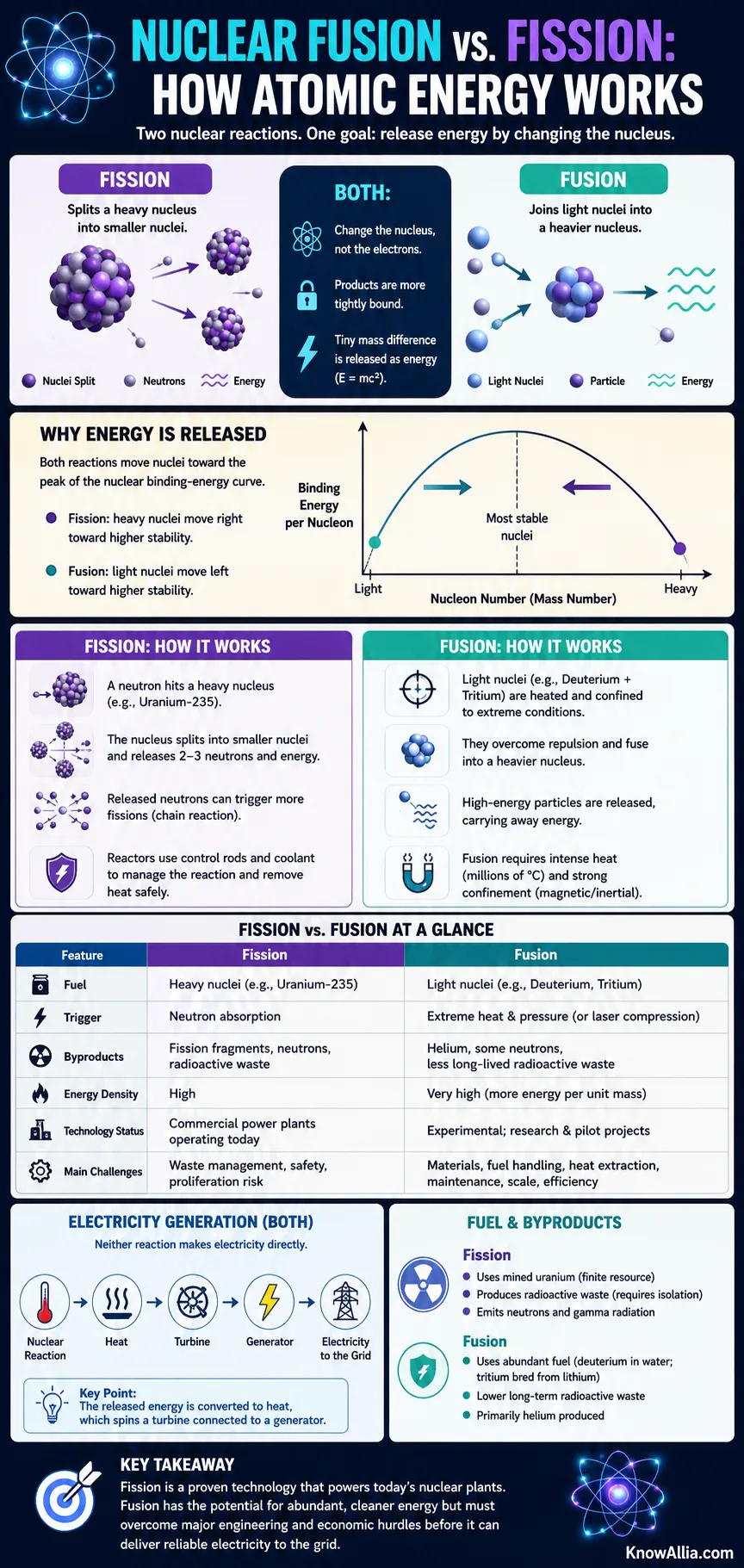
Nuclear fission releases energy by splitting certain heavy atomic nuclei, while nuclear fusion releases energy by joining light nuclei into a heavier nucleus. Both processes change the nucleus rather than the atom’s outer electrons, and both can release energy because the reaction products are more tightly bound than the starting nuclei.
The two reactions are often described as opposites, but that description leaves out the reason they work. Fission and fusion move nuclei from different sides of the nuclear binding-energy curve toward more stable arrangements. A small difference in mass appears as released energy through E = mc².
The Main Idea
Fission is already used in commercial power plants. Fusion powers stars and has produced controlled laboratory energy gains, but turning it into dependable grid electricity still requires advances in materials, fuel handling, heat extraction, maintenance, and plant-scale efficiency.
- Fission: a heavy nucleus splits and releases heat, radiation, and neutrons.
- Fusion: light nuclei combine under extreme conditions and release particles carrying energy.
- Electricity: neither reaction makes electricity directly; the released energy is usually converted into heat that drives a turbine and generator.
This article explains what changes inside the nucleus, why both reactions can release energy, how reactors control the process, how fuel and reaction products differ, and why a laboratory fusion gain is not the same as a power plant sending net electricity to the grid.
What Changes Inside an Atom?
An atom contains a small central nucleus surrounded by electrons. The nucleus contains positively charged protons and electrically neutral neutrons. Protons and neutrons are collectively called nucleons.
Chemical reactions rearrange electrons and chemical bonds. Nuclear reactions alter the nucleus itself. That distinction explains why nuclear reactions release far more energy per reacting particle than ordinary chemical reactions: nuclear binding energies are measured in millions of electron volts, while many electron-level changes are measured in electron volts.
Atoms, Nuclei, and Isotopes
- The number of protons identifies the element.
- Atoms of the same element can have different numbers of neutrons; these forms are isotopes.
- Uranium-235 and uranium-238 are isotopes of uranium, but their nuclear behavior differs.
- Deuterium and tritium are hydrogen isotopes used in many fusion experiments.
Why Both Reactions Release Energy
The nucleus is held together by the strong nuclear interaction, while positively charged protons repel one another through the electromagnetic interaction. Nuclear stability reflects the balance between these effects.
The mass of a bound nucleus is slightly lower than the combined mass of its separate protons and neutrons. This difference is called the mass defect. The corresponding energy is the nucleus’s binding energy, expressed by E = mc².[d]
A useful analogy is a valley with slopes on both sides. Very light nuclei sit on one slope, while very heavy nuclei sit on the other. Fusion can move light nuclei downhill toward more tightly bound medium-mass nuclei; fission can move heavy nuclei downhill from the opposite direction. The drop in the system’s stored nuclear energy appears as motion, heat, and radiation.
The act of splitting or joining is not automatically energy-producing. Energy is released only when the final nuclei have a more favorable binding-energy arrangement than the starting nuclei. Fusion of very heavy nuclei and fission of light nuclei generally require added energy rather than supplying it.
Nuclear Energy Follows the Binding-Energy Slope
Fission and fusion begin on opposite sides, yet both can move nuclei toward more tightly bound states.
Heavy Nuclei: Fission
- A suitable heavy nucleus absorbs a neutron.
- The nucleus deforms and splits.
- Fragments, neutrons, and radiation carry released energy.
More Tightly Bound Products
A small decrease in total mass corresponds to released energy through E = mc². The energy first appears mainly as particle motion and radiation, then becomes heat in surrounding material.
Light Nuclei: Fusion
- Light nuclei are heated and confined.
- Some collisions overcome electrical repulsion.
- A heavier nucleus and energetic particles are formed.
How Nuclear Fission Works
In a common reactor fission event, a uranium-235 nucleus absorbs a neutron. The resulting nucleus becomes unstable, deforms, and separates into two smaller nuclei called fission products. The event also releases energy, radiation, and usually additional neutrons.[a]
The Fission Sequence
- Neutron absorption: a fissile nucleus captures a neutron.
- Nuclear deformation: the enlarged nucleus enters an unstable state.
- Scission: the nucleus separates into two main fragments.
- Energy release: the fragments move apart rapidly, while neutrons and gamma radiation carry additional energy.
- Further reactions: some released neutrons may be absorbed by other fissile nuclei.
How a Chain Reaction Is Controlled
A fission chain reaction continues when neutrons from one generation of fissions cause later fissions. In steady reactor operation, the system is maintained near criticality: each generation causes roughly the same number of fissions as the previous one. If fewer reactions continue, the system is subcritical; if the reaction rate rises from generation to generation, it is supercritical.[j]
Moderator
A moderator slows fast neutrons, making them more likely to produce further fission in fuels used by many reactor designs. Ordinary water serves this role in light-water reactors.
Control Rods
Control rods absorb neutrons. Inserting them farther into the core reduces the reaction rate; withdrawing them allows more neutrons to remain available for fission.
The reactor also needs coolant, heat exchangers or steam systems, shielding, instrumentation, and multiple engineered barriers. The nuclear reaction supplies heat; the rest of the plant manages that heat and converts part of it into electricity.
How Nuclear Fusion Works
Fusion joins light nuclei. The reaction studied most often for near-term energy systems combines deuterium and tritium, two isotopes of hydrogen. The products are a helium-4 nucleus and a neutron. The helium nucleus carries part of the energy, while the neutron carries most of it in this reaction.
Both fuel nuclei are positively charged, so they repel one another. Fusion becomes likely only when the nuclei approach closely enough for the short-range nuclear attraction to take over. Laboratory systems therefore need very high temperature, enough particle density, and enough confinement time.[c]
Why Plasma Is Used
At fusion temperatures, matter becomes plasma: electrons are separated from nuclei, producing a mixture of charged particles. No ordinary solid container can sit in direct contact with plasma at these temperatures. Fusion devices instead use magnetic fields, rapid compression, or combinations of methods to create the needed conditions without relying on a conventional material wall to hold the hottest region.
Main Confinement Approaches
Magnetic Confinement
Devices such as tokamaks and stellarators use magnetic fields to guide charged plasma particles and keep the hot plasma away from most material surfaces. Heating systems raise the plasma temperature, while magnetic geometry and active control limit energy loss.
Inertial Confinement
Powerful laser or particle pulses compress a small fuel target so rapidly that fusion occurs before the target can expand. Each event is brief, so a future power system would need repeatable targets, rapid firing, efficient drivers, and durable reaction chambers.
Fusion is not maintained by the same neutron-driven chain reaction used in fission. If plasma temperature, density, or confinement falls below the required range, the fusion rate drops quickly. This physical behavior reduces the possibility of a self-sustaining runaway reaction, though a fusion facility still requires careful control of heat, radiation, tritium, magnets, vacuum systems, and activated materials.
Fission and Fusion Compared
| Feature | Nuclear Fission | Nuclear Fusion |
|---|---|---|
| Basic reaction | Splits a suitable heavy nucleus into smaller nuclei. | Combines light nuclei into a heavier nucleus. |
| Common energy fuel | Uranium-235 is widely used; other reactor fuels and fuel cycles also exist. | Deuterium and tritium are the leading pair for many current designs. |
| Starting condition | A neutron can initiate fission in a fissile nucleus. | Fuel must reach extreme temperature and suitable density and confinement. |
| Reaction continuity | A neutron-driven chain reaction can be sustained and controlled. | The reaction rate falls when plasma conditions are not maintained. |
| Primary energy carriers | Fast-moving fission fragments, neutrons, and radiation. | For D-T fusion, an energetic neutron and helium nucleus. |
| Electricity today | Used in operating commercial power plants. | Experimental; not yet used to provide dependable commercial electricity to public grids. |
| Radioactive materials | Produces radioactive fission products and spent fuel requiring managed storage and disposal. | Uses radioactive tritium in many designs and can activate machine components through neutron exposure. |
| Control challenge | Maintain a stable chain reaction and remove decay and operating heat safely. | Create and sustain plasma conditions while protecting materials and closing the fuel cycle. |
In an operating fission plant, the reactor houses and controls the chain reaction, while the wider plant removes heat and turns a turbine-generator system.[b]
How Atomic Energy Becomes Electricity
A nuclear reaction does not push electrons through the power grid by itself. In most plant designs, it serves as the heat source in a thermal power cycle.
- The nuclear reaction releases energy. In fission, much of it begins as kinetic energy of fission fragments. In D-T fusion, energetic neutrons carry most of the reaction energy away from the plasma.
- Surrounding material absorbs that energy. Collisions convert particle motion and radiation into heat.
- A coolant transports heat. Depending on the design, water, gas, liquid metal, or another fluid may carry thermal energy to a power-conversion system.
- Heat produces mechanical motion. Steam or another working fluid drives a turbine.
- A generator produces electricity. The rotating turbine turns a generator, creating electrical current through electromagnetic induction.
- Unused heat is rejected. A condenser and cooling system complete the cycle.
Commercial light-water fission reactors already use this sequence. A future D-T fusion plant would absorb neutrons in a surrounding blanket, remove the resulting heat with coolant, and use a turbine-generator system or another heat-to-electricity method.[e]
Thermal efficiency still matters. A reaction may release a large amount of energy, yet only part of the heat becomes electricity. Pumps, magnets, lasers, refrigeration, fuel processing, controls, and cooling systems also consume power.
Fuel and Reaction Products
Fission Fuel
Reactor fuel must contain nuclei capable of supporting the intended chain reaction. Uranium ore is processed, converted, and fabricated into fuel. In many light-water reactors, uranium dioxide ceramic pellets are stacked inside sealed metal fuel rods, which are grouped into fuel assemblies. Fuel composition, enrichment, cladding, geometry, coolant, and moderator behavior are selected as one engineered system.
Fusion Fuel
Deuterium occurs naturally in water. Tritium is radioactive, has a relatively short half-life, and is scarce in nature. Many proposed D-T plants would surround the reaction chamber with a lithium-containing breeding blanket. Fusion neutrons absorbed in lithium can produce tritium that is extracted and returned to the fuel system.[f]
This fuel cycle is more than a supply detail. A practical plant must breed, recover, purify, measure, store, and reinject tritium while limiting losses. The blanket must also absorb neutron energy, remove heat, shield other components, and survive repeated exposure.
Radiation, Waste, and Safety
Fission and fusion both involve ionizing radiation, but their radioactive materials differ in type, amount, and lifetime. A fair comparison avoids two extremes: treating them as identical or claiming that fusion produces no radioactive material at all.
Fission Materials
- Fission products: many are unstable and decay over times ranging from short to very long periods.
- Spent fuel: contains unused fuel, fission products, and heavier nuclei formed during reactor operation.
- Activated components: neutron exposure can make some reactor materials radioactive.
- Decay heat: radioactive decay continues producing heat after the chain reaction stops, so cooling remains necessary.
Fusion Materials
- Tritium: a radioactive hydrogen isotope that must be contained and tracked.
- Neutron activation: high-energy neutrons can turn stable atoms in machine components into radioactive isotopes.
- Maintenance waste: replaced plasma-facing or structural parts may require controlled handling, recycling, storage, or disposal.
- Material selection: low-activation alloys can reduce the duration and level of radioactive waste, but performance must be shown under plant-like neutron exposure.
The NRC notes that fusion neutron exposure can create activation products and that tritium can be absorbed by machine materials. Fusion is expected to avoid the same kind of spent fuel and long-lived fission products produced by fission reactors, yet it is not a radiation-free technology.[g]
Radiation itself is energy transmitted by particles or waves. Whether exposure is harmful depends on the radiation type, energy, dose, route, and duration. Shielding, distance, time limits, containment, monitoring, and regulated procedures are used to manage exposure.[h]
What Fusion Milestones Actually Mean
Fusion progress is reported with several different energy boundaries. Confusing them can make a laboratory result sound like a finished power station.
| Measurement | What Is Compared | What It Does Not Prove by Itself |
|---|---|---|
| Target gain | Fusion energy from the fuel target compared with energy delivered directly to that target. | It does not include all energy used by lasers, cooling, support equipment, or the rest of the facility. |
| Plasma gain | Fusion power compared with external heating power delivered to the plasma. | It does not by itself show net electricity after magnets, pumps, heating, and conversion losses. |
| Engineering break-even | Useful plant energy output compared with the total energy consumed by the whole system. | It does not alone establish reliability, maintainability, fuel self-sufficiency, or acceptable cost. |
| Net grid electricity | Electricity exported after the facility supplies all of its own operating loads. | A brief demonstration would still need to be followed by repeated, dependable operation. |
On April 7, 2025, the U.S. National Ignition Facility reported 8.6 megajoules of fusion yield from 2.08 megajoules delivered to the target, a target gain of 4.13. On June 20, 2026, it reported its eleventh ignition result, with 7.9 megajoules of yield and a target gain of about 3.8. These are controlled fusion achievements, not net-electricity demonstrations for the entire facility.[i]
A power plant must repeat the reaction, capture heat, withstand neutron damage, manage fuel, replace components, operate safely, limit downtime, and export more electricity than all plant systems consume. Magnetic-confinement and inertial-confinement programs approach these tasks differently, so one gain number cannot compare every design fairly.
Common Points of Confusion
“Fission Destroys Matter, While Fusion Creates Matter”
Neither description is accurate. Both reactions rearrange protons and neutrons into new nuclei. The measurable mass difference between the starting and final systems corresponds to released or absorbed energy.
“Splitting Any Atom Releases Energy”
No. Useful fission energy comes from selected heavy nuclei and suitable reaction paths. Breaking apart a tightly bound light nucleus requires energy.
“Fusion Is Simply Fission in Reverse”
The words describe opposite changes in nuclear size, but the engineering is not reversible. Fission reactors manage neutron multiplication in solid fuel. Fusion systems create and confine hot plasma or rapidly compress tiny targets.
“Fusion Produces No Radioactive Waste”
D-T fusion does not create fission products or conventional spent fuel, but tritium is radioactive and fusion neutrons can activate structural materials. Waste characteristics depend strongly on material choices and service life.
“Fusion Ignition Means Commercial Electricity Is Ready”
Ignition refers to a reaction-level condition. Commercial electricity also requires efficient drivers or heating, high repetition or long-duration operation, heat conversion, tritium supply, maintainable components, and positive whole-plant energy output.
Nuclear Energy Terms
- Binding Energy
- The energy required to separate a nucleus into its protons and neutrons.
- Chain Reaction
- A sequence in which neutrons released by fission cause additional fissions.
- Criticality
- The condition in which a fission chain reaction maintains a steady reaction level from one neutron generation to the next.
- Deuterium
- A stable hydrogen isotope with one proton and one neutron.
- Fissile
- Capable of undergoing fission after absorbing a neutron of a suitable energy and supporting a chain reaction under suitable conditions.
- Mass Defect
- The difference between the mass of a bound nucleus and the sum of the masses of its separate nucleons.
- Moderator
- A material used in many fission reactors to slow neutrons.
- Neutron Activation
- The creation of radioactive isotopes when stable nuclei absorb neutrons.
- Plasma
- An ionized state of matter containing free electrons and atomic nuclei or ions.
- Tritium
- A radioactive hydrogen isotope with one proton and two neutrons.
- Tokamak
- A magnetic-confinement device with a toroidal chamber designed to contain hot plasma.
Limits and Open Questions
The basic physics of fission and fusion is well established, but power-plant performance depends on full systems rather than isolated reactions. For fission, open engineering and operational work includes new fuel forms, advanced coolants, waste reduction, long-term component behavior, and economical construction. Results vary by reactor design, fuel cycle, regulation, site, and operating history.
For fusion, several plant-level questions remain unresolved at commercial scale. Materials must tolerate repeated high-energy neutron exposure. D-T systems must demonstrate tritium self-sufficiency. Heat-removal components must operate reliably near an extreme plasma environment. Maintenance may need remote systems because internal components can become activated. Whole-plant energy gain, component lifetime, availability, and cost cannot be inferred from a single plasma pulse or target shot.
Timelines for commercial fusion are forecasts, not measured outcomes. Laboratory records show that controlled fusion performance is advancing, while dependable net electricity remains a separate engineering goal.
Questions About Fission and Fusion
Frequently Asked Questions
Why can splitting and joining nuclei both release energy?
They start on different sides of the nuclear binding-energy curve. Selected light nuclei can release energy by joining into more tightly bound nuclei, while selected heavy nuclei can release energy by splitting into more tightly bound fragments. In both cases, a small mass difference appears as energy.
Does nuclear fission split the entire atom?
The main change occurs in the nucleus. The resulting fragments become new atoms after their electron arrangements settle, but the energy-producing event is nuclear rather than chemical.
Why does fusion need such a high temperature?
Light nuclei carry positive electric charge and repel each other. High temperature gives particles enough kinetic energy for some collisions to bring nuclei close enough for the short-range nuclear attraction to act.
Is plasma the same as extremely hot gas?
Plasma is an ionized state of matter in which many electrons are separated from atoms. It behaves differently from an ordinary neutral gas because its charged particles respond strongly to electric and magnetic fields.
Can a fusion reaction continue without outside control?
A laboratory fusion system needs a narrow range of temperature, density, and confinement. When those conditions are lost, the reaction rate falls rapidly. A burning plasma can receive much of its heating from fusion products, but the machine still needs active control and support systems.
Does fusion produce radiation?
Yes. D-T fusion produces energetic neutrons, and tritium is radioactive. Neutrons can also activate structural materials. Fusion waste is expected to differ from fission spent fuel, but radiation protection remains necessary.
Why is fission used for electricity while fusion is still experimental?
Fission chain reactions can be initiated and controlled in reactor fuel with established engineering systems. Fusion requires plasma or fuel targets to reach demanding conditions while materials, heat extraction, fuel supply, and whole-plant efficiency all work together.
Does fusion ignition mean the facility generated net electricity?
No. Ignition or target gain measures a defined part of the experiment. Net electricity requires the entire facility to produce more usable electrical energy than all of its lasers, magnets, pumps, cooling equipment, fuel systems, and other loads consume.
Sources
- ↩ U.S. Nuclear Regulatory Commission – Understanding the Difference Between Nuclear Fission and Fusion Technologies — Definitions, fuels, chain reactions, and reactor-level differences.
- ↩ U.S. Department of Energy – How Does a Nuclear Reactor Work? — Fuel rods, moderators, control rods, coolant, steam, and electricity production.
- ↩ ITER – Making Fusion Work — Plasma temperature, density, confinement time, D-T products, and neutron heat capture.
- ↩ OpenStax – Nuclear Binding Energy — Mass defect, binding energy, and the binding-energy-per-nucleon curve.
- ↩ ITER – In a Few Lines — How a future fusion plant would transfer reaction heat to turbines and generators.
- ↩ ITER – Tritium Breeding — Lithium blankets, neutron capture, and tritium recycling.
- ↩ U.S. Nuclear Regulatory Commission – Fusion FAQs — Tritium, activation products, fusion fuels, and material handling.
- ↩ U.S. Nuclear Regulatory Commission – Radiation Basics — Radioactive decay, fission products, ionizing radiation, and exposure concepts.
- ↩ Lawrence Livermore National Laboratory – Achieving Fusion Ignition — Verified National Ignition Facility yields and target-gain records through June 2026.
- ↩ U.S. Nuclear Regulatory Commission – What Is a Chain Reaction? — Neutron generations and controlled fission behavior.