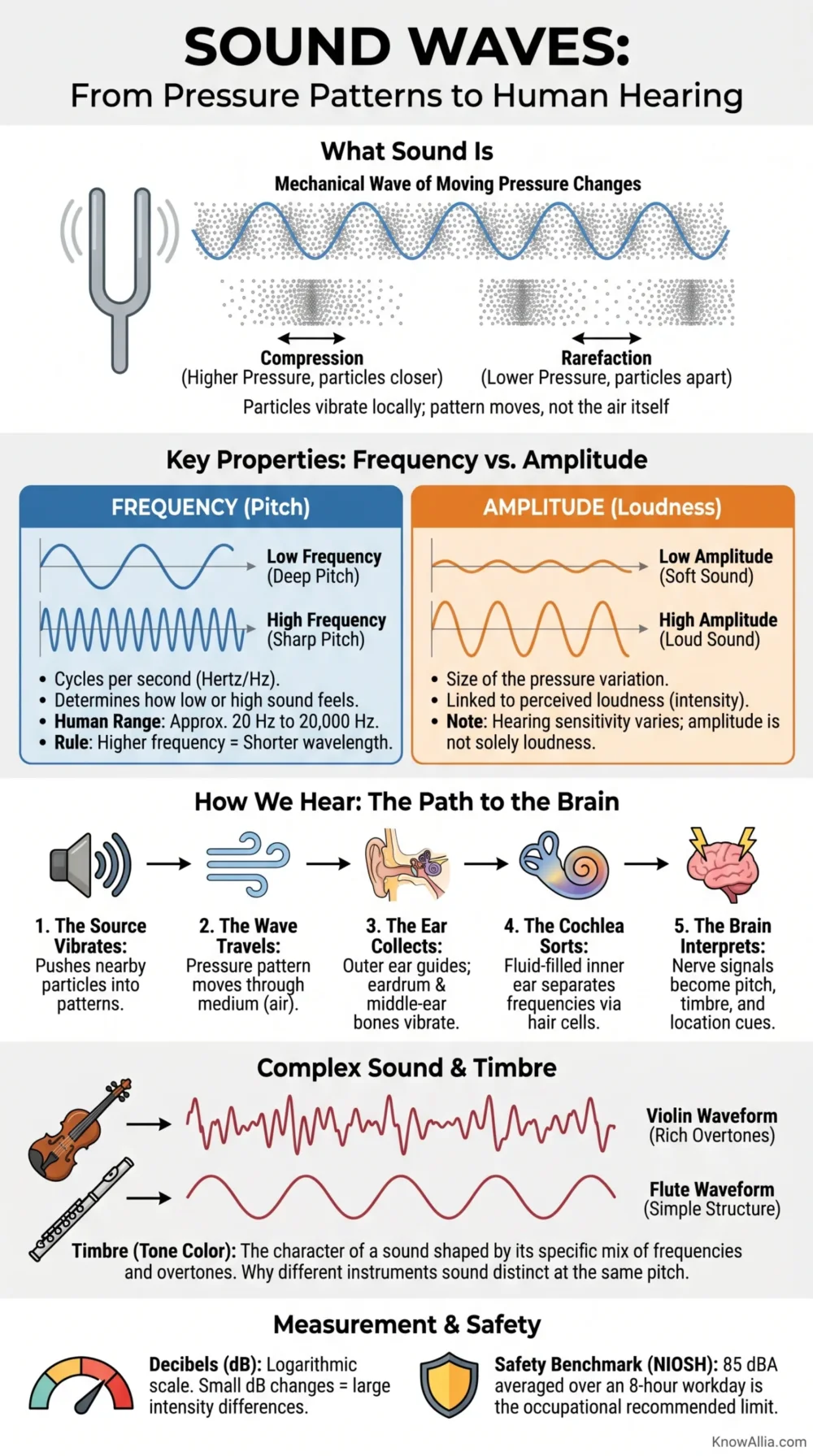
Sound waves are moving pressure changes that travel through a material such as air, water, or solid matter. In everyday hearing, they reach the ear as tiny patterns of compression and rarefaction, then the auditory system turns those patterns into pitch, loudness, tone color, and location. Frequency mainly shapes pitch, amplitude is closely tied to loudness, and the ear and brain do the difficult work of making those physical signals feel like meaningful sound.
The Main Idea, Stated Plainly
A sound is not a piece of air flying from a source to your ear. It is a wave of changing pressure moving through particles that mostly vibrate around their own positions. The ear reads this wave with fine mechanical parts and nerve signals, not like a simple volume meter.
- Frequency is the number of wave cycles per second, measured in hertz.
- Amplitude describes the size of the pressure variation, often linked with perceived loudness.
- Hearing happens when the outer ear, eardrum, middle-ear bones, cochlea, hair cells, auditory nerve, and brain work together.
This article explains what a sound wave is, how frequency, amplitude, wavelength, intensity, pitch, and loudness differ, how the ear detects them, and why common statements such as “higher amplitude means higher volume” are useful but incomplete.
What Sound Waves Are
A sound wave begins when something vibrates. A vocal fold, speaker cone, guitar string, drumhead, door panel, water surface, or machine part can push and pull on nearby particles. Those particles push and pull on neighboring particles, and the disturbance moves outward as a mechanical wave.[Source-a]
In air, sound usually travels as a longitudinal wave. That means the particle motion is mostly back and forth in the same direction the wave travels. The air does not march across the room like a crowd. It behaves more like people in a line passing a gentle squeeze along the line: each person shifts a little, but the squeeze moves much farther than any one person.
The Physical Pattern
- Compression: a region where particles are closer together and pressure is slightly higher.
- Rarefaction: a region where particles are farther apart and pressure is slightly lower.
- Wave travel: the pressure pattern moves through the medium, carrying energy rather than carrying the medium itself across the whole distance.
- Medium: the material that lets the wave travel. Air is common for hearing, but sound can also move through liquids and solids.
This is why empty space does not carry ordinary sound. A sound wave needs particles that can interact. Light can cross a vacuum; a normal acoustic wave cannot.
Frequency and Pitch
Frequency means how many complete wave cycles pass a point each second. It is measured in hertz, written as Hz. A 100 Hz tone completes 100 cycles per second. A 1,000 Hz tone completes 1,000 cycles per second.
For hearing, frequency is closely connected to pitch. Lower frequencies tend to sound deeper. Higher frequencies tend to sound higher. The usual human hearing range is often given as about 20 Hz to 20,000 Hz, but real hearing varies by age, exposure history, listening level, and the person being tested.[Source-b]
Low-Frequency Sound
- Feels deeper or heavier in pitch.
- Has longer wavelengths at the same wave speed.
- May be felt as vibration when strong enough.
- Can pass through some barriers more easily than higher frequencies.
High-Frequency Sound
- Feels brighter or sharper in pitch.
- Has shorter wavelengths at the same wave speed.
- Helps define consonants, detail, and edge in speech.
- May be reduced more strongly by distance, soft materials, or barriers.
A useful example is the musical reference tone A4, often set at 440 Hz. The exact number tells you the wave’s repetition rate, not its loudness. The same 440 Hz tone can be soft, moderate, or loud depending on amplitude and sound level.
Frequency, Wavelength, and Wave Speed
Wavelength is the distance between matching points in a repeating wave, such as one compression to the next compression. When sound speed stays the same, frequency and wavelength move in opposite directions: higher frequency means shorter wavelength, and lower frequency means longer wavelength.
Simple relation: wave speed equals frequency multiplied by wavelength. In symbols, this is often written as v = fλ. For sound in air, the speed changes with conditions such as temperature, so exact wavelength values depend on the setting.
Amplitude and Loudness
Amplitude describes how large the pressure change is in a sound wave. In a simple wave drawing, it is often shown as the height of the wave from the middle line to a peak. In real air, it means the size of the pressure variation around normal air pressure.
Larger amplitude usually means more sound energy and a louder sound, but loudness is not a perfect copy of amplitude. Human hearing is sensitive in some frequency ranges more than others, and the brain judges loudness using level, frequency, duration, and context. A low rumble and a high tone can have the same measured level yet feel different to the listener.
What Amplitude Can and Cannot Tell You
- It can describe the size of the wave’s pressure change.
- It can help explain why one version of the same tone is softer or louder.
- It does not fully predict human loudness by itself.
- It does not describe pitch. Pitch is mainly linked to frequency.
Why Decibels Are Different From Plain Amplitude
Sound level is often given in decibels, written as dB. The decibel scale is logarithmic, which means it compresses a very wide range of intensities into more manageable numbers. A small-looking change in dB can represent a much larger change in physical intensity.[Source-c]
Many sound meters also use A-weighting, written as dBA. A-weighting adjusts the measurement to better match how human hearing responds across frequencies. This is useful for hearing-risk discussions, but it also means a dBA value is not a raw physical pressure number.
| Property | What It Means Physically | Common Hearing Link | Common Unit |
|---|---|---|---|
| Frequency | Cycles of vibration per second | Pitch: lower or higher sound | Hz |
| Amplitude | Size of the pressure variation | Loudness tendency, though not loudness alone | Pressure units or wave height in models |
| Wavelength | Distance between matching points in the wave | Helps explain reflection, filtering, and room behavior | Meters |
| Intensity | Sound power spread over area | Used in sound-level calculations | W/m² |
| Sound Level | Logarithmic comparison to a reference level | Used for practical measurement and exposure discussion | dB or dBA |
| Timbre | Mixture of frequencies and how they change over time | Why the same note can sound different on different instruments | No single basic unit |
How One Sound Becomes Hearing
From Pressure Pattern to Perceived Sound
The ear does not receive “music” or “speech” directly. It receives pressure changes, then separates timing, level, spectral shape, and movement into a usable auditory signal.
Vibration Starts
A source moves back and forth, pushing nearby particles into a repeating pressure pattern.
Wave Travels
Compressions and rarefactions move through the medium while particles mostly oscillate in place.
Ear Sorts Detail
The eardrum and middle ear pass vibration into the cochlea, where different regions respond to different frequencies.
Brain Interprets
Nerve signals become pitch, loudness, timbre, speech cues, direction, and distance clues.
How We Hear Sound Waves
Hearing starts as physics and becomes biology. The ear collects a pressure wave, changes it into mechanical vibration, moves that vibration through fluid, then converts it into electrical signals for the brain.[Source-d]
The Path From Air to Brain
- Outer ear: the visible ear and ear canal help gather sound and guide it toward the eardrum.
- Eardrum: the pressure wave makes the tympanic membrane vibrate.
- Middle-ear bones: three small bones pass the vibration onward and help match air vibration to fluid movement.
- Cochlea: a fluid-filled inner-ear structure receives the vibration as waves moving through fluid.
- Hair cells: sensory cells bend in response to motion and help create nerve signals.
- Auditory nerve and brain: signals travel to the brain, where they are interpreted as sound.
The cochlea is not a flat receiver. It has a frequency map. Different regions respond best to different frequency ranges, which is one reason the ear can separate pitch detail inside a complex sound.[Source-e]
Pitch, Loudness, and Timbre Are Not the Same
Three words are often mixed together, but they describe different listening experiences:
- Pitch is the sense of low or high sound, mainly tied to frequency.
- Loudness is the sense of soft or loud sound, related to level but shaped by the ear’s sensitivity.
- Timbre is the character or color of a sound, shaped by overtones, attack, decay, noise content, and changes over time.
A flute, piano, and violin can play the same note at the same basic frequency. You still hear them as different instruments because their spectral mixture and time pattern are different. The ear is reading more than one number.
Pure Tones, Noise, and Real-Life Sounds
A pure tone is a simple repeating wave with one main frequency. It is useful for testing and explanation, but many everyday sounds are more complex. Speech, music, footsteps, birdsong, engines, flowing water, and room noise contain many frequencies at once.
A Simple Tone
- Mostly one steady frequency.
- Easier to describe with one pitch number.
- Useful in hearing tests and physics examples.
- Can feel unnatural when heard alone.
A Real Sound
- Usually contains a mix of frequencies.
- Changes in amplitude over time.
- May include harmonics, bursts, friction, and background noise.
- Gives the brain clues about source, space, and meaning.
Spoken language is a good example. Vowels often carry strong tone-like patterns. Consonants may contain short bursts, high-frequency detail, or noisy airflow. That mix is one reason speech can become harder to understand when background noise covers the fine details.
Sound Level, Distance, and Hearing Safety
Sound usually spreads out as it moves away from a source. In open space, that spreading reduces intensity with distance. Indoors, reflection, absorption, room shape, and surfaces can change the result. A soft room with curtains, carpets, and furniture handles sound differently from a hard room with bare walls and glass.
For hearing protection, both level and duration matter. NIOSH gives an occupational recommended exposure limit of 85 dBA averaged over an eight-hour workday. That value is for workplace risk management, not a personal guarantee that every lower exposure is always harmless or every higher exposure causes the same outcome for everyone.[Source-f]
Careful wording matters: a decibel reading is useful, but it depends on measurement method, distance, time averaging, frequency weighting, and the sound source. A phone app can be helpful for awareness, yet it is not the same as a calibrated professional sound-level meter.
Useful Terms for Sound Waves
- Acoustic Wave
- A mechanical wave that travels through a medium as pressure and particle-motion changes.
- Amplitude
- The size of the wave’s variation from its resting level. In sound, it is linked with pressure variation and often with perceived loudness.
- Compression
- A region of a longitudinal sound wave where particles are closer together and pressure is higher.
- Rarefaction
- A region where particles are farther apart and pressure is lower.
- Frequency
- The number of cycles per second, measured in hertz. It is strongly linked with pitch.
- Wavelength
- The distance between matching points in a repeating wave, such as compression to compression.
- Intensity
- Sound power passing through a given area. It is not the same word as loudness.
- Decibel
- A logarithmic unit used to express sound level or related ratios.
- Timbre
- The recognizable character of a sound, shaped by its frequency mix and time pattern.
- Cochlea
- The fluid-filled inner-ear structure that helps convert vibration into nerve signals.
Common Misconceptions About Sound and Hearing
“Sound Is Air Moving From the Speaker to My Ear”
Not quite. Sound in air is a traveling pressure disturbance. Air particles move back and forth locally; the pattern moves across the space. This difference helps explain why sound can pass through air without a gust of wind carrying every sound to you.
“Amplitude and Volume Are the Same Thing”
Amplitude is a physical property of the wave. Volume is a common everyday word for perceived loudness or playback setting. They are related, but not identical. Frequency, duration, the listener’s hearing, and the playback system all affect what someone experiences as loud.
“Higher Frequency Means Louder Sound”
Higher frequency means a faster repeating wave and usually a higher pitch. It does not automatically mean a louder sound. A high-pitched tone can be quiet, and a low-pitched sound can be loud.
“The Ear Measures Sound Like a Simple Microphone”
The ear does act as a detector, but it is not just a passive microphone. It has mechanical filtering, fluid movement, sensory cells, nerve coding, and brain interpretation. The final experience of sound is constructed from many cues.
Examples That Show the Difference
| Situation | What Changes | What You Notice |
|---|---|---|
| Turning a speaker knob up while playing the same note | Amplitude and sound level rise; frequency mostly stays the same | The sound becomes louder, not higher in pitch |
| Playing a higher piano key at the same loudness | Frequency rises; amplitude may stay similar | The note sounds higher, not automatically louder |
| A violin and flute playing the same note | Basic frequency may match; harmonic mix and attack differ | The pitch can match, but the instrument character is different |
| Speech heard in a noisy room | Background sound masks parts of the speech spectrum | Words may become harder to separate, even when voices are audible |
| A sound heard in a tiled hallway | Reflections add delayed copies of the sound | The sound may feel brighter, echo-like, or less clear |
What We Can and Cannot Say Exactly
Sound science gives clear definitions for frequency, amplitude, wavelength, intensity, and decibel level. Still, hearing is personal. Two listeners may not judge the same sound in the same way, especially if they differ in age, listening history, ear health, attention, or background noise.
- The 20 Hz to 20,000 Hz range is a common reference range, not a promise that every person hears all those frequencies equally.
- Amplitude is not the full story of loudness, because the ear’s sensitivity changes across frequency and level.
- Decibel values need context, including distance, weighting, averaging time, and measurement equipment.
- Real sounds are layered, so one frequency or one amplitude number rarely describes the whole listening experience.
A Clear Way to Read Any Sound
When you hear a sound, separate the question into four parts. First, ask how fast it repeats; that points to frequency and pitch. Second, ask how large the pressure change is; that points to amplitude and level. Third, ask what frequencies are mixed together; that points to timbre. Fourth, ask how the ear and brain receive it; that explains why the same physical sound can feel different in different rooms, distances, and listening conditions.
FAQ About Sound Waves
Common Questions
What Is a Sound Wave?
A sound wave is a moving pressure disturbance that travels through a medium such as air, water, or solid matter. In air, it usually moves as a longitudinal pattern of compressions and rarefactions.
What Is Frequency in Sound?
Frequency is the number of wave cycles per second. It is measured in hertz. In hearing, frequency is strongly connected with pitch: lower frequency usually sounds lower, and higher frequency usually sounds higher.
What Is Amplitude in Sound?
Amplitude is the size of the sound wave’s pressure variation. Larger amplitude is usually linked with louder sound, but human loudness also depends on frequency, duration, context, and hearing sensitivity.
Do Sound Waves Carry Air Across the Room?
No. In ordinary sound through air, particles mostly vibrate back and forth around their positions. The pressure pattern travels across the room, not the same packet of air.
Why Do Different Instruments Sound Different on the Same Note?
They can share the same basic frequency but differ in overtones, attack, decay, noise content, and amplitude changes. Those details shape timbre, which is the recognizable character of a sound.
Can a Sound Be High-Pitched but Quiet?
Yes. Pitch and loudness are different. A sound can have high frequency and low amplitude, making it high-pitched but quiet.
Sources
- [Source-a] OpenStax – University Physics Volume 1, 17.1 Sound Waves — used for the physical description of sound waves as pressure variations produced by vibrating sources.
- [Source-b] NIDCD – How Is Sound Measured? — used for hearing range, frequency, and human response to sound measurement.
- [Source-c] OpenStax – Physics, 14.2 Sound Intensity and Sound Level — used for sound intensity, sound level, decibels, and the relation between physical sound and hearing.
- [Source-d] NIDCD – How Do We Hear? — used for the path of sound through the ear, including the eardrum, middle ear, cochlea, hair cells, and auditory nerve.
- [Source-e] Encyclopaedia Britannica – Sound, The Ear as Spectrum Analyzer — used as a reference source for how the ear separates frequency information.
- [Source-f] CDC/NIOSH – Understand Noise Exposure — used for the 85 dBA occupational recommended exposure limit and noise-exposure context.