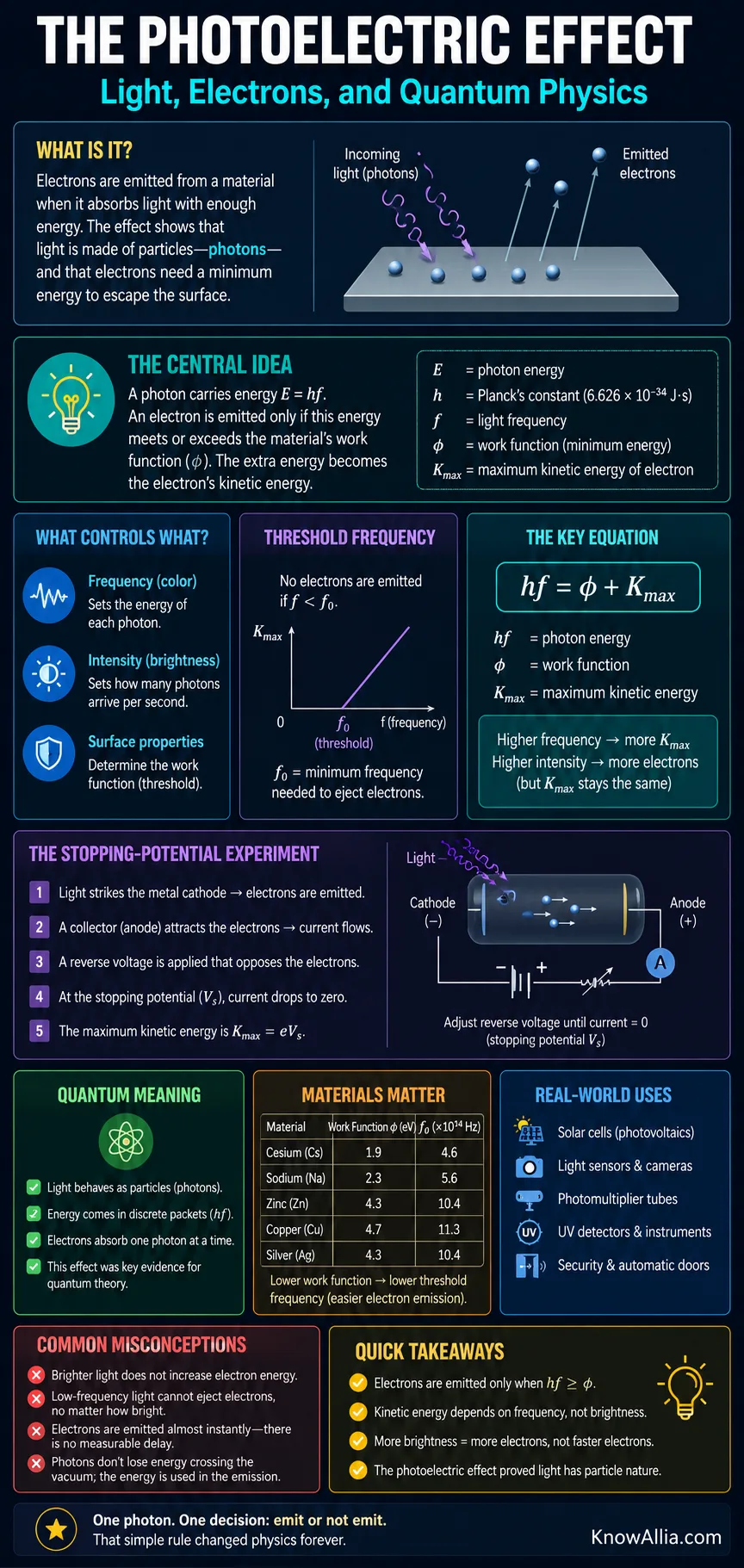
The photoelectric effect is the release of electrons from a material after it absorbs electromagnetic radiation with enough energy. In the standard experiment, light shines on a metal surface and emitted electrons are collected as an electric current. The effect shows that light transfers energy in discrete units called photons, while the material sets a minimum energy cost for electron emission.
The Central Idea
A photon carries energy equal to E = hf. An electron can leave the surface only when that photon energy reaches or exceeds the material’s work function. Any energy left after escape becomes the electron’s kinetic energy.
- Frequency controls the energy carried by each photon.
- Intensity usually controls how many photons arrive per second.
- Surface properties determine the threshold for emission.
This article explains what is measured, why brightness and color have different effects, how the stopping-potential experiment works, and where the familiar textbook equation needs extra care.
What the Photoelectric Effect Means
When suitable light reaches a surface, an electron may absorb energy from the radiation and escape. The emitted electron is called a photoelectron. In the familiar external photoelectric effect, it leaves the material and moves into the surrounding vacuum or gas. OpenStax summarizes the defining observations as rapid emission, a cut-off frequency, and electron energy that does not rise merely because the light becomes brighter.A
The word light here includes electromagnetic radiation outside human vision. Depending on the surface, visible light may be energetic enough, or ultraviolet radiation may be needed. X-rays can also eject electrons, which is the basis of photoelectron spectroscopy.J
Energy Transfer in One Interaction
- A photon reaches the material with energy hf.
- An electron absorbs the photon’s energy.
- The material requires an escape energy called the work function.
- If enough energy remains, the electron exits with kinetic energy.
The simplest account treats the event as one photon transferring its energy to one electron. This model describes ordinary photoelectric experiments very well, provided the light is not in an extreme high-intensity regime.
What the Experiments Show
The photoelectric effect became central to quantum physics because several measurements did not fit the expected behavior of a purely classical wave transferring energy continuously across a surface.
A Threshold Exists
Each prepared surface has a minimum light frequency. Below that threshold, ordinary one-photon emission does not occur, even if the beam is made brighter.
Emission Is Prompt
Once the photon energy is high enough, electrons appear without the long charging delay expected if each electron had to collect tiny portions of wave energy over time.
Frequency Sets Maximum Energy
Higher-frequency light produces photoelectrons with a higher maximum kinetic energy, as long as the frequency is above the threshold.
Intensity Sets the Emission Rate
For one fixed frequency above threshold, brighter light supplies more photons per second and usually raises the photocurrent. It does not raise the maximum energy carried by each emitted electron.
| Change | Photon Energy | Maximum Electron Energy | Photocurrent |
|---|---|---|---|
| Increase frequency | Increases | Increases above threshold | May change because emission probability can vary |
| Increase intensity at fixed frequency | Unchanged per photon | Ideally unchanged | Usually increases above threshold |
| Use a surface with a larger work function | Unchanged | Lower for the same frequency | Emission may stop if the threshold is no longer met |
| Use light below threshold | Too low for one-photon escape | No emitted photoelectrons in the basic regime | No photoelectric current |
The Photoelectric Equation
Einstein described the energy balance with a compact relation:
Kmax = hf − φ
Kmax is the maximum kinetic energy of the emitted electrons, h is the Planck constant, f is light frequency, and φ is the work function of the surface.
Photon Energy
Each photon carries energy E = hf. Because frequency and wavelength are related by c = fλ, photon energy can also be written as E = hc/λ. Shorter wavelength means higher frequency and therefore higher photon energy.
The SI value of the Planck constant is exactly 6.62607015 × 10⁻³⁴ J·s under the modern definition of SI units.B For calculations in electronvolts, h ≈ 4.135667696 × 10⁻¹⁵ eV·s is often convenient.
Threshold Frequency and Threshold Wavelength
At the threshold, the electron has just enough energy to leave, so its maximum kinetic energy is zero. The relations are:
- Threshold frequency: f0 = φ/h
- Threshold wavelength: λ0 = hc/φ
- Emission condition: f ≥ f0, or equivalently λ ≤ λ0
The threshold is a boundary for a specific surface condition. It should not be treated as a perfect permanent number for every sample of the same element, because surface orientation, adsorbed material, oxidation, and preparation can alter the measured work function.
Worked Energy Example
Suppose 400 nm light reaches a surface with a work function of 2.30 eV.
- Photon energy: E = hc/λ ≈ 3.10 eV.
- Subtract the work function: Kmax ≈ 3.10 − 2.30 = 0.80 eV.
- The stopping potential has a magnitude of about 0.80 V, because an electron gains or loses 1 eV when it moves through a potential difference of 1 V.
If the same beam becomes brighter without changing wavelength, the basic model predicts more emitted electrons, not a larger 0.80 eV maximum.
How the Experiment Measures Electron Energy
The Evacuated Phototube
A standard apparatus contains a light-sensitive emitter and a collector inside an evacuated tube. The vacuum reduces collisions between emitted electrons and gas molecules. Monochromatic light reaches the emitter, and an adjustable voltage controls whether the electrons are helped toward the collector or pushed back.
- Illumination: Light of a known frequency strikes the emitter.
- Collection: A favorable voltage draws emitted electrons to the collector.
- Current reading: The circuit measures the resulting photocurrent.
- Retarding voltage: The polarity is adjusted to oppose electron motion.
- Stopping point: The voltage is raised until even the fastest photoelectrons fail to reach the collector.
The magnitude of this retarding voltage is the stopping potential, Vs. In the introductory model, eVs = Kmax, where e is the magnitude of the electron charge. University laboratory versions use this relation to compare stopping potential with light frequency.C
What the Graphs Reveal
| Graph | What Is Changed | What It Shows |
|---|---|---|
| Photocurrent versus applied voltage | Collector voltage | A positive collecting voltage leads toward saturation current; a reverse voltage lowers current to zero at the stopping potential. |
| Stopping potential versus frequency | Light frequency | An ideal straight line has slope h/e. The threshold is found where the stopping potential reaches zero. |
| Photocurrent versus intensity | Light intensity at fixed frequency | Above threshold, more intense light normally produces a larger current because more emission events occur. |
| Stopping potential versus intensity | Light intensity at fixed frequency | In the ordinary one-photon regime, stopping potential remains nearly unchanged. |
The straight-line frequency test also provided an early precision route to the ratio h/e. NIST’s history of fundamental-constant measurements notes that Millikan used photoelectric stopping measurements with sodium and lithium in work reported in 1916.D
Why the Effect Changed Physics
A classical electromagnetic wave carries energy according to its intensity. A simple classical picture therefore suggested that brighter light should eventually give an electron more energy, even when the frequency was low. The measured threshold and the frequency-dependent maximum energy did not follow that expectation.
Einstein’s 1905 proposal treated light energy as localized quanta with energy hf. Raising intensity at one frequency means sending more photons, while raising frequency increases the energy of each photon. That distinction matches the observed separation between photocurrent and maximum electron energy.
An analogy: think of the work function as a fixed admission price and each photon as one payment token. Sending more low-value tokens increases the number arriving, but in the ordinary one-photon process each token must individually meet the price. A higher-value token can pay the entry cost and leave the remainder as electron motion.
The analogy is limited. A photon is not a tiny classical ball with a fully defined path in every situation. Modern quantum theory describes light with quantum states that can produce both wave-like interference and particle-like detection events. The photoelectric effect is evidence for quantized energy exchange; it does not erase the wave behavior of light.
- 1887: Heinrich Hertz reported that ultraviolet light affected spark production in his apparatus.
- Late nineteenth and early twentieth centuries: further experiments established electron emission and its dependence on light and material.
- 1905: Einstein used light quanta to explain the measured energy relation.I
- 1916: Robert Millikan reported precise measurements supporting Einstein’s equation.
- 1921 prize year: Einstein’s Nobel citation especially recognized the law of the photoelectric effect; the award was presented in 1922.E
How Photon Energy Becomes Electron Motion
The energy account for an ideal single-photon emission event.
Frequency fixes the energy carried by one photon.
The electron must receive enough energy to escape the surface.
Below the threshold, ordinary one-photon emission does not occur.
Excess photon energy appears as maximum electron kinetic energy.
Higher Frequency
Raises photon energy and, above threshold, raises maximum photoelectron energy.
Higher Intensity
Usually raises the number of emitted electrons at the same above-threshold frequency.
Different Surface
Changes the work function, threshold frequency, and emission efficiency.
Materials, Surfaces, and Related Effects
External and Internal Photoelectric Effects
The phrase photoelectric effect is used in both narrow and broad ways. The classic Einstein experiment concerns external photoemission, where an electron leaves the material. Many modern light sensors use related internal processes in which charge carriers remain inside a semiconductor and change its conductivity or produce a voltage.K
| Process | Where the Electron Goes | Typical Physical Result | Example Device or Method |
|---|---|---|---|
| External photoelectric effect | Leaves the surface into vacuum or gas | Photoelectron emission and collectable current | Phototube or photocathode |
| Photoconductive effect | Remains within the material as a mobile carrier | Electrical conductivity changes under illumination | Photoconductive light sensor |
| Photovoltaic effect | Remains in the semiconductor and is separated by an internal electric field | A voltage and current can be produced | Solar cell |
| Photoelectron spectroscopy | Leaves the sample and enters an energy analyzer | Measured kinetic energy reveals electronic and surface information | XPS or ultraviolet photoelectron spectroscopy |
This distinction prevents a common overstatement: a camera sensor or solar cell is not usually operating as a bare metal plate that throws electrons into open space. It uses quantum absorption in a solid, followed by controlled charge transport inside the device.
Why the Surface Matters
The work function is connected to the energy needed to move an electron from the material to the vacuum just outside it. Because that boundary is a surface property, measurements can respond to more than the chemical name of the sample.
- Crystal orientation: different exposed faces of a crystal may have different work functions.
- Adsorbed atoms or molecules: even a thin surface layer can alter electron escape conditions.
- Oxidation and contamination: the measured threshold and emission yield may shift.
- Surface roughness: local electric fields and escape paths can change.
- Temperature and preparation: these can affect electron distributions and measurement stability.
Millikan’s precision work used an apparatus that cleaned the metal surface inside the vacuum chamber. APS notes that this fresh-surface method helped him test Einstein’s equation with high accuracy.F
Where the Effect Is Used
The photoelectric effect is more than a historical experiment. It provides the conversion step in devices that turn faint light into measurable electrons and in methods that study the electronic structure of matter.
| Use | Role of Light and Electrons | Important Distinction |
|---|---|---|
| Photomultiplier tube | A photocathode emits an electron; later electrodes multiply the signal through secondary emission. | Uses the external photoelectric effect at the photocathode. |
| Photoelectron spectroscopy | Known photon energy ejects electrons; their measured kinetic energies reveal binding-energy information. | The surface condition and analyzer calibration matter. |
| Photocathode electron source | A laser releases electrons from a prepared cathode for use in an electron beam. | Timing, wavelength, and emission yield are selected for the instrument. |
| Photodiode and camera sensor | Absorbed photons create mobile charge carriers inside a semiconductor. | Usually an internal photoelectric process rather than vacuum emission. |
| Photovoltaic cell | Light creates carriers that are separated to produce electric current. | Uses semiconductor junction physics, not the simple metal-vacuum setup. |
Photomultipliers are especially useful when very low light levels must be detected. OpenStax describes how a photoelectron from the photocathode starts a multiplication chain across a sequence of electrodes.G
Common Points of Confusion
At a fixed above-threshold frequency in the ordinary one-photon regime, brightness mainly changes the number of arriving photons. The maximum electron energy remains tied to frequency.
Not in the standard one-photon experiment. A photon below the threshold energy cannot eject an electron merely because more photons of the same energy arrive. Very intense lasers can produce multiphoton processes, but that is a different regime.
The equation gives the maximum kinetic energy in the simple surface model. Real electrons begin in different states and may lose energy before escaping, so an experiment usually detects an energy distribution.
Light also displays interference, diffraction, and polarization. Quantum theory does not require a choice between a classical wave and a classical particle in every experiment.
The phenomenon was observed before 1905. Einstein supplied the light-quantum explanation and the energy law that connected frequency, work function, and electron kinetic energy.
Both depend on quantized light absorption, but a solar cell creates and separates charge carriers inside a semiconductor. Electrons do not need to escape into vacuum.
Key Terms in Plain Language
- Photon
- A quantum of electromagnetic radiation with energy hf.
- Photoelectron
- An electron emitted or detected after light absorption causes a photoelectric event.
- Work Function, φ
- The minimum energy needed to remove an electron from a specified surface into the vacuum just outside it.
- Threshold Frequency, f0
- The lowest frequency that can produce ordinary one-photon emission from that surface.
- Threshold Wavelength, λ0
- The longest wavelength that can still meet the one-photon emission threshold.
- Photocurrent
- An electric current produced when emitted or light-generated charge carriers are collected.
- Stopping Potential, Vs
- The reverse potential needed to prevent the most energetic emitted electrons from reaching the collector.
- Saturation Current
- The current reached when the collecting field is strong enough that nearly all available emitted electrons are gathered.
- Quantum Efficiency
- The fraction of incident photons that produce collected electrons or useful charge carriers under stated conditions.
What the Basic Equation Leaves Out
The equation Kmax = hf − φ is well tested, but it is an idealized energy balance. It does not, by itself, predict every feature of a real photocathode, semiconductor, or spectroscopy experiment.
- It predicts a maximum, not a single electron energy. Electrons may begin at different energies or scatter before leaving.
- It does not set the emission yield. The number of emitted electrons depends on absorption, electronic states, escape depth, surface preparation, and collection geometry.
- The work function is surface-sensitive. A value quoted for a clean surface may not match an oxidized or contaminated sample.
- Real apparatus has contact potentials. When emitter and collector materials differ, the voltage intercept can include electrode work-function effects.L
- High-intensity laser fields can change the process. Electrons may absorb more than one photon, or emission may enter a strong-field regime that is not described by the basic single-photon picture.H
What cannot be known from the equation alone: the exact photocurrent, energy spread, and stability of a particular real surface. Those quantities require material data and measurement conditions. The threshold law and energy conservation remain the starting point.
Questions About the Photoelectric Effect
Frequently Asked Questions
What causes the photoelectric effect?
An electron absorbs energy from electromagnetic radiation. If the absorbed energy is high enough to overcome the relevant escape energy, the electron can leave the surface.
Why does frequency matter more than brightness for electron energy?
Frequency determines the energy of each photon through E = hf. Brightness at a fixed frequency usually changes the number of photons, not the energy carried by each one.
Can visible light cause the photoelectric effect?
Yes, for surfaces with a low enough work function. Other surfaces require shorter-wavelength ultraviolet light. The material and surface condition determine the threshold.
What happens exactly at the threshold frequency?
In the ideal model, the photon supplies just enough energy for escape, so the maximum kinetic energy approaches zero.
Does increasing intensity ever affect stopping potential?
In an ideal low-intensity, one-photon experiment at fixed frequency, it should not change the stopping potential. Real instruments may show small shifts from space charge, heating, spectral changes, or other nonideal effects.
How is Planck’s constant measured with the effect?
Stopping potential is measured for several light frequencies. A plot of Vs against f is ideally linear, and its slope equals h/e.
Is the photovoltaic effect the same process?
It is closely related but not identical to external photoemission. In a photovoltaic device, photons create charge carriers inside a semiconductor, and an internal field separates them to produce voltage and current.
Did the photoelectric effect prove all of quantum mechanics?
No. It supplied strong evidence for quantized light–matter energy exchange and helped establish photon physics. Quantum mechanics was developed through many other experiments and theories.
Sources
- OpenStax – 6.2 Photoelectric Effect — Experimental characteristics, threshold frequency, intensity, and photon explanation. ↩
- NIST – Meet the Constants — Official numerical value and exact SI status of h. ↩
- UCLA Physics & Astronomy – Experiment 6: The Photoelectric Effect — Laboratory method, threshold condition, and stopping-potential relation. ↩
- NIST – Introduction to the Constants for Nonexperts, 1900–1920 — Historical account of photoelectric measurements of h/e. ↩
- Nobel Prize – Albert Einstein Facts — Official prize year, presentation timing, and citation wording. ↩
- APS Physics – Millikan’s Measurement of Planck’s Constant — Surface-cleaning method, stopping measurements, and the 1916 test of Einstein’s equation. ↩
- OpenStax – Radiation Detection and Detectors — Photomultiplier operation and electron multiplication after photocathode emission. ↩
- Physical Review B – Above-Threshold Multiphoton Photoemission from Noble Metal Surfaces — Peer-reviewed example of nonlinear photoemission under intense laser excitation. ↩
- American Physical Society – Einstein and the Photoelectric Effect — Hertz’s observation, Einstein’s 1905 explanation, and the frequency–intensity distinction. ↩
- NIST Journal of Research – Electronic Densities of States from X-Ray Photoelectron Spectroscopy — Use of emitted photoelectrons to study electronic states and surfaces. ↩
- OpenStax – Einstein and the Photoelectric Effect — Related photoconductive and photovoltaic processes in light-sensitive devices. ↩
- University of Massachusetts Amherst – Photoelectric Effect Experiment — Stopping-potential measurements and the effect of contact potential between unlike electrodes. ↩