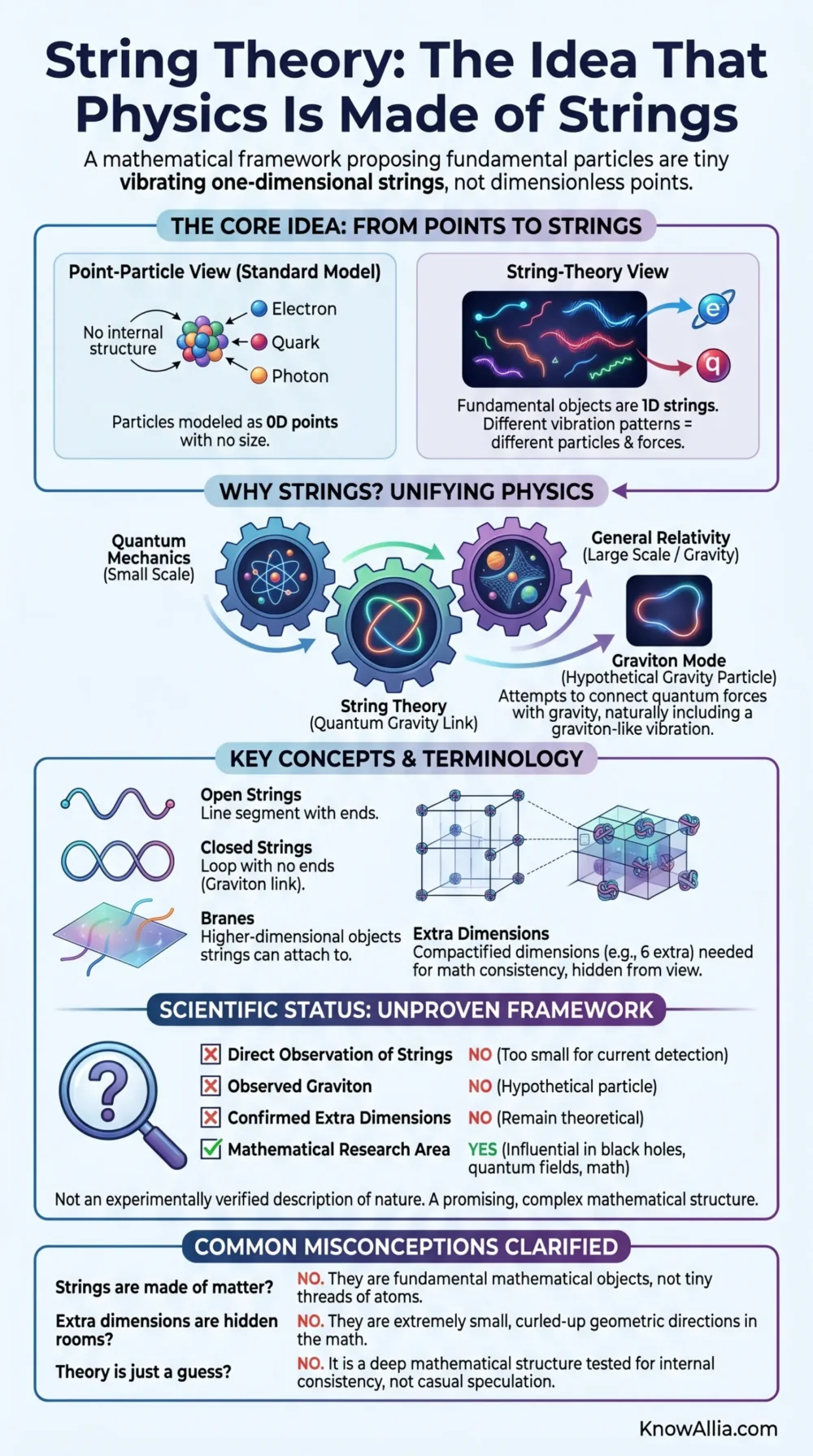
String theory is a mathematical idea in physics that treats the smallest particles not as dimensionless points, but as extremely tiny one-dimensional strings. In this view, an electron, a quark, or a possible graviton would not be a hard little bead. It would be a different vibration pattern of the same basic kind of object. The idea is bold, but it is not a proven description of nature.
The Idea in Plain Words
String theory tries to connect quantum mechanics, which describes very small things, with general relativity, which describes gravity, space, and time. Its central move is simple to say: replace point particles with tiny strings that can vibrate, join, split, and move through space.
- Particles become patterns: different string vibrations could appear as different particles.
- Gravity enters naturally in many models: one closed-string vibration behaves like a hypothetical graviton.
- The theory remains unconfirmed: no experiment has directly observed fundamental strings.
This page explains what string theory says, what it does not say, why physicists connect it with gravity, and why it is still treated with care. The goal is to separate the clear idea from the popular image. A string in this theory is not a thread made of ordinary matter. It is a proposed basic object in a mathematical description of reality.
What String Theory Means
In the usual particle-physics picture, elementary particles are treated as point-like. They have no internal size in the model. String theory changes that starting point. It says the most basic objects may have one tiny length direction, like a line too small to see.
That small change has large consequences. A point particle traces a line through spacetime as it moves. A string sweeps out a tiny surface. Because it is extended, a string can vibrate in different ways. Those vibration modes are where the particle-like behavior comes from.
Careful wording matters: string theory does not say that visible matter is made of little threads. It says that, at an extremely small scale, the mathematical object behind what we call a particle may be string-like rather than point-like.
The Stanford Encyclopedia of Philosophy describes the original idea as replacing ordinary point particles with one-dimensional extended objects called strings.[Source-b] Britannica gives the same broad definition and notes that string theory attempts to connect quantum mechanics with general relativity.[Source-c]
The Basic Picture
- Point-particle view: an electron is treated as having no spatial extent in the model.
- String-theory view: the electron-like behavior could come from a tiny vibrating string state.
- Particle properties: mass, charge, and spin are connected to the string’s allowed vibration pattern.
- Scale: the strings, if real in this sense, would be far smaller than anything directly visible in current detectors.
Why Physicists Consider Strings
The main reason is gravity. The Standard Model describes known particles and three forces very well: electromagnetism, the strong force, and the weak force. Gravity is not part of the Standard Model, and fitting it into quantum theory has proved difficult.[Source-a]
String theory attracted attention because many versions naturally include a vibration mode that behaves like a graviton, the hypothetical quantum particle associated with gravity. This does not mean gravitons have been observed. It means the mathematics of the theory has a place for quantum gravity in a way ordinary point-particle methods struggle to provide.
A Simple Analogy
A guitar string can produce different notes depending on how it vibrates. String theory uses a similar image, but the result is not sound. A different vibration would show up as a different particle property. The analogy helps only up to a point: physical strings in string theory are not musical strings, and they are not made of metal, fiber, or any ordinary material.
CERN traces the origin of string theory to Gabriele Veneziano’s 1968 work on particle interactions, which later gained a string-based interpretation.[Source-d] The theory’s early path was unusual: it began in studies of the strong interaction, then became more closely linked with quantum gravity.
How Strings Could Appear as Particles
A string can have many possible vibration states. In the theory, each allowed state could look like a different particle to an observer using ordinary particle physics. That is why string theory is sometimes described as the idea that particles are music-like patterns in a deeper mathematical object.
There are two basic string shapes in many introductions:
- Open strings: string-like objects with two ends.
- Closed strings: loop-like objects with no ends.
Closed strings matter because a specific closed-string vibration has the right kind of behavior for a graviton in many string models. This is one reason string theory is closely tied to quantum gravity.
| Topic | Ordinary Particle Picture | String-Theory Picture | Research Status |
|---|---|---|---|
| Smallest Object | A particle is modeled as point-like. | A particle-like state comes from a tiny one-dimensional string. | The string itself has not been directly detected. |
| Particle Identity | Particles are described by fields and measured properties. | Different vibration modes may appear as different particles. | Matching the exact observed particle spectrum is still difficult. |
| Gravity | Gravity is outside the Standard Model. | A closed-string mode can behave like a graviton. | The graviton remains hypothetical. |
| Dimensions | Observed physics uses three space dimensions plus time. | Many string models use extra compact dimensions. | No extra spatial dimension has been directly confirmed. |
| Evidence | The Standard Model has strong experimental support in its domain. | String theory is studied mainly through mathematics and indirect links. | It is not yet an experimentally verified theory of nature. |
Why Extra Dimensions Appear
Extra dimensions are one of the most famous and most misunderstood parts of string theory. They are not imagined as large secret rooms beside ordinary space. In many versions, they are compact: curled up so tightly that ordinary movement and ordinary instruments do not reveal them.
Common superstring models use ten spacetime dimensions: nine space dimensions plus time. The older bosonic string theory uses twenty-six spacetime dimensions but does not describe fermions, the matter-type particles that include electrons and quarks. M-theory is often discussed in eleven spacetime dimensions. These numbers come from mathematical consistency conditions, not from direct observation.
CMS, one of the major experiments at CERN, explains the basic extra-dimension idea as six additional dimensions that may be hidden from ordinary senses if they are curled up very small.[Source-e]
Important distinction: “extra dimensions” in string theory are mathematical directions needed by many models. They are not confirmed places that a person, object, or spacecraft could enter.
String Theory in One Visual Map
From Point Particles to Vibrating Strings
The theory changes the assumed shape of the smallest objects, then follows what that change does to particles, forces, gravity, and dimensions.
The “string” is a proposed basic object in a mathematical theory, not a tiny fiber made of matter.
The theory has not been confirmed by directly seeing strings, extra dimensions, or gravitons.
It offers a way to discuss quantum particles and gravity in the same mathematical language.
Modern work links it with black holes, quantum fields, cosmology, particle physics, and advanced mathematics.
Open Strings, Closed Strings, and Branes
A string can be pictured in two broad ways: a line segment or a loop. A line segment is called an open string. A loop is called a closed string. These names describe mathematical boundary conditions, not ordinary shapes floating in space like visible objects.
String theory also uses the idea of branes. A brane is a higher-dimensional object on which strings may be attached or through which they may move, depending on the model. The term comes from “membrane,” but it is broader: a brane can have different numbers of dimensions.
Perimeter Institute describes modern string theory as a broad field connected with quantum gravity, particle physics, cosmology, and mathematics.[Source-f] That breadth is one reason the topic can feel confusing: string theory is not one small formula. It is a family of related models, tools, and ideas.
What Is Confirmed and What Is Not
The confirmed part is not the string itself. The confirmed part is the need for a better understanding of gravity at quantum scales. The Standard Model works very well within its tested range, but it leaves gravity outside. General relativity works very well for planets, stars, galaxies, and spacetime curvature, but it is not a full quantum description of gravity.
String theory is one attempt to close that gap. It is studied because it has mathematical strengths and because it can include a graviton-like state. Still, a responsible explanation must say this plainly: string theory has not been experimentally verified as the true structure of nature.
Well Supported
- The Standard Model describes known particles and three forces within its domain.
- General relativity describes gravity very accurately on large scales.
- Quantum theory gives highly accurate predictions for microscopic systems.
Still Open
- Whether fundamental strings physically exist.
- Whether extra dimensions exist in the way string models need.
- Whether a specific string model matches our universe.
- Whether a direct or indirect test can settle the issue.
Common Points of Confusion
“Strings Are Tiny Pieces of Ordinary Matter”
No. Ordinary matter is made of atoms, and atoms contain electrons and nuclei. String theory asks whether the objects we call elementary particles may come from something more basic. The string is not made of atoms. It is treated as fundamental inside the theory.
“String Theory Has Been Proved”
No. It is a serious mathematical research area, not a confirmed physical fact. Some of its ideas are elegant and useful in theory work, but the central claim that fundamental particles are string-like has not been directly tested.
“Extra Dimensions Mean Hidden Worlds Next to Us”
That is not the careful scientific meaning. Extra dimensions in string theory are usually small geometric directions in the mathematics. Popular descriptions often make them sound like hidden rooms, but the models are much more abstract.
“Theory Means Guess”
In science, a theory can be a deep, mathematical structure. String theory is not a casual guess. The issue is not seriousness. The issue is experimental contact: nature must decide whether the mathematics describes the real world.
Useful Terms for Reading String Theory
- String
- A proposed one-dimensional basic object. It can be open like a segment or closed like a loop.
- Vibration Mode
- An allowed pattern of motion or excitation of a string. In the theory, different modes may appear as different particles.
- Quantum Gravity
- The search for a quantum description of gravity. String theory is one approach to this problem.
- Graviton
- A hypothetical quantum particle associated with gravity. It has not been observed.
- Compactification
- The idea that extra dimensions may be curled up in a very small geometric form, making them hidden from ordinary observation.
- Brane
- A higher-dimensional object used in modern string theory. Some strings can end on certain branes in specific models.
- Supersymmetry
- A proposed relation between matter particles and force-carrying particles. It is used in superstring theory but has not been confirmed experimentally.
- M-Theory
- A proposed eleven-dimensional setting that links several superstring theories as related limits.
Where the Mathematics Is Used
Even without direct proof that nature is made of strings, the mathematics of string theory has influenced several areas of theoretical physics. It has helped researchers study black holes, quantum fields, dualities, strongly interacting systems, and the relation between geometry and physical law.
One famous type of result is a duality: two descriptions that look different can turn out to describe the same physics. This is useful because a hard calculation in one description may become easier in another. Such links do not prove that strings are physically real, but they show why the subject remains active.
A Concrete Example of the Idea
Imagine two physicists describing the same object. One uses a picture of particles moving through spacetime. The other uses a string sweeping out a tiny surface. If both descriptions give the same measurable result in a certain limit, then the string picture may be mathematically useful even before anyone has detected a string.
What Scientists Do Not Yet Know
The honest limits are part of the topic. String theory has not yet selected one clearly confirmed model of our universe. It often allows many possible compact shapes for extra dimensions, and those choices can lead to different low-energy physics. That makes it hard to move from elegant mathematics to a single testable prediction.
- No direct detection: fundamental strings have not been observed.
- No observed graviton: the graviton remains a hypothetical particle.
- No confirmed extra dimension: compact dimensions remain unverified.
- No single settled model: many versions and choices exist inside the subject.
- Testing is hard: the natural scale for strings is often far beyond current laboratory reach.
This does not make the topic empty. It means the right language is careful language: promising idea, mathematical research area, not yet confirmed.
Why the Idea Still Matters
String theory matters because it gives physicists a way to ask precise questions about gravity at quantum scales. It also links areas that used to look separate: particle physics, geometry, black holes, quantum fields, and cosmology. The value of the theory is not only in whether every popular description turns out to be correct. It is also in the mathematical tools and physical insights it has produced.
A good way to read string theory is to hold two facts at the same time. First, it is one of the most developed attempts to describe quantum gravity. Second, it is not a settled picture of reality. That balance keeps the idea interesting without turning it into hype.
FAQ About String Theory
String Theory Questions Readers Often Ask
Is string theory proven?
No. String theory is a major mathematical research area in theoretical physics, but its central claim has not been directly confirmed by experiment.
What are the strings made of?
Inside the theory, strings are treated as fundamental. That means they are not made of atoms, quarks, or smaller ordinary parts. Asking what they are made of is like asking what an elementary particle is made of in a model where it is defined as elementary.
Does string theory replace the Standard Model?
Not in practical particle physics. The Standard Model remains the tested theory for known particles and three forces. String theory is studied as a deeper possible description that might include gravity, but it has not replaced the Standard Model as an experimentally confirmed theory.
Why does string theory need extra dimensions?
Many string models need extra dimensions for mathematical consistency. These dimensions are usually described as compact, meaning curled up so small that they are not visible in everyday experience or current direct measurements.
Is a string in string theory like a real piece of string?
No. The name is visual shorthand. A string in string theory is a mathematical one-dimensional object, not a material thread with thickness, fibers, or chemical structure.
Why do physicists still study string theory?
Physicists study it because it offers a mathematically rich way to connect quantum theory with gravity. It has also produced useful ideas about black holes, quantum fields, geometry, and dual descriptions in physics.
Sources
- [Source-a] CERN – The Standard Model — Used for the relation between the Standard Model, known forces, and the absence of gravity from the Standard Model.
- [Source-b] Stanford Encyclopedia of Philosophy – Quantum Gravity — Used for the explanation of string theory as replacing point particles with one-dimensional extended objects.
- [Source-c] Encyclopaedia Britannica – String Theory — Used for the general definition of string theory and its unconfirmed experimental status.
- [Source-d] CERN – Untangling the Origin of String Theory — Used for the historical connection to Gabriele Veneziano’s 1968 work.
- [Source-e] CMS Experiment at CERN – Do We Really Live in Only Three Dimensions? — Used for the explanation of hidden or compact extra dimensions.
- [Source-f] Perimeter Institute – Quantum Fields and Strings — Used for the broader modern research context of quantum fields, strings, particle physics, cosmology, and mathematics.