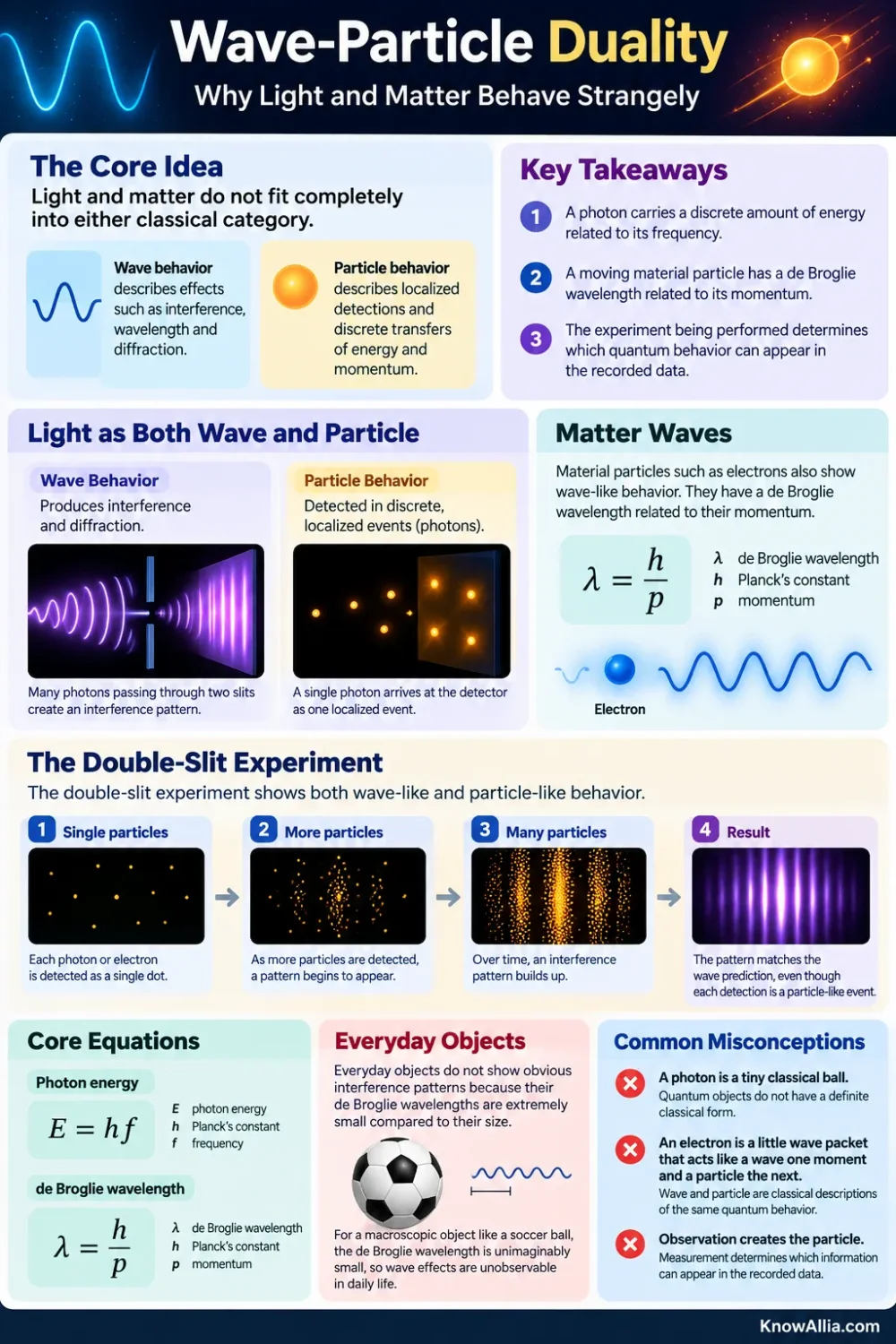
Wave-particle duality is the quantum behavior in which light and matter produce wave-like effects such as interference and diffraction, yet are detected or exchanged in discrete, particle-like events. A photon can arrive at a detector as one localized event while many photons sent through two slits build an interference pattern. Electrons can do the same. Quantum mechanics describes these observations without requiring a photon or electron to be an ordinary classical wave one moment and a tiny classical ball the next.[a] ↗
The Core Idea
Light and matter do not fit completely into either classical category. Wave language describes effects such as interference, wavelength and diffraction. Particle language describes localized detections and discrete transfers of energy and momentum.
- A photon carries a discrete amount of energy related to its frequency.
- A moving material particle has a de Broglie wavelength related to its momentum.
- The experiment being performed determines which quantum behavior can appear in the recorded data.
The most useful way to understand the subject is to follow the evidence: why light could not be explained only as a classical wave, why electrons could not be treated only as classical particles, what happens in the double-slit experiment, and why everyday objects do not display obvious interference patterns.
What Wave-Particle Duality Actually Means
In classical physics, a wave and a particle are very different models. A classical particle is imagined as a localized object with a position and a trajectory. A classical wave is spread through space and can overlap with another wave, producing constructive or destructive interference.
Quantum objects do not obey that classical division. Photons, electrons, atoms and other quantum systems can produce experimental results associated with both categories. The phrase wave-particle duality is therefore a description of observed behavior, not a claim that an electron literally changes back and forth between two familiar physical substances.
An analogy helps. A road map and a subway map can describe the same city while emphasizing different information. Neither map is the city itself. In a similar way, “wave” and “particle” are classical descriptions that capture different measurable features of a quantum system. Quantum mechanics supplies the mathematical description that connects those observations.
A useful distinction: “particle-like” does not necessarily mean a tiny rigid sphere, and “wave-like” does not necessarily mean a material ripple moving through a physical medium. These words identify patterns in measurable behavior.
How Quantum Behavior Appears in an Experiment
A single experiment can connect wave-like propagation with localized detection without treating either classical picture as the complete description.
A photon, electron or other quantum object is prepared in a controlled state.
Its quantum amplitudes can include more than one possible path or outcome.
Coherent alternatives can reinforce or cancel, changing the probability distribution.
The detector records an individual localized event rather than a faint fraction spread across the screen.
Interference, diffraction, wavelength and phase-sensitive effects.
Discrete detector events and quantized transfers of energy and momentum.
Probability amplitudes predict how likely different measurable outcomes are.
Why Light Cannot Be Described Only as a Wave
Light displays unmistakable wave behavior. It has frequency and wavelength, undergoes diffraction, and produces interference. Thomas Young’s double-slit work helped establish the wave description of light long before quantum mechanics existed.
Later experiments exposed limits in a purely classical wave description. One of the clearest examples is the photoelectric effect, in which light can cause electrons to be emitted from a material.
The Photoelectric Effect
In Einstein’s 1905 explanation, light transfers energy in discrete quanta. The energy of one photon is related to the light’s frequency. A photon must carry enough energy for an electron to escape the material. The Nobel Prize records Einstein’s work on the law of the photoelectric effect as the basis for his 1921 Physics Prize, awarded in 1922.[b] ↗
The basic photon-energy relation is E = hf, where E is photon energy, h is Planck’s constant and f is frequency. Raising the frequency raises the energy carried by each photon.
- Below the threshold frequency: photons do not individually carry enough energy to release electrons from the material, regardless of simply making the beam brighter.
- Above the threshold: increasing frequency can raise the maximum kinetic energy available to emitted electrons.
- Greater intensity at a fixed suitable frequency: generally means more photons are arriving, so more photoelectric events can occur.
This behavior is naturally described in terms of localized energy transfers involving photons. Yet the same light can later produce interference in another experimental arrangement. Neither classical description works by itself in every situation.
Photon Momentum and Compton Scattering
Photons also carry momentum even though they have no rest mass. For light in vacuum, photon momentum can be written as p = h/λ. Experiments such as Compton scattering reveal momentum exchange between photons and electrons in a way that reinforces the particle-like side of light’s behavior.
Why Matter Can Behave Like a Wave
The surprising symmetry came from asking the reverse question. If something long described as a wave can show particle-like behavior, could something normally called a particle show wave-like behavior?
Louis de Broglie proposed that a moving material particle has an associated wavelength. His idea gave matter a wave relation of the same general form used for photon momentum. De Broglie received the 1929 Nobel Prize in Physics for the discovery of the wave nature of electrons.[c] ↗
De Broglie Relation
λ = h/p
λ is the de Broglie wavelength, h is Planck’s constant, and p is the particle’s momentum.
The relation means that greater momentum corresponds to a shorter matter wavelength.
The proposal was testable. If electrons really had wave properties, a regularly spaced crystal structure should be able to diffract them in much the same mathematical manner that a diffraction grating affects other waves.
Electron Diffraction Confirmed the Prediction
Experiments by Clinton Davisson and Lester Germer, along with independent electron-diffraction work by George Paget Thomson, provided direct experimental evidence of electron wave behavior. Davisson and Thomson later shared the 1937 Nobel Prize in Physics for the experimental discovery of electron diffraction by crystals.[d] ↗
In the Davisson-Germer work, electrons scattered from a crystal with angular patterns associated with diffraction. The measured behavior agreed with the wavelength expected from de Broglie’s proposal, connecting a material particle’s momentum with measurable wave behavior.[e] ↗
Wave behavior is not restricted to electrons. Under suitable experimental conditions, atoms and molecules can also display matter-wave effects. As systems become larger and interact more strongly with their surroundings, however, observing coherent interference becomes much harder.
What the Double-Slit Experiment Reveals
The double-slit experiment gives one of the clearest demonstrations of why classical categories become inadequate. Imagine a source aimed toward a barrier containing two narrow openings, with a detector screen behind it.
Classical Particles
If ordinary macroscopic particles were fired through the openings, each would pass through one slit or the other. After many trials, the detector would show a distribution associated with those two available routes. There would be no alternating series of interference maxima and minima caused by adding wave amplitudes.
Classical Waves
A wave reaching both openings behaves differently. The two outgoing wave contributions overlap. Where they arrive in phase, they reinforce one another. Where they arrive out of phase, they can partly or fully cancel. The resulting pattern contains interference fringes.
Quantum Objects
Photons or electrons sent through a suitable two-slit arrangement can be registered as individual localized events. One detector event appears at one location. Another appears somewhere else. Yet after many trials, the accumulated detections follow an interference distribution rather than the distribution expected from independent classical particles.[f] ↗
This remains true even when the source is operated so that quantum objects pass through the apparatus individually. The interference pattern is therefore not merely the result of separate particles physically colliding with one another on the way to the screen. The probability distribution itself carries the interference structure.
Important: saying that an electron “must secretly have taken both classical paths” goes beyond what the detection record alone establishes. Quantum mechanics instead assigns amplitudes to the available alternatives and uses those amplitudes to calculate outcome probabilities.
Why Measuring the Path Changes the Pattern
A two-slit experiment changes when information is physically recorded that can distinguish which path the quantum object took. Under conditions where the alternatives become distinguishable, the interference between them is reduced or disappears.
This does not require a person to stare at the apparatus. A detector, scattered photon, nearby particle or other environmental interaction can correlate with the possible paths. What matters physically is the interaction and the availability of distinguishing information, not human awareness.
The connection is described through concepts such as entanglement and decoherence. If the path alternatives become correlated with distinguishable states of another system, the phase relationship needed to observe ordinary interference in the original system can become inaccessible. Stanford’s review of decoherence uses the two-slit experiment to show how environmental interactions can suppress observable interference.[g] ↗
It Is Not Simply “Looking Disturbs the Particle”
A common shortcut says that measuring the slit merely gives the particle a physical kick. Disturbance can matter in a real apparatus, but the deeper issue is whether the alternatives remain coherent and indistinguishable. Quantum experiments can be designed so that path information and interference visibility are related in more subtle ways than a simple mechanical collision picture suggests.
That distinction matters because wave-particle duality is not a story about a shy particle behaving differently because someone watches it. It is a statement about how quantum states, interactions and measurements determine the probabilities found in experimental records.
The Equations Connecting Waves and Particles
A small set of equations shows how closely wave quantities and particle quantities are linked in quantum physics.
| Relation | Equation | Meaning |
|---|---|---|
| Photon energy | E = hf | A photon’s energy is proportional to its frequency. |
| Photon momentum | p = h/λ | Shorter-wavelength light carries more momentum per photon. |
| Matter wavelength | λ = h/p | A material particle has a de Broglie wavelength inversely related to its momentum. |
| Probability from a wavefunction | P ∝ |ψ|2 | The squared magnitude of the relevant quantum amplitude determines measurable probabilities. |
These relations explain why neither wave vocabulary nor particle vocabulary disappears from quantum mechanics. Frequency and wavelength sit directly beside energy and momentum in the equations.
Why Momentum Changes the Matter Wavelength
From λ = h/p, doubling a particle’s momentum halves its de Broglie wavelength. Low-momentum particles therefore have longer wavelengths than otherwise identical particles with higher momentum. Whether that wavelength produces an observable diffraction or interference pattern also depends on the geometry and scale of the experiment.
Evidence Seen Across Different Experiments
| Experiment or Observation | Behavior Revealed | What the Result Shows |
|---|---|---|
| Light interference | Wave-like | Light amplitudes can interfere and produce bright and dark regions. |
| Light diffraction | Wave-like | Light spreads in characteristic patterns after apertures or around structures comparable with its wavelength. |
| Photoelectric effect | Particle-like | Energy exchange occurs in photon-sized quanta related to frequency. |
| Compton scattering | Particle-like | Photons participate in measurable energy and momentum exchange. |
| Electron diffraction | Wave-like matter | Electrons can produce diffraction associated with a de Broglie wavelength. |
| Single-particle double slit | Both signatures | Individual detections accumulate into a distribution shaped by interference. |
The American Physical Society’s educational treatment of particle-wave duality likewise connects double-slit interference with discrete detections and notes that wave-particle behavior has been tested with photons, electrons, atoms and molecules.[h] ↗
Why Everyday Objects Do Not Look Like Matter Waves
The de Broglie equation applies to matter generally, so it is reasonable to ask why a moving ball, chair or person does not form an obvious diffraction pattern.
The first reason is scale. Planck’s constant is extremely small in ordinary mechanical units. A macroscopic object has vastly more momentum than an electron used in a laboratory diffraction experiment, giving the object a correspondingly tiny de Broglie wavelength. Producing an apparatus with relevant structures on that scale is not practical for ordinary objects.
The second reason is decoherence. Large objects constantly interact with their surroundings through light, air molecules, thermal radiation and other environmental contacts. Those interactions rapidly spread quantum correlations into the environment and suppress observable interference between macroscopically different alternatives.
Quantum Rules Do Not Simply Stop at Large Size
The transition to familiar classical behavior is not adequately described by saying that quantum mechanics applies only to tiny objects. Size, momentum, experimental resolution and environmental interaction all affect whether distinctly quantum interference can be observed.
What Is Waving in a Matter Wave?
A de Broglie matter wave should not be pictured as an electron made of physical material that sloshes up and down like water. In standard quantum mechanics, a system is represented by a quantum state. For a position description, a wavefunction can assign a complex probability amplitude to different locations.
The wavefunction can spread, combine and interfere according to wave-like mathematics. Yet a position measurement can produce one localized detection. Repeating the same preparation many times reveals the probability distribution predicted from the quantum state.
This is why the interference pattern becomes clearest after many events. Quantum mechanics generally predicts the distribution of possible outcomes. It does not ordinarily specify the exact point where the next individual electron will appear on the screen.
Superposition and Interference
Interference becomes possible because quantum amplitudes can be combined. If a system has two coherent alternatives, the amplitudes associated with those alternatives are added before the final probability is calculated.
- The experimental setup permits multiple coherent alternatives.
- Quantum mechanics assigns an amplitude to each alternative.
- The amplitudes combine, including their relative phase.
- The squared magnitude of the combined amplitude gives the detection probability.
- Repeating the experiment reveals the predicted distribution.
This differs from adding ordinary classical probabilities. Two amplitudes can partly cancel, producing a location where the probability becomes smaller when a second path is opened. That behavior is one reason the double-slit experiment cannot be reproduced by a simple picture of independent classical particles following unknown but ordinary trajectories.
Common Confusion About Wave-Particle Duality
“A Quantum Object Is Literally a Wave and a Tiny Ball at the Same Time”
This wording takes classical models too literally. A photon or electron is a quantum object. Wave-like and particle-like identify experimentally observed properties that resemble parts of familiar classical models.
“The Particle Decides Whether to Be a Wave or Particle”
There is no need to assign a decision to the object. The experimental arrangement determines which observables are accessible and whether phenomena such as interference can occur. Quantum theory predicts the statistics of the resulting measurements.
“Human Consciousness Causes the Quantum Effect”
The loss of a two-path interference pattern does not require a conscious observer. Physical interactions that make the alternatives distinguishable can correlate the quantum system with a detector or environment and suppress the observable interference.
“Each Particle Must Have Followed One Unknown Classical Path”
A model in which every particle simply travels through one slit along an ordinary classical route does not reproduce the standard interference calculation by itself. Quantum mechanics combines amplitudes associated with alternatives, and those amplitudes contain phase information that ordinary path probabilities lack.
“Large Objects Are Not Quantum Objects”
The better statement is that distinctly quantum interference becomes extremely difficult to observe for ordinary macroscopic objects. Their de Broglie wavelengths are tiny, and continuous environmental interactions strongly suppress accessible coherence.
Terms That Make the Topic Easier to Read
- Photon
- A quantum of electromagnetic radiation carrying energy and momentum.
- Interference
- The change produced when coherent wave amplitudes combine, allowing reinforcement or cancellation.
- Diffraction
- Wave-like spreading and pattern formation associated with apertures, edges or periodic structures.
- De Broglie Wavelength
- The wavelength associated with a particle’s momentum, expressed as λ = h/p.
- Wavefunction
- A mathematical representation used in quantum mechanics to calculate probability amplitudes for measurable outcomes.
- Probability Amplitude
- A quantity that can combine with other amplitudes and interfere before measurement probabilities are obtained.
- Superposition
- A quantum state containing a coherent combination of possible states or alternatives.
- Coherence
- The preservation of phase relationships needed for observable interference.
- Decoherence
- The suppression of observable interference when a system becomes sufficiently correlated with other degrees of freedom, often through environmental interactions.
- Which-Path Information
- Information that can distinguish between alternative routes in an interference experiment.
What Wave-Particle Duality Changed in Physics
The experiments behind wave-particle duality forced physics beyond the idea that nature must always fit ordinary macroscopic categories. Light could no longer be treated only as a continuous classical electromagnetic wave when individual quantum energy transfers mattered. Electrons could no longer be treated only as localized classical particles when diffraction and interference appeared.
Quantum mechanics replaced that forced choice with a theory in which states evolve according to quantum rules and measurements produce definite recorded outcomes with calculable probabilities. The older wave and particle pictures remain useful because they describe recognizable features of those outcomes.
The practical reach extends far beyond a philosophical puzzle. Electron diffraction is used to study structures on very small scales. Electron microscopes exploit the short wavelengths available to energetic electrons. Photon interactions underlie photodetectors and many forms of spectroscopy. Interference remains central to precision measurement and quantum technologies.
What the Simple Duality Picture Cannot Settle
Wave-particle duality is useful language, but it is not a complete interpretation of quantum mechanics. The mathematical theory predicts experimental probability distributions with extraordinary accuracy, while questions about how its formalism should be interpreted have more than one proposed answer.
Decoherence explains how interactions with an environment can suppress observable interference and help account for the emergence of classical-looking behavior. It should not automatically be presented as a solution to every conceptual question associated with quantum measurement. Different interpretations of quantum mechanics can agree on experimental predictions while describing the underlying physical picture differently.
For that reason, statements such as “the electron really is a classical wave until someone observes it” or “the particle secretly chooses one slit” should not be presented as experimentally established facts. What experiments establish directly are the preparation conditions, detector outcomes and statistical patterns connecting them.
Questions About Wave-Particle Duality
Is light a wave or a particle?
Light is a quantum phenomenon that can display wave-like behavior, including interference and diffraction, while also producing discrete photon detections and discrete transfers of energy and momentum. Neither ordinary classical model alone describes every experiment.
Do electrons really behave like waves?
Yes. Electron diffraction and interference are experimentally observed. A moving electron has a de Broglie wavelength related to its momentum by λ = h/p, although an electron should not be pictured as an ordinary material wave.
Can one electron interfere in a double-slit experiment?
When electrons are sent through a suitable two-slit apparatus individually, localized detections can accumulate into an interference distribution. Quantum mechanics describes this by combining probability amplitudes associated with the coherent alternatives.
Why does detecting the slit remove the interference pattern?
Obtaining distinguishable path information correlates the alternatives with a detector or another physical system. The coherence required for the original two-path interference is then reduced or lost in the measured subsystem. Human awareness is not required.
Does wave-particle duality apply only to photons and electrons?
No. Matter-wave behavior is a general feature of quantum physics, and interference has been demonstrated with systems larger than individual electrons, including atoms and molecules under carefully controlled conditions.
Why can we not see a person behaving like a wave?
A person’s de Broglie wavelength at ordinary momentum is extraordinarily small, while continuous interactions with the surrounding environment suppress accessible quantum coherence. Both effects make macroscopic matter-wave interference effectively unobservable in everyday conditions.
Does a photon have mass if it behaves like a particle?
A photon has zero rest mass. It nevertheless carries energy and momentum. Particle-like behavior does not require the photon to be a tiny massive classical object.
Is wave-particle duality still accepted in modern physics?
Yes, the experimental behaviors described by wave-particle duality are established parts of quantum physics. Modern quantum theory provides a more precise description than the older classical labels alone, so physicists generally treat “wave” and “particle” as useful descriptions of different observable features rather than complete identities.
Sources
- [a] ↩ OpenStax – Wave-Particle Duality — University Physics treatment of photons, matter waves, diffraction and the limits of classical wave and particle descriptions.
- [b] ↩ Nobel Prize – Albert Einstein Facts — Nobel Foundation account of Einstein’s work on the photoelectric effect and light quanta.
- [c] ↩ Nobel Prize – Louis de Broglie Facts — Official account of de Broglie’s proposal concerning the wave nature of electrons.
- [d] ↩ Nobel Prize – Physics Prize 1937 — Official record of the prize awarded to Clinton Davisson and George Paget Thomson for electron diffraction by crystals.
- [e] ↩ American Physical Society – Quantum Milestones: Electrons Act Like Waves — Historical and experimental account of the Davisson-Germer electron-diffraction result.
- [f] ↩ Open Yale Courses – Quantum Mechanics I: Key Experiments and Wave-Particle Duality — University lecture covering localized photon detections, interference and quantum probability.
- [g] ↩ Stanford Encyclopedia of Philosophy – The Role of Decoherence in Quantum Mechanics — Detailed reference on interference suppression, environmental interaction and the limits of decoherence as an account of measurement.
- [h] ↩ American Physical Society – Particle-Wave Duality — Educational reference connecting interference, discrete detection and wave-particle experiments involving light and matter.