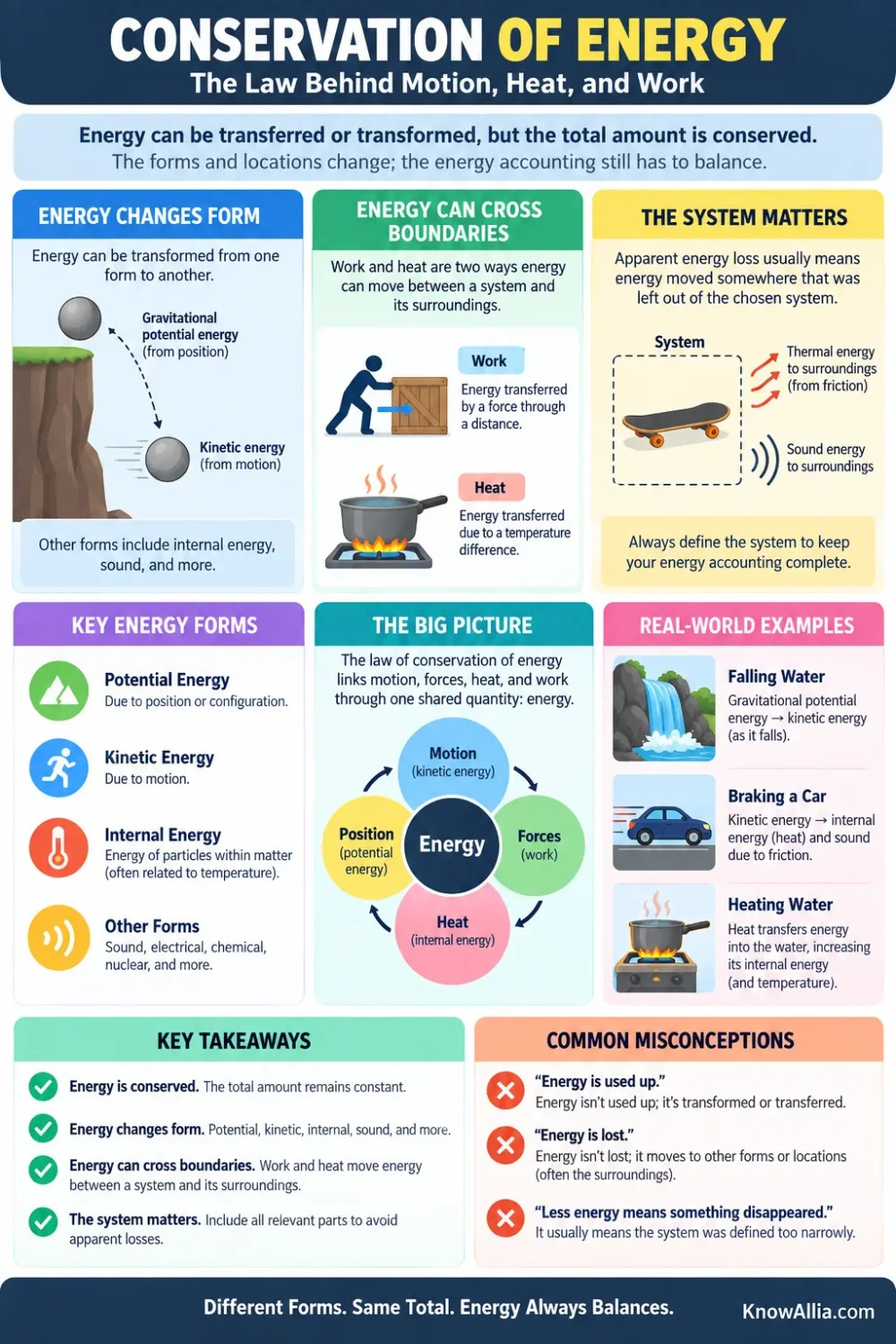
Conservation of energy is the physical law that says energy can be transferred or transformed, but the total amount is conserved. A falling object can turn gravitational potential energy into kinetic energy. Friction can turn organized motion into internal energy. Heating can transfer energy into matter, while work can transfer energy into or out of a system. The forms and locations change; the energy accounting still has to balance.
The Main Idea
The law links motion, forces, heat, and work through one shared quantity: energy. Mechanical problems often track kinetic and potential energy, while thermal problems also include internal energy and energy crossing a system boundary.
- Energy changes form: potential energy can become kinetic energy, internal energy, sound, or other forms.
- Energy can cross boundaries: work and heat are two ways energy can move between a system and its surroundings.
- The system matters: apparent energy loss often means energy moved somewhere that was left out of the chosen system.
The sections below connect the familiar equations of motion with friction, temperature, internal energy, thermodynamics, and efficiency. They also explain why saying that energy was “used up” or “lost” can be misleading in physics.
What the Law of Conservation of Energy Says
The general conservation rule is simple: the total energy of an isolated system remains constant. Energy may move between objects or change its form, but those changes do not create additional energy or erase existing energy. NASA describes the same principle by noting that energy can be converted from one form to another while the total within the chosen domain remains fixed.
This does not mean every individual form of energy stays constant. A moving object may lose kinetic energy. A stretched spring may lose elastic potential energy. A warm object may transfer energy to cooler surroundings. What conservation requires is that the complete energy balance still accounts for where that energy went.
Energy conservation is broader than mechanical energy conservation. Kinetic energy plus potential energy may decrease when friction acts, even though total energy remains conserved. The missing mechanical energy commonly appears as increased internal energy of the interacting objects and their surroundings.
Energy Is a Quantity, Not a Substance
Energy is a measurable property used to describe a system’s capacity for physical change. It is not a material that pours invisibly from one object to another. The same unit—the joule (J)—is used for energy, work, and amount of heat in the International System of Units. NIST defines one joule in mechanical terms as one newton-meter.
This common unit is useful because motion, heating, electrical processes, deformation, and other physical changes can all be placed in the same energy account.
How Energy Is Accounted For
Stored forms and transfer processes play different roles in an energy balance.
Energy Stored in a System
Energy Crossing a Boundary
Mechanical Energy: Motion and Position
In many motion problems, the most useful forms are kinetic energy and potential energy. Their sum is called mechanical energy:
- Mechanical energy
- Emech = KE + PE
- Kinetic energy
- KE = ½mv²
- Gravitational potential energy near Earth’s surface
- PEg = mgh, relative to a chosen reference level
- Elastic potential energy of an ideal spring
- PEs = ½kx²
Here, m is mass, v is speed, g is gravitational acceleration, h is height relative to a reference level, k is the spring constant, and x is the spring’s displacement from equilibrium.
When Mechanical Energy Is Conserved
If only conservative forces such as gravity or an ideal spring force do work, kinetic and potential energy can trade places while their sum stays constant. A convenient expression is:
KEi + PEi = KEf + PEf
A ball dropped from rest is a straightforward example. As its height falls, gravitational potential energy decreases. Its speed rises, so kinetic energy increases. If air resistance is neglected, the decrease in gravitational potential energy matches the increase in kinetic energy.
Why Friction Changes the Mechanical-Energy Equation
Friction often reduces the amount of mechanical energy available. That does not violate energy conservation. When two surfaces slide against each other, organized motion becomes microscopic motion and deformation within the materials. Their internal energy can rise.
This distinction resolves one of the most common puzzles in basic physics: mechanical energy can decrease while total energy remains conserved. OpenStax treats non-conservative work as a change in mechanical energy rather than as the destruction of energy.
How Work Transfers Energy
In physics, work is an energy-transfer process. For a constant force, the mechanical work done by that force is:
W = Fd cos θ
The angle θ is measured between the force and the displacement. A force in the direction of motion does positive work. A force opposite the displacement does negative work on the object. A force perpendicular to the displacement does zero work in the simple point-particle model.
The Work–Energy Theorem
The work–energy theorem states that the net work on an object equals its change in kinetic energy:
Wnet = ΔKE
If the net work is positive, kinetic energy increases. If net work is negative, kinetic energy decreases. This creates a direct mathematical link between forces and changes in motion without requiring every step of the motion to be analyzed separately.
An everyday accounting analogy is useful: think of energy as money distributed among several accounts. Moving money from a savings account to a checking account changes the balance of each account but not the total amount you own. In the same way, changing potential energy into kinetic or internal energy changes individual terms without making the total disappear.
Heat, Temperature, and Internal Energy
Heat and internal energy are closely related, but they are not interchangeable terms. Internal energy is energy associated with the microscopic state of a system. Heat describes energy being transferred because of a temperature difference.
Once an energy transfer has occurred, it is usually more accurate to discuss the resulting change in internal energy rather than saying that an object “contains heat.” NIST similarly describes heat as energy in transit and distinguishes internal energy from thermodynamic temperature.
Temperature Is Not the Same as Total Internal Energy
Temperature tells us about the thermal state of matter, but it is not simply a measurement of the total energy stored in an object. Two samples can have the same temperature while containing different total internal energies because they differ in mass, composition, phase, or microscopic degrees of freedom.
Adding energy by heating often raises temperature, but not every energy transfer by heat must produce a temperature increase. During a phase change, for example, energy can alter the microscopic arrangement of matter while temperature remains unchanged during the idealized transition.
The First Law of Thermodynamics
Thermodynamics expresses energy conservation through the first law of thermodynamics. With the convention that Q is energy transferred into a system by heating and W is work done by the system, one common form is:
ΔU = Q − W
ΔU is the change in internal energy. Positive heat input adds energy to the system, while positive work done by the system transfers energy out. Some textbooks instead define positive work as work done on the system, producing the equivalent form ΔU = Q + W. The physics is the same as long as the sign convention is stated and used consistently.
| Quantity | What It Describes | Typical Expression | SI Unit |
|---|---|---|---|
| Kinetic energy | Energy associated with motion | KE = ½mv² | joule (J) |
| Gravitational potential energy | Energy associated with position in a gravitational field | PE = mgh near Earth’s surface | joule (J) |
| Elastic potential energy | Energy associated with an ideal spring’s deformation | PE = ½kx² | joule (J) |
| Work | Energy transferred through a mechanical interaction | W = Fd cos θ for a constant force | joule (J) |
| Heat | Energy transferred because of a temperature difference | Represented by Q | joule (J) |
| Internal energy | Microscopic energy stored within a system | Represented by U | joule (J) |
| Power | Rate of energy transfer or work | P = ΔE/Δt or W/Δt | watt (W), equal to J/s |
Why the System Boundary Changes the Energy Story
Before applying conservation of energy, physicists decide what belongs to the system. This choice determines which energies count as internal to the system and which transfers cross its boundary.
Isolated, Closed, and Open Systems
- Isolated system: an idealized system that exchanges neither matter nor energy with its surroundings. Its total energy stays constant.
- Closed system: matter does not cross the boundary, but energy can cross through processes such as heat transfer or work.
- Open system: both matter and energy can cross the boundary, so energy carried by incoming and outgoing matter must also be included.
Consider a block sliding across a rough floor. If the system contains only the block, energy can leave the block through its interaction with the floor. If the system contains both the block and the floor, the rise in their internal energy is part of the system’s energy balance. The physical event is unchanged; only the bookkeeping boundary has changed.
A Reliable Energy-Balance Method
- Choose the system and state what is inside its boundary.
- Identify the forms of energy present initially and finally.
- Identify energy transferred across the boundary by work, heat, matter, or other relevant processes.
- Write an energy balance with consistent signs.
- Check that every term uses compatible units, normally joules in SI calculations.
Energy Conservation in Physical Examples
Example 1: A Falling Object
Suppose a 2.00 kg object starts from rest 5.00 m above a chosen zero-height level. Ignoring air resistance and using g = 9.81 m/s², its initial gravitational potential energy is:
PE = mgh = (2.00 kg)(9.81 m/s²)(5.00 m) = 98.1 J
Just before the object reaches the zero-height level, that gravitational potential energy has become kinetic energy in the idealized model:
KE = 98.1 J
Using KE = ½mv² gives a speed of approximately 9.90 m/s. No additional motion energy appeared during the fall; gravitational potential energy changed form.
Example 2: Friction Slows a Sliding Object
Imagine that an object begins with 100 J of kinetic energy and eventually stops because it slides across a rough surface. The object’s final kinetic energy is zero, but the original 100 J has not ceased to exist.
If the object and surface are included in the system, most of that energy may appear as increased internal energy associated with microscopic motion and deformation. Small portions may also be carried away through sound or transferred farther into the surroundings.
Example 3: Heating a Gas That Does Work
Suppose 500 J of energy enters a closed gas system by heating, while the gas performs 200 J of work on its surroundings. Using ΔU = Q − W:
ΔU = 500 J − 200 J = 300 J
The system’s internal energy therefore increases by 300 J. The other 200 J has crossed the boundary as work. The entire 500 J remains accounted for.
Example 4: A Pendulum
At the highest point of an ideal pendulum’s swing, speed is smallest and gravitational potential energy is largest. As the pendulum moves downward, potential energy decreases while kinetic energy rises. At the lowest point, speed and kinetic energy are greatest.
A real pendulum eventually slows because air resistance and friction at the support transfer mechanical energy into internal energy and other forms. The pendulum’s mechanical energy decreases; total energy does not vanish.
Energy Conservation and Efficiency
Energy conservation does not mean that every joule entering a device emerges in the form people intended to use. A motor may receive electrical energy and produce motion while also increasing the internal energy of its components and surroundings. A lamp converts electrical energy into electromagnetic radiation while some energy is also transferred thermally.
Efficiency compares the desired energy output with the energy input:
Efficiency = useful energy output ÷ total energy input × 100%
A device with an efficiency below 100% has not destroyed the remainder of the energy. The remainder has simply ended up in other forms or locations. This is why energy conservation and energy usefulness are different questions.
Where Energy Seems to Disappear
“Friction Destroys Energy”
Friction destroys neither energy nor the conservation law. It can reduce kinetic or mechanical energy while increasing internal energy and transferring energy to the surroundings.
“Heat Is Energy Stored Inside an Object”
In thermodynamics, heat is best treated as energy being transferred because of a temperature difference. Internal energy describes energy associated with the state of the system itself.
“If an Object Stops, Its Energy Is Gone”
Stopping means the object’s macroscopic kinetic energy has decreased to zero relative to the chosen reference frame. The energy that was associated with its motion must be found elsewhere in the larger energy balance.
“Potential Energy Belongs to One Object Alone”
Potential energy is associated with the configuration of an interacting system. Gravitational potential energy, for example, describes an interaction between masses rather than a mysterious supply stored independently inside one object.
“Conservation Means Every Kind of Energy Stays Constant”
The conserved quantity is the appropriate total energy of the system. Individual forms can rise or fall dramatically. Kinetic energy, gravitational potential energy, elastic potential energy, and internal energy can all change while the combined accounting remains consistent.
Energy, Time, and a Deeper Physics Connection
There is a deeper mathematical reason energy conservation appears so broadly in physics. Noether’s theorem connects conservation laws with symmetries of physical laws. In physical theories with the appropriate time-translation symmetry—meaning the laws themselves do not change merely because an experiment is carried out at a different time—the corresponding conserved quantity is energy.
This connection goes beyond the usual falling-object or spring examples. It explains why energy conservation is not merely an empirical bookkeeping trick. It is tied to the mathematical structure used to describe physical systems.
Key Terms
- Energy
- A physical quantity that can be stored, transferred, and transformed while obeying conservation laws.
- Kinetic energy
- Energy associated with motion.
- Potential energy
- Energy associated with the configuration or position of interacting parts of a system.
- Mechanical energy
- The sum of kinetic and potential energy in the mechanical description of a system.
- Internal energy
- Microscopic energy associated with particles and interactions within a system.
- Work
- A process through which energy is mechanically transferred.
- Heat
- Energy transferred because of a temperature difference.
- Power
- The rate at which energy is transferred or work is done.
- Conservative force
- A force for which the work between two positions can be represented through a potential-energy change.
- System
- The object or collection of objects selected for physical analysis.
- Surroundings
- Everything outside the selected system.
Where Simple Energy Models Have Limits
Basic conservation equations work extremely well when the relevant forms of energy have been identified, but simplified textbook models intentionally leave out details. An equation containing only kinetic and gravitational potential energy, for example, cannot correctly describe a process in which friction, deformation, heating, or other energy transfers matter unless those effects are added to the accounting.
The familiar expression KE = ½mv² is also a classical approximation. At speeds approaching the speed of light, relativistic expressions are required. Likewise, microscopic and quantum systems may need forms of energy that do not appear in an introductory mechanical model.
Measurements bring another limitation. Real experiments have uncertainty, and it may be difficult to measure every small thermal, acoustic, rotational, or deformation-related contribution. An experimental energy total can therefore appear slightly unbalanced even when the physical conservation law is not in question.
Frequently Asked Questions
What is the law of conservation of energy in simple terms?
Energy can change form or move between a system and its surroundings, but it is not created from nothing or simply erased. For an isolated system, total energy remains constant.
Is mechanical energy always conserved?
No. Kinetic plus potential energy remains constant in the standard mechanical model when no non-conservative process transfers mechanical energy into other forms. Friction, drag, deformation, or external work can change mechanical energy while total energy conservation still holds.
Where does energy go when friction stops an object?
Much of the object’s organized kinetic energy becomes internal energy of the interacting surfaces and nearby environment. Some energy can also be transferred through sound and deformation.
Are heat and thermal energy the same thing?
Not exactly. Heat describes energy transferred because of a temperature difference. Internal energy is a property of a system, while thermal energy is commonly used when discussing microscopic energy related to temperature and particle motion.
How are work and energy related?
Work is one way energy is transferred. The work–energy theorem states that net work on an object equals the change in its kinetic energy.
What is the difference between energy and power?
Energy measures an amount of physical capacity for change, while power measures how rapidly energy is transferred. One watt equals one joule per second.
Does an inefficient machine violate conservation of energy?
No. Low efficiency means a smaller fraction of the input energy appears in the desired output. The remaining energy is transferred into other forms or locations rather than being destroyed.
Why is choosing a system boundary so important?
The boundary determines whether a particular energy change is treated as an internal transformation or as energy crossing between the system and its surroundings. Many apparent contradictions disappear once the system is clearly defined.
What unit is used for energy, heat, and work?
The SI unit is the joule, symbol J. NIST lists the joule as the coherent derived SI unit for energy, work, and amount of heat.
Sources
- NASA Glenn Research Center – Conservation of Energy — Energy conservation and conversion between potential, kinetic, internal, heat-transfer, and work terms.
- National Institute of Standards and Technology – NIST Guide to the SI, Chapter 4 — SI definitions showing the joule as the unit of energy, work, and amount of heat.
- National Institute of Standards and Technology – Kelvin: Thermodynamic Temperature — Relationship among thermodynamic temperature, microscopic motion, internal energy, and heat transfer.
- OpenStax – University Physics Volume 1: Conservation of Energy — Mechanical energy, conservative and non-conservative forces, and energy accounting.
- OpenStax – University Physics Volume 2: First Law of Thermodynamics — Internal energy, heat, work, state functions, and the first-law equation.
- University of Central Florida – Energy Balance for Closed Systems — Closed-system energy balance including kinetic, potential, internal energy, heat, and work.
- UCLA – Noether and the Connection Between Symmetry and Conservation Laws — Background on the relation between time-translation symmetry and energy conservation.