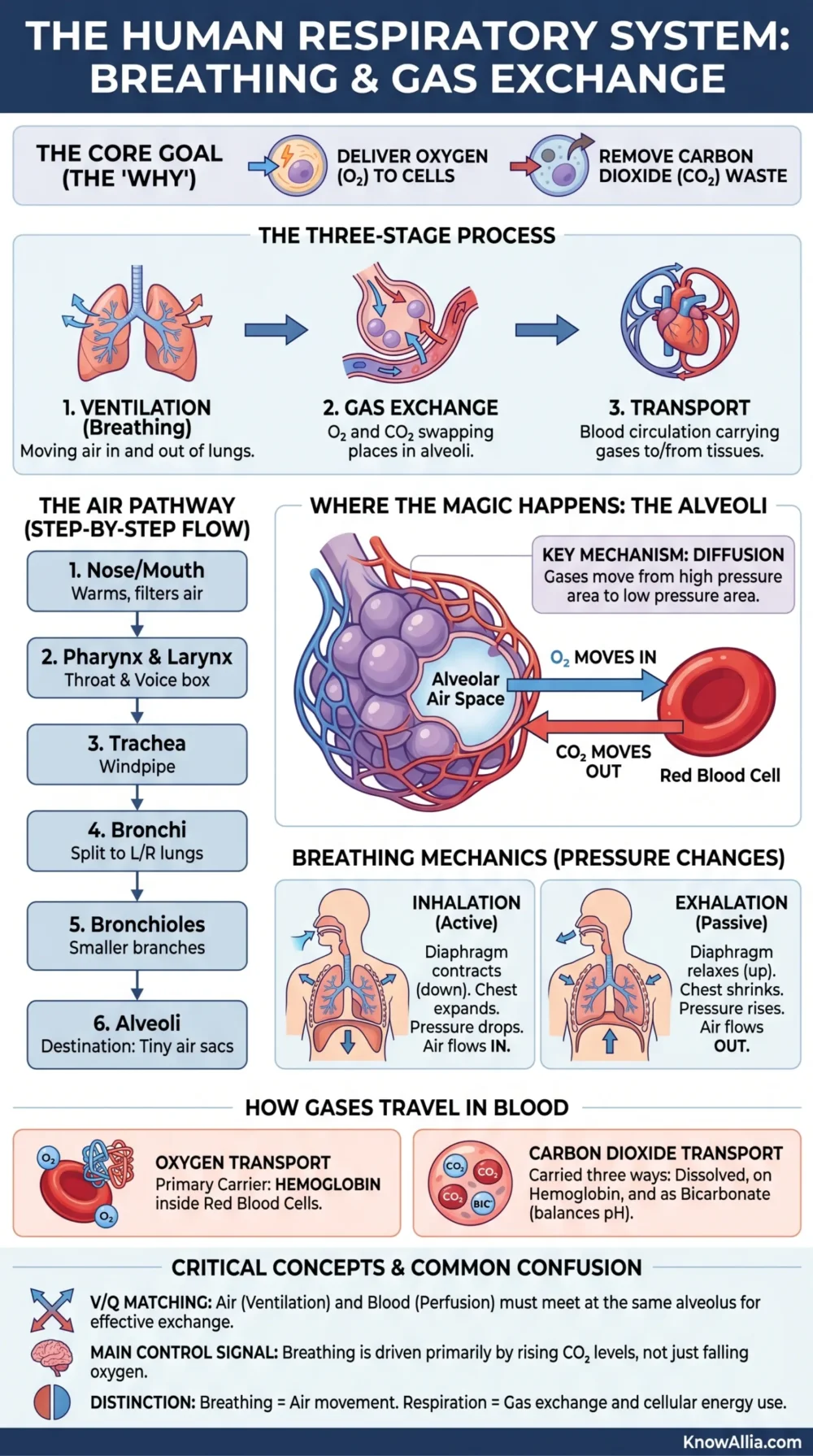
The human respiratory system is the body system that moves air into the lungs, transfers oxygen into the blood, and removes carbon dioxide from the blood. Breathing is the visible part of this process, but the real work happens deep in the lungs, where tiny air sacs called alveoli sit next to fine blood vessels and allow gases to move across a very thin surface.
The Main Idea in Plain Terms
Every breath connects the outside air with the bloodstream. Air travels through the nose or mouth, down the windpipe, into branching airways, and finally into the alveoli, where gas exchange takes place.[Source-1]
- Breathing moves air in and out of the lungs.
- Gas exchange moves oxygen into blood and carbon dioxide out of blood.
- Blood circulation carries oxygen to body tissues and returns carbon dioxide to the lungs.
This article explains the path of air, the mechanics of inhaling and exhaling, how alveoli exchange gases, how blood carries oxygen and carbon dioxide, why ventilation and blood flow must match, and why breathing changes during activity. It also clears up common confusion around terms such as respiration, ventilation, diffusion, and oxygen saturation.
What the Respiratory System Does
The respiratory system has one main job: it keeps gas levels in the body suitable for cells to work. Cells use oxygen during energy release and produce carbon dioxide as a by-product. The lungs do not work alone. They depend on the heart, blood vessels, red blood cells, respiratory muscles, and nervous system.
Air Side
The airways bring fresh air toward the alveoli. They also help warm, moisten, and filter incoming air before it reaches the deepest parts of the lungs.
Blood Side
Blood brings carbon dioxide from body tissues to the lungs and carries oxygen-rich blood away from the lungs toward the rest of the body.
A helpful way to picture the system is to think of the alveoli as a small exchange counter. Oxygen moves from air into blood, while carbon dioxide moves from blood into air. Both gases move in opposite directions across the same thin boundary.
The Air Pathway From Nose to Alveoli
Air does not go straight into the bloodstream. It follows a branching route that gets narrower as it enters the lungs. The deeper the air travels, the closer it gets to the surface where gas exchange can happen.
- Nose or mouth: Air enters the body. The nose helps warm, moisten, and filter air.
- Pharynx and larynx: Air passes through the throat area and the voice box.
- Trachea: The windpipe carries air downward toward the chest.
- Bronchi: The trachea divides into right and left main airways.
- Bronchioles: Smaller branching tubes spread air through the lungs.
- Alveoli: Tiny air sacs receive air and sit beside capillaries, where gas exchange occurs.
The right lung has three lobes and the left lung has two. The left lung is smaller because the heart takes up space on the left side of the chest.[Source-2] This shape is not a design flaw; it is part of how the chest organs fit together.
How Breathing Mechanics Work
Breathing depends on pressure changes. Air moves from higher pressure to lower pressure. When the chest cavity expands, pressure inside the lungs drops, so air flows inward. When the chest cavity becomes smaller, pressure rises, so air flows outward.
Inhalation
During inhalation, the diaphragm contracts and moves downward. The external muscles between the ribs also help lift the rib cage. This expands the chest cavity, lowers pressure inside the lungs, and draws air in.[Source-3]
Exhalation
At rest, exhalation is usually passive. The diaphragm relaxes, the chest cavity becomes smaller, and elastic lung tissue helps push air out. During exercise, strong speech, singing, or forced breathing, abdominal and rib muscles can help move air out more actively.
Breathing is not the same as gas exchange. Breathing moves air. Gas exchange moves oxygen and carbon dioxide across the alveolar-capillary surface. A person can move air poorly, exchange gases poorly, or have problems with both.
How Gas Exchange Happens in the Alveoli
Gas exchange happens mainly in the respiratory zone, where alveoli are present. The alveoli are small, thin-walled sacs surrounded by capillaries. Their structure gives the lungs a large surface for gases to move across.
OpenStax describes the alveolus as roughly 200 micrometers in diameter, with elastic walls that stretch during air intake. It also describes type I alveolar cells as very thin cells that cover most of the gas-exchange surface, while type II alveolar cells help produce surfactant.[Source-4]
Diffusion: The Movement Behind Gas Exchange
Oxygen and carbon dioxide move by diffusion. That means they move from an area where their pressure is higher to an area where their pressure is lower. Oxygen pressure is higher in alveolar air than in incoming blood, so oxygen moves into the blood. Carbon dioxide pressure is higher in incoming blood than in alveolar air, so carbon dioxide moves into the alveoli.
Gas exchange is helped by four features: a thin membrane, a large exchange surface, moist alveolar lining, and dense capillary blood flow. NCBI Bookshelf notes that effective gas exchange needs both ventilated alveoli and blood flow through nearby capillaries.[Source-5]
Breathing and Gas Exchange: One Continuous Loop
Air movement, diffusion, blood transport, and carbon dioxide removal work as one linked process.
Process Flow
- Air enters: The diaphragm contracts, the chest expands, and air moves toward the alveoli.
- Oxygen crosses: Oxygen diffuses through the alveolar-capillary surface into blood.
- Blood carries oxygen: Hemoglobin in red blood cells carries most oxygen toward body tissues.
- Carbon dioxide returns: Blood brings carbon dioxide from tissues back to the lungs.
- Air leaves: Carbon dioxide diffuses into alveoli and exits during exhalation.
What Must Stay Matched
Air must reach alveoli that can exchange gases.
Blood must flow beside those alveoli through capillaries.
Gases must cross a thin, moist membrane between air and blood.
Best Site for Exchange
Alveoli are the main exchange surface because they are thin, numerous, and closely wrapped by capillaries.
Main Oxygen Carrier
Most oxygen travels attached to hemoglobin inside red blood cells, not simply dissolved in plasma.
Main Breathing Signal
Carbon dioxide level and related pH changes strongly influence how the brain adjusts breathing.
How Oxygen and Carbon Dioxide Travel in Blood
After oxygen crosses into the capillaries, only a small amount stays dissolved in blood plasma. Most oxygen attaches to hemoglobin, a protein inside red blood cells. This allows blood to carry far more oxygen than plasma could carry alone.
Carbon dioxide travels in several forms. Some dissolves in plasma, some attaches to hemoglobin, and much of it is converted into bicarbonate in the blood. This makes carbon dioxide transport more flexible than many simple explanations suggest. It is not just “waste”; it also helps the body maintain normal acid-base balance.
| Part or Process | Main Role | Why It Matters |
|---|---|---|
| Diaphragm | Primary breathing muscle | Changes chest volume so air can move in and out. |
| Trachea | Large airway | Carries air between the throat and the bronchi. |
| Bronchi and Bronchioles | Branching air passages | Distribute air through the lungs. |
| Alveoli | Gas-exchange sacs | Provide a thin surface where oxygen and carbon dioxide diffuse. |
| Capillaries | Tiny blood vessels | Bring carbon dioxide-rich blood to alveoli and receive oxygen. |
| Hemoglobin | Oxygen-carrying protein | Allows red blood cells to transport oxygen efficiently. |
| Surfactant | Surface-tension reducer | Helps alveoli stay open and reduces the work needed to breathe. |
| Diffusion | Gas movement by pressure difference | Moves oxygen into blood and carbon dioxide into alveoli without direct energy use. |
Ventilation and Perfusion: Why Air and Blood Must Meet
Two things must happen at the same place for gas exchange to work well: air must reach the alveolus, and blood must flow past it. Ventilation means air movement into and out of alveoli. Perfusion means blood flow through the capillaries around alveoli.
If an alveolus receives air but little blood, gas exchange is limited. If blood flows past an alveolus that receives little air, gas exchange is also limited. This relationship is called ventilation-perfusion matching, often shortened to V/Q matching in medical and physiology texts. NCBI Bookshelf describes ventilation as air flow into and out of alveoli and perfusion as blood flow to alveolar capillaries.[Source-6]
A useful detail: More air movement does not automatically mean better oxygen delivery. The air has to reach alveoli that are next to active blood flow, and the blood has to be able to carry oxygen away.
How the Body Controls Breathing
Breathing can feel voluntary because a person can hold their breath or take a deep breath on purpose. Still, the basic rhythm is automatic. The brainstem coordinates breathing muscles and adjusts breathing based on signals from the body.
Carbon dioxide is a major part of that control. When carbon dioxide rises, it changes blood chemistry in a way the nervous system can detect. The brain can respond by increasing breathing rate or depth, helping remove more carbon dioxide. NCBI Bookshelf describes breathing as a process coordinated by respiratory muscles and control centers in the brain, with sensory input adjusting breathing according to metabolic demand.[Source-7]
Why Breathing Changes During Exercise
During exercise, working muscles use more oxygen and produce more carbon dioxide. The body responds by increasing breathing depth and rate. Heart rate also rises, moving more blood through the lungs and to active muscles. This is why breathing during exercise is not just faster; it is part of a coordinated response involving the lungs, heart, blood, and muscles.
Common Confusion About Breathing
- Breathing and respiration are not identical. Breathing is air movement. Respiration can also refer to gas exchange and cellular use of oxygen.
- The lungs do not “make” oxygen. They move oxygen from inhaled air into blood.
- Carbon dioxide is not only a waste gas. It also helps influence blood pH and breathing control.
- Deep breathing is not always the same as better gas exchange. Gas exchange also depends on alveoli, capillary blood flow, hemoglobin, and pressure gradients.
- Oxygen saturation is not the whole story. Pulse oximeters estimate oxygen saturation, but readings can be affected by device and user factors. The FDA notes that poor circulation, skin pigmentation, skin thickness, skin temperature, current tobacco use, and fingernail polish can affect accuracy.[Source-8]
Useful Terms for Understanding the Respiratory System
- Ventilation
- Movement of air into and out of the lungs or alveoli.
- Gas Exchange
- Movement of oxygen and carbon dioxide between alveolar air and capillary blood.
- Diffusion
- Passive movement of gases from higher pressure to lower pressure.
- Alveoli
- Tiny air sacs in the lungs where most gas exchange occurs.
- Perfusion
- Blood flow through capillaries near the alveoli.
- Hemoglobin
- Protein in red blood cells that carries most oxygen in the blood.
- Surfactant
- Substance that reduces surface tension inside alveoli and helps them stay open.
- Oxygen Saturation
- The percentage of hemoglobin binding sites carrying oxygen, often estimated with a pulse oximeter.
Limits and What We Do Not Know Exactly
Respiratory science is well established, but not every number applies to every person. Alveolar counts are often described as being in the hundreds of millions, but exact counts vary by age, body size, lung size, and measurement method. Resting breathing rate also varies with age, activity, temperature, fitness, emotion, altitude, and health status.
Home measurements can be useful for noticing patterns, but they are not the same as a full clinical evaluation. A pulse oximeter reading, breathing rate, or feeling of breathlessness should be interpreted with context, especially if symptoms are present or readings do not match how a person feels.
FAQ About the Human Respiratory System
Questions People Often Ask
What Is the Main Function of the Respiratory System?
The main function is gas exchange. The system brings oxygen into the body and removes carbon dioxide from the blood through the lungs.
Where Does Gas Exchange Happen?
Gas exchange happens mainly in the alveoli. These tiny air sacs sit next to capillaries, allowing oxygen to move into blood and carbon dioxide to move into the air spaces.
What Is the Difference Between Breathing and Respiration?
Breathing means moving air in and out of the lungs. Respiration can mean the exchange of gases in the lungs and tissues, and it can also refer to how cells use oxygen to release energy.
Why Does Carbon Dioxide Need to Be Removed?
Cells produce carbon dioxide during energy release. If too much carbon dioxide builds up, it can disturb normal blood chemistry, so the lungs remove it during exhalation.
Why Do We Breathe Faster During Exercise?
Working muscles use more oxygen and produce more carbon dioxide. Breathing becomes faster and deeper to bring in more air and remove extra carbon dioxide.
Does More Breathing Always Mean More Oxygen in the Body?
Not always. Oxygen delivery depends on air reaching the alveoli, blood flowing beside those alveoli, gases diffusing across the membrane, and hemoglobin carrying oxygen through the blood.
Sources
- [Source-1] NHLBI, NIH – How the Lungs Work: The Respiratory System — Used for the basic pathway of air into the alveoli and the role of gas exchange.
- [Source-2] NHLBI, NIH – Lung Structure and Lobes — Used for right and left lung lobe structure and the position of the lungs in the chest.
- [Source-3] NCBI Bookshelf – Physiology, Respiratory Drive — Used for the mechanics of inhalation and the role of the diaphragm and respiratory control.
- [Source-4] OpenStax – Organs and Structures of the Respiratory System — Used for alveolar structure, approximate alveolar size, and alveolar cell types.
- [Source-5] OpenStax – Gas Exchange — Used for diffusion, the respiratory membrane, oxygen movement into blood, and carbon dioxide movement into alveoli.
- [Source-6] NCBI Bookshelf – Physiology, Pulmonary Ventilation and Perfusion — Used for ventilation, perfusion, alveolar-capillary gas exchange, and V/Q matching.
- [Source-7] NCBI Bookshelf – Respiratory Drive and Brainstem Control — Used for respiratory rhythm, muscle coordination, and adjustment to metabolic demand.
- [Source-8] U.S. Food and Drug Administration – Pulse Oximeters — Used for limitations that can affect pulse oximeter readings.