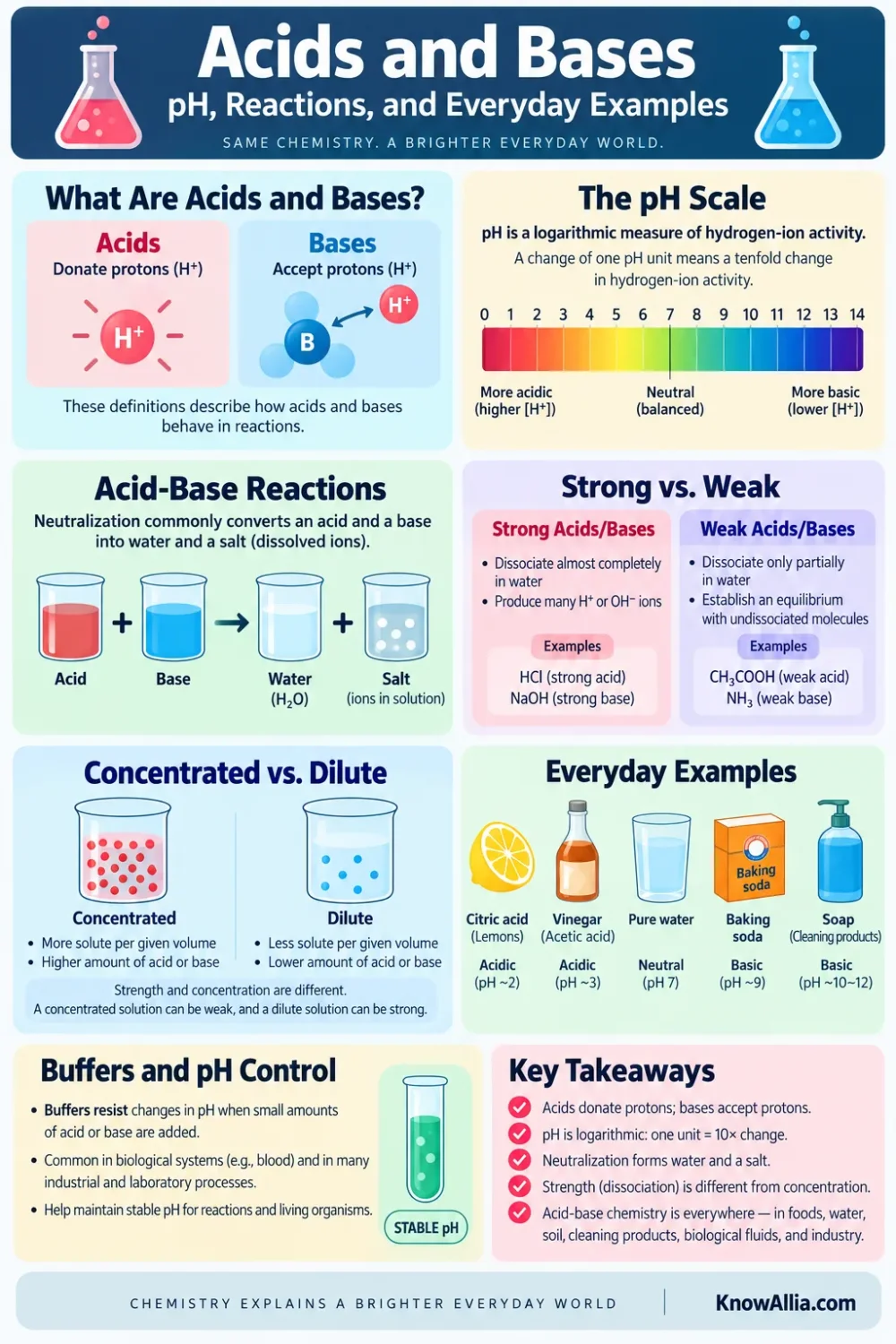
Acids and bases are substances defined by how they interact with hydrogen ions, hydroxide ions, or electron pairs. In water, their behavior is commonly described with pH, a logarithmic measure related to hydrogen-ion activity. Acids have greater acidic activity, bases have greater basic activity, and a neutral solution has balanced acidic and basic ion activity. The chemistry appears in foods, water, soil, cleaning products, biological fluids, laboratory reactions, and many industrial processes.
This article explains what acids and bases are, how the pH scale works, why a one-unit pH change represents a tenfold change, what happens during acid-base reactions, and how familiar substances fit into the chemistry. It also separates several ideas that are often confused, including strong versus weak, concentrated versus dilute, and neutral pH versus the number 7.
The Main Ideas
Acid-base chemistry can be understood through a few connected ideas. The pH scale describes aqueous acidity, proton transfer explains many reactions, and equilibrium determines how weak acids, weak bases, and buffers behave.
- Acids can donate protons in the Brønsted-Lowry model; bases can accept them.
- pH is logarithmic: a change of one pH unit corresponds to a tenfold change in hydrogen-ion activity.
- Neutralization commonly converts acidic and basic reactants into water and dissolved ions that form a salt.
What Are Acids and Bases?
There is more than one useful definition of an acid or a base. The definitions are not competing labels; they describe acid-base behavior at different levels.
The Arrhenius Definition
In the Arrhenius model, an acid increases the amount of hydronium ion, H3O+, in water, while a base increases the amount of hydroxide ion, OH−. Introductory descriptions sometimes write H+ instead of H3O+, although an isolated proton does not simply float freely through liquid water.
This model works well for many familiar aqueous acids and bases, but it is tied closely to reactions in water.
The Brønsted-Lowry Definition
The Brønsted-Lowry model focuses on proton transfer. An acid donates a proton, while a base accepts a proton. The proton is H+.
When an acid loses a proton, the species left behind is its conjugate base. When a base accepts a proton, it becomes its conjugate acid. These paired substances are called conjugate acid-base pairs. OpenStax describes acid-base reactions in this model as proton transfers from a donor to an acceptor. OpenStax
For a generic acid HA reacting with water:
HA + H₂O ⇌ H₃O⁺ + A⁻
HA donates the proton and acts as the acid. Water accepts it and acts as the base. A− is the conjugate base of HA.
The Lewis Definition
The Lewis model is broader still. A Lewis acid accepts an electron pair, while a Lewis base donates an electron pair. This description covers reactions that may not look like ordinary proton-transfer reactions.
- Acid
- A proton donor in the Brønsted-Lowry model or an electron-pair acceptor in the Lewis model.
- Base
- A proton acceptor in the Brønsted-Lowry model or an electron-pair donor in the Lewis model.
- Conjugate Acid
- The species formed after a base accepts a proton.
- Conjugate Base
- The species formed after an acid donates a proton.
- Amphiprotic Substance
- A substance capable of acting as either a proton donor or proton acceptor. Water is an important example.
How the pH Scale Works
pH expresses acidity on a logarithmic scale. In formal chemical terminology, IUPAC defines pH in terms of the activity of hydrogen ions in solution rather than simply their concentration. For many introductory calculations involving dilute aqueous solutions, pH is commonly treated using hydronium concentration:
pH ≈ −log₁₀[H₃O⁺]
The more hydronium activity an aqueous solution has, the lower its pH. The formal activity-based definition matters more as solutions depart from ideal dilute behavior. IUPAC
Reading pH as a Chemical Scale
The familiar 0–14 display is useful for ordinary aqueous examples, but the logarithmic relationship is the part that defines how pH values compare.
Acidic at 25 °C
pH below 7 corresponds to more hydronium activity than hydroxide activity under ordinary dilute-solution conditions.
Neutral at 25 °C
Pure water has equal hydronium and hydroxide concentrations and a pH of 7.00 at 25 °C.
Basic at 25 °C
pH above 7 corresponds to less hydronium activity and greater hydroxide activity.
One pH Unit
A difference of one unit represents a factor of ten in hydrogen-ion activity.
Two pH Units
A difference of two units represents a factor of one hundred.
The Scale Can Extend
Very concentrated solutions can produce calculated pH values below 0 or above 14.
Why a One-Unit pH Difference Is Large
A pH of 4 is not merely “one amount more acidic” than a pH of 5. Because the scale uses base-10 logarithms, a one-unit decrease corresponds to ten times greater hydrogen-ion activity. A change from pH 6 to pH 4 corresponds to a factor of about 100.
A useful analogy is a staircase where each step multiplies the value by ten instead of adding one. Moving two steps changes the underlying quantity by 10 × 10, or 100. That is why apparently small numerical differences on the pH scale can represent much larger chemical differences. The U.S. Geological Survey likewise describes each whole pH unit as a tenfold change. USGS
Why pH 7 Is Not Always the Neutral Point
The statement “neutral means pH 7” is specifically correct for pure water at 25 °C. Neutrality itself means that hydronium and hydroxide are present in equal amounts. The ionization equilibrium of water changes with temperature, so the numerical pH of neutral water changes as well.
For example, OpenStax gives a neutral pH of about 6.31 for pure water at 80 °C because the water-ionization constant is different at that temperature. A neutral solution can therefore have a pH below 7 without being acidic. OpenStax pH
Can pH Be Below 0 or Above 14?
Yes. The familiar 0–14 scale is an excellent teaching range for many dilute aqueous solutions, but 0 and 14 are not absolute mathematical limits on pH. Highly concentrated solutions can have values outside that range. OpenStax includes calculations involving a negative pH, while the IUPAC definition itself is based on hydrogen-ion activity rather than a fixed 0–14 boundary.
| Condition | Hydronium vs. Hydroxide | pH at 25 °C | Meaning |
|---|---|---|---|
| Acidic | [H3O+] > [OH−] | Below 7 | Hydronium activity dominates. |
| Neutral | [H3O+] = [OH−] | 7.00 | The two ions are balanced. |
| Basic | [H3O+] < [OH−] | Above 7 | Hydroxide activity dominates. |
pOH and the Water-Ion Relationship
Hydroxide concentration can be expressed using pOH in the same logarithmic way:
pOH = −log₁₀[OH⁻]
At 25 °C, the ion-product constant of water gives the familiar relationship:
pH + pOH = 14.00
The number 14 in that equation is temperature-dependent. It should not be treated as a universal constant for water at every temperature.
Strong, Weak, Concentrated, and Dilute
One of the most common sources of confusion is treating strength, concentration, and pH as if they meant the same thing. They describe different properties.
- Acid or base strength describes the extent to which a substance ionizes or reacts with water.
- Concentration describes how much dissolved substance is present in a given amount of solution.
- pH describes hydrogen-ion activity in an aqueous solution.
A strong acid reacts essentially completely with water under ordinary dilute-solution conditions. A weak acid establishes an equilibrium in which only part of the acid is ionized at any moment. The same distinction applies to strong and weak bases.
Strong does not automatically mean concentrated. A highly diluted solution of a strong acid can contain less acid per unit volume than a concentrated solution of a weak acid. Their actual pH values depend on concentration, acid or base strength, temperature, and the chemistry of the solution.
Useful distinction: “strong acid” describes ionization behavior. “Low pH” describes the state of a particular solution. These ideas are related, but they are not interchangeable.
What Happens in Acid-Base Reactions?
Many acid-base reactions can be understood as transfer of a proton from an acid to a base. The products depend on the reactants, their relative strengths, and the surrounding solution.
Neutralization
When a suitable acid and base react, hydronium and hydroxide can combine to form water:
H₃O⁺ + OH⁻ → 2H₂O
For a strong acid reacting with a soluble ionic hydroxide, this equation captures the central chemical change. Other ions remain in solution and form the dissolved salt. OpenStax uses this net ionic equation to describe neutralization between strong acids and ionic hydroxides. OpenStax reactions
The general pattern is often written:
acid + base → salt + water
Neutralization does not necessarily mean the final solution will have exactly pH 7. The resulting pH depends on the amounts and identities of the reacting acid and base, especially when weak acids or weak bases are involved.
Acids and Carbonates
Acids also react with carbonate and hydrogen carbonate ions. These reactions commonly form a salt, water, and carbon dioxide gas:
acid + carbonate → salt + water + carbon dioxide
A familiar example is the reaction between acetic acid in vinegar and sodium bicarbonate in baking soda. The visible bubbling comes from carbon dioxide formation.
Weak-Acid and Weak-Base Equilibria
Weak acids and bases generally do not react completely. Their reactions are represented with reversible arrows because reactants and products coexist at equilibrium.
weak acid + water ⇌ conjugate base + hydronium
weak base + water ⇌ conjugate acid + hydroxide
This equilibrium behavior explains why two solutions containing different acids at the same formal concentration can have different pH values.
| Reaction Type | General Pattern | Main Chemical Change |
|---|---|---|
| Proton transfer | acid + base ⇌ conjugate base + conjugate acid | A proton moves from donor to acceptor. |
| Neutralization | acid + hydroxide → salt + water | Hydronium and hydroxide ultimately form water. |
| Acid-carbonate reaction | acid + carbonate → salt + H2O + CO2 | Proton transfer is followed by carbon dioxide formation. |
| Weak-acid ionization | HA + H2O ⇌ H3O+ + A− | Only part of the weak acid is ionized at equilibrium. |
Acids and Bases in Everyday Life
Many ordinary materials contain weak acids, weak bases, or salts that interact with water through acid-base chemistry. Their exact pH can vary with formulation, concentration, temperature, freshness, and measurement method, so broad classifications are often more useful than assigning one fixed pH number to every sample.
| Example | Typical Character | Relevant Chemistry | Everyday Context |
|---|---|---|---|
| Lemon and lime juice | Acidic | Contains citric acid and other naturally occurring acids. | Flavor, food preparation, and acid-base demonstrations. |
| Vinegar | Acidic | Contains acetic acid dissolved in water. | Cooking and food preparation. |
| Yogurt | Acidic | Lactic acid contributes to its acidity. | Food chemistry and fermentation. |
| Carbonated water | Mildly acidic | Dissolved carbon dioxide participates in equilibria involving carbonic acid and bicarbonate. | Beverage chemistry. |
| Pure water at 25 °C | Neutral | Equal hydronium and hydroxide concentrations. | Reference point for introductory pH discussions. |
| Baking soda solution | Mildly basic | Bicarbonate can accept a proton from water or from an acid. | Baking and common chemistry demonstrations. |
| Many soap solutions | Basic | Formulations often produce alkaline aqueous conditions. | Cleaning and surface chemistry. |
Acid-Base Chemistry in Baking
Sodium bicarbonate is a weak base. When it encounters an appropriate food acid in a mixture, proton-transfer reactions ultimately produce carbon dioxide gas. Gas bubbles can expand within the mixture during preparation and heating. Acid-base chemistry therefore contributes directly to the behavior of many baked foods.
Water and Natural pH
Water found outside a laboratory is rarely chemically pure. Dissolved minerals, carbon dioxide, organic compounds, and other dissolved substances can alter its pH. This is one reason pH is widely measured as part of water-quality work. The U.S. Geological Survey notes that pH can help show when the chemistry of a water body is changing.
Buffers, Indicators, and pH Measurement
What a Buffer Does
A buffer is a solution that resists large changes in pH when modest amounts of acid or base are added. A common buffer contains a weak acid together with its conjugate base, or a weak base together with its conjugate acid.
If extra acid is introduced, the basic member of the buffer pair can accept some of the added protons. If base is introduced, the acidic member can donate protons. The pH still changes, but less than it would in an otherwise comparable unbuffered solution. OpenStax describes buffer action through these coupled acid-base equilibria. OpenStax buffers
Buffering appears in biological fluids, foods, natural waters, laboratory solutions, and many formulated products. A buffer does not make pH permanently fixed. Every buffer has a limited capacity, and enough added acid or base can overwhelm it.
Indicators and pH Paper
An acid-base indicator is a substance whose molecular form and color depend on pH. Litmus can show whether a solution is broadly acidic or basic, while universal indicator mixtures and pH paper provide a rougher numerical estimate over a wider range.
Indicator paper is useful for approximate comparisons, but color interpretation, lighting, sample color, and the indicator’s own transition range limit precision.
Electronic pH Meters
A pH meter uses an electrochemical measuring system, commonly including a glass electrode responsive to hydrogen-ion activity and a reference electrode. IUPAC describes this electrochemical-cell approach as the basis of practical pH measurement.
Electronic meters can give more precise readings than indicator paper when the instrument is suitable for the task and properly calibrated. Temperature, electrode condition, calibration standards, sample composition, and handling all affect measurement quality.
Common Points of Confusion
A Low pH Does Not Define Acid Strength by Itself
pH describes a solution. Acid strength describes the ionization behavior of an acid species. Concentration also influences the measured pH, so strength cannot be identified from a pH number alone without knowing more about the solution.
Neutralization Does Not Always Produce pH 7
An acid and a base can react in stoichiometrically equivalent amounts and still leave a solution whose pH is not exactly 7. Salts formed from weak acids or weak bases can react with water and shift the final pH. Temperature also affects the numerical pH associated with neutrality.
Neutral Does Not Mean Chemically Inactive
A neutral solution is defined by the balance between acidic and basic ion activity. It can still contain many dissolved ions or molecules and can participate in chemical reactions.
The pH Scale Is Not a Simple Linear Ruler
The difference between pH 5 and pH 6 is a factor of ten in hydrogen-ion activity, not a small one-unit linear difference. The logarithmic design lets a compact scale represent very large ranges in chemical activity.
The 0–14 Range Is a Familiar Range, Not an Absolute Boundary
Many educational charts focus on pH 0 through 14 because that range covers a wide variety of familiar aqueous solutions. The mathematical and thermodynamic definition of pH does not impose those numbers as hard limits.
Key Terms
- pH
- A logarithmic quantity defined formally through hydrogen-ion activity in solution.
- Hydronium Ion, H3O+
- The ion formed when a water molecule accepts a proton.
- Hydroxide Ion, OH−
- An ion closely associated with basic aqueous conditions.
- Neutralization
- An acid-base reaction in which acidic and basic species react; strong-acid and strong-hydroxide neutralization has the net reaction H3O+ + OH− → 2H2O.
- Strong Acid
- An acid that reacts essentially completely with water under ordinary dilute aqueous conditions.
- Weak Acid
- An acid that establishes an equilibrium in which only part of the acid is ionized.
- Buffer
- A chemical system that limits pH change when modest amounts of acid or base are introduced.
- Indicator
- A substance whose observable properties, commonly color, change over a particular pH range.
- Conjugate Pair
- Two species related by the gain or loss of one proton.
Limits of Simple pH Descriptions
The classroom pH model is most straightforward for aqueous solutions near ordinary laboratory conditions. Real solutions can be more complicated. Temperature alters water’s ionization equilibrium, concentrated solutions depart from ideal concentration-based calculations, dissolved salts can change ion activity, and colored or cloudy samples can make visual indicators harder to interpret.
There is also no single universal pH value for broad categories such as “vinegar,” “soap,” or “fruit juice.” Composition differs among products and natural samples. Exact values therefore require measurement of the particular sample under stated conditions.
For ordinary introductory chemistry, the familiar rules remain useful: acids increase acidic ion activity, bases increase basic behavior, pH is logarithmic, and proton transfer explains a large share of acid-base reactions. The more exact description adds equilibrium, activity, temperature, and concentration to that picture.
Frequently Asked Questions
What is the simplest difference between an acid and a base?
In the Brønsted-Lowry model, an acid donates a proton and a base accepts a proton. In an aqueous solution at 25 °C, acidic conditions normally correspond to pH below 7 and basic conditions to pH above 7.
Why is pH logarithmic?
Hydrogen-ion activity can vary over enormous ranges. A base-10 logarithmic scale compresses that range into manageable numbers. Each one-unit pH difference corresponds to a tenfold difference in hydrogen-ion activity.
Is pH 7 always neutral?
No. pH 7.00 is neutral for pure water at 25 °C. Neutrality means equal hydronium and hydroxide activity, and the numerical pH at which this occurs changes with temperature.
Can pH be negative?
Yes. Highly concentrated acidic solutions can have calculated pH values below zero. The commonly shown 0–14 scale covers many ordinary aqueous examples but is not an absolute mathematical boundary.
Does a strong acid always have a lower pH than a weak acid?
No. Acid strength and solution concentration are different properties. A sufficiently dilute strong acid can have a higher pH than a more concentrated weak acid. The actual pH depends on the entire solution.
What happens when an acid and a base react?
A proton is transferred from an acidic species to a basic species. In a common strong-acid and hydroxide neutralization, hydronium and hydroxide form water while other ions remain as a salt in solution.
What is the difference between pH paper and a pH meter?
pH paper estimates pH from an indicator color change. A pH meter uses an electrochemical measurement and can provide a more precise numerical value when it is correctly calibrated and used under suitable conditions.
What does a buffer do?
A buffer reduces the size of a pH change after modest additions of acid or base. It usually contains a weak acid and its conjugate base, or a weak base and its conjugate acid. A buffer has limited capacity and cannot resist unlimited additions.
Sources
- U.S. Geological Survey – pH and Water — Explanation of aqueous pH, the logarithmic scale, water-quality measurement, and pH meters.
- OpenStax Chemistry 2e – Brønsted-Lowry Acids and Bases — Proton transfer, conjugate acid-base pairs, amphiprotic substances, and water autoionization.
- OpenStax Chemistry 2e – pH and pOH — Logarithmic pH calculations, pOH, temperature dependence, neutral water, and values outside the familiar pH range.
- OpenStax Chemistry 2e – Classifying Chemical Reactions — Acid-base reactions, strong acids and bases, neutralization, and common aqueous reaction patterns.
- OpenStax Chemistry 2e – Buffers — Buffer composition, equilibrium behavior, and resistance to changes in pH.
- IUPAC Gold Book – pH — Formal definition of pH in terms of hydrogen-ion activity and notes on practical pH standards.