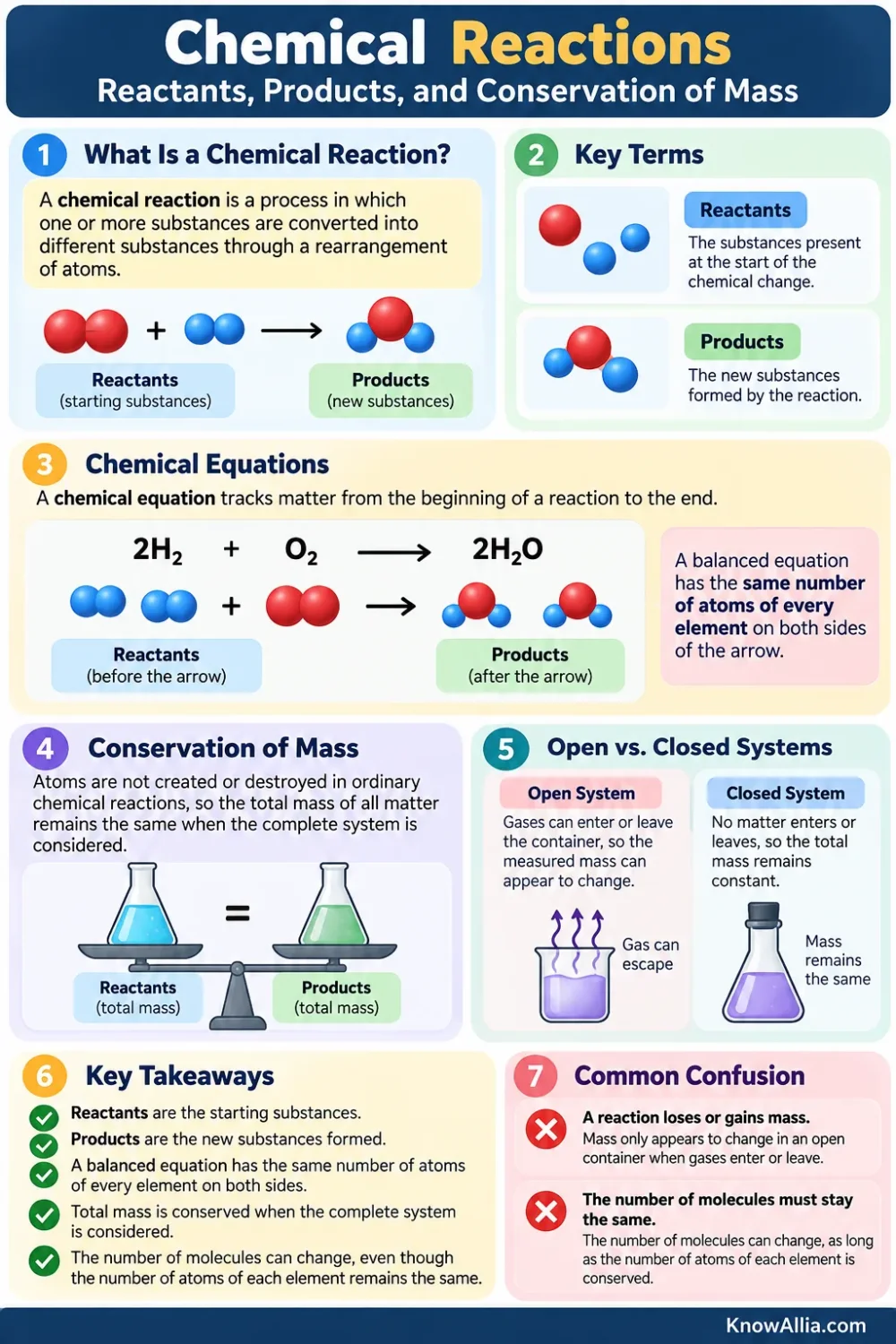
A chemical reaction is a process in which one or more substances are converted into different substances through a rearrangement of atoms. The starting substances are called reactants, while the substances formed are called products. Although atoms change partners and chemical bonds are broken or formed, ordinary chemical reactions do not create or destroy atoms. This is why the total mass of all matter involved remains conserved when the complete system is considered.
The Main Idea
A chemical equation tracks matter from the beginning of a reaction to the end. Reactants appear before the reaction arrow, products appear after it, and a correctly balanced equation contains the same number of atoms of every element on both sides.
- Reactants are the substances present at the start of the chemical change.
- Products are the new substances formed by the reaction.
- Conservation of mass means all matter must be counted, including gases that enter or leave an open container.
These ideas explain how to read chemical equations, why equations must be balanced, why a reaction can appear to lose or gain mass in an open container, and why the number of molecules does not have to remain constant even though the number of atoms of each element does.
What Happens in a Chemical Reaction?
During a chemical reaction, atoms that were arranged in one set of substances become arranged in another. Existing chemical bonds may break, new bonds may form, and the identities of the substances can change. The atoms themselves remain part of the material being tracked.
A useful analogy is to imagine a collection of colored beads being separated and regrouped into different patterns. The groups change, but the beads do not disappear. Chemical reactions work at an atomic level in a similar accounting sense: the arrangement changes while the atoms are retained.
A reaction may involve one reactant or several reactants. It may also form one product or several products. The International Union of Pure and Applied Chemistry describes a chemical reaction equation as a symbolic representation with reactant entities on the left and product entities on the right.[a]
Reactants
Reactants are the substances that participate in the reaction from the starting side of the chemical equation. Their atoms are the material from which the products are formed.
In the equation 2H2 + O2 → 2H2O, hydrogen and oxygen are reactants. The plus sign separates two different reactant formulas.
Products
Products are the substances generated by the reaction. They appear on the right side of a standard forward-reaction arrow. In the water equation above, H2O is the product.
Products can have properties very different from those of the reactants because their atoms are connected in different arrangements. Conservation of matter does not mean that the original substances remain unchanged. It means the matter from which those substances were made is still accounted for.
Chemical Change vs. Physical Change
A chemical reaction forms substances with new chemical identities. A physical change, such as melting or a change between liquid and gas, changes the form or state of matter without changing its chemical identity. Mass is conserved in both types of change when the entire system is counted.
- Chemical change: atoms become connected or arranged differently, producing different substances.
- Physical change: the substance remains chemically the same even though its state, shape, size, or distribution may change.
- Both: matter remains accounted for when nothing enters or leaves the system.
How Chemical Equations Represent Reactions
A chemical equation is a compact description of a chemical change. OpenStax identifies several standard features: reactants are written on the left, products on the right, plus signs separate formulas, an arrow separates the two sides, and coefficients indicate relative amounts.[b]
| Part | Meaning | Example |
|---|---|---|
| Reactant formula | Identifies a substance present on the starting side of the reaction. | H2 |
| Product formula | Identifies a substance formed by the reaction. | H2O |
| Plus sign | Separates multiple substances on the same side. | H2 + O2 |
| Reaction arrow | Separates the reactant side from the product side in a forward reaction. | → |
| Coefficient | Shows the relative number of formula units, molecules, or amounts represented. | 2H2O |
| Subscript | Shows the number of atoms of an element within a chemical formula. | The 2 in H2O |
| State symbol | Can identify whether a substance is solid, liquid, gas, or dissolved in water. | (s), (l), (g), (aq) |
Why Equations Must Be Balanced
A chemical equation is balanced when every element has the same number of atoms on both sides. This reflects conservation of matter. If an equation shows four hydrogen atoms among the reactants, a balanced version must also account for four hydrogen atoms among the products.
Balanced equation: 2H2 + O2 → 2H2O
- Hydrogen atoms: 4 on the reactant side, 4 on the product side.
- Oxygen atoms: 2 on the reactant side, 2 on the product side.
The equation also reveals a detail that is easy to miss: there are three molecules represented on the reactant side—two H2 molecules and one O2 molecule—but two H2O molecules on the product side. The number of molecules is not required to stay the same. The number of atoms of each element is what must remain balanced in an ordinary chemical equation.
Coefficients Can Change; Subscripts Cannot
Balancing an equation is done by changing coefficients, not the subscripts within established chemical formulas. A coefficient changes how many units of a substance are represented. Changing a subscript changes the formula itself and may represent a different substance.
For example, H2O and H2O2 do not represent two different quantities of the same substance. They are different compounds. For this reason, changing H2O into H2O2 is not a valid method of balancing an equation.
The Law of Conservation of Mass
The law of conservation of mass states that matter is not created or destroyed during an ordinary chemical reaction. In practical chemical measurements, this means the total mass of the complete set of reactants equals the total mass of the complete set of products when all matter is contained and accounted for. The American Chemical Society uses before-and-after mass measurements to demonstrate that total mass remains unchanged during chemical and physical processes.[c]
This relationship can be expressed simply as:
Total mass before the reaction = total mass after the reaction
The wording total mass matters. It does not mean that the mass of one chosen product must equal the mass of one chosen reactant. Every substance participating in the system has to be included.
Following Matter Through a Chemical Reaction
Chemical identities can change while the same atoms remain accounted for.
1. Start With Reactants
Count every substance that enters the reaction, including gases supplied by the surrounding air when they participate.
2. Rearrange the Atoms
Chemical bonds change and atoms form new combinations. The identity of the substances may therefore change.
3. Account for Products
The products contain the same elements and the same total number of atoms of each element represented by the balanced reaction.
Closed Container
If matter cannot enter or leave, the measured total mass should remain the same within experimental uncertainty.
Gas Leaves
An open container may become lighter because gaseous matter has moved into the surrounding air.
Matter Enters
A sample can become heavier when a substance from the surroundings, such as oxygen, becomes part of a product.
Mass Is Conserved Even When Substances Look Different
The appearance of the products does not determine whether mass has been conserved. A reaction can produce a solid, a liquid, a gas, or a mixture. Matter may become difficult to see or may spread into a larger volume, but visibility is not the same as existence.
If a sealed reaction container has a total mass of 125.0 g before a reaction, the complete sealed system should still have a total mass of approximately 125.0 g afterward, allowing for the uncertainty of the measuring equipment. The material inside may have changed chemically, but no matter has crossed the system boundary.
Why Open and Closed Systems Matter
Many apparent exceptions to conservation of mass come from measuring only part of a reaction. The distinction between an open system and a closed system explains much of the confusion.
Closed System
In a closed reaction system, matter is prevented from entering or leaving the chosen boundary. Energy may still move between the system and its surroundings, so a closed system should not automatically be confused with a perfectly isolated system.
Northwestern University’s CT-STEM conservation-of-mass activities use closed setups that trap gaseous products so students can compare the overall mass before and after a reaction.[d]
Open System
An open system allows matter to cross the boundary. A gas can escape, water can evaporate, or a gas from the surrounding air can enter and react. A balance measures what remains on it; it does not automatically include matter that has moved elsewhere.
| Observation | What May Be Happening | Does It Violate Conservation of Mass? |
|---|---|---|
| Measured mass stays the same | The system is closed and all matter remains inside the measured boundary. | No. This directly matches the expected result. |
| Container appears to lose mass | A gaseous product or vapor may have left an open container. | No. The escaped matter must be included in the complete accounting. |
| Sample appears to gain mass | Matter from the surroundings may have entered the reaction and become part of the products. | No. The incoming substance was also a reactant. |
| Small unexplained difference | Measurement uncertainty, material transfer, evaporation, residue, or an incomplete measurement may be involved. | Not enough information from the mass reading alone. |
Why a Gas Can Make Mass Seem to Disappear
Suppose a reaction in an uncovered container produces a gas. If the gas moves into the room, the material remaining on the balance can have less mass than the original material. The reaction has not destroyed matter. The measurement boundary has changed what is being weighed.
If the same reaction occurred in a sealed system that retained the gas, the mass of the entire sealed setup before and after the reaction would be expected to match within normal measurement uncertainty.
Why a Product Can Become Heavier
The opposite situation is also possible. A material exposed to air can react with oxygen. If only the original solid is treated as the starting mass, the product may appear to have gained mass. There is no unexplained creation of matter: oxygen from the air has become part of the product.
Reading Reactions Step by Step
Example 1: Formation of Water
Consider the balanced equation:
2H2 + O2 → 2H2O
- The reactants are H2 and O2.
- The product is H2O.
- The coefficient 2 in front of H2 represents two units of H2.
- The coefficient 2 in front of H2O represents two units of H2O.
- Both sides contain four hydrogen atoms and two oxygen atoms.
This equation is balanced even though the number of molecules represented on each side is different. Conservation applies to the atoms and the resulting total mass, not to a requirement that the same number of molecules must exist before and after the reaction.
Example 2: Decomposition
A reaction does not always combine several reactants. One substance can also form two or more products. A simple symbolic pattern is:
AB → A + B
Here, AB is the reactant and A and B are products. If the equation represents an ordinary chemical change, every atom originally present in AB must still be represented among the products.
Example 3: Two Reactants Form Two Products
Another common pattern is:
AB + CD → AD + CB
The atoms represented by A, B, C, and D appear on both sides, but their combinations have changed. This simple pattern shows the central accounting rule behind chemical equations: atoms may be regrouped without being lost from the reaction.
Coefficients Describe Ratios, Not Equal Masses
A balanced equation does not say that every reactant has the same mass as every product. Coefficients describe relative amounts of chemical species. Because different substances have different molar masses, equal coefficients do not usually mean equal gram masses.
Balanced equations provide the ratios used in reaction stoichiometry. Purdue University’s chemistry resources likewise connect balanced equations with the principle that the total mass of products must equal the total mass of reactants.[e]
Common Confusion About Reactions and Mass
“Products Must Weigh the Same as Each Individual Reactant”
This is not what conservation of mass means. The comparison is between the total mass of all reactants and the total mass of all products. Individual substances can have very different masses.
“The Same Number of Molecules Must Appear on Both Sides”
No. Molecules can combine or separate. A balanced reaction can have different numbers of molecules on the two sides. What must balance is the number of atoms of each element represented in the chemical equation.
“A Gas Has No Mass”
Gases are matter and have mass. When a gas escapes from an open reaction vessel, the measured mass of the vessel and its remaining contents can decrease because some matter is no longer on the balance.
“If Mass Increases, Matter Was Created”
An apparent gain can occur when matter enters from the surroundings. If oxygen from the air becomes part of a product, for example, the incoming oxygen must be included with the reactants when total mass is calculated.
“Balancing Means Changing Chemical Formulas”
Chemical formulas identify substances. They are not adjusted simply to make atom counts match. Equations are normally balanced by changing coefficients placed before the formulas.
“Any Visible Change Proves a Chemical Reaction Occurred”
Observations such as gas formation, a new solid, a color change, light, or a temperature change can provide evidence of chemical change, but an observation by itself may not identify exactly what happened. Some physical processes can also create visible changes. Determining whether new substances formed requires attention to the chemistry of the system rather than appearance alone.
Essential Terms
- Reactant
- A substance represented on the starting side of a chemical reaction.
- Product
- A substance formed by a chemical reaction.
- Chemical reaction
- A process in which substances are converted into other substances through changes in atomic arrangement and chemical bonding.
- Chemical equation
- A symbolic representation of reactants, products, and their quantitative relationships.
- Coefficient
- A number placed before a chemical formula to indicate its relative amount in an equation.
- Subscript
- A number within a chemical formula that helps specify how many atoms of an element are represented in that formula unit or molecule.
- Balanced equation
- An equation with equal numbers of atoms of every represented element on the reactant and product sides.
- Conservation of mass
- The principle that the total mass of matter remains accounted for during an ordinary chemical reaction.
- Closed system
- A defined system in which matter does not cross the system boundary during the process being considered.
- Open system
- A system in which matter can enter or leave the chosen boundary.
- Stoichiometry
- The quantitative relationships between reactants and products described by a balanced chemical equation.
What Mass Measurements Can and Cannot Tell Us
Real measurements are not perfectly exact. Two recorded masses may differ slightly because balances have limited precision and because transferring materials, evaporation, residue on equipment, or matter entering or leaving the setup can affect what is measured.
A small difference between measured mass before and after an experiment therefore does not automatically show that matter was created or destroyed. The first questions are whether the entire system was measured, whether matter crossed its boundary, and whether the difference is larger than the uncertainty of the measurement.
Important distinction: conservation of mass describes the full chemical system. A laboratory balance records only the objects and materials that remain within the part of the system being weighed.
For ordinary chemistry, conservation of mass is an extremely accurate working rule. Modern physics describes the broader conservation of mass-energy, but the energy changes involved in typical introductory chemical reactions do not alter the practical method of balancing chemical equations or ordinary laboratory mass accounting.
Frequently Asked Questions
What is the difference between a reactant and a product?
A reactant is a substance present on the starting side of a chemical reaction. A product is a substance formed by the reaction. In a standard forward chemical equation, reactants are written on the left of the arrow and products on the right.
Why must a chemical equation be balanced?
A balanced equation contains the same number of atoms of each element on both sides. This keeps the equation consistent with conservation of matter and provides the correct relative amounts for quantitative calculations.
Does the number of molecules stay the same during a chemical reaction?
Not necessarily. Molecules can combine to form fewer molecules or split into a larger number of molecules. The atom count for each element must remain balanced, but the total number of molecules can change.
Can the measured mass decrease during a chemical reaction?
Yes, an open container can show a lower measured mass if matter such as a gaseous product leaves the measured system. When that escaped gas is included, the complete mass accounting remains consistent with conservation of mass.
Can a reaction product weigh more than the original sample?
Yes. Matter from the surroundings can enter the reaction. If a substance reacts with oxygen from the air, for example, the oxygen becomes part of the product and contributes to its mass.
Do gases have mass?
Yes. Gases are matter and have mass. Their low density and ability to spread through a room can make them less obvious than solids or liquids, but they must still be included when tracking matter through a reaction.
Can subscripts be changed to balance an equation?
No. A subscript is part of a chemical formula and changing it can change the identity of the substance. Balancing is normally done by adjusting coefficients placed before chemical formulas.
Does conservation of mass apply only to chemical reactions?
No. Matter also remains conserved during ordinary physical changes. Melting, freezing, evaporation, and dissolving can change the form or distribution of matter without causing it to disappear.
Why might experimental masses differ slightly before and after a reaction?
Small differences can result from measurement uncertainty, evaporation, material left on equipment, transfer losses, matter entering or leaving an open system, or other experimental conditions. The size of the difference must be considered together with the limits of the measurement.
Sources
- IUPAC Gold Book – Chemical Reaction Equation — Standard terminology for the symbolic arrangement of reactants, products, coefficients, and reaction arrows. ↩
- OpenStax Chemistry 2e – Writing and Balancing Chemical Equations — Detailed treatment of reactants, products, coefficients, atom counting, and balanced equations. ↩
- American Chemical Society – Conservation of Mass — Educational material showing conservation of total mass during physical and chemical changes. ↩
- Northwestern University CT-STEM – What Happens to Mass During a Chemical Reaction? — Closed-system reaction activities designed to retain gases and compare total mass before and after reaction. ↩
- Purdue University Chemistry – Chemical Reactions and Stoichiometry — University reference connecting balanced equations, atom conservation, and quantitative relationships between reactants and products. ↩