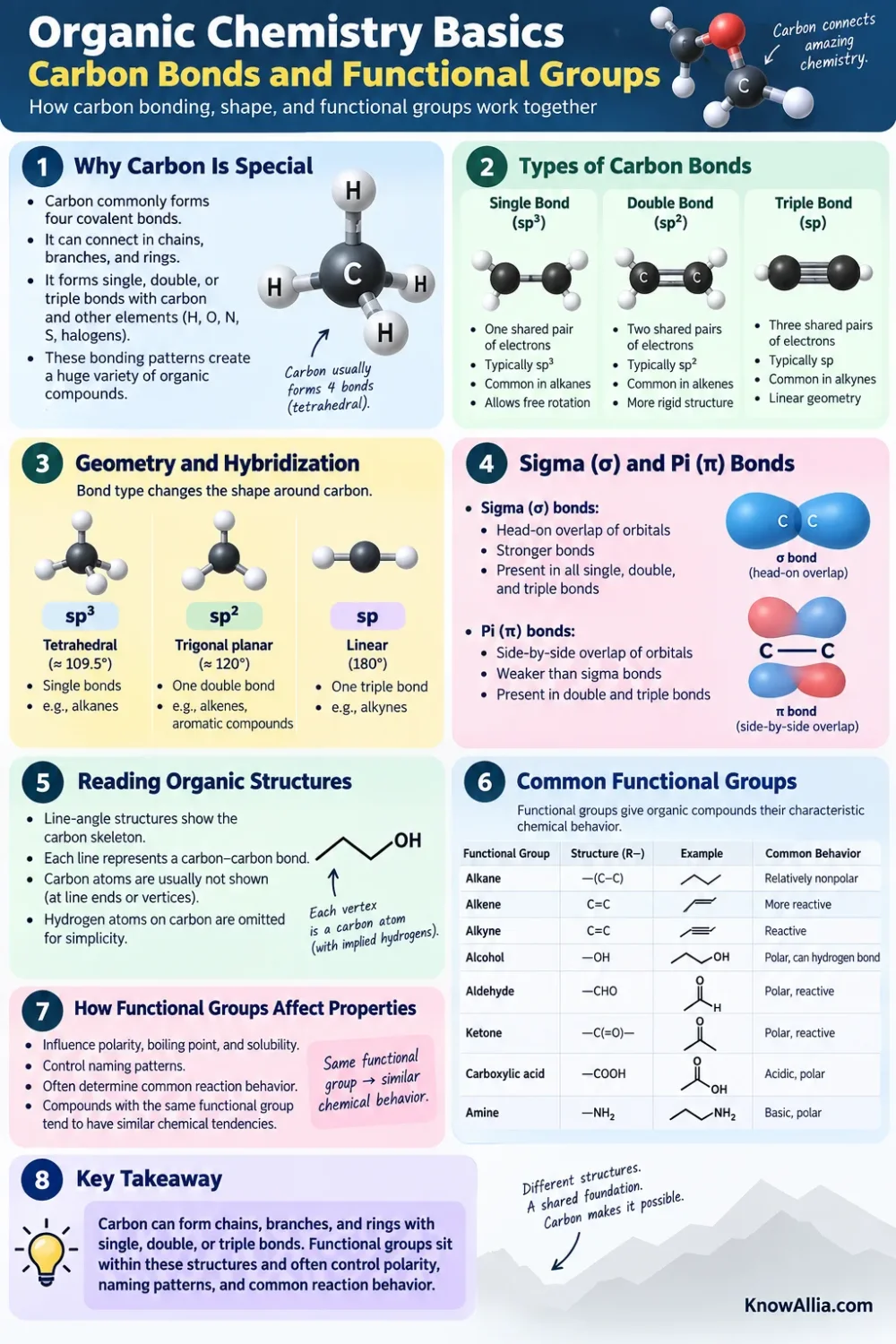
Organic chemistry focuses mainly on carbon compounds and the ways carbon atoms connect to one another and to elements such as hydrogen, oxygen, nitrogen, sulfur, and the halogens. The subject becomes much easier to read once two ideas are clear: carbon commonly forms four covalent bonds, and recurring arrangements of atoms called functional groups give many organic compounds their recognizable chemical behavior. [a] ↘
This page explains carbon single, double, and triple bonds; sp3, sp2, and sp bonding; sigma and pi bonds; line-angle structures; common functional groups; bond polarity; and the structural patterns that help distinguish one organic compound family from another. The goal is not to memorize isolated formulas, but to see how bonding pattern, shape, and functional group identity fit together.
The Main Idea
Carbon can connect in chains, branches, and rings while also forming multiple bonds. Functional groups sit within those carbon structures and often control polarity, naming patterns, and common reaction behavior.
- Four-bond pattern: neutral carbon most often reaches a total bond order of four.
- Bond type changes geometry: single-, double-, and triple-bonded carbon commonly correspond to sp3, sp2, and sp descriptions.
- Functional groups organize organic chemistry: the same recognizable group often gives related compounds similar chemical tendencies.
Why Carbon Forms So Many Different Structures
Carbon has four valence electrons. In the most common neutral bonding patterns used in introductory organic chemistry, it shares electrons with other atoms through covalent bonds and forms a total bond order of four. That is why methane is written CH4, why a carbon in an alkane may have four single bonds, and why a carbon in a carbonyl group can have one double bond plus two single bonds. OpenStax describes carbon as tetravalent in stable organic compounds, while IUPAC defines a covalent bond in terms of shared electron density between nuclei. [b] ↘
Carbon also bonds well to other carbon atoms. This allows straight chains, branched chains, rings, double bonds, triple bonds, and aromatic systems. A carbon skeleton can therefore range from only one or two carbon atoms to a much larger network. The skeleton is not just a support structure: its length, branching, ring formation, and unsaturation can alter shape, flexibility, and physical properties.
Single, Double, and Triple Carbon Bonds
- Single bond, C–C: two carbon atoms share one bonding pair. The bond is a sigma bond.
- Double bond, C=C: the two carbons share two bonding pairs. One bond is sigma and one is pi.
- Triple bond, C≡C: the two carbons share three bonding pairs. One bond is sigma and two are pi.
The difference is more than the number of lines drawn between atoms. Multiple bonds change electron distribution and molecular geometry. They also restrict motion compared with many ordinary carbon–carbon single bonds. In a localized two-center description, IUPAC distinguishes sigma and pi bonding by the symmetry of the electron distribution around the internuclear axis. [c] ↘
A useful analogy: think of the carbon skeleton as a road network and functional groups as junctions that change where traffic can go. The roads define the overall route, while the junctions strongly influence what can happen at particular locations.
Bonding and Molecular Geometry Around Carbon
Hybridization is a model used to describe the directional bonding of atoms. IUPAC defines hybridization as a linear combination of atomic orbitals and notes the common sp3, sp2, and sp descriptions used for tetrahedral, trigonal, and linear bonding arrangements in organic chemistry. [d] ↘
| Carbon Description | Typical Bond Pattern | Approximate Geometry | Approximate Bond Angle | Bond Components |
|---|---|---|---|---|
| sp3 | Four single bonds | Tetrahedral | 109.5° | Four sigma bonds |
| sp2 | One double bond plus two other bonds | Trigonal planar | 120° | Three sigma directions plus one pi bond |
| sp | One triple bond, or two double-bond directions in some structures | Linear | 180° | Two sigma directions plus two available p orbitals for pi bonding |
These angles are idealized values. Real molecules can deviate because neighboring atoms, ring strain, electron distribution, and other structural effects can shift bond angles away from the simplest model.
sp3: Tetrahedral Carbon
An sp3-described carbon has four sigma-bonding directions arranged approximately tetrahedrally. Methane is the simplest example. In an alkane chain, a carbon bonded only through single bonds is commonly described this way. Rotation is often possible around a carbon–carbon single bond because a sigma bond is cylindrically symmetric around the bond axis, although the rest of the molecule can make some conformations more favorable than others.
sp2: Planar Carbon in Double Bonds
An sp2-described carbon has three bonding directions in one plane and an unhybridized p orbital perpendicular to that plane. In a carbon–carbon double bond, the carbons form one sigma bond and one pi bond. The pi interaction depends on parallel p orbitals, so free rotation around the double bond would disrupt that overlap. This is why C=C units are much more geometrically constrained than ordinary C–C single bonds.
sp: Linear Carbon in Triple Bonds
An sp-described carbon has two bonding directions about 180° apart. In a carbon–carbon triple bond, one sigma bond joins the nuclei while two pi bonds arise from two sets of p orbitals. The local C≡C unit is therefore linear.
Carbon Bonding Pattern Map
Bond order changes the local geometry around carbon and changes how the surrounding atoms are arranged in space.
Three Common Carbon Environments
Mostly single bonds; tetrahedral arrangement; about 109.5° between idealized bond directions.
Often found in C=C and C=O units; planar around the carbon; about 120°.
Found in C≡C and C≡N units; linear arrangement; 180°.
What the Bond Lines Mean
One sigma bond.
One sigma bond plus one pi bond.
One sigma bond plus two pi bonds.
Flexibility
Many single bonds can rotate, although nearby groups affect which shapes are favored.
Planarity
Double-bonded carbon is commonly planar because of sp2 geometry and p-orbital overlap.
Recognition
Seeing C=C, C≡C, or C=O immediately tells you something about local geometry and electron distribution.
How Organic Structures Are Written
The same molecule can be represented in several ways. A molecular formula shows how many atoms of each element are present, but it does not necessarily show how those atoms connect. A condensed formula shows more of the connectivity, while a Lewis structure can show bonds and lone-pair electrons. A skeletal or line-angle structure removes much of the repeated carbon-and-hydrogen labeling so the carbon skeleton and functional groups are easier to see.
In standard skeletal notation, a carbon atom is normally understood at each line end and line intersection. Hydrogens attached to carbon are usually omitted and supplied mentally so that the carbon has the expected valence. Heteroatoms such as oxygen and nitrogen are written explicitly. OpenStax presents these as the basic conventions for skeletal structures. [e] ↘
- Molecular formula
- Counts atoms, such as C2H6O, but may not reveal connectivity.
- Condensed formula
- Shows grouped connectivity, such as CH3CH2OH.
- Lewis structure
- Shows bonding pairs and can show nonbonding electron pairs.
- Skeletal structure
- Uses lines for bonds and usually leaves carbon labels and carbon-bound hydrogens implicit.
Why Molecular Formula Alone Can Be Misleading
Two compounds can share a molecular formula but have different atom-to-atom connections. For example, C2H6O can be arranged as CH3CH2OH, an alcohol, or CH3OCH3, an ether. The atom counts are the same, but the functional groups are different. These are constitutional isomers.
This is one reason structural formulas matter so much in organic chemistry. A formula tells you composition; a structure tells you connectivity, and connectivity is closely tied to chemical behavior.
What Functional Groups Are
A functional group is an atom or group of atoms within a molecule that tends to show characteristic chemical properties across a family of compounds. IUPAC describes functional groups as recurring parts of organic molecules that define characteristic physical and chemical properties. [f] ↘ OpenStax similarly organizes organic compound families around recurring structural features such as carbon–carbon multiple bonds, carbon bonded to electronegative atoms, and carbonyl-containing groups. [g] ↘
In formulas below, R means the rest of an organic structure, Ar means an aromatic group, and X represents a halogen such as F, Cl, Br, or I.
| Compound Family | Recognizable Pattern | Example | Common Naming Signal | What Stands Out Structurally |
|---|---|---|---|---|
| Alkene | C=C | CH2=CH2 | -ene | Carbon–carbon double bond |
| Alkyne | C≡C | HC≡CH | -yne | Carbon–carbon triple bond |
| Arene | Aromatic ring | C6H6 | Often ring-specific naming | Conjugated cyclic pi system |
| Haloalkane | R–X | CH3Cl | fluoro-, chloro-, bromo-, iodo- | Carbon bonded to a halogen |
| Alcohol | R–OH | CH3CH2OH | -ol | Hydroxyl group on a non-aromatic carbon |
| Phenol | Ar–OH | C6H5OH | Phenol-based naming | OH directly attached to an aromatic ring |
| Ether | R–O–R | CH3OCH3 | Often alkoxy substituent naming | Oxygen between two carbon groups |
| Amine | R–NH2, R2NH, or R3N | CH3NH2 | -amine or amino- | Nitrogen bonded to carbon without an adjacent carbonyl in the amine group |
| Thiol | R–SH | CH3SH | -thiol | Sulfhydryl group |
| Aldehyde | R–CHO | CH3CHO | -al | Carbonyl carbon bonded to at least one hydrogen |
| Ketone | R–CO–R | CH3COCH3 | -one | Carbonyl carbon bonded to two carbon groups |
| Carboxylic Acid | R–COOH | CH3COOH | -oic acid | Carbonyl and hydroxyl attached to the same carbon |
| Ester | R–COOR | CH3COOCH3 | -oate | Carbonyl carbon bonded to an oxygen that continues to carbon |
| Amide | R–CONH2, R–CONHR, or R–CONR2 | CH3CONH2 | -amide | Nitrogen directly attached to a carbonyl carbon |
| Nitrile | R–C≡N | CH3C≡N | -nitrile | Carbon–nitrogen triple bond |
The Carbonyl Group Connects Several Families
The carbonyl group, C=O, deserves special attention because it appears inside several different functional groups. Aldehydes, ketones, carboxylic acids, esters, and amides all contain a carbonyl, yet they are not the same compound family. What is attached to the carbonyl carbon determines the class.
- If the carbonyl carbon is bonded to hydrogen, the group can be an aldehyde.
- If the carbonyl carbon is bonded to two carbon groups, it is a ketone.
- If the carbonyl carbon is bonded to OH, the group is a carboxylic acid.
- If the carbonyl carbon is bonded to OR, the group is an ester.
- If the carbonyl carbon is bonded to nitrogen, the group is an amide.
This pattern is more useful than memorizing each family in isolation because the same C=O unit becomes a reference point for recognizing several groups.
Aromatic Rings Are Not Just Ordinary Alternating Double Bonds
A benzene-like aromatic ring is often drawn with alternating single and double bonds, but that drawing is a representation of a delocalized pi-electron system rather than a set of permanently localized alternating bonds. Introductory line drawings remain useful, but the electron distribution is better described as delocalized across the conjugated ring. [j] ↘
How Functional Groups Affect Molecular Behavior
Functional groups matter because they change where electron density sits in a molecule. Bonds between atoms of different electronegativity can become polar, meaning the shared electrons are distributed unevenly. Oxygen, nitrogen, and halogens often create polar bonds when attached to carbon. IUPAC defines electronegativity as an atom’s tendency to attract electrons, while organic reaction models use those differences to explain partial positive and partial negative regions in molecules. [h] ↘
OpenStax describes many polar organic reactions in terms of attraction between electron-rich and electron-poor regions, with bond polarity often concentrated in or near functional groups. [i] ↘ That does not mean every molecule containing the same group reacts identically. The rest of the structure can change accessibility, electron distribution, stability, and reaction conditions.
Polarity and Intermolecular Attraction
A functional group can make part of a molecule polar even when the carbon skeleton is mostly nonpolar. Hydroxyl groups, carbonyl groups, amines, amides, and other heteroatom-containing groups can therefore alter how molecules interact with one another and with polar solvents. The exact physical effect depends on the full molecule, not on one group alone.
Acid–Base Behavior
Some functional groups can donate a proton under suitable conditions, while others can accept a proton through a lone pair of electrons. Carboxylic acids and amines are common introductory examples of groups with recognizable acid–base behavior, although the exact strength depends on molecular environment.
Likely Reaction Sites
Multiple bonds and polar functional groups often mark locations where reactions occur. A C=C bond has exposed pi electron density, while a carbonyl has an electron-poor carbon and an electron-rich oxygen in a simple polarity model. Organic reaction study often starts by identifying these local patterns before considering the detailed mechanism.
Naming Clues
Functional groups also appear in systematic names. Endings such as -ol, -al, -one, -oic acid, -oate, -amide, and -nitrile often signal the highest-priority group being named as a suffix. Prefixes can indicate other groups present in the same molecule. Full IUPAC naming rules include ordering and priority details beyond the basic recognition stage.
How to Identify Functional Groups in a Structure
- Locate multiple bonds first. Mark C=C, C≡C, C=O, and C≡N units.
- Inspect every heteroatom. Check oxygen, nitrogen, sulfur, and halogens and note what each one is directly bonded to.
- Classify carbonyl groups by the atom attached to the carbonyl carbon. This separates aldehydes, ketones, carboxylic acids, esters, and amides.
- Distinguish similar-looking oxygen groups. R–OH is an alcohol, R–O–R is an ether, R–COOH is a carboxylic acid, and R–COOR is an ester.
- Look for more than one group. Many organic molecules are multifunctional and cannot be described by a single functional group.
That last point matters. A molecule may contain an aromatic ring, an alkene, an amine, and an ester at the same time. Functional-group identification is therefore a pattern-recognition task, not a search for one label per molecule.
Common Points of Confusion
“Carbon Always Makes Four Single Bonds”
Carbon commonly has a total bond order of four in neutral introductory structures, but those bonds do not have to be four separate single bonds. One carbon can have four single bonds, two single bonds plus one double bond, one single bond plus one triple bond, or other valid arrangements. Charged and radical carbon species introduce additional patterns.
“A Double Bond Is Two Sigma Bonds”
A conventional carbon–carbon double bond contains one sigma bond and one pi bond. A carbon–carbon triple bond contains one sigma bond and two pi bonds. The pi component is what makes double and triple bonds electronically and geometrically different from ordinary single bonds.
“Any C=O Group Is a Ketone”
C=O is a carbonyl group, not automatically a ketone. A ketone is one specific carbonyl family. Aldehydes, carboxylic acids, esters, amides, and several other families also contain C=O.
“Alcohol and Ether Mean the Same Oxygen Pattern”
An alcohol contains an O–H bond in an R–OH pattern. An ether has oxygen between two carbon groups, R–O–R. Their oxygen atoms may look similar in a condensed formula, but their connectivity is different.
“Amine and Amide Are Interchangeable”
An amine has nitrogen attached to carbon without that nitrogen being directly attached to a carbonyl carbon. An amide has nitrogen directly attached to a carbonyl carbon, as in R–CONH2. That neighboring carbonyl changes the electron distribution and chemical behavior of the nitrogen-containing group.
“Same Functional Group Means Identical Reactivity”
Functional groups give useful families and recurring reaction patterns, but the surrounding molecular structure still matters. Steric crowding, resonance, inductive effects, ring strain, neighboring groups, solvent, temperature, and other conditions can change how readily a reaction occurs and which pathway is favored.
Key Terms
- Covalent bond
- A bond associated with shared electron density between atoms.
- Valence electron
- An electron in an atom’s outer electron shell that can participate in bonding.
- Bond order
- A description of how many bonding interactions connect two atoms; single, double, and triple bonds have increasing conventional bond order.
- Sigma bond
- A bond with electron density centered around the internuclear axis in the localized two-center description.
- Pi bond
- A bond formed from sideways overlap of suitable orbitals, with electron density distributed on opposite sides of the internuclear axis.
- Hybridization
- A model based on combinations of atomic orbitals, commonly described as sp3, sp2, or sp for carbon.
- Heteroatom
- In organic chemistry, an atom other than carbon or hydrogen within the organic structure, commonly oxygen, nitrogen, sulfur, or a halogen.
- Functional group
- A recurring atom or group of atoms associated with characteristic properties and reaction patterns.
- Carbonyl group
- A C=O unit found in aldehydes, ketones, carboxylic acids, esters, amides, and related families.
- Constitutional isomer
- One of two or more compounds with the same molecular formula but different atom-to-atom connectivity.
- Skeletal structure
- A line-angle representation in which most carbon labels and hydrogens attached to carbon are omitted.
Where These Introductory Models Stop
The models on this page are intentionally simplified. Hybridization, localized sigma and pi bonds, Lewis structures, and line-angle drawings are highly useful for learning and prediction, but actual electron density is described by quantum mechanics and may be delocalized across more than two atoms. Resonance drawings, for example, are alternative representations of one electronic structure rather than separate molecules rapidly switching back and forth. [k] ↘
Functional-group labels are also starting points rather than complete predictions. Two molecules that both contain an ester, amide, alkene, or other group can behave differently because the rest of the molecule changes electron distribution and accessibility. Exact reaction rates, equilibria, acidity, basicity, and physical properties require more information than the group name alone provides.
There is also a conventional boundary around the word organic. Organic chemistry centers on carbon compounds, but some simple carbon-containing substances are traditionally treated within inorganic chemistry. The useful dividing line is therefore disciplinary convention, not the mere presence or absence of a carbon atom.
Questions About Carbon Bonds and Functional Groups
Frequently Asked Questions
Why can carbon form four bonds?
Carbon has four valence electrons. In common neutral organic structures, sharing electrons through covalent bonds allows carbon to reach a stable valence-shell arrangement with a total bond order of four.
Is a carbon–carbon double bond a functional group?
Yes. A carbon–carbon double bond defines the alkene functional group. A carbon–carbon triple bond defines the alkyne group.
What is the difference between a carbonyl group and a carboxyl group?
A carbonyl is the general C=O unit. A carboxyl group is a specific arrangement, –COOH, containing a carbonyl and an OH attached to the same carbon.
How can I tell an ester from an ether?
An ether has the pattern R–O–R. An ester contains a carbonyl next to the oxygen, R–COO–R. The adjacent C=O is the feature that separates an ester from an ether.
Can one molecule contain several functional groups?
Yes. Many organic molecules contain two or more functional groups. Each group can contribute to polarity, naming, shape, and reactivity, while nearby groups can also influence one another.
What do R and X mean in organic formulas?
R usually stands for the rest of an organic carbon-containing group, while X commonly represents a halogen such as fluorine, chlorine, bromine, or iodine.
Why are skeletal structures used so often?
They reduce visual clutter. Carbon atoms at line ends and intersections are understood, most carbon-bound hydrogens are omitted, and heteroatoms remain visible. This makes carbon skeletons and functional groups easier to inspect.
Sources
The terminology and bonding descriptions above are grounded in current chemical reference definitions and open academic chemistry texts.
- [a] ↩ OpenStax – Development of Chemical Bonding Theory — carbon tetravalence, covalent bonding, valence electrons, and line-bond representations.
- [b] ↩ IUPAC Gold Book – Covalent Bond — official terminology for covalent bonding.
- [c] ↩ IUPAC Gold Book – Sigma and Pi — definitions and symmetry description of sigma and pi bonding.
- [d] ↩ IUPAC Gold Book – Hybridization — definition of hybridization and common sp3, sp2, and sp descriptions.
- [e] ↩ OpenStax – Drawing Chemical Structures — condensed and skeletal structure conventions.
- [f] ↩ IUPAC Gold Book – Functional Group — official definition of a functional group.
- [g] ↩ OpenStax – Functional Groups — common organic functional-group families and structural patterns.
- [h] ↩ IUPAC Gold Book – Electronegativity — reference definition for electron-attracting tendency.
- [i] ↩ OpenStax – Polar Reactions — bond polarity and electron-rich/electron-poor regions in organic reactions.
- [j] ↩ IUPAC Gold Book – Aromaticity — reference description of aromatic electron delocalization.
- [k] ↩ OpenStax – Resonance — resonance forms and delocalized electronic structure.