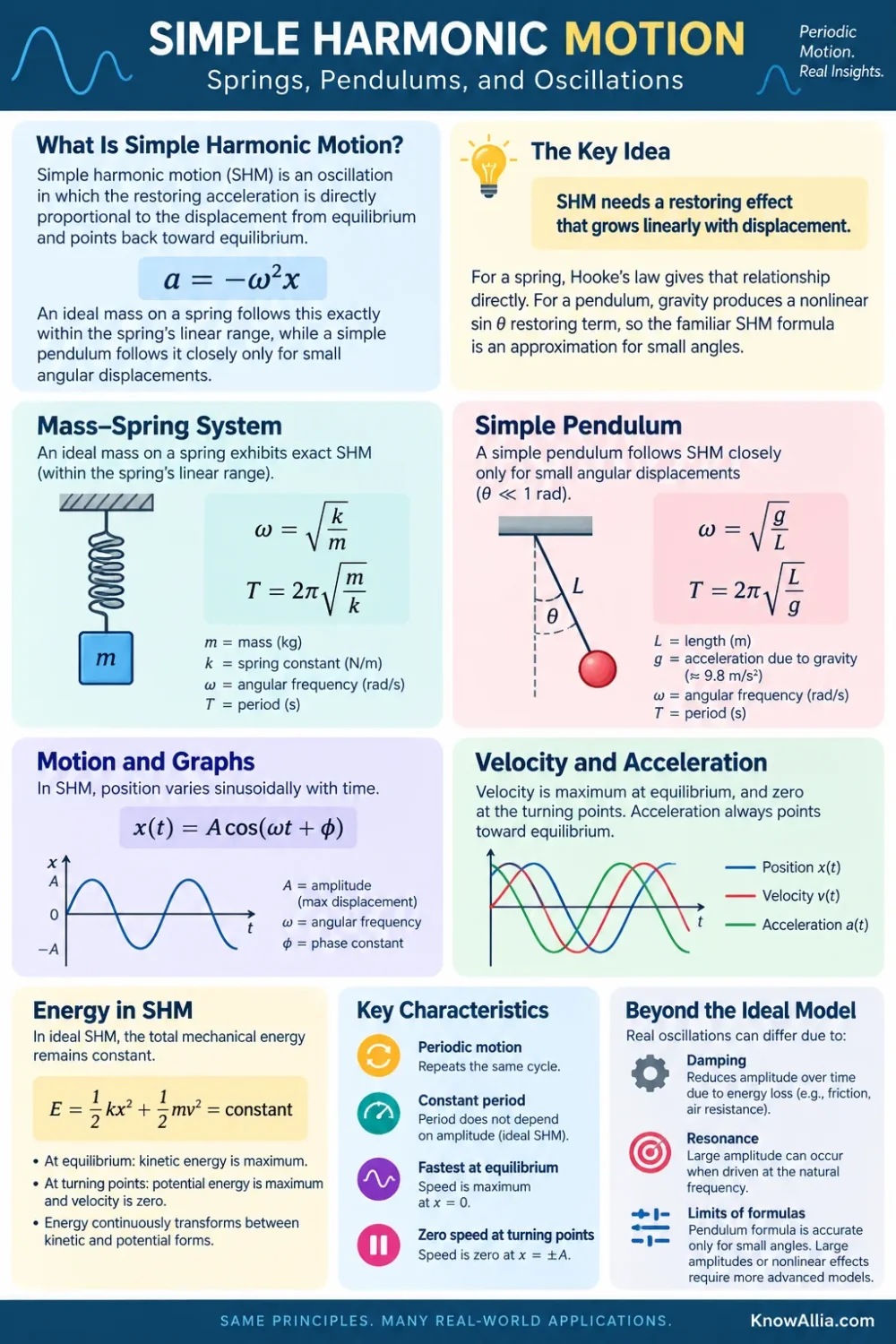
Simple harmonic motion (SHM) is an oscillation in which the restoring acceleration is directly proportional to displacement from equilibrium and points back toward equilibrium. In one dimension, that condition is written as a = −ω²x. An ideal mass on a spring follows it exactly within the spring’s linear range, while a simple pendulum follows it closely only for small angular displacements. [a]↗
The same model connects force, position, velocity, acceleration, period, frequency, phase, and energy. It also explains why an oscillator moves fastest at equilibrium, slows to zero speed at its turning points, and can repeat the same cycle without changing its period in the ideal model. You will see how the equations arise, how springs and pendulums differ, when the usual formulas stop being accurate, and how damping and resonance change real oscillations.
The Idea in a Few Lines
SHM needs a restoring effect that grows linearly with displacement. For a spring, Hooke’s law gives that relationship directly. For a pendulum, gravity produces a nonlinear sin θ restoring term, so the familiar SHM formula is an approximation for small angles.
- Spring:
ω = √(k/m)andT = 2π√(m/k). - Simple pendulum, small angle:
ω = √(g/L)andT = 2π√(L/g). - Ideal SHM: position is sinusoidal, total mechanical energy stays constant, and the period does not depend on amplitude.
What Makes Motion Simple Harmonic?
An object can oscillate without undergoing simple harmonic motion. The defining test is not merely that it moves back and forth. The net restoring force must have the form F = −Cx, where x is displacement from a stable equilibrium and C is a positive constant. Newton’s second law then gives ma = −Cx, so a = −(C/m)x. Comparing this with a = −ω²x identifies ω² = C/m.
The minus sign carries physical meaning: the acceleration always points opposite the displacement. If the object is to the right of equilibrium, acceleration points left. If it is to the left, acceleration points right. At equilibrium, x = 0, so the restoring acceleration is zero even though the object can be moving at its maximum speed.
Oscillation, Periodic Motion, and SHM Are Not Identical
- Oscillation means repeated motion or variation around an equilibrium value.
- Periodic motion repeats after a fixed time interval.
- Simple harmonic motion is the special sinusoidal case produced by acceleration proportional to
−x.
A real pendulum at a large angle, for example, still oscillates and can be periodic, but its restoring acceleration is not exactly proportional to angular displacement. That distinction matters because the familiar SHM equations become approximations rather than exact descriptions.
Core Equations and Quantities
The standard position equation is x(t) = A cos(ωt + φ). A sine form is equally valid; choosing sine or cosine changes how the phase constant is written, not the physics. Differentiating position gives velocity, and differentiating velocity gives acceleration. OpenStax lists the same sinusoidal position, velocity, and acceleration relationships for an ideal oscillator. [b]↗
| Quantity | Symbol / Equation | Meaning |
|---|---|---|
| Displacement | x(t) = A cos(ωt + φ) | Position measured from equilibrium. |
| Amplitude | A | Maximum magnitude of displacement. |
| Angular frequency | ω = 2πf = 2π/T | Rate of phase change, in rad/s. |
| Period | T | Time for one complete cycle, in seconds. |
| Frequency | f = 1/T | Cycles per second, measured in hertz. |
| Velocity | v(t) = −Aω sin(ωt + φ) | Zero at turning points; greatest magnitude at equilibrium. |
| Acceleration | a(t) = −ω²x(t) | Always directed toward equilibrium. |
| Phase constant | φ | Sets where in the cycle the oscillator is at t = 0. |
Useful extremes: vmax = Aω and amax = Aω². Increasing amplitude therefore raises the maximum speed and acceleration even when the period remains unchanged in ideal SHM.
Why Sine and Cosine Appear
A useful analogy is the shadow of a point moving uniformly around a circle. Imagine a point traveling around a circle of radius A at constant angular speed ω. Its horizontal projection moves back and forth between +A and −A as A cos(ωt + φ). This is more than a visual analogy: the projection of uniform circular motion follows the same mathematics as SHM. [c]↗
One Cycle of Simple Harmonic Motion
Three equations describe where the oscillator is, how fast it moves, and how strongly it is pulled back.
Position
Amplitude sets the farthest displacement. Phase sets the starting point in the cycle.x = A cos(ωt + φ)
Velocity
Speed is greatest while crossing equilibrium and zero at either turning point.v = −Aω sin(ωt + φ)
Acceleration
Acceleration is zero at equilibrium and greatest in magnitude at the turning points.a = −ω²x
Mass–Spring Simple Harmonic Motion
For an ideal spring that obeys Hooke’s law, the restoring force is F = −kx. Here k is the spring constant in newtons per meter (N/m). A larger k means a stiffer spring. Combining Hooke’s law with F = ma gives ma = −kx, or a = −(k/m)x. Therefore:
- Angular frequency:
ω = √(k/m) - Period:
T = 2π√(m/k) - Frequency:
f = (1/2π)√(k/m)
The dependencies are easy to read from the formulas. More mass means a longer period; a stiffer spring means a shorter period. In the ideal linear model, amplitude does not appear in the period equation. Doubling the amplitude doubles the maximum speed and doubles the maximum acceleration, but it does not change T.
Horizontal and Vertical Springs Use the Same Period Formula
A vertical spring can look different because gravity stretches it before oscillation begins. If y is measured from the spring’s unstretched length, static equilibrium occurs when ky₀ = mg, so y₀ = mg/k. Now measure the motion from that shifted equilibrium using x = y − y₀. The constant gravitational term cancels, leaving m d²x/dt² = −kx.
Result: for an ideal vertical spring, gravity changes the equilibrium position but not the angular frequency √(k/m) or the period 2π√(m/k). This statement assumes a constant spring stiffness and that the spring remains in its linear elastic range.
What If the Spring Has Noticeable Mass?
The textbook formula treats the spring as massless. A real spring has distributed mass, so parts of the spring also move and store kinetic energy. For a light spring compared with the attached mass, the massless-spring approximation works well. When spring mass is no longer negligible, the system’s effective inertia changes and the simple T = 2π√(m/k) form needs correction.
Pendulums and the Small-Angle Approximation
A simple pendulum consists of an idealized point mass on a light, inextensible string of length L. Gravity supplies the tangential restoring force. The exact tangential equation contains sin θ:
d²θ/dt² = −(g/L) sin θ
That equation is nonlinear, so a pendulum is not exactly a simple harmonic oscillator at arbitrary amplitude. For small angles measured in radians, sin θ ≈ θ. The equation then becomes d²θ/dt² ≈ −(g/L)θ, which has the SHM form. University treatments show this same small-angle step explicitly. [d]↗
- Angular frequency:
ω = √(g/L) - Period:
T = 2π√(L/g) - Frequency:
f = (1/2π)√(g/L)
A common introductory rule is to use the simple-pendulum SHM formula for angular amplitudes below about 15°; smaller angles give a closer approximation. The period in this approximation depends on pendulum length and gravitational acceleration, not on the bob’s mass. [e]↗
Why Pendulum Mass Cancels
A heavier bob experiences a larger gravitational force, but it also has proportionally greater inertia. In the equation of motion, the mass appears on both sides and cancels. Under the ideal simple-pendulum assumptions, replacing the bob with a heavier one does not change the small-angle period if L and g stay the same.
Large Angles Make the Period Longer
Once the angular amplitude is no longer small, sin θ cannot be replaced accurately by θ. The motion remains oscillatory, but the period acquires an amplitude dependence. The simple expression 2π√(L/g) then underestimates the actual period. This is one reason the phrase “a pendulum is SHM” always needs the small-angle condition attached to it.
| Change | Ideal Mass–Spring System | Small-Angle Simple Pendulum |
|---|---|---|
| Increase oscillating mass | Period increases as √m. | Bob mass does not change the ideal period. |
| Increase stiffness / shorten length | Larger k makes the period shorter. | Smaller L makes the period shorter. |
| Increase amplitude | No period change while Hooke’s law stays linear. | Nearly no change only in the small-angle range; large angles lengthen the period. |
| Change gravity | Gravity shifts vertical equilibrium but not the ideal spring period. | Period changes because T ∝ 1/√g. |
| Add damping | Amplitude decays and the ideal undamped equations no longer fully describe the motion. | |
Phase, Initial Conditions, and Motion Graphs
The phase ωt + φ tells where the oscillator is within its cycle. The phase constant φ is set by the initial position and velocity. At t = 0:
x₀ = A cos φv₀ = −Aω sin φ
If an oscillator is released from rest at its positive maximum displacement, then x₀ = A and v₀ = 0, so a convenient choice is φ = 0. If it starts at equilibrium moving in the positive direction, a sine-based position equation may be cleaner.
Position, Velocity, and Acceleration Are Out of Phase
Position and acceleration always have opposite signs because a = −ω²x. Velocity is shifted by one quarter-cycle relative to position. These phase relationships explain the characteristic sequence:
- At
x = +A, velocity is zero and acceleration points toward equilibrium. - At
x = 0, speed is maximum and acceleration is zero. - At
x = −A, velocity is zero again and acceleration points back toward equilibrium. - The oscillator returns through equilibrium with maximum speed in the opposite direction.
Energy During Simple Harmonic Motion
For an ideal spring oscillator with no friction, mechanical energy shifts continuously between spring potential energy and kinetic energy. The total remains constant:
- Spring potential energy:
U = ½kx² - Kinetic energy:
K = ½mv² - Total energy:
E = ½kA²
At either turning point, |x| = A and v = 0, so all the mechanical energy is potential. At equilibrium, x = 0, so the spring potential energy is zero relative to that equilibrium reference and the kinetic energy is maximum. Combining energy conservation with ω² = k/m gives another useful relation:
v = ±ω√(A² − x²)
This equation gives the speed at a known displacement without first finding time or phase. It also makes the turning points obvious: when x = ±A, the square root becomes zero.
Damping, Driving, Natural Frequency, and Resonance
Ideal SHM continues forever with constant amplitude. Real systems lose mechanical energy through effects such as friction, internal material losses, and fluid resistance. This produces damped oscillation. With light viscous damping, the system can continue crossing equilibrium while its amplitude decays over time. With enough damping, it can return to equilibrium without oscillating. OpenStax distinguishes underdamped, critically damped, and overdamped behavior in this way. [f]↗
Natural Frequency and Forced Oscillation
The natural frequency is the frequency an oscillator tends to use when displaced and released under its own restoring forces. A driven or forced oscillator receives an external periodic force. Its long-term response depends on the driving frequency, damping, and the oscillator’s own natural frequency.
Resonance
Resonance is the enhanced response that occurs when a periodic driving force acts near the frequency where the system responds most strongly. In the lightly damped idealization, this occurs close to the natural frequency. Damping limits the amplitude and changes the shape of the frequency response; lower damping produces a sharper resonance peak. [g]↗
Free, Damped, and Driven Motion
| Model | Energy Input or Loss | Typical Behavior |
|---|---|---|
| Ideal free SHM | No loss and no external driving after release. | Constant amplitude and one natural frequency. |
| Damped free oscillation | Mechanical energy is dissipated. | Amplitude decays; heavy damping can remove repeated crossings. |
| Driven oscillation | A periodic external force supplies energy. | Steady response depends on driving frequency and damping; resonance can occur. |
Worked Examples
Example 1: Spring Period, Speed, Acceleration, and Energy
A 0.50 kg mass is attached to an ideal spring with k = 200 N/m. It oscillates with amplitude A = 0.080 m.
- Angular frequency:
ω = √(200/0.50) = 20 rad/s. - Period:
T = 2π/20 ≈ 0.314 s. - Frequency:
f = 1/T ≈ 3.18 Hz. - Maximum speed:
vmax = Aω = 0.080 × 20 = 1.60 m/s. - Maximum acceleration:
amax = Aω² = 0.080 × 400 = 32.0 m/s². - Total mechanical energy:
E = ½kA² = 0.64 J.
If the same oscillator is mounted vertically, the mass stretches the spring by mg/k before it oscillates. Using g = 9.80665 m/s², that static stretch is about 0.0245 m, or 2.45 cm. The value 9.80665 m/s² is the conventional standard acceleration of free fall listed by NIST. [h]↗ The period around the shifted equilibrium remains about 0.314 s under the ideal spring assumptions.
Example 2: A One-Meter Pendulum
For a simple pendulum of length L = 1.00 m, using the same standard gravity value and assuming a small angular amplitude:
T = 2π√(L/g)T = 2π√(1.00/9.80665) ≈ 2.01 sf = 1/T ≈ 0.498 Hz
The mass of the bob does not enter the small-angle period formula. If the length becomes four times larger, the period doubles because period scales with √L.
Example 3: Find Speed from Position Without Finding Time
Return to the spring in Example 1, where A = 0.080 m and ω = 20 rad/s. At x = 0.040 m:
|v| = ω√(A² − x²) = 20√(0.080² − 0.040²) ≈ 1.39 m/s.
The sign of v cannot be determined from position alone because the oscillator passes the same position twice per cycle—once moving in each direction.
Common Confusions About SHM
- “The force is largest at equilibrium.”
- For SHM, the restoring force is proportional to displacement, so it is zero at equilibrium and largest in magnitude at the turning points.
- “The object stops at equilibrium because acceleration is zero there.”
- Acceleration is zero at equilibrium, but speed is maximum there. Zero acceleration does not mean zero velocity.
- “Every periodic motion is SHM.”
- No. SHM requires the specific linear restoring relation
a = −ω²x. - “A pendulum always has the period 2π√(L/g).”
- That expression is the small-angle approximation for an ideal simple pendulum. Large amplitudes make the actual period longer.
- “A heavier pendulum bob swings more slowly.”
- Not in the ideal small-angle simple-pendulum model. The bob mass cancels from the equation of motion.
- “Gravity changes the period of a vertical mass–spring oscillator.”
- For an ideal linear spring, gravity shifts the equilibrium extension but the oscillation period about that equilibrium remains
2π√(m/k). - “Amplitude never affects period.”
- That is true for ideal SHM. It can fail when the restoring force becomes nonlinear, as with a large-angle pendulum or a spring outside its linear range.
Key Terms
- Equilibrium position
- The position where the net restoring force is zero.
- Restoring force
- A force that acts toward equilibrium after displacement.
- Amplitude, A
- The maximum displacement from equilibrium.
- Period, T
- The time required for one complete cycle.
- Frequency, f
- The number of cycles per second;
f = 1/T. - Angular frequency, ω
- The rate at which phase changes;
ω = 2πf. - Phase, ωt + φ
- The quantity that identifies the oscillator’s position within a cycle.
- Natural frequency
- The characteristic frequency of free oscillation for a given idealized system.
- Damping
- Energy loss that reduces oscillation amplitude over time.
- Resonance
- A large driven response near a frequency where the oscillator responds strongly.
Limits of the Ideal Model
SHM is a model, and the formulas are only as accurate as their assumptions. A spring must remain close enough to its linear elastic range for F = −kx to hold. A pendulum must have a small enough amplitude for sin θ ≈ θ to be accurate. Air resistance, pivot friction, internal material losses, and other dissipative effects produce damping, so real amplitudes normally change with time.
Other details can matter too. A real spring may have noticeable mass. A real pendulum bob has finite size, and its suspension may have mass and elasticity. Local gravitational acceleration is not exactly the same everywhere, while 9.80665 m/s² is a defined standard reference value rather than the measured value at every location. Coupled oscillators can also have several normal modes instead of one frequency. These cases are not failures of mechanics; they simply require a model with more terms than ideal SHM.
Frequently Asked Questions
What is the simplest definition of simple harmonic motion?
Simple harmonic motion is oscillation in which acceleration is proportional to displacement from equilibrium and directed toward equilibrium: a = −ω²x.
What is the difference between an oscillation and SHM?
An oscillation is any repeated variation around an equilibrium state. SHM is the special case with a linear restoring relation, which produces sinusoidal motion.
Does amplitude affect the period of a spring?
Not for an ideal spring obeying Hooke’s law. Its period is T = 2π√(m/k). Large deformation can make a real spring nonlinear, in which case the ideal statement may no longer hold.
Does the mass of a pendulum bob affect its period?
Not in the ideal small-angle simple-pendulum model. The period is T = 2π√(L/g), so bob mass does not appear.
Why is the pendulum formula only approximate?
The exact restoring term is proportional to sin θ, not θ. Replacing sin θ by θ is accurate only when the angle, expressed in radians, is small.
Where is speed greatest in SHM?
At equilibrium, where displacement is zero. The speed falls to zero at the two turning points.
Where is acceleration greatest in SHM?
The magnitude of acceleration is greatest at the turning points because |a| = ω²|x|. It is zero at equilibrium.
Does gravity affect a vertical spring oscillator?
Gravity changes the equilibrium extension by mg/k. When displacement is measured from that new equilibrium, the ideal oscillation still has ω = √(k/m).
What is resonance in an oscillator?
Resonance is a strong response to periodic driving near a frequency where the system responds efficiently. Damping limits the response and changes how narrow or broad the resonance region is.
Sources
- OpenStax – Simple Harmonic Motion — definitions, Hooke’s law, periods, frequency, and introductory spring/pendulum relationships. [a] ↩
- OpenStax – University Physics: Simple Harmonic Motion — sinusoidal position, velocity, acceleration, and maximum-value equations. [b] ↩
- OpenStax – Oscillations Chapter Summary — circular-motion projection, pendulums, damping, and forced oscillation summary. [c] ↩
- University of Maryland – Simple Pendulum — nonlinear pendulum equation and the small-angle reduction to SHM. [d] ↩
- Idaho State University – Simple Pendulum — small-angle pendulum behavior, period, and mass independence. [e] ↩
- OpenStax – Damped Oscillations — damping regimes and decay of real oscillations. [f] ↩
- OpenStax – Forced Oscillations — driving frequency, resonance, and the role of damping. [g] ↩
- NIST – Guide to the SI, Appendix B.9 — standard acceleration of free fall,
9.80665 m/s². [h] ↩