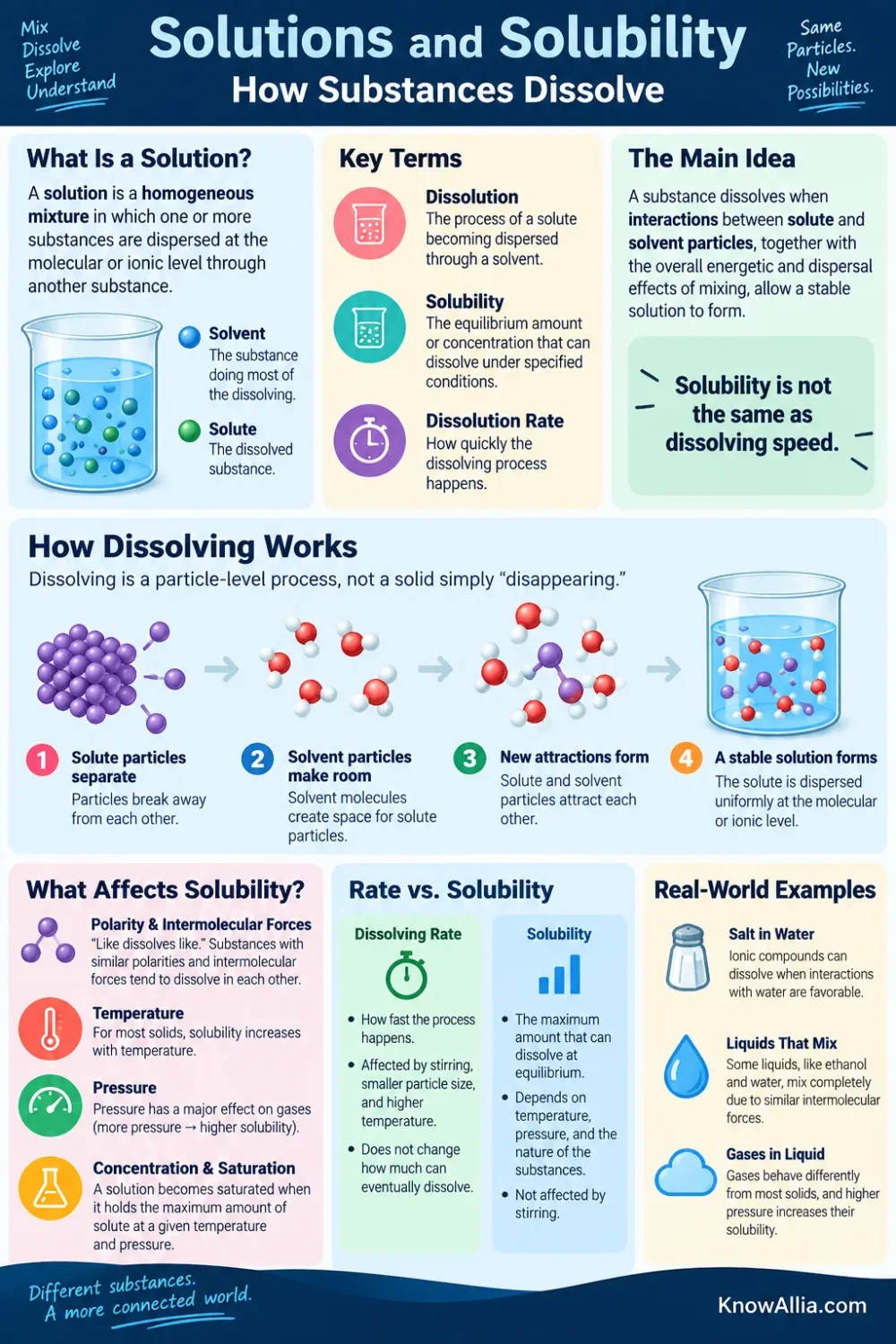
A solution is a homogeneous mixture in which one or more substances are dispersed at the molecular or ionic level through another substance. The substance doing most of the dissolving is called the solvent, while the dissolved substance is the solute. Solubility describes how much of a particular solute can exist in a solvent at equilibrium under specified conditions such as temperature and pressure.
Dissolving is not simply a solid “disappearing.” Solute particles separate from one another, solvent particles make room for them, and new attractions form between solute and solvent. Whether that process is favorable depends on particle interactions, energy changes, and the tendency of matter to become more dispersed. The same ideas explain why salt can dissolve in water, why some liquids mix completely, why gases behave differently from most solids, and why stirring can make something dissolve faster without necessarily making more of it soluble.
The Main Idea
A substance dissolves when interactions between solute and solvent particles, together with the overall energetic and dispersal effects of mixing, allow a stable solution to form. Solubility is not the same as dissolving speed.
- Dissolution is the process of a solute becoming dispersed through a solvent.
- Solubility is the equilibrium amount or concentration that can dissolve under specified conditions.
- Dissolution rate describes how quickly the process happens.
The sections below connect the particle-level process with polarity, intermolecular forces, temperature, pressure, concentration, saturation, electrolytes, and the practical difference between how fast something dissolves and how much can ultimately dissolve.
What Makes a Mixture a Solution?
A true solution is uniform at the molecular or ionic scale. A sample taken from one part of a well-mixed solution has the same composition as a sample of equal size taken from another part, assuming no settling, evaporation, reaction, or other change has occurred.
The International Union of Pure and Applied Chemistry describes a solution as a phase containing more than one substance in which one or more substances are treated as the solvent and the others as solutes.[a] In everyday introductory chemistry, the solvent is often the component present in the larger amount, although that simple rule does not cover every chemical system.
| Term | Meaning | Example |
|---|---|---|
| Solute | The substance treated as being dissolved | Sucrose in sugar water |
| Solvent | The medium through which the solute becomes dispersed | Water in sugar water |
| Aqueous solution | A solution in which water is the solvent | Potassium chloride dissolved in water |
| Homogeneous mixture | A mixture with uniform composition on the scale being considered | Air or a fully mixed salt solution |
| Solubility | The equilibrium composition of a saturated solution under specified conditions | A solute’s maximum equilibrium concentration at a stated temperature |
Solutions are not limited to solids dissolved in liquids. Chemists encounter gas-in-liquid, liquid-in-liquid, liquid-solid, solid-solid, and other solution systems. The physical state of a solution is generally associated with the solvent phase.
How the Dissolving Process Works
At the particle level, dissolution can be understood through three sets of interactions: solute-solute attractions, solvent-solvent attractions, and solute-solvent attractions. Dissolving requires particles that were originally associated with one another to become redistributed into a mixed state.
- Solute particles separate. Existing attractions within the solute must be overcome to some extent.
- Solvent particles rearrange. Space and suitable orientations develop for incoming solute particles.
- Solute-solvent interactions form. The solvent surrounds or interacts with the separated solute particles.
- The particles disperse. Random molecular motion spreads the solute through the solvent.
Separating particles generally requires energy, while establishing attractive solute-solvent interactions can release energy. A solution can therefore form with heat being absorbed, released, or with only a small net thermal change. OpenStax describes dissolution in terms of these competing intermolecular attractions and the increased dispersal of matter that accompanies solution formation.[b]
An analogy: imagine people changing seats in a crowded room. Existing groups have to separate, spaces must open, and new neighbors form. Whether the rearrangement happens easily depends on how strongly the original groups stay together and how favorable the new arrangements are. Molecules do not behave like people, but the comparison helps separate the three interaction steps involved in dissolution.
Solvation and Hydration
The interaction of a dissolved particle with surrounding solvent is called solvation. IUPAC defines solvation in terms of stabilizing interactions between a solute and solvent, including electrostatic attractions, van der Waals interactions, and more specific effects such as hydrogen bonding.[c]
When the solvent is specifically water, solvation is commonly called hydration. For an ionic solid such as potassium chloride, polar water molecules orient around the separated positive and negative ions. The resulting ion-dipole attractions help stabilize the ions after they leave the crystal.
Dissolution at the Particle Level
A solution forms through particle separation, rearrangement, attraction, and dispersal.
Separate the Solute
Some attractions holding solute particles together are overcome.
Rearrange the Solvent
Solvent particles move and create suitable local spaces.
Form New Attractions
Solute and solvent particles interact through forces appropriate to their structures.
Disperse Through the Phase
Particle motion distributes the dissolved species through the solution.
Polarity and Intermolecular Forces
The familiar phrase “like dissolves like” is a useful first approximation, but it is not a complete law of solubility. It means that substances with compatible types and strengths of intermolecular attraction often mix more readily than substances with very different intermolecular behavior.
Polar solvents can interact strongly with many polar molecules and ions. Nonpolar solvents tend to interact more favorably with nonpolar molecules through dispersion forces. Yet real solubility depends on the balance of all interactions in the system rather than polarity alone.
| Interaction | Where It Appears | Effect on Dissolution |
|---|---|---|
| Ion-dipole | Ions interacting with polar molecules | Helps stabilize many ions in polar solvents such as water |
| Hydrogen bonding | Suitable molecules containing strongly polarized bonds and available interaction sites | Can favor mixing when comparable interactions form between solute and solvent |
| Dipole-dipole | Polar molecules | Can support dissolution between compatible polar substances |
| Dispersion forces | Present between all atoms and molecules | Especially relevant in interactions among nonpolar substances |
Why Water Dissolves Many Substances
Water is strongly polar and can form hydrogen bonds. Its partial positive and negative regions interact with ions and many polar molecules, which makes it an effective solvent for a wide range of substances. That does not mean water dissolves everything. Many nonpolar substances have very low solubility in water because replacing favorable water-water interactions with relatively weak water-solute interactions may be unfavorable.
Miscible and Immiscible Liquids
When two liquids can form a single phase in all relative proportions, they have infinite miscibility. Liquids with very low mutual solubility form separate phases and are commonly described as immiscible. The boundary is not always absolute: two liquids described as immiscible may still dissolve in each other to a small extent.
Unsaturated, Saturated, and Supersaturated Solutions
Solubility is an equilibrium property. According to IUPAC, the solubility of a substance can be expressed through composition measures such as concentration, molality, mole fraction, or mole ratio.[d] This makes the conditions attached to a solubility value essential: the solvent, temperature, pressure when relevant, chemical form of the solute, and measurement basis all matter.
Unsaturated
The solution contains less dissolved solute than its equilibrium limit under the stated conditions. More solute can ordinarily dissolve if it is added and the chemical system remains otherwise unchanged.
Saturated
The dissolved solute is at its equilibrium solubility. If undissolved solute is present, dissolution and deposition can continue microscopically while producing no net concentration change.
Supersaturated
The solution temporarily contains more dissolved solute than the equilibrium solubility for the specified conditions. Such a state is outside stable equilibrium and may crystallize or precipitate when nucleation occurs.
A saturated solution is not one in which molecules have stopped moving. Dissolution and the reverse process can occur simultaneously. At equilibrium, their opposing rates balance so that the macroscopic concentration remains constant.
Supersaturation Is Not Simply “Extra Solute”
A supersaturated solution is a metastable or nonequilibrium state, not an ordinary saturated solution with a different name. It may be produced by changing conditions after a concentrated solution has formed. If crystallization begins, dissolved material can leave the solution until the system moves toward equilibrium. IUPAC defines a supersaturated solution by comparison with the composition of a solution in equilibrium with undissolved solute at the specified temperature and pressure.
How Temperature and Pressure Affect Solubility
There is no universal rule saying that heating always increases solubility. The response depends on the solute, solvent, physical state, and thermodynamics of the dissolution process.
Solid Solutes and Temperature
For many solids dissolved in liquids, solubility rises as temperature rises. Some solids show a much smaller change, while others can become less soluble over part of a temperature range. A solubility curve is therefore substance-specific; it is safer to consult measured data than to assume that every solid follows the same trend.
Gas Solubility and Temperature
For many gases dissolved in liquids, raising the temperature reduces gas solubility. Dissolved gas molecules have more opportunity to escape into the gas phase as thermal motion changes the balance between the phases. The exact relationship depends on the particular gas-solvent system.
Gas Solubility and Pressure
Gas solubility is especially sensitive to partial pressure. Under conditions where Henry’s law is a suitable approximation, the dissolved concentration of a gas is proportional to its partial pressure above the liquid. NIST notes that Henry’s law is a limiting relationship and that care is needed when applying it outside suitably dilute conditions.[e]
For one common form of Henry's law:

C = kP

C = dissolved gas concentration
P = partial pressure of the gas
k = proportionality constant for the chosen gas, solvent, temperature, and unit convention
Unit conventions matter. Several forms of the Henry-law constant are used in chemistry. A numerical constant cannot safely be transferred from one equation form to another without checking its definition and units.
Dissolution Rate Is Not the Same as Solubility
This distinction prevents one of the most common errors in introductory solution chemistry. Rate asks how quickly? Solubility asks how much can be present at equilibrium under these conditions?
| Change | Typical Effect on Dissolution Rate | Does It Necessarily Change Equilibrium Solubility? |
|---|---|---|
| Stirring | Usually makes a solid dissolve faster by improving contact with fresh solvent | No, not by itself at fixed equilibrium conditions |
| Grinding a solid | Usually increases rate by exposing more surface area | No for ordinary macroscopic equilibrium comparisons under otherwise unchanged conditions |
| Changing temperature | Can change the rate | Yes, often; the direction and size depend on the system |
| Changing gas pressure | Changes gas-liquid mass transfer conditions | Yes for dissolved gases when pressure affects equilibrium |
| Changing the solvent | May make dissolution faster, slower, or negligible | Yes, because solute-solvent interactions change |
Consider equal masses of granulated sugar and a sugar cube placed in otherwise identical water samples. The smaller particles expose more total surface area, so solvent molecules can interact with more solute surface at once. The granulated sample can therefore dissolve faster. That does not mean the equilibrium solubility of sucrose has automatically become larger merely because the crystals were smaller.
Stirring works differently but leads to the same distinction. It transports dissolved solute away from the immediate surface and brings less concentrated solvent into contact with undissolved material. The process can reach equilibrium faster, while the equilibrium limit remains governed by thermodynamic conditions rather than by how vigorously the container was stirred.
Solubility and Concentration Are Different Quantities
Concentration describes the composition of the solution that actually exists. Solubility describes an equilibrium limit under specified conditions. An unsaturated solution therefore has a concentration below its solubility, while a saturated solution has reached the relevant equilibrium value.
A solution can also be described informally as dilute or concentrated. Those words are relative and do not tell whether the solution is saturated. A concentrated solution can still be unsaturated, and a saturated solution of a poorly soluble material may contain only a small amount of solute.
Common Ways to Express Concentration
- Molarity: moles of solute per liter of solution.
- Molality: moles of solute per kilogram of solvent.
- Mass percentage: solute mass expressed as a percentage of total solution mass.
- Mole fraction: moles of one component divided by total moles of all components.
- Mass concentration: solute mass per chosen volume of solution, such as grams per liter.
Simple Molarity Example
If a solution contains 0.50 mol of solute in 2.00 L of final solution, its molarity is:
Molarity = moles of solute ÷ liters of solution

M = 0.50 mol ÷ 2.00 L
M = 0.25 mol/L
This calculation gives the concentration. It does not by itself tell whether 0.25 mol/L is unsaturated, saturated, or supersaturated. To determine that, the measured concentration must be compared with reliable solubility data for the same substance, solvent, temperature, pressure where relevant, and chemical form.
What Happens When Ionic Substances Dissolve?
When many soluble ionic compounds dissolve in water, their ions become separated and hydrated. For example, dissolved potassium chloride produces mobile potassium and chloride ions rather than intact neutral KCl units moving freely through the water.
Solutions containing mobile ions can conduct electric current and are called electrolyte solutions. OpenStax distinguishes strong electrolytes, weak electrolytes, and nonelectrolytes according to the extent to which dissolved material produces ions in solution.[f]
| Type | Particles Present in Solution | General Conductivity Behavior |
|---|---|---|
| Strong electrolyte | A high proportion of dissolved material exists as ions | Relatively strong conductivity at comparable concentration |
| Weak electrolyte | Only part of the dissolved material produces ions | Lower conductivity at comparable concentration |
| Nonelectrolyte | Dissolved particles remain primarily as neutral molecules | Little conductivity from the solute itself |
Electrolyte strength and solubility are different ideas. An ionic compound can be only sparingly soluble yet the fraction that does dissolve can dissociate extensively. Calling a substance a strong electrolyte does not mean that an unlimited amount of it will dissolve.
Solubility of Ionic Solids and the Solubility Product
For a sparingly soluble ionic compound, equilibrium can be written between the undissolved solid and its dissolved ions. Chemists describe such equilibria using a solubility product, commonly written as Ksp.
For a hypothetical solid AB that dissolves according to:
AB(s) ⇌ A⁺(aq) + B⁻(aq)
the equilibrium expression is related to the activities of the dissolved ions. IUPAC defines the solubility product in terms of ion activities raised to the powers required by the dissolution equilibrium.[g]
Ksp is not simply another word for solubility. Solubility describes how much dissolves under specified conditions. Ksp is an equilibrium quantity based on ion activities. Stoichiometry and other equilibria can affect how a Ksp value relates numerically to molar solubility.
Common Confusion About Dissolving
“If It Disappears, It Has Been Destroyed”
Dissolution does not mean matter has vanished. In an ordinary physical dissolution process, the solute particles become dispersed through the solvent. Evaporating the solvent can often recover a nonvolatile dissolved substance, although the exact recovery method depends on the chemical system.
“A Clear Liquid Must Be Pure”
A solution can look perfectly clear while containing large numbers of dissolved molecules or ions. Homogeneity and transparency do not establish chemical purity.
“Stirring Makes More Solute Soluble”
Stirring often makes dissolution occur faster, but it does not normally alter the equilibrium solubility simply because the liquid is moving. Once equilibrium is reached under the same temperature, pressure, and composition conditions, agitation alone does not create a new equilibrium solubility.
“Heating Always Raises Solubility”
Many solid-liquid systems show higher solubility at higher temperature, but exceptions exist. Gases commonly show the opposite trend in liquids. The correct relationship must be determined for the specific solute-solvent pair.
“Dilute Means Unsaturated”
Dilute and concentrated describe relative composition. Unsaturated and saturated compare the actual concentration with an equilibrium solubility. A substance with very low solubility can produce a solution that contains little solute yet is already saturated.
“Like Dissolves Like Predicts Every Case”
The phrase is a useful starting point for thinking about intermolecular forces, not a substitute for measured solubility data. Molecular size, structure, crystal stability, ionization, temperature, pressure, solvent composition, and competing equilibria can all influence real behavior.
Where Simple Solubility Rules Stop Working
Solubility values are only meaningful when their conditions and chemical definitions are clear. A single statement such as “compound X is soluble” may hide several variables. Different crystal forms of a solid can behave differently. A substance that reacts with the solvent can show behavior that cannot be explained as simple physical mixing. Acids and bases may become more or less soluble when their ionization state changes. Mixtures of solvents can behave differently from either pure solvent.
Particle size can also require more careful treatment at very small scales, and concentrated solutions may depart from simplified models based purely on concentration. In equilibrium calculations, activity rather than raw concentration provides the more fundamental thermodynamic description. For routine introductory problems, concentration-based approximations may still be appropriate when the assumptions are stated.
Measured solubility data can also differ when experiments use different temperatures, pressure conditions, chemical forms, purity levels, equilibration times, or reporting units. A value should therefore be interpreted with its measurement conditions rather than treated as a universal constant.
Key Terms
- Solution
- A homogeneous phase containing more than one substance.
- Solute
- A substance treated as being dissolved in a solution.
- Solvent
- The component treated as the dissolving medium.
- Dissolution
- The process by which a substance becomes dispersed in a solvent at the molecular or ionic level.
- Solvation
- Stabilizing interactions between solute and surrounding solvent.
- Hydration
- Solvation in which water is the solvent.
- Solubility
- The equilibrium composition of a saturated solution for a specified solute, solvent, temperature, pressure, and other relevant conditions.
- Unsaturated Solution
- A solution whose dissolved solute concentration is below the equilibrium solubility under the stated conditions.
- Saturated Solution
- A solution whose solute concentration corresponds to equilibrium with the relevant undissolved solute under specified conditions.
- Supersaturated Solution
- A nonequilibrium solution containing more dissolved solute than the corresponding equilibrium state.
- Miscible
- Describes liquids capable of forming one phase over the composition range being discussed; liquids miscible in all proportions can form one phase at any relative proportion.
- Immiscible
- A practical description for liquids with very low mutual solubility that separate into distinct phases.
- Electrolyte
- A substance that produces mobile ions when dissolved and therefore allows the solution to conduct electric current.
- Molarity
- The amount of solute in moles divided by the volume of solution in liters.
- Ksp
- The solubility-product equilibrium quantity used for sparingly soluble ionic substances.
Questions About Solutions and Solubility
What is the difference between a solute and a solvent?
The solute is the substance treated as being dissolved, while the solvent is the medium in which it is dispersed. In simple liquid solutions, the solvent is often present in the larger amount, but chemical definitions are not based only on which component has more mass.
What actually happens when a solid dissolves?
Particles at the solid surface separate from neighboring solute particles and become surrounded or stabilized by solvent particles. Random molecular motion then distributes the dissolved particles through the solvent.
Does stirring increase solubility?
Stirring generally increases the rate of dissolution by improving contact between undissolved solute and fresh solvent. It does not ordinarily change the equilibrium solubility at fixed temperature, pressure, and composition simply because the mixture is stirred.
Does crushing a solid make more of it dissolve?
Crushing increases surface area and can make an ordinary macroscopic solid dissolve faster. Under otherwise unchanged equilibrium conditions, greater surface area does not normally mean that a larger total equilibrium amount becomes soluble.
Why does temperature affect solubility?
Changing temperature changes the thermodynamic balance between dissolved and undissolved states. Many solids become more soluble as temperature rises, but this is not universal. Many gases become less soluble in liquids as temperature increases.
Why does pressure matter more for gases?
A gas dissolved in a liquid remains in equilibrium with gas above the solution. Raising the gas’s partial pressure can shift that equilibrium toward a greater dissolved amount. Under suitable dilute conditions, this relationship can be approximated with Henry’s law.
Can a saturated solution still contain undissolved solid?
Yes. In fact, undissolved solid may coexist with a saturated solution at equilibrium. Solute can continue entering and leaving the solution microscopically even though the overall dissolved concentration remains constant.
Is a supersaturated solution stable?
A supersaturated solution lies beyond the normal equilibrium solubility under its current conditions. It can persist for a time, but crystallization or precipitation may occur if nucleation begins.
Does a strong electrolyte have to be highly soluble?
No. Electrolyte strength concerns how extensively the dissolved material forms ions. Solubility concerns how much material enters solution. A sparingly soluble ionic compound can still dissociate extensively in the portion that does dissolve.
Is solubility a fixed property of a substance?
Not by itself. Solubility refers to a particular solute in a particular solvent under specified conditions. Temperature is usually relevant, pressure is especially relevant for gases, and chemical form or solution composition may also matter.
Sources
- IUPAC Gold Book – Solution — Terminology for solutions, solvents, solutes, and dilute solutions. ↩
- OpenStax Chemistry 2e – The Dissolution Process — Particle interactions, energy changes, solvation, and matter dispersal during dissolution. ↩
- IUPAC Gold Book – Solvation — Definition and interaction types involved in solvation. ↩
- IUPAC Gold Book – Solubility — Definition of solubility and accepted ways of expressing solution composition. ↩
- NIST – IUPAC-NIST Solubility Data Series Introduction — Gas solubility quantities and Henry-law conventions. ↩
- OpenStax Chemistry 2e – Electrolytes — Dissociation, hydration, conductivity, and strong versus weak electrolytes. ↩
- IUPAC Gold Book – Solubility Product — Definition of the activity-based solubility product for ionic solutes. ↩
- OpenStax Chemistry: Atoms First 2e – Solubility — Saturation, supersaturation, temperature, gas pressure, Henry’s law, and liquid-liquid miscibility.