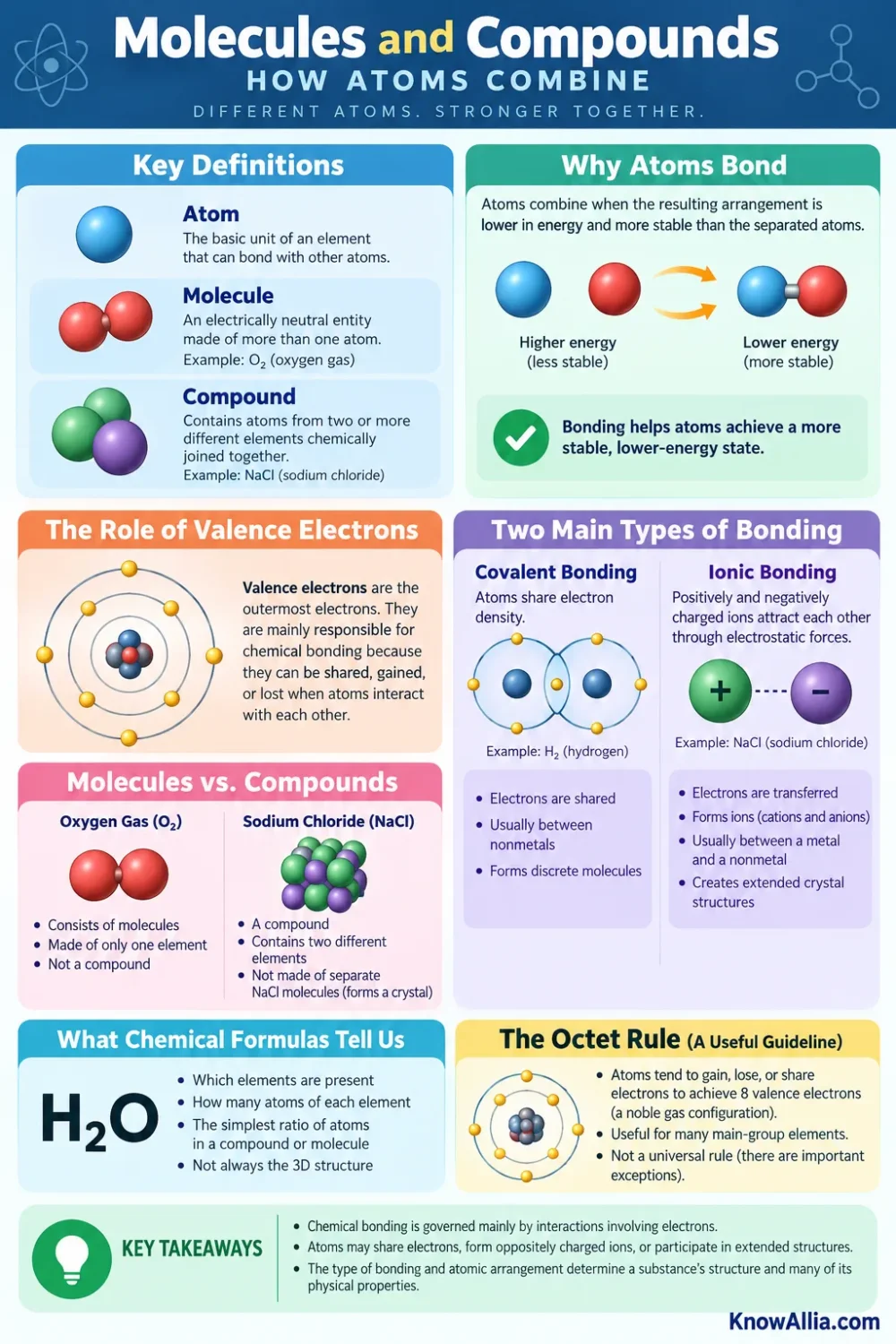
Atoms combine when interactions among their nuclei and electrons create a bonded arrangement that is energetically more favorable than keeping the atoms apart. A molecule is an electrically neutral entity made of more than one atom, while a compound contains atoms from two or more different elements chemically joined together. These ideas overlap, but they are not identical: oxygen gas, O2, consists of molecules but is not a compound, while solid sodium chloride, NaCl, is a compound but is not made of separate NaCl molecules. IUPAC molecule
The Central Idea
Chemical bonding is governed mainly by interactions involving electrons, especially valence electrons. Atoms may share electron density, form oppositely charged ions that attract one another, or participate in extended structures where electrons are spread across many atoms.
- Covalent bonding: electron density is shared between atoms.
- Ionic bonding: positively and negatively charged ions are held together by electrostatic attraction.
- Bonding type and atomic arrangement help determine a substance’s structure and many of its physical properties.
This article explains how atoms form molecules and compounds, why valence electrons matter, how covalent and ionic bonding differ, what chemical formulas actually describe, and why familiar rules such as the octet rule are useful without being universal laws.
Why Do Atoms Form Chemical Bonds?
A chemical bond exists when attractive interactions hold atoms or groups of atoms together in a stable arrangement. The details are described by quantum mechanics, but the basic picture is largely electrostatic: negatively charged electrons interact with positively charged nuclei while electrons repel other electrons and nuclei repel other nuclei. A stable bond length appears where these competing effects reach a favorable energy balance. IUPAC bond
It is therefore misleading to say that atoms bond simply because they “want eight electrons.” Atoms do not have intentions, and the octet rule is a pattern used to predict many structures, not the physical cause of bonding. Bond formation depends on the total energy of the system and the distribution of electrons.
When atoms approach each other, their outer electron clouds begin to interact. If the resulting arrangement lowers the system’s energy enough to produce a stable structure, a bond can form. Different elements do this in different ways because their electron configurations, orbital energies, nuclear charges, atomic sizes, and tendencies to attract electrons are different.
A useful mental picture: think of bond formation as finding a comfortable separation between two magnets surrounded by springs. Too far apart, the attractive interaction is weak. Push them too close and repulsive effects rise sharply. A stable bond occurs near an energy minimum between those extremes. The analogy is simplified, but it captures why bonded atoms have characteristic distances instead of collapsing into one another.
Molecules, Compounds, and Elements Are Different Categories
The terms atom, molecule, element, and compound describe different aspects of matter. Mixing them together leads to many introductory chemistry errors.
- An atom is an individual atomic entity identified by its number of protons.
- An element is defined by one atomic number. All oxygen atoms, for example, have eight protons.
- A molecule contains more than one atom and is electrically neutral according to the IUPAC definition used here.
- A compound contains atoms of at least two different elements chemically combined.
This produces an important distinction. H2, N2, and O2 are molecules but not compounds, because every atom within each molecule belongs to the same element. H2O and CO2 are both molecules and compounds because they contain different elements.
Ionic substances require another distinction. Sodium chloride is certainly a compound, but a crystal of ordinary NaCl is an extended arrangement of Na+ and Cl− ions rather than a collection of separate NaCl molecules. Its formula states the simplest charge-balanced proportion of the ions. OpenStax likewise distinguishes molecular compounds from ionic compounds. OpenStax classification
| Substance | Formula | Molecule? | Compound? | What the Formula Represents |
|---|---|---|---|---|
| Hydrogen | H2 | Yes | No | One molecule containing two hydrogen atoms |
| Oxygen | O2 | Yes | No | One molecule containing two oxygen atoms |
| Water | H2O | Yes | Yes | One molecule with two H atoms and one O atom |
| Carbon dioxide | CO2 | Yes | Yes | One molecule with one C atom and two O atoms |
| Sodium chloride | NaCl | No discrete NaCl molecules in the crystal | Yes | A 1:1 ratio of Na+ and Cl− in an ionic lattice |
| Silicon dioxide | SiO2 | Not as discrete SiO2 molecules in common network solids such as quartz | Yes | An overall 1:2 atomic ratio within an extended covalent network |
Why Valence Electrons Matter
Electrons occupy quantum states around an atomic nucleus. For basic bonding predictions, the most useful electrons are the valence electrons, the outer electrons that participate most directly in chemical interactions.
Elements in the same main-group column of the periodic table often have similar chemical behavior because they have related valence-electron patterns. This is why periodic-table position helps chemists anticipate common charges and bonding patterns.
The Octet Rule Is a Prediction Tool
Many main-group atoms form structures in which eight electrons are associated with their valence shell. This pattern is called the octet rule. Hydrogen is normally described by a two-electron arrangement instead.
The rule works particularly well for many simple compounds containing second-period elements such as carbon, nitrogen, oxygen, and fluorine. It also helps explain familiar bonding patterns: carbon often forms four covalent bonds, nitrogen often forms three, and oxygen often forms two.
Yet chemistry contains odd-electron species, electron-deficient structures, and hypervalent structures. OpenStax lists all three as recognized classes of octet-rule exceptions. Octet exceptions
Four Bonding Ideas That Explain Most Introductory Examples
The same atoms can behave differently depending on how electrons are distributed and how the bonded units are arranged.
Atoms are attracted to electron density located between their nuclei. Covalent bonds can be single, double, or triple in common Lewis representations.
Electron redistribution produces cations and anions. Opposite charges then attract throughout an extended ionic structure.
When bonded atoms attract shared electrons differently, the bond develops partial positive and partial negative ends.
Ionic crystals, covalent-network solids, and metals can extend through large numbers of atoms or ions instead of existing as independent molecules.
Covalent Bonds Form Through Shared Electron Density
In a covalent bond, electron density between two nuclei contributes to the attraction holding the atoms together. IUPAC describes such a bond in terms of relatively high electron density between nuclei arising at least partly from electron sharing. IUPAC covalent bond
Covalent bonding is common between nonmetal atoms. Familiar examples include H2, H2O, NH3, CH4, CO2, and many carbon-based compounds.
Single, Double, and Triple Bonds
- A single bond is represented in a Lewis structure by one shared electron pair, such as H–H.
- A double bond uses two shared pairs, as represented by the O=C=O bonds in carbon dioxide.
- A triple bond uses three shared pairs, as in N≡N.
These line drawings are models of electron distribution rather than tiny physical sticks connecting atoms. Real bonding is described through quantum-mechanical electron density and molecular orbitals, but Lewis structures remain useful for tracking valence electrons and predicting many simple structures.
Bonding Also Produces Molecular Shape
A molecular formula states which atoms are present, but it does not by itself show their three-dimensional arrangement. Water and carbon dioxide illustrate why shape matters. H2O is bent, while CO2 is linear. Their geometries influence their overall polarity and physical behavior.
Ionic Bonds Hold Oppositely Charged Ions Together
An atom becomes an ion when its number of electrons no longer equals its number of protons. Losing electrons produces a positively charged cation; gaining electrons produces a negatively charged anion.
In elementary examples, ionic compounds often form from metals and nonmetals. Sodium can form Na+, while chlorine can form Cl−. The resulting ions attract one another because opposite electric charges attract.
The ionic bond is the electrostatic attraction between charged ions. Electron transfer is a useful way to describe how ions may form, but the transfer event itself should not be confused with the force that holds an ionic solid together. IUPAC also notes that real bonding is better understood in terms of degrees of ionic character rather than treating every bond as perfectly ionic or perfectly covalent. IUPAC ionic bond
Ionic Compounds Usually Form Extended Lattices
A sodium chloride crystal contains vast numbers of Na+ and Cl− ions arranged in a repeating structure. Each ion interacts with several surrounding ions. This is why calling a single NaCl pair a “sodium chloride molecule” gives the wrong picture of the ordinary solid.
The formula NaCl instead communicates the overall 1:1 ratio required for electrical neutrality. Calcium chloride, CaCl2, has a 1:2 ratio because one Ca2+ balances two Cl− ions.
Bond Polarity Connects Covalent and Ionic Descriptions
Electron sharing in a covalent bond is not always equal. Electronegativity describes an atom’s tendency to attract bonding electrons toward itself. When two bonded atoms differ in electronegativity, the shared electron density may be shifted toward one atom. IUPAC electronegativity
This produces a polar covalent bond. The more electron-rich end is commonly marked δ−, while the more electron-poor end is marked δ+. The charges are partial rather than full ionic charges.
Bonding is therefore better pictured as a continuum than as two completely separate boxes. Some bonds have very little polarity, some are strongly polar covalent, and strongly ionic interactions lie farther toward the ionic end.
A Polar Bond Does Not Automatically Make a Polar Molecule
Molecular geometry matters. Carbon dioxide contains polar C=O bonds, yet its linear and symmetric arrangement allows the bond dipoles to oppose one another. The molecule has no net permanent dipole in its ordinary ground-state geometry. Water is bent, so its O–H bond dipoles do not cancel; the molecule is polar.
This distinction helps explain why knowing only the elements in a compound is not enough. Composition, bonding, and three-dimensional arrangement all matter.
Chemical Formulas Do Not Always Describe Individual Molecules
A chemical formula tells you about composition, but its exact meaning depends on the type of substance. Treating every formula as a picture of one molecule is one of the easiest chemistry mistakes to make.
A useful analogy is to think of a chemical formula as a recipe ratio rather than a photograph. Sometimes the ratio describes one discrete molecule. In other substances, it describes the repeating composition of a much larger structure.
Molecular Formulas
For a discrete molecule, a molecular formula can state the actual number of atoms in one molecule. H2O means that one water molecule contains two hydrogen atoms and one oxygen atom. C6H12O6 states the numbers of carbon, hydrogen, and oxygen atoms in a molecule represented by that molecular formula.
Formula Units in Ionic Compounds
For an ionic solid, the written formula normally gives the simplest whole-number ratio of ions. NaCl indicates equal numbers of Na+ and Cl− ions overall. MgCl2 indicates twice as many chloride ions as magnesium ions.
Covalent Networks Can Extend Beyond One Molecule
Some covalently bonded substances form extended networks rather than independent molecules. Diamond is an elemental example: each carbon atom is covalently connected within an extended three-dimensional structure. Quartz and related forms of silicon dioxide contain extended Si–O networks, so SiO2 describes composition rather than an isolated three-atom molecule in the ordinary crystal.
Metals Use Another Extended Bonding Pattern
Metallic solids are also not collections of ordinary molecules. A common introductory model describes positive atomic cores within mobile, delocalized electron density. This helps account for electrical conductivity and the ability of many metals to deform without immediately breaking apart. OpenStax metallic solids
How Bonding and Structure Affect Material Properties
The type of bonding present in a substance matters, but the full structure must also be considered. Two compounds can contain similar elements yet behave very differently because their atoms are connected and arranged differently.
| Structure Type | Particle or Structure | Common Electrical Behavior | Typical Structural Pattern |
|---|---|---|---|
| Molecular covalent | Discrete molecules | Often poor conductors as pure substances | Atoms covalently bonded within separate molecular units |
| Ionic | Cations and anions | Solid usually conducts poorly; conductivity can occur when ions are mobile in a melt or suitable solution | Extended ionic lattice |
| Covalent network | Connected atoms | Often poor conductors, with notable exceptions | Extended covalent structure |
| Metallic | Metal atoms with delocalized electronic states | Often good electrical conductors | Extended metallic solid |
Melting point, boiling point, hardness, solubility, conductivity, and mechanical behavior cannot be predicted from a label such as “covalent” alone. Molecular size, molecular shape, intermolecular attractions, crystal arrangement, defects, pressure, and temperature can all influence observed properties.
From Separate Atoms to a Bonded Substance
The details differ from one reaction to another, but a useful sequence for understanding atomic combination is:
- Atoms or ions come close enough to interact. Their electrons and nuclei begin influencing one another.
- Electron density changes. Electrons may become shared, polarized, transferred in a simplified ionic description, or delocalized over several atoms.
- Attractive and repulsive interactions balance. A favorable separation can produce a stable bonded arrangement.
- A structure forms. The result may be a discrete molecule, an ionic lattice, a covalent network, a metallic solid, or another bonded species.
- The structure influences observable properties. Geometry, charge distribution, bonding, and interactions between particles help determine how the material behaves.
Chemical reactions can rearrange these connections. Bonds in reactants may be broken while new bonds form in products, yet the atomic nuclei normally retain their elemental identities during ordinary chemical reactions. The atoms are rearranged rather than converted into different elements.
Common Confusions About Molecules and Compounds
“Every Molecule Is a Compound”
No. O2 and N2 are molecules made entirely from one element, so they are not compounds.
“Every Compound Is Made of Molecules”
No. Ionic crystals and many covalent-network solids are compounds without discrete molecules corresponding directly to their simplest formulas.
“Electron Transfer Is the Ionic Bond”
Electron transfer can describe ion formation. The ionic bond itself is associated with electrostatic attraction between oppositely charged ions.
“Atoms Always Need an Octet”
The octet rule predicts many simple structures, but recognized exceptions include odd-electron, electron-deficient, and hypervalent species.
“A Polar Bond Means a Polar Molecule”
Not necessarily. Molecular geometry determines whether individual bond dipoles reinforce or cancel one another.
“Chemical Bonds Are Tiny Solid Connectors”
Lines in structural drawings represent bonding relationships. Actual bonds arise from electron distributions and electromagnetic interactions described by quantum mechanics.
Key Terms for Understanding Atomic Combination
- Atom
- An individual atomic entity whose element is determined by the number of protons in its nucleus.
- Element
- A chemical category defined by atoms sharing the same atomic number.
- Molecule
- An electrically neutral entity containing more than one atom under the IUPAC definition used here.
- Compound
- A substance containing atoms from two or more different elements chemically combined.
- Chemical Bond
- An interaction that holds atoms or groups of atoms together in a stable arrangement.
- Valence Electron
- An outer electron that can participate in chemical bonding and reactions.
- Covalent Bond
- A bond involving electron density shared between bonded atoms.
- Ion
- An atom or bonded group with a net electric charge.
- Cation
- A positively charged ion.
- Anion
- A negatively charged ion.
- Ionic Bond
- Electrostatic attraction involving oppositely charged ions, with real bonds often having mixed ionic and covalent character.
- Electronegativity
- A measure used to describe an atom’s tendency to attract bonding electrons.
- Bond Polarity
- An unequal distribution of electron density across a bond.
- Formula Unit
- The simplest composition ratio commonly used to describe an ionic compound.
- Lewis Structure
- A representation that uses element symbols, dots, and bond lines to track valence electrons and bonding patterns.
Where Simple Bonding Models Have Limits
Introductory categories are useful because they make chemical patterns easier to recognize, but nature does not divide every bond into perfectly separate types. Covalent bonds can have different degrees of polarity, ionic substances can contain covalent bonding within polyatomic ions, and some electron density may extend across several atoms rather than fit neatly between one pair.
Lewis structures also do not display every feature of an electron distribution. Resonance, delocalization, orbital interactions, electron correlation, and the quantum-mechanical behavior of electrons require more advanced models. Even a familiar formula may leave structural questions unanswered unless geometry or connectivity is also known.
For that reason, descriptions such as sharing, transfer, and the octet rule should be treated as useful chemical models rather than literal microscopic movies of what electrons do.
Questions About Molecules, Compounds, and Bonds
What is the simplest difference between a molecule and a compound?
A molecule contains more than one atom and is electrically neutral under the IUPAC definition used here. A compound contains atoms from at least two different elements. O2 is therefore a molecule but not a compound, while H2O is both.
Why do atoms combine?
Atoms can combine when interactions among nuclei and electrons produce a stable arrangement with favorable energy compared with the separated species under the relevant conditions. Valence electrons play a central role in ordinary chemical bonding.
What is the difference between ionic and covalent bonding?
Covalent bonding involves shared electron density between atoms. Ionic bonding is associated with electrostatic attraction between oppositely charged ions. Real chemical bonds can show characteristics between idealized covalent and ionic extremes.
Is NaCl a molecule?
Ordinary solid sodium chloride is better described as an ionic crystal rather than as a collection of separate NaCl molecules. The formula NaCl gives the overall 1:1 ratio of sodium ions to chloride ions.
Can atoms of the same element form molecules?
Yes. H2, N2, O2, and several other elemental substances contain molecules made from atoms of the same element. Such molecules are not compounds because they do not contain different elements.
Does every atom follow the octet rule?
No. The octet rule works well for many simple main-group structures, especially those involving several second-period elements. Hydrogen follows a two-electron pattern, and odd-electron, electron-deficient, and hypervalent structures provide familiar exceptions.
Are all covalent compounds made of molecules?
No. Many covalent compounds are molecular, but covalent-network solids form extended structures rather than separate molecules. Common crystalline forms of silicon dioxide are examples.
Can a molecule have polar bonds but still be nonpolar?
Yes. If molecular geometry causes the individual bond dipoles to cancel, the molecule can have no net permanent dipole. Carbon dioxide is a standard example because its two C=O bond dipoles point in opposite directions in a linear molecule.
Sources
- IUPAC Gold Book – Molecule — Current IUPAC terminology used for the definition of a molecule.
- IUPAC Gold Book – Chemical Bond — Reference terminology for the physical concept of chemical bonding.
- IUPAC Gold Book – Covalent Bond — Definition describing covalent bonding through electron density between nuclei.
- IUPAC Gold Book – Ionic Bond — Reference definition of ionic bonding and the idea of ionic character.
- IUPAC Gold Book – Electronegativity — Terminology and background for electronegativity.
- OpenStax Chemistry 2e – Ionic and Molecular Compounds — Academic reference for distinguishing molecular compounds from ionic compounds and for interpreting simple ionic formulas.
- OpenStax Chemistry 2e – Lewis Symbols and Structures — Academic treatment of Lewis structures, the octet rule, and recognized classes of exceptions.
- OpenStax Chemistry: Atoms First 2e – The Solid State of Matter — Academic reference for ionic, covalent-network, and metallic solid structures.