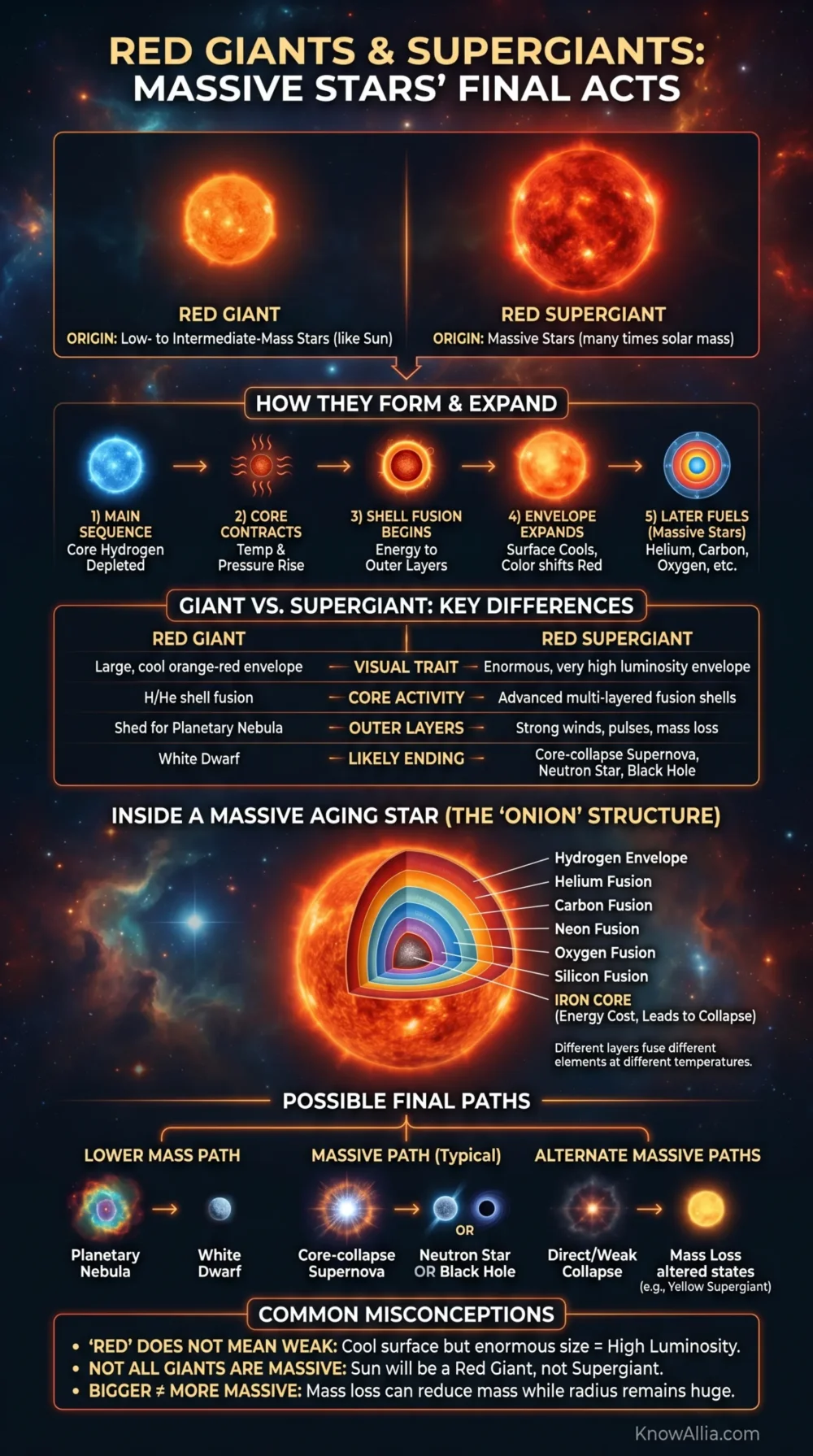
A red giant is an aging star whose outer layers have expanded after hydrogen fusion in the core has slowed or stopped. A red supergiant is the larger, brighter late-life version reached by many massive stars. The two names sound similar, but they do not mean the same thing: ordinary red giants usually come from low- or intermediate-mass stars, while red supergiants are tied to stars massive enough to end as core-collapse supernovae or, in some cases, collapse into compact remnants without a bright visible blast.[Source-1][Source-2]
The Main Idea, Without the Noise
Red giants and red supergiants both look cool and swollen from the outside, yet their inner lives can be very different. The most useful way to read the topic is by mass: mass sets the fuel path, the lifetime, the size of the envelope, and the likely final remnant.
- Red giants are late-stage stars with expanded outer layers, often leading toward planetary nebulae and white dwarfs.
- Red supergiants are huge late-stage massive stars with strong winds, large convective envelopes, and unstable outer layers.
- Massive-star endings depend on initial mass, mass loss, rotation, composition, and whether the star has a close companion.
You will learn how these stars form, why they turn red, how their cores change, what makes a red supergiant different from an ordinary red giant, and why astronomers are careful when predicting the last step of a massive star’s life.
What Red Giants and Supergiants Mean
The word giant in astronomy describes a star with a much larger radius and luminosity than a main sequence star of similar surface temperature. The word supergiant goes further: it describes stars with very high intrinsic brightness and enormous size, separated from ordinary giants by features in their spectra, not just by how large they look in a picture.[Source-7]
A star becomes a red giant or red supergiant after it leaves the main sequence, the long stable phase when hydrogen fusion in the core supplies outward pressure. Once the core’s hydrogen supply is no longer enough to support the star in the same way, the core contracts and the outer layers expand. The surface cools, so the star shifts toward orange-red colors even while its total light output may rise.
Plain-language definition: a red giant or red supergiant is not “burning out” like a candle. It is changing its internal fuel source. Gravity squeezes the inner regions, fusion moves into shells around the core, and the star’s outer envelope swells outward.
Why the Word “Red” Can Be Misleading
Red giants and red supergiants are called red because their surfaces are cooler than those of hot blue-white stars. The core is not cool. In fact, the core becomes hotter as it contracts. The visible surface cools because the star’s outer layers spread over a much larger area, a little like the same amount of heat being spread across a much wider blanket.
How a Star Becomes Red and Huge
During the main sequence, a star balances inward gravity with outward pressure created by fusion. For a Sun-like star, this phase lasts billions of years. More massive stars use their fuel much faster, so their lives are shorter even though they contain more fuel at birth.
- Core hydrogen runs low. Fusion in the central region weakens as usable hydrogen is depleted.
- The core contracts. Gravity compresses the inner material, raising temperature and pressure.
- Shell fusion begins. Hydrogen can fuse in a shell around the core, adding energy to the outer layers.
- The envelope expands. The star grows wider, the surface cools, and the color moves toward orange-red.
- Later fuels appear in massive stars. Helium, carbon, neon, oxygen, and silicon burning can occur in later stages, depending on mass.
For lower- and intermediate-mass stars, the red giant path usually leads toward the loss of the outer layers and the formation of a white dwarf. For massive stars, the red or yellow supergiant stage can be a doorway to core collapse, a neutron star, or a black hole.
Red Giant vs Red Supergiant
The cleanest difference is not color. It is stellar mass and luminosity class. A red giant can be huge compared with the Sun, but a red supergiant can be hundreds to more than a thousand solar radii across in some cases. Many massive stars become so bright and large after leaving the main sequence that astronomers call them supergiants rather than ordinary giants.[Source-3]
| Feature | Red Giant | Red Supergiant |
|---|---|---|
| Usual origin | Low- to intermediate-mass star, including stars broadly similar to the Sun. | Massive star, often born many times more massive than the Sun. |
| Main visual trait | Large, cool outer envelope with orange-red appearance. | Enormous cool outer envelope with very high luminosity. |
| Core activity | Hydrogen shell fusion and, in later phases, helium fusion can shape the star. | Advanced fusion stages may form layered shells around a dense core. |
| Outer layers | Can be shed into space, forming material for a planetary nebula. | Can lose mass through winds, pulses, dust-rich outflows, and unstable surface activity. |
| Likely ending | White dwarf after outer layers are lost. | Core-collapse supernova, neutron star, black hole, or a less visible collapse path depending on conditions. |
| Common mistake | Calling every red giant a massive dying star. | Assuming every massive star must stay red until the final event. |
Useful distinction: all red supergiants are giant-like in size, but not all red giants are supergiants. A red giant can be the future of a Sun-like star. A red supergiant belongs to the late life of a star born much heavier.
Inside a Massive Aging Star
A massive star does not simply swell and wait. Its center changes fast. After hydrogen burning, the core can move through helium burning and then into heavier fuels. Late in its life, a massive star may develop a layered interior: iron near the center, then shells where silicon, oxygen, neon, carbon, helium, and hydrogen are found at different depths. The common analogy is an onion: not because the star is solid, but because different layers hold different fusion products and temperatures.[Source-5]
Why Iron Changes the Story
Fusion normally helps support a star because it releases energy. Iron is different. Fusing iron does not release useful energy for the star; it costs energy. Once a massive star builds an iron-rich core that can no longer support itself, collapse can begin very quickly. The outer layers may then be blown outward in a core-collapse supernova, while the core becomes a neutron star or black hole, depending on mass and collapse details.
Massive Star End-State Map
From Hot Massive Star to Compact Remnant
A massive star can look calm from far away while its core moves through faster and hotter fuel stages. The outer red supergiant phase is only the visible surface of a deeper internal change.
Stage Flow
- Hot main sequence star: hydrogen fusion supports the core.
- Core hydrogen exhaustion: the center contracts and the envelope expands.
- Red or yellow supergiant phase: the star becomes huge, cool at the surface, and very luminous.
- Advanced burning: heavier elements form in shells in the inner regions.
- Core collapse: the final remnant may be a neutron star or black hole.
What Controls the Last Step?
More mass usually means faster evolution and a more extreme core.
Winds and dusty outflows can remove outer layers before the final collapse.
A nearby star can strip material, change rotation, or alter the visible end stage.
The star’s chemical mix affects opacity, winds, temperature, and evolution.
Red Surface
Cooler surface temperature, not a cooler core.
Huge Radius
Outer layers expand while the core contracts.
Uncertain Ending
The exact final event can differ from star to star.
Why Red Supergiants Lose So Much Mass
Red supergiants have extended, low-gravity outer envelopes. Their surfaces can pulse, convect, and throw material outward. Dust can form in the cooler gas around the star, and radiation can help push that dusty material away. The result is a slow reshaping of the star before the final collapse.
This mass loss is not a side detail. It changes what telescopes see before and after a supernova. A star that has kept a large hydrogen envelope can create one type of visible supernova pattern. A star that has lost much of that envelope may appear different. For the most luminous red supergiants, mass-loss episodes are still an active area of research, especially because dusty material can hide part of the star’s true brightness.[Source-9]
Material Leaving the Star
- Stellar wind: a steady outward flow of gas.
- Pulsation: repeated expansion and contraction of outer layers.
- Convection: large surface cells moving heat and gas.
- Dust formation: cool gas forming grains that absorb and reradiate light.
Why It Changes Observations
- Dust can make a star look dimmer in visible light.
- Lost gas can surround the star before the final event.
- The remaining envelope affects the supernova’s spectrum.
- Mass loss can shift a star away from the red supergiant state.
What Happens After the Supergiant Stage
The familiar path is: massive star, red supergiant, core collapse, supernova, compact remnant. That path is real, but it is not the only useful description. Massive stars can lose enough mass to look hotter before collapse. Some may appear as yellow supergiants, blue supergiants, luminous blue variables, or Wolf-Rayet stars before the last event. A close companion can also strip outer gas and change the visible stage.
Type II supernovae are linked to massive stars that retain hydrogen in their outer layers. NASA’s explanation of Type II supernovae describes them as occurring when a massive star’s nuclear fuel is exhausted and the iron core can collapse, with hydrogen lines used in classification.[Source-4]
Possible End States
- Neutron star: an ultra-dense remnant formed when the collapsed core is not massive enough to become a black hole.
- Black hole: a remnant formed when gravity wins more completely and the core collapses beyond the neutron-star path.
- Visible supernova remnant: expanding gas and dust from the outer layers after a successful explosion.
- Direct or weak collapse candidate: a possible path where the star’s collapse may be faint compared with a typical bright supernova. This is still studied carefully and should not be described as the ending for all red supergiants.
Observed Examples That Help Astronomers
Well-known red supergiants such as Betelgeuse and Antares show how large and variable these stars can be, though neither should be treated as a ready-to-explode object on a human timescale. Their changing brightness and extended atmospheres are useful for studying convection, dust, and mass loss.
A newer observational example is SN 2025pht in galaxy NGC 1637. NASA reported that archived Webb images showed a red supergiant at the position where the supernova later appeared, making it an important case for linking a visible progenitor star to a later stellar explosion.[Source-6]
- Progenitor Star
- The star that existed before a supernova or other final event.
- Envelope
- The outer gas layers surrounding the core of an evolved star.
- Core Collapse
- The rapid inward fall of a massive star’s inner region after support fails.
- Remnant
- The object or material left after the final event, such as a neutron star, black hole, or expanding nebula.
Common Confusion About Red Giants and Supergiants
“Red” Does Not Mean Weak
A red supergiant has a cooler surface than a blue star, but it can still be incredibly luminous because it is so large. Luminosity depends on both surface temperature and radius. A cooler surface spread across a huge area can produce a large total output.
A Red Giant Is Not Always a Massive Star
The Sun is expected to become a red giant in the far future, but the Sun is not a massive star in the supernova sense. It does not have enough mass to become a red supergiant or produce a core-collapse supernova.
Bigger Does Not Always Mean More Massive
Red supergiants can have enormous radii, yet they are not always the most massive stars by the time we observe them. Some have already lost a large amount of gas through winds and outflows. A compact hot star may be smaller in radius but still very massive.
The Final Stage Is Not Always Visually Red
A massive star may pass through a red supergiant phase and later move back toward warmer surface temperatures if mass loss strips or changes the envelope. The last visible stage before collapse can therefore be red, yellow, blue, or heavily dust-covered.
Core Terms Mini Glossary
| Term | Meaning | Why It Matters |
|---|---|---|
| Main Sequence | The long phase when a star fuses hydrogen into helium in its core. | Leaving this phase starts the path toward giant or supergiant stages. |
| Solar Mass | A unit equal to the mass of the Sun, often written as M☉. | It lets astronomers compare stars by mass in a simple way. |
| Luminosity | The total energy a star emits per second. | A red supergiant can be cool at the surface but still very luminous. |
| Hydrogen Shell Burning | Fusion of hydrogen in a layer around the core. | It helps drive envelope expansion after core hydrogen is depleted. |
| Core Collapse | Rapid inward collapse of a massive star’s core after support fails. | It can produce a supernova and leave a neutron star or black hole. |
| Mass Loss | Gas and dust leaving the star through winds or outflows. | It changes the star’s future appearance and final event. |
What Astronomers Still Cannot Pin Down
Models of red supergiants are strong enough to explain the broad path, but several details remain uncertain. The outer envelopes are huge, cool, turbulent, and dusty. That makes exact measurements difficult.
- Mass-loss rates can be hard to measure because dust and gas are uneven around the star.
- Initial mass estimates can shift when distance, dust, and brightness are revised.
- Binary companions may change a star’s envelope without being easy to detect.
- Final collapse behavior may differ between stars that look similar from far away.
- Short late-life phases are rarely caught directly because they pass quickly on cosmic timescales.
The safest wording is therefore careful: many massive stars pass through a red supergiant phase, many red supergiants are linked to Type II supernovae, and some massive-star endings may be altered by mass loss, dust, rotation, or companions.
FAQ
Questions Readers Often Ask
Are red giants and red supergiants the same thing?
No. A red giant is usually a late-stage low- or intermediate-mass star. A red supergiant is a much larger and more luminous evolved massive star. The difference is tied to mass, luminosity class, internal evolution, and likely final fate.
Will the Sun become a red supergiant?
No. The Sun is expected to become a red giant, not a red supergiant. It does not have enough mass to go through the advanced fusion stages that lead to a core-collapse supernova.
Why do massive stars become red supergiants?
After core hydrogen is depleted, the inner regions contract while fusion continues in shells. The outer envelope expands and cools, making the star look redder. In massive stars, this expanded stage can become a red supergiant.
Do all red supergiants explode as supernovae?
Many red supergiants are linked to Type II core-collapse supernovae, but astronomers avoid saying all of them must end the same way. Mass loss, dust, initial mass, rotation, and companions can change the visible final stage or the collapse path.
Why are red supergiants bright if their surfaces are cool?
They are bright because they are enormous. A cool surface spread over a very large area can still emit a huge amount of total light.
What is left after a massive red supergiant dies?
The remnant may be a neutron star or black hole, with expanding gas left around it if the outer layers are ejected. The exact result depends on the star’s mass and late-life evolution.
Sources
- NASA Science – Star Types — Used for main sequence and red giant definitions, including the Sun’s future red giant stage. ↩ Source-1
- ESA/Hubble – Red Giant — Used for red giant formation, intermediate-mass range, and the red supergiant distinction. ↩ Source-2
- OpenStax Astronomy 2e – The Evolution of More Massive Stars — Used for massive-star evolution, supergiants, expansion, and mass loss. ↩ Source-3
- NASA Imagine the Universe – Type II Supernovae — Used for the connection between massive stars, fuel exhaustion, iron-core collapse, and Type II supernova classification. ↩ Source-4
- OpenStax Astronomy 2e – Evolution of Massive Stars: An Explosive Finish — Used for layered late-stage massive-star interiors and collapse behavior. ↩ Source-5
- NASA Science – Webb Telescope Locates Former Star That Exploded as Supernova — Used for the SN 2025pht red supergiant progenitor observation. ↩ Source-6
- Encyclopaedia Britannica – Supergiant Star — Used for the reference definition of supergiant stars and spectral classification. ↩ Source-7
- Swinburne Astronomy Online – Hertzsprung-Russell Diagram — Used for HR diagram placement of giants and supergiants. ↩ Related Section
- Galaxies – Stellar Evolution Through the Red Supergiant Phase — Used for red supergiant mass loss, mass ranges, and open research limits. ↩ Source-9