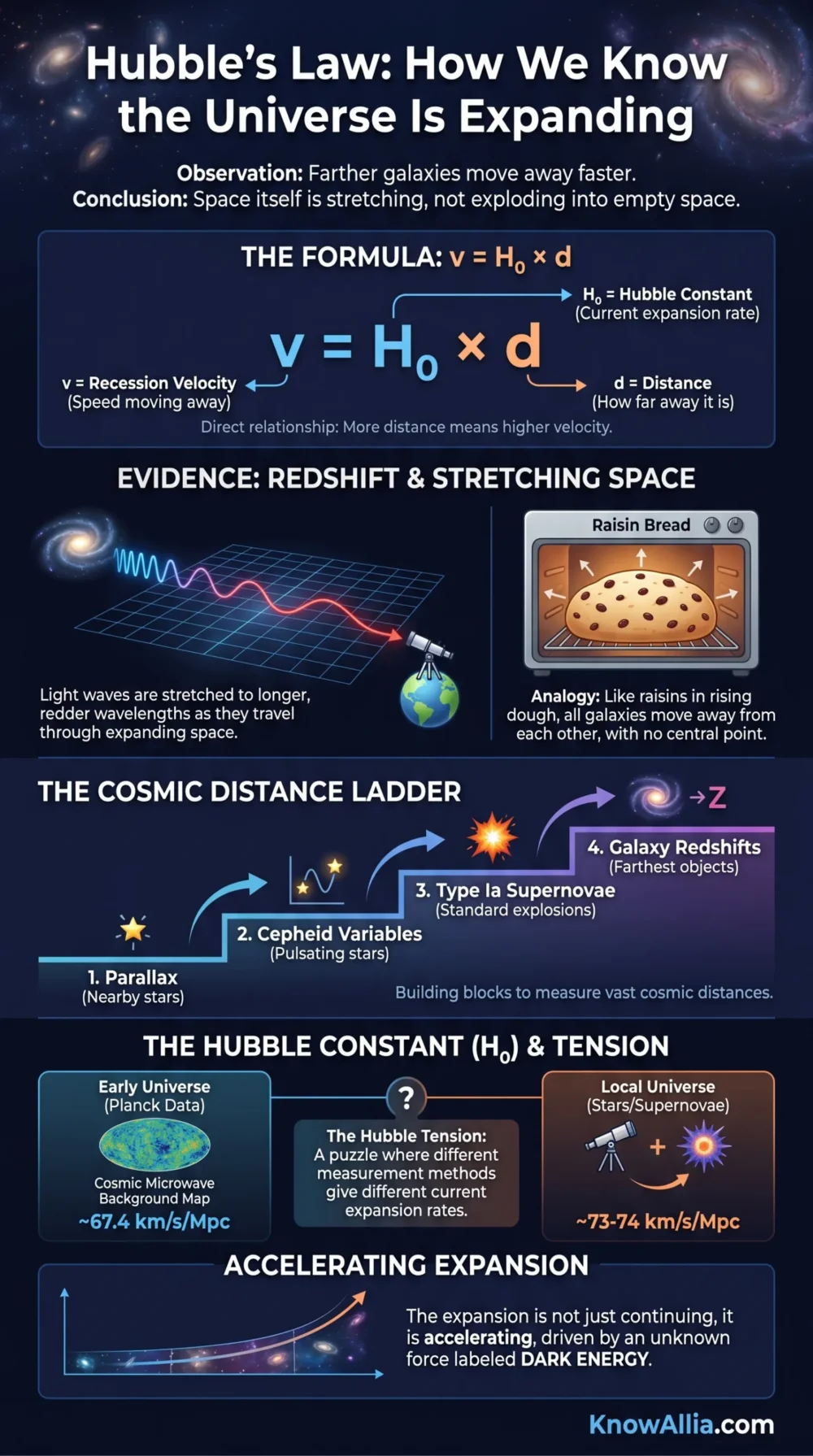
Hubble’s Law says that distant galaxies tend to move away from us faster when they are farther away. It is one of the main observations behind the idea that the universe is expanding, not as an explosion into empty space, but as a stretching of space itself. The short form is simple: velocity is proportional to distance.
The Basic Idea in Plain English
Hubble’s Law, also called the Hubble–Lemaître Law, connects two things astronomers can measure or estimate: a galaxy’s distance and the speed at which its distance from us is growing. The law is usually written as v = H₀ × d, where v is recession velocity, H₀ is the Hubble constant, and d is distance.[Source-a]
- Redshift shows that light from distant galaxies has been stretched toward longer, redder wavelengths.
- Distance measurements show how far those galaxies are from us.
- The pattern shows that farther galaxies, on average, have larger recession speeds.
You will learn how Hubble’s Law works, why redshift matters, what the Hubble constant measures, why the universe has no special center, and why today’s “Hubble tension” is a measurement puzzle rather than a reason to reject cosmic expansion.
What Hubble’s Law Says
Hubble’s Law describes a pattern seen in galaxies beyond our local neighborhood: the farther a galaxy is, the faster its distance from us appears to increase. In its common form, the relationship is:
v = H₀ × d
- v means the galaxy’s recession velocity.
- H₀ means the Hubble constant, the present-day expansion rate.
- d means the galaxy’s distance.
This formula is most direct for relatively nearby galaxies on cosmic scales. For very distant galaxies, astronomers need a fuller cosmological model because the expansion rate has changed during the time their light has been traveling.
The law is not saying that Earth is sitting at the center of the universe. It says that space between large, unbound objects is growing. A distant observer in another galaxy would see a similar large-scale pattern from their own location.
Why It Is Also Called the Hubble–Lemaître Law
The name Hubble’s Law is still widely used, but the International Astronomical Union recommended the name Hubble–Lemaître Law in 2018 to recognize Georges Lemaître’s earlier theoretical work as well as Edwin Hubble’s observational evidence.[Source-b] Both parts matter: theory showed that expansion was possible, and observation showed that the pattern appeared in real galaxy data.
How Redshift Reveals Expansion
When astronomers split galaxy light into a spectrum, they can see dark or bright lines made by known atoms. If those lines appear shifted toward longer wavelengths, the light is redshifted. In cosmology, this usually means the light has been stretched while traveling through expanding space.[Source-c]
What Astronomers Observe
- Known spectral lines appear in a changed position.
- The change is measured as redshift, often written as
z. - Greater redshift usually means the light has traveled from farther away.
What It Means
- Light waves are stretched as space expands.
- The stretched light arrives redder than when it left.
- This gives a record of cosmic expansion during the light’s journey.
A useful analogy is raisin bread rising in an oven. The raisins are like galaxies, and the dough is like space. As the dough expands, every raisin sees other raisins getting farther away. Raisins that are farther apart separate faster because there is more dough between them. The analogy is not perfect, but it helps explain why expansion does not need a central point inside the universe.
Redshift Is Not Always Simple Motion Through Space
For nearby galaxies, redshift can often be treated in a way that resembles ordinary Doppler motion. For galaxies at very large distances, the better explanation is cosmological redshift: space itself has stretched the light. This detail matters because a high-redshift galaxy is not simply a normal object flying through space in the everyday sense.
What the Hubble Constant Measures
The Hubble constant, written as H₀, is the present-day rate of cosmic expansion. Its usual unit is kilometers per second per megaparsec, written as km/s/Mpc. A megaparsec is one million parsecs, and astronomers use it for distances between galaxies.[Source-d]
| Term | Meaning | Why It Matters |
|---|---|---|
| Recession Velocity | The rate at which a galaxy’s distance from us grows because of expansion. | It is the v in v = H₀ × d. |
| Distance | The estimated distance to a galaxy, often measured in megaparsecs. | The law predicts that larger distance means larger average recession velocity. |
| Hubble Constant | The current expansion rate of the universe. | It connects distance with recession velocity. |
| Redshift | The stretching of light toward longer wavelengths. | It gives evidence that distant galaxy light has traveled through expanding space. |
| Hubble Flow | The smooth large-scale expansion pattern seen beyond local gravitational motions. | It helps separate cosmic expansion from local galaxy movement. |
Why “Constant” Does Not Mean Unchanging Forever
The word constant can be confusing. H₀ refers to the expansion rate today. Cosmologists also use H(z) for the expansion rate at different cosmic times. The expansion rate has not stayed the same through the whole history of the universe; it depends on the universe’s contents and evolution.[Source-e]
How We Know the Universe Is Expanding
The evidence is not based on one galaxy or one telescope image. It comes from a repeated pattern: galaxy distances and redshifts line up in a way expected from expansion. Edwin Hubble’s 1929 paper compared distances and radial velocities for extra-galactic nebulae, helping turn the idea of expansion into an observational result.[Source-f]
The Expansion Pattern
Hubble’s Law connects three linked observations: distance, redshift, and recession velocity. The pattern appears on large scales, where local galaxy motions average out.
Distance and Velocity Rise Together
Smaller distance usually means a smaller recession velocity, though local motion can add scatter.
More space between galaxies means a larger expansion effect across that distance.
Greater redshift records light that has traveled through more cosmic expansion.
What the Measurements Tell Us
Light has been stretched toward longer wavelengths.
Distances are built from nearer methods to farther standard candles.
The slope of the distance–velocity pattern gives H₀.
Not an Explosion
Expansion means distances grow on large scales; it is not debris flying away from one central blast point.
Not Perfectly Smooth Nearby
Gravity gives galaxies local motions, so nearby objects can deviate from the clean pattern.
Not a Solved Number
Different methods still give different values for today’s expansion rate.
The Distance Ladder Behind the Law
To use Hubble’s Law, astronomers need distances. That is hard because galaxies are far beyond direct measuring tools used in daily life. Astronomers build a cosmic distance ladder, starting with nearby distance methods and extending outward to objects whose brightness can be compared across huge distances.
- Parallax helps measure nearby stars by their tiny apparent shift against the background sky.
- Cepheid variable stars can be used because their brightness changes in a regular way tied to their true luminosity.
- Type Ia supernovae can act as far-reaching distance markers when carefully calibrated.
- Galaxy redshifts then show how those distances fit the expansion pattern.
Why Nearby Galaxies Can Break the Simple Pattern
Hubble’s Law works best on large cosmic scales. Nearby galaxies can have peculiar velocities, meaning local motions caused by gravity. For example, galaxies inside a group or cluster can move toward, around, or past one another. These local motions can hide the clean expansion pattern until astronomers look far enough away.
The Hubble Tension in Today’s Measurements
Modern measurements do not all give the same value for H₀. Measurements based on the early universe, especially the cosmic microwave background interpreted through the standard cosmological model, give a value near 67.4 km/s/Mpc in Planck results.[Source-g] Some local measurements using stars and supernovae tend to give higher values, often around the low-to-mid 70s. NASA describes this mismatch as the Hubble tension.[Source-h]
The tension does not mean expansion is doubtful. The broad evidence for expansion is well established. The open question is more precise: why do different measurement routes give different values for the present expansion rate?
What the Tension Could Mean
- The measurements may still contain subtle errors or calibration issues that are hard to find.
- The standard model may need a refinement, though that is not yet settled.
- More independent methods may narrow the gap or show where the mismatch enters.
A careful wording is important here. The Hubble tension is not proof of one final answer. It is a live measurement problem in cosmology.
Expansion Is Also Accelerating
Hubble’s Law shows the universe is expanding. Later observations of distant supernovae showed that the expansion is not merely continuing; it is accelerating. The 2011 Nobel Prize in Physics recognized work on this accelerating expansion through observations of distant supernovae.[Source-i]
This led scientists to use the term dark energy for whatever is causing the accelerated expansion in current models. The name is a label for an observed effect, not a complete explanation. Scientists still do not know the full physical nature of dark energy.
Common Confusion About Hubble’s Law
- “Galaxies are flying away from Earth because we are central.”
- No. On large scales, every observer would see distant galaxies moving away on average. The pattern comes from expanding space, not from Earth holding a special position.
- “Expansion means galaxies themselves are getting larger.”
- No. Galaxies, solar systems, planets, and atoms are held together by gravity or other forces. Cosmic expansion is mainly seen across vast distances between galaxy systems.
- “Redshift always means ordinary speed through space.”
- No. At small redshifts, that shortcut can work well. At larger redshifts, cosmological redshift is better understood as light stretching while space expands.
- “The Hubble constant is a final fixed number.”
- No.
H₀is today’s expansion rate, and its exact measured value is still under active study. - “Hubble’s Law explains everything about the universe.”
- No. It gives a central relation between distance and recession speed. It does not, by itself, explain dark energy, galaxy formation, or every detail of cosmic history.
Key Terms in Simple Language
Observation Terms
- Galaxy: A large system of stars, gas, dust, and dark matter.
- Spectrum: Light spread into wavelengths, often showing chemical fingerprints.
- Redshift: A shift of light toward longer, redder wavelengths.
- Standard Candle: An object whose true brightness can be estimated and used for distance measurement.
Cosmology Terms
- Hubble Constant: The present-day expansion rate of the universe.
- Megaparsec: One million parsecs, used for intergalactic distances.
- Hubble Flow: The large-scale expansion pattern after local motions are averaged out.
- Dark Energy: The name used for the unknown cause linked to accelerated expansion.
What We Still Do Not Know
Hubble’s Law is one of the clearest observational patterns in cosmology, but several details remain open. The exact value of H₀ is still debated because early-universe and local-universe methods do not fully agree. The physical cause of accelerated expansion is also unknown. Even the best measurements rely on models, calibration steps, and assumptions that scientists continue to test.
That is not a weakness of the idea of expansion. It is how precision science works: a broad pattern can be well supported while the finer numbers and deeper cause remain active research questions.
Why Hubble’s Law Matters
Hubble’s Law changed the universe from a mostly static picture into an evolving one. It helps astronomers estimate galaxy distances, compare cosmic models, study the age of the universe, and test how expansion has changed over time. It also connects nearby observations with the largest scales we can study.
The main message is direct: the universe is not fixed in size. On large scales, space has been expanding for billions of years, and light from distant galaxies carries that expansion record to our telescopes.
FAQ About Hubble’s Law
Questions Readers Often Ask
What does Hubble’s Law prove?
It shows that distant galaxies follow a distance–velocity pattern: farther galaxies tend to recede faster. This is one of the main observations showing that the universe is expanding.
Is Hubble’s Law the same as the Big Bang?
No. Hubble’s Law is an observed relationship between galaxy distance and recession speed. The Big Bang model is a broader explanation of the universe’s hot, dense early state and later expansion.
Does Hubble’s Law mean Earth is at the center of the universe?
No. The expansion pattern does not require Earth to be central. In a uniformly expanding universe, observers in other galaxies would also see distant galaxies receding on average.
Why is redshift important for Hubble’s Law?
Redshift lets astronomers measure how much galaxy light has been stretched. When redshift is compared with galaxy distance, the expansion pattern becomes visible.
What is the Hubble tension?
The Hubble tension is the mismatch between different ways of measuring today’s expansion rate. Early-universe methods and local distance measurements do not currently give the same value.
Can galaxies move faster than light because of expansion?
Very distant galaxies can have recession rates greater than the speed of light because space itself is expanding. This does not mean the galaxy is locally moving through space faster than light.
Sources
- [Source-a] HubbleSite – Glossary — Used for the standard form of Hubble’s Law and the meaning of
v = H₀ × d. - [Source-b] International Astronomical Union – Hubble–Lemaître Law Recommendation — Used for the naming history and 2018 recommendation.
- [Source-c] NASA Science – Hubble Cosmological Redshift — Used for cosmological redshift and the stretching of light by expansion.
- [Source-d] NASA Science – Cosmic Distances — Used for parsecs, megaparsecs, and intergalactic distance units.
- [Source-e] PNAS – Hubble’s Law and the Expanding Universe — Used for the expansion-rate context and how the rate changes over cosmic time.
- [Source-f] PNAS – Edwin Hubble’s 1929 Paper — Used for the original distance and radial velocity observation record.
- [Source-g] ESA Planck – Measurements of the Hubble Constant — Used for the Planck-based value near 67.4 km/s/Mpc.
- [Source-h] NASA Science – Hubble Constant and Tension — Used for the present-day measurement mismatch known as the Hubble tension.
- [Source-i] Nobel Prize – 2011 Physics Press Release — Used for the discovery of accelerated expansion through distant supernova observations.