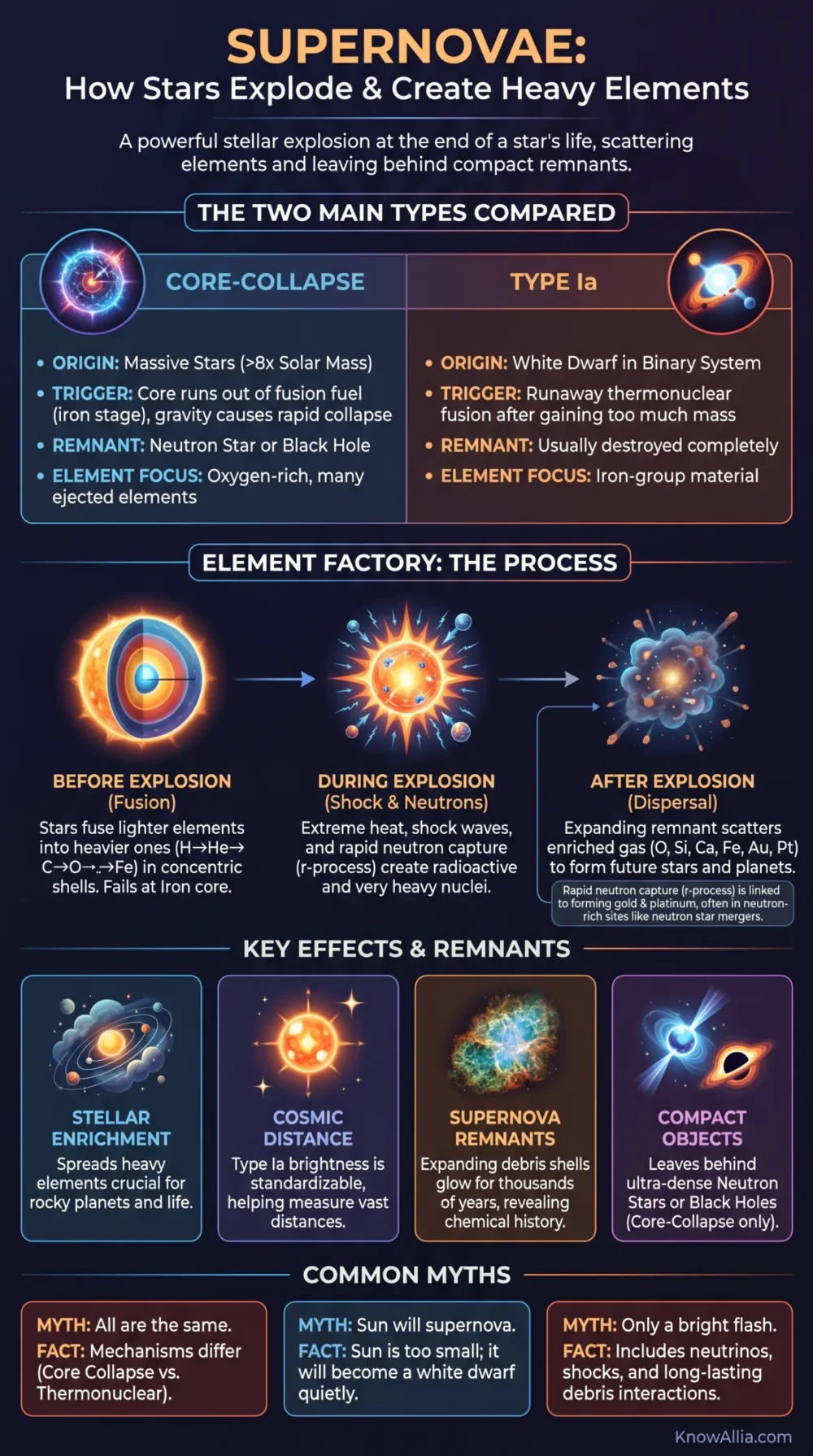
A supernova is the explosion of a star at the end of a major stage in its life. In a short burst of light, heat, particles, and expanding gas, a star can release more energy than it produced across much of its normal lifetime. Supernovae matter because they scatter elements into space, shape clouds of gas, leave behind neutron stars or black holes in many cases, and help astronomers measure large cosmic distances.[Source-1]
The Core Idea in Plain Language
Supernovae are not all the same. Some happen when the core of a massive star collapses; others happen when a white dwarf in a binary system is destroyed in a thermonuclear blast.
- Core-collapse supernovae come from massive stars, usually above about eight solar masses.
- Type Ia supernovae come from white dwarfs and are useful as distance markers because their peak brightness can be standardized.
- Element creation happens before, during, and after these explosions through fusion, shock heating, radioactive decay, and neutron-capture processes.
This article explains what a supernova is, why stars explode, what happens inside the star before the blast, how heavy elements form, and why astronomers still treat some details with care rather than certainty.
What a Supernova Is
A supernova is a stellar explosion that marks the destruction or violent transformation of a star. The plural form is supernovae. To an observer, the event can look like a sudden new point of light in the sky because the star becomes far brighter for a limited time.
The word does not describe one single mechanism. It describes a visible class of stellar explosions. Two broad routes matter most for understanding them: core collapse in massive stars and thermonuclear destruction of white dwarfs.
What Makes a Supernova Different From an Ordinary Stellar Outburst?
- Scale: A supernova releases an enormous amount of energy compared with normal stellar activity.
- Stellar fate: The original star is destroyed or transformed into a compact object in many cases.
- Material ejection: Gas rich in newly made and previously made elements is thrown into surrounding space.
- Afterglow: The expanding debris can remain visible as a supernova remnant for thousands of years.
How Stars Explode
Stars are held in balance by two opposing effects. Gravity pulls matter inward. Pressure from hot gas and nuclear fusion pushes outward. For much of a star’s life, this balance is steady. A supernova begins when that balance fails in an extreme way.
Core-Collapse Supernovae: When a Massive Star Runs Out of Support
A massive star spends its life fusing lighter elements into heavier ones. Hydrogen fuses into helium. Later stages can produce carbon, oxygen, neon, magnesium, silicon, sulfur, and eventually iron-group material in the core. This layered structure is often compared to an onion, with different fusion zones around the center.
The trouble starts with iron. Fusion of iron does not release useful energy for the star. Instead of helping the core push back against gravity, iron marks the point where the core can no longer support itself by normal fusion. The center collapses in seconds, and the outer layers respond with a shock wave that helps drive the explosion.[Source-2]
A simple analogy: imagine a factory line where each step produces usable energy until the process reaches a final product that cannot power the line anymore. In a massive star, iron is that stopping point. The “line” stalls, gravity takes over, and the core collapses.
Core-collapse supernovae are linked with stars that began life with much more mass than the Sun. NASA describes this route for stars above about eight times the Sun’s mass. The explosion may leave behind a neutron star, a black hole, or in some cases a more complex remnant depending on the star’s mass, rotation, composition, and surrounding gas.
Type Ia Supernovae: When a White Dwarf Is Destroyed
A Type Ia supernova starts from a white dwarf, the dense leftover core of a star that was once more like the Sun than like a massive supernova progenitor. On its own, a white dwarf can cool for a very long time. In a binary system, though, it may gain matter from a companion star or merge with another white dwarf.
When conditions become extreme enough, carbon and oxygen in the white dwarf undergo runaway fusion. The result is not a normal surface flare. It is a thermonuclear explosion that can destroy the white dwarf. NASA notes that Type Ia events are valuable to astronomy because their brightness can be standardized, which helps measure cosmic distances.[Source-3]
Core-Collapse Route
- Starts with a high-mass star.
- Core support fails after advanced fusion stages.
- Often leaves a neutron star or black hole.
- Produces and ejects many elements, especially oxygen-rich material in many remnants.
Type Ia Route
- Starts with a white dwarf in a binary system.
- Runaway fusion destroys the white dwarf.
- Usually leaves no central compact stellar core.
- Produces large amounts of iron-group elements.
How Supernovae Create and Spread Heavy Elements
Supernovae are often described as element factories, but the full story is more careful. Some elements are made inside stars before the explosion. Some are made during the explosion. Some of the heaviest naturally occurring elements may form in neutron-rich environments such as certain supernova conditions and neutron star mergers.[Source-4]
Before the Explosion: Fusion Builds Elements up to Iron
Inside massive stars, fusion creates heavier nuclei step by step. The sequence does not run forever. Fusion can release energy efficiently up to the iron-group region. Once the core becomes dominated by iron-group material, further fusion no longer gives the star the pressure support it needs.
- Hydrogen burning creates helium.
- Helium burning can create carbon and oxygen.
- Later burning stages in massive stars can form neon, magnesium, silicon, sulfur, and iron-group nuclei.
- Iron-group buildup sets the stage for collapse in massive stars because ordinary fusion no longer supplies outward pressure.
During the Explosion: Heat, Shock, and Neutrons Change the Mix
The explosion launches a shock wave through the star. That shock heats the outer layers and can trigger more nuclear reactions. Some radioactive nuclei form and later decay into stable elements. In Type Ia events, radioactive nickel and other iron-group products shape much of the light curve.
For elements heavier than iron, the picture depends on neutron capture. In the rapid neutron-capture process, often called the r-process, atomic nuclei capture neutrons faster than they decay. This can build very heavy nuclei. DOE notes that neutron-rich environments such as neutron star mergers or some supernovae are linked to heavy elements including gold, platinum, and uranium.[Source-5]
After the Explosion: Space Gets Enriched
A supernova does not only make elements. It moves them. Expanding debris carries oxygen, silicon, sulfur, calcium, iron, nickel, and other nuclei into interstellar gas. Over time, that material can mix into clouds that later form new stars, planets, asteroids, and dust grains. ESA describes Earth’s rocky ingredients, including oxygen, silicon, aluminum, and iron, as part of a wider history of stellar enrichment.[Source-6]
From Star to Elements: The Supernova Path
A supernova links stellar life, collapse or runaway fusion, expanding debris, and the chemical enrichment of future star-forming clouds.
Main Flow
What Changes Chemically?
Massive stars build layered shells of elements, ending near iron-group nuclei in the core.
Extreme heat and pressure alter nuclei and help eject enriched material into space.
The heaviest nuclei need rapid neutron capture, linked to some supernova conditions and neutron star mergers.
Debris mixes with interstellar gas and can later become part of new stars and planets.
Type Ia
White dwarf destruction; rich in iron-group products; useful for distance measurement.
Core Collapse
Massive star collapse; often leaves a neutron star or black hole; enriches gas with many elements.
Remnant
Expanding debris glows as shocks heat gas and reveal the chemical record of the blast.
Core-Collapse and Type Ia Supernovae Compared
| Feature | Core-Collapse Supernova | Type Ia Supernova |
|---|---|---|
| Starting object | A massive star, often above about eight solar masses. | A white dwarf in a binary system. |
| Main trigger | The core loses pressure support after advanced fusion stages, then collapses under gravity. | Runaway thermonuclear fusion destroys the white dwarf after mass gain or merger. |
| Typical remnant | A neutron star, pulsar, black hole, or expanding debris structure depending on conditions. | No ordinary central stellar core is expected because the white dwarf is disrupted. |
| Element pattern | Often oxygen-rich in remnants, with many elements ejected into space. | Produces relatively more iron-group material. |
| Astronomy use | Reveals massive-star death, compact objects, shock physics, and stellar feedback. | Helps measure cosmic distances because brightness can be standardized. |
| Common spectral clue | Hydrogen, helium, or heavier element lines may appear depending on the star’s outer layers. | Defined by the lack of hydrogen lines and strong silicon features near maximum light. |
Chandra’s supernova remnant material notes a useful observational split: core-collapse remnants tend to be richer in oxygen, while thermonuclear remnants produce relatively more iron. Astronomers use those chemical fingerprints, along with the shape and energy of the remnant, to infer what kind of star exploded.[Source-7]
What Happens During the Blast
The visible flash is only one part of a supernova. The event also involves neutrinos, radiation, fast-moving gas, magnetic fields, shock waves, and radioactive decay. A core-collapse supernova can release a vast amount of energy in neutrinos, while the light we see is only a smaller visible part of the total event.
The Shock Wave
In a core-collapse event, the inner core collapses to extreme density. A shock wave forms and moves outward. The exact route from collapse to a successful explosion is still an active research topic because neutrinos, turbulence, rotation, magnetic fields, and three-dimensional flow can all matter.
The Light Curve
A light curve records how brightness changes over time. Some supernovae brighten quickly and fade over weeks or months. Others stay bright longer. The shape of the light curve tells astronomers about the explosion energy, ejected mass, radioactive elements, and the surrounding material.
The Spectrum
A spectrum splits light into wavelengths. Dark and bright lines in a spectrum reveal which elements are present and how fast the debris is moving. If the lines are shifted or broadened, astronomers can estimate expansion speeds. This is how a distant point of light becomes a readable chemical record.
- Shock
- A pressure wave driven through stellar material after collapse or explosive burning.
- Neutrinos
- Tiny particles produced in huge numbers during core collapse; they carry away much of the released energy.
- Radioactive Decay
- The process that lets unstable nuclei transform into more stable nuclei, often powering part of the visible glow.
- Remnant
- The expanding shell and surrounding energized material left after the explosion.
Supernova Remnants: The Long Afterlife of an Explosion
A supernova remnant is the expanding structure left behind after the blast. It can include hot gas, dust, fast particles, magnetic fields, and a compact object. Remnants are not just leftovers. They are laboratories for studying shock waves, particle acceleration, element mixing, and the surrounding interstellar medium.
- Expanding shells show where debris pushes into surrounding gas.
- X-ray emission often reveals very hot gas and heavy-element-rich material.
- Radio emission can trace high-energy electrons moving through magnetic fields.
- Optical filaments show cooler glowing gas and shock-heated knots.
- Pulsars can mark the neutron-star remains of some core-collapse events.
Famous remnants such as the Crab Nebula and Cassiopeia A are studied across many wavelengths because no single type of light gives the full physical picture. X-rays, radio waves, visible light, infrared light, and gamma rays each reveal a different layer of the event.
Why Supernovae Matter for Planets and Life
Hydrogen and helium dominated the early universe. The heavier elements needed for rocky planets, oceans, atmospheres, and living chemistry had to be made later. Supernovae are one of the ways the universe moved from simple early matter to richer chemical mixtures.
This does not mean every atom in a person came from one supernova. The chemical history of the Solar System is mixed. Some atoms came from earlier generations of ordinary stars, some from massive stars, some from supernova debris, and some from other energetic events. The honest statement is stronger than the oversimplified one: supernovae are part of the cosmic recycling process that made heavy-element-rich planets possible.
| Element or Group | Common Cosmic Formation Link | Role in Matter Around Us |
|---|---|---|
| Carbon | Made in stars through helium fusion and later spread by stellar winds and explosions. | Central to organic chemistry and many minerals. |
| Oxygen | Produced in massive stars and released by stellar death and explosions. | Major part of water, rocks, and biological molecules. |
| Silicon | Built in advanced burning stages in massive stars. | Major element in rocky planets and silicate minerals. |
| Iron | Built in massive-star cores and produced heavily in Type Ia events. | Common in planetary cores, meteorites, and many minerals. |
| Gold and Platinum | Linked to rapid neutron capture in neutron-rich environments. | Rare heavy elements used in materials and technology. |
Common Confusions About Supernovae
“All Supernovae Are the Same Kind of Explosion”
They are not. A core-collapse supernova is driven by the collapse of a massive star’s core. A Type Ia supernova is driven by runaway fusion in a white dwarf. Both are called supernovae because of their observed explosive brightness, but the physical triggers differ.
“Supernovae Make Every Heavy Element by Themselves”
Supernovae create and scatter many elements, but not every element has a single birthplace. Some heavy elements are also strongly linked with neutron star mergers and other neutron-rich settings. The exact share from each site is still studied.
“The Sun Will Explode as a Supernova”
The Sun does not have enough mass for a core-collapse supernova. Its expected path is much quieter: it will become a red giant, lose outer layers, and leave behind a white dwarf. That white dwarf would only become part of a Type Ia route under special binary-system conditions, which does not describe the Sun as it is.
“A Supernova Is Only a Bright Flash”
The flash is what observers notice first, but the event also sends out neutrinos, shock waves, high-energy particles, and chemically rich debris. The remnant can keep interacting with surrounding gas long after the light fades.
Terms Worth Knowing
- Supernova
- A stellar explosion that marks the destruction or violent end stage of certain stars.
- Core Collapse
- The rapid inward fall of a massive star’s core after pressure support fails.
- Type Ia
- A thermonuclear supernova caused by the destruction of a white dwarf in a binary system.
- White Dwarf
- A dense stellar remnant left after a lower-mass star sheds its outer layers.
- Neutron Star
- An ultra-dense remnant that may remain after some core-collapse supernovae.
- Black Hole
- A compact object with gravity so strong that light cannot escape from inside its event horizon.
- Nucleosynthesis
- The creation of atomic nuclei through nuclear reactions in the Big Bang, stars, supernovae, and other cosmic sites.
- r-Process
- Rapid neutron capture, a route for forming some of the heaviest naturally occurring elements.
- Light Curve
- A graph of brightness over time, used to classify and understand stellar explosions.
- Spectrum
- Light separated by wavelength; it reveals chemical composition, temperature, and motion.
How Astronomers Study Supernovae
Astronomers cannot touch a supernova. They read its light, particles, and remnant structure. The best studies combine many tools because each method answers a different question.
- Discovery imaging: Repeated sky surveys find new bright points that were not visible before.
- Spectroscopy: Element lines classify the supernova and reveal debris speeds.
- Light-curve tracking: Brightness over time shows explosion type, energy, and radioactive heating.
- X-ray observations: Hot gas and compact remnants become visible.
- Radio observations: Magnetic fields, fast particles, and surrounding gas interaction can be measured.
- Neutrino detection: For nearby core-collapse events, neutrinos can reveal the core collapse directly.
- Remnant mapping: Long-lived debris helps reconstruct the explosion and chemical yields.
Type Ia supernovae have a special place in distance measurement. Since their brightness can be standardized, astronomers compare how bright they look from Earth with how bright they are expected to be. That difference gives distance, which can then be used to study the expansion history of the universe.
What Scientists Still Work to Pin Down
Supernova science is mature in many areas, but not every detail is settled. A careful explanation should separate the broad picture from the open parts.
- Explosion mechanics: In core-collapse events, researchers still model how neutrinos, turbulence, magnetic fields, and rotation help turn collapse into an outward explosion.
- Type Ia triggers: Both companion-fed white dwarfs and white-dwarf mergers are studied, and different Type Ia events may not all start the same way.
- Heavy-element shares: Supernovae and neutron star mergers both matter for neutron-capture elements, but the exact contribution from each setting varies by element and cosmic time.
- Progenitor details: Some stars are identified before explosion, but many supernova progenitors are inferred from models, spectra, remnants, and nearby stellar populations.
- Dust survival: Supernovae can make dust, but shocks can also destroy grains. How much dust survives and joins future star-forming clouds remains an active topic.
Careful wording matters: it is accurate to say supernovae create and spread many heavy elements. It is less accurate to say they are the only source of all heavy elements. Modern research points to a shared chemical story involving stars, supernovae, neutron star mergers, and other stellar processes.
Examples of Well-Studied Supernovae and Remnants
Examples help connect the physics to real observations. These objects are often studied because they are bright, nearby in astronomical terms, historically recorded, or visible across several wavelengths.
| Object | Type or Nature | Why It Matters |
|---|---|---|
| Supernova 1987A | Core-collapse supernova in the Large Magellanic Cloud | Nearby enough for detailed study; neutrinos were detected from the event. |
| Crab Nebula | Core-collapse remnant with a pulsar | Shows how a neutron star can power a glowing nebula of high-energy particles. |
| Cassiopeia A | Young core-collapse remnant in the Milky Way | Rich target for studying element distribution, shocks, and compact remnants. |
| Tycho’s Supernova Remnant | Linked with a Type Ia event | Used to study thermonuclear explosion debris and iron-rich material. |
| Kepler’s Supernova Remnant | Often interpreted as Type Ia | Helps compare historical supernova records with modern remnant chemistry. |
Why the Word “Heavy” Can Be Confusing
In everyday language, “heavy” might mean dense or weighty. In astronomy, heavy elements usually means elements heavier than hydrogen and helium. Sometimes the phrase is used more narrowly for elements heavier than iron. Context matters.
Astronomers often call all elements heavier than helium metals, even when chemists would not. So oxygen, carbon, neon, and iron can all be “metals” in astronomical language. This is normal usage in astrophysics, but it can sound odd outside astronomy.
Three Useful Meanings
- Heavy elements in broad astronomy: anything heavier than helium.
- Iron-group elements: elements near iron and nickel, often central to supernova light and yields.
- Very heavy elements: elements such as gold, platinum, lead, and uranium, often linked with neutron-capture processes.
The Main Picture to Remember
Supernovae are stellar explosions, but their deeper value is chemical and physical. They mark the end of certain stars, generate shock waves, create and scatter atomic nuclei, reveal compact objects, and enrich the gas from which future stars and planets can form.
The cleanest summary is this: massive stars collapse when their cores can no longer resist gravity, while Type Ia supernovae destroy white dwarfs through runaway fusion. Both routes help explain why the universe contains far more than hydrogen and helium, but neither route should be treated as the single source of every element.
FAQ About Supernovae
Questions Readers Often Ask
What is a supernova?
A supernova is a powerful stellar explosion. It can happen when the core of a massive star collapses or when a white dwarf is destroyed by runaway fusion in a binary system.
Do all stars become supernovae?
No. Lower-mass stars, including stars like the Sun, do not normally end as core-collapse supernovae. They shed outer layers and leave white dwarfs. Massive stars are the classic route to core-collapse supernovae.
What causes a massive star to explode?
A massive star explodes when its core can no longer support itself against gravity. Once advanced fusion reaches the iron-group stage, normal fusion no longer supplies the needed pressure, and the core collapses rapidly.
What is a Type Ia supernova?
A Type Ia supernova is the thermonuclear destruction of a white dwarf in a binary system. It may happen after the white dwarf gains matter from a companion or merges with another white dwarf.
Do supernovae create gold?
Some heavy elements such as gold are linked to rapid neutron capture in neutron-rich environments. Certain supernova conditions may contribute, but neutron star mergers are also considered a major source for many of the heaviest elements.
What is left after a supernova?
A core-collapse supernova can leave a neutron star, pulsar, or black hole, plus an expanding remnant of gas and dust. A Type Ia supernova usually destroys the white dwarf and does not leave the same kind of central compact stellar core.
Why are Type Ia supernovae useful for measuring distance?
Type Ia supernovae can be standardized by their light curves, so astronomers can compare their expected brightness with their observed brightness. That helps estimate how far away they are.
Can a supernova create a black hole?
Yes, some core-collapse supernovae can leave black holes if the remaining core is massive enough. Others leave neutron stars instead.
Sources
- ↩ NASA Science – Stellar Explosions — Used for the definition of supernovae, broad types, rarity, and stellar explosion context.
- ↩ U.S. Department of Energy – DOE Explains: Supernovae — Used for core collapse, pressure balance, shock-driven fusion, and compact remnants.
- ↩ NASA Science – Type Ia Supernovae — Used for white dwarf destruction and the use of Type Ia supernovae as distance markers.
- ↩ U.S. Department of Energy – DOE Explains: Nucleosynthesis — Used for element formation, nuclei production, and neutron-rich heavy-element environments.
- ↩ U.S. Department of Energy – Nucleosynthesis and Heavy Elements — Used for rapid neutron capture and the role of neutron-rich sites in forming very heavy elements.
- ↩ European Space Agency – The Atoms That Make Us — Used for stellar fusion, supernova enrichment, and gamma-ray fingerprints of newly made elements.
- ↩ Chandra X-ray Observatory – Supernovas and Supernova Remnants — Used for remnant observations and the oxygen-rich versus iron-rich comparison.