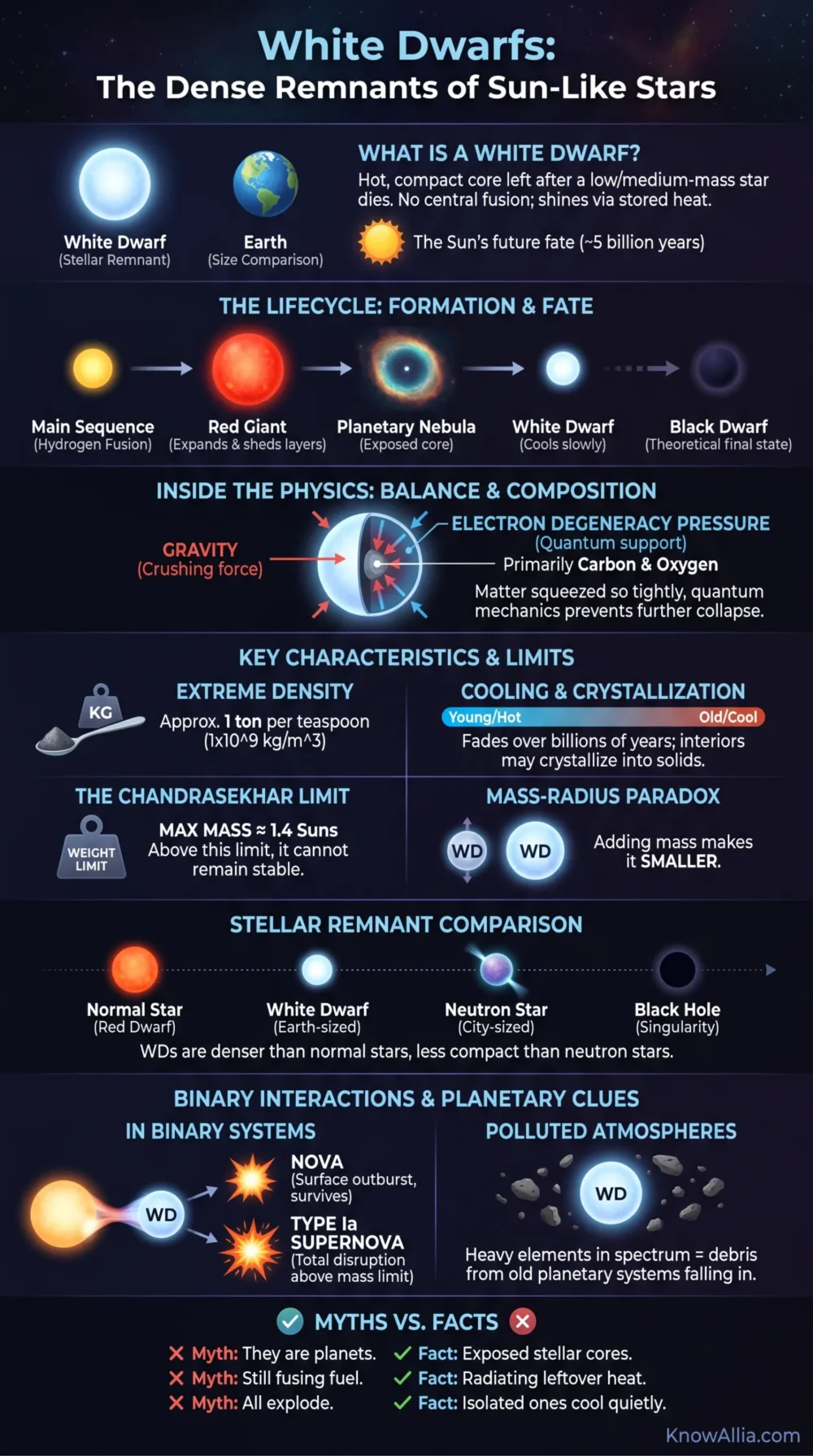
A white dwarf is the hot, compact leftover core of a low- or medium-mass star after the star has used up the fuel in its center and shed its outer layers. It is not a normal shining star with steady core fusion. It is a stellar remnant: small in size, high in density, and slowly cooling for billions of years.
Most stars in the Milky Way are not massive enough to finish as neutron stars or black holes. Many will end as white dwarfs. That makes white dwarfs one of the most common long-term endings for stars like the Sun, even though they are faint and hard to see without telescopes.
The Basic Picture
A white dwarf is usually about Earth-sized, yet it can hold a mass comparable to a star. Its light comes mostly from stored heat, not from fresh energy made by nuclear fusion. Over time, it fades from hot white or bluish-white toward cooler colors.
- Origin: the exposed core of a star that has passed through a red giant phase.
- Support: gravity is balanced mainly by electron degeneracy pressure.
- Future: it cools slowly and may eventually become a theoretical black dwarf, though the universe is not old enough for confirmed black dwarfs today.
What Is a White Dwarf?
A white dwarf is the compact remnant left after a star similar to the Sun has lost its outer gas layers. NASA describes this stage as the remaining core after a red giant has shed its atmosphere; the object is usually about the size of Earth but far more massive than a planet.[Source-1]
The word dwarf refers to its small size compared with ordinary stars, not to low mass. A white dwarf can be small in diameter and still contain a large amount of matter. That is why its density is so extreme.
A useful way to picture it: imagine shrinking much of a star’s leftover core into a sphere roughly the size of Earth. The result is not a planet, because it formed from stellar material and remains extremely hot. It is also not a normal star, because its central fusion engine has stopped.
What this page makes clear: why white dwarfs are dense, how Sun-like stars make them, what holds them up against gravity, why they cool so slowly, and why some white dwarfs help astronomers study old planetary systems.
How White Dwarfs Form
White dwarfs form through a quiet stellar ending compared with the deaths of massive stars. A Sun-like star spends most of its life fusing hydrogen into helium. Later, it expands into a red giant, changes its inner structure, and releases much of its outer material into space.
After those outer layers drift away, the exposed hot center remains. That center becomes the white dwarf. In many cases, the shed gas forms a glowing planetary nebula, a name that comes from early telescope history; it does not mean planets are being made there.
- Main sequence: the star fuses hydrogen steadily for a long part of its life.
- Red giant phase: the star expands and its outer layers become easier to lose.
- Outer-layer loss: gas leaves the star and may glow as a planetary nebula.
- Exposed core: the remaining core becomes a hot white dwarf.
- Long cooling stage: the white dwarf fades gradually over billions of years.
Stars with initial masses below roughly eight times the Sun’s mass can lose enough material to become white dwarfs rather than continuing toward the path of a neutron star or black hole.[Source-2] The exact outcome depends on mass loss, composition, and whether the star has a close companion.
The Sun’s Future as a White Dwarf
The Sun is expected to follow the white dwarf path. NASA states that the Sun is a little less than halfway through its lifetime and will last about another five billion years before becoming a white dwarf.[Source-3] This is a slow stellar-life process, not a short-term change.
For readers, the main point is simple: white dwarfs are the natural late stage of many ordinary stars. They are not rare cosmic accidents.
Inside a White Dwarf
A white dwarf is held up by a quantum effect called electron degeneracy pressure. OpenStax explains that in the white dwarf stage, electron degeneracy pressure, not ordinary gas pressure from heat, stops the core from contracting further.[Source-4]
The idea is easier with an analogy. Think of a packed theater where every seat represents an allowed electron state. Once the seats are filled, new arrivals cannot simply sit in the same seat. In a white dwarf, electrons resist being forced into identical quantum states. That resistance helps support the star’s leftover core against gravity.
What White Dwarfs Are Made Of
Many white dwarfs are made mostly of carbon and oxygen, wrapped in thin outer layers of helium or hydrogen. Some lower-mass white dwarfs can be helium-rich, often shaped by binary-star evolution. Some higher-mass white dwarfs may contain more oxygen, neon, and magnesium. Astronomers avoid treating one composition as universal because white dwarf history matters.
The surface layers are especially useful because they affect the star’s spectrum. By reading absorption lines, astronomers can estimate temperature, surface gravity, atmospheric composition, and sometimes traces of material falling onto the star.
Size, Mass, and Density
A typical white dwarf is only slightly larger than Earth but may contain around half the mass of the Sun. NASA’s Imagine the Universe gives a typical density near 1 × 10⁹ kilograms per cubic meter, far denser than Earth’s average density.[Source-5]
This is why white dwarfs are often described with teaspoon comparisons. Such comparisons are not exact measurements, but they help show the scale: a tiny amount of white dwarf material would have a mass far beyond normal everyday matter.
| Property | Typical White Dwarf Description | Why It Matters |
|---|---|---|
| Size | Often close to Earth-sized | It is much smaller than ordinary stars but still stellar in origin. |
| Mass | Often around half the Sun’s mass, with a range from object to object | Large mass in small volume creates extreme gravity and density. |
| Density | Far above planetary rock or metal | Atoms are squeezed into unusual conditions where quantum pressure matters. |
| Energy Source | Mainly stored heat, not steady core fusion | The white dwarf fades as it radiates old heat into space. |
| Support Against Gravity | Electron degeneracy pressure | Gravity is balanced by a quantum effect rather than ordinary gas pressure. |
The Mass–Radius Rule
White dwarfs behave in a way that feels backwards at first: adding mass can make a white dwarf smaller. In ordinary objects, more material often means a larger object. In a white dwarf, stronger gravity squeezes the degenerate matter into a tighter sphere.
This mass–radius relation is one reason white dwarfs are useful tests of physics. They connect astronomy with quantum mechanics in a visible, measurable way.
The Chandrasekhar Limit
A white dwarf cannot support unlimited mass. The usual upper boundary is near 1.4 solar masses, called the Chandrasekhar limit. Below this limit, electron degeneracy pressure can support a white dwarf. Above it, a white dwarf cannot remain stable in the same way.
Chandra explains that Type Ia supernovas are linked to white dwarfs and the Chandrasekhar limit; a white dwarf below that limit is stable, while added mass in a close binary can trigger explosive behavior under the right conditions.[Source-6]
Careful wording matters: not every white dwarf becomes a supernova. An isolated white dwarf is expected to cool quietly. Supernova pathways usually involve a close companion, mass transfer, merger behavior, or related binary-star processes.
Cooling, Color, and Age
White dwarfs are born hot. They can shine with white or bluish-white light early in their cooling lives, then fade and redden as they lose heat. NASA notes that white dwarfs produce no new heat of their own and gradually cool over billions of years, while their visible color can range from blue-white toward redder tones.[Source-1]
This cooling is slow enough that white dwarfs can work as cosmic clocks. If astronomers know how white dwarfs cool, they can estimate the ages of old star clusters by studying the faintest white dwarfs in them.
Crystallization Inside White Dwarfs
As some white dwarfs cool, their interiors can begin to crystallize. ESA’s Gaia mission provided evidence that white dwarf interiors can turn into solid spheres as the hot material cools.[Source-7] This does not mean a white dwarf becomes a gemstone in the everyday sense. It means ions inside the star settle into a more ordered solid structure under extreme pressure.
A peer-reviewed Nature study reported a pile-up in the cooling sequence of white dwarfs within 100 parsecs of the Sun and connected it to latent heat released as white dwarf cores crystallize.[Source-8] The cooling clock still works, but it must account for this slowing effect.
White Dwarf Structure in One View
A white dwarf is small, dense, hot at birth, and supported by electron degeneracy pressure rather than steady core fusion.
From Red Giant Core to Cooling Remnant
Main Physics Notes
It is the exposed core of a former star, not an object formed in a disk like Earth.
It shines mainly because it is still hot from its earlier life.
Near 1.4 solar masses, ordinary white dwarf stability fails.
Its fading pattern can help estimate the ages of old star groups.
Birth
Red giant outer layers drift away and leave a hot compact core.
Balance
Gravity is balanced mainly by electron degeneracy pressure.
Long Future
The remnant fades slowly and may crystallize as it cools.
White Dwarf Types and Atmospheres
White dwarfs are often grouped by the absorption lines in their spectra. The atmosphere can be dominated by hydrogen, helium, or show traces of other elements. These surface layers are thin compared with the whole star, yet they control much of what telescopes detect.
| Label | Main Spectral Feature | Plain Meaning |
|---|---|---|
| DA | Hydrogen lines | A hydrogen-rich atmosphere is visible. |
| DB | Helium lines | A helium-rich atmosphere is visible. |
| DZ | Metal lines | Heavier elements appear in the atmosphere, often linked with outside material. |
| DQ | Carbon features | Carbon is visible in the spectrum. |
| Magnetic white dwarfs | Magnetic effects in spectral lines | Strong magnetic fields can alter what astronomers observe. |
Hubble’s spectroscopy resources describe how white dwarf spectra can show broadened absorption lines because pressure inside and around these objects is so high.[Source-9] Spectra are one of the main ways astronomers turn faint starlight into physical data.
White Dwarfs in Binary Systems
Many stars are born with companions. When a white dwarf has a close partner, its story can become more active. Gas may flow from the companion toward the white dwarf, or two white dwarfs may orbit each other closely enough that gravitational-wave energy slowly changes the orbit.
Nova vs. Type Ia Supernova
A nova can happen when material builds up on a white dwarf’s surface and briefly ignites. The white dwarf usually survives. A Type Ia supernova is far more energetic and is tied to a white dwarf reaching unstable conditions, often through binary interaction. The two events are related to white dwarfs, but they are not the same event.
- Nova: surface-level outburst; the white dwarf can remain.
- Type Ia supernova: thermonuclear disruption linked with a white dwarf in an unstable state.
- Quiet cooling: the expected path for an isolated white dwarf.
White Dwarfs and Planetary Clues
Some white dwarfs have “polluted” atmospheres, meaning their spectra show heavier elements that should sink out of sight over time. A leading explanation is that asteroids, rocky fragments, or icy bodies from an old planetary system were disturbed and fell toward the white dwarf.
ESA/Hubble reported silicon in the atmospheres of two white dwarfs, likely linked with rocky material from asteroid-like debris shredded by the stars’ gravity.[Source-10] This makes some white dwarfs useful laboratories for studying the chemistry of old planetary systems.
This does not mean every white dwarf has visible planetary debris. It means some white dwarfs preserve chemical clues from material that once orbited the original star.
White Dwarfs Compared With Other Stellar Remnants
White dwarfs sit between ordinary stars and more compact remnants in the stellar-remnant family. They are much denser than planets and normal stars, but less compact than neutron stars and black holes.
| Object | How It Forms | What Supports or Defines It | Common Confusion |
|---|---|---|---|
| White Dwarf | Leftover core of a low- or medium-mass star | Electron degeneracy pressure | Sometimes mistaken for a small normal star or planet |
| Neutron Star | Collapsed remnant of a more massive star after a supernova | Mainly neutron-degenerate matter and nuclear forces | Often grouped with white dwarfs because both are dense |
| Black Hole | Extreme collapse when no known pressure support prevents further collapse | Defined by an event horizon | Sometimes assumed to be the end of all stars, which is not correct |
| Red Dwarf | A small, cool, long-lived main-sequence star | Normal hydrogen fusion | Confused with white dwarfs because both include “dwarf” |
| Brown Dwarf | Substellar object too low in mass for steady hydrogen fusion | Not a stellar remnant | Confused with white dwarfs because both are faint |
Common Confusion Points
“White Dwarfs Are Planets”
They can be close to Earth in size, but they are not planets. They are stellar cores left after a star’s late-life evolution.
“They Are Always White”
The name is historical. A white dwarf’s color depends on temperature, and cooler ones can appear less blue-white.
“They Still Burn Fuel Like the Sun”
A normal white dwarf does not run steady core fusion. Its light is mainly leftover heat escaping slowly.
“Every White Dwarf Explodes”
Most are expected to cool quietly. Explosive paths require special conditions, usually involving a close companion.
Useful Terms
- White Dwarf
- A compact stellar remnant left after a low- or medium-mass star sheds its outer layers.
- Electron Degeneracy Pressure
- The quantum pressure that helps stop a white dwarf from collapsing further.
- Planetary Nebula
- Glowing gas released by a dying Sun-like star; the name does not mean it is made of planets.
- Chandrasekhar Limit
- The mass boundary near 1.4 solar masses above which a white dwarf cannot remain stable in the usual way.
- Cooling Sequence
- The pattern white dwarfs follow as they lose heat and become fainter over time.
- Polluted White Dwarf
- A white dwarf whose atmosphere shows heavier elements, often interpreted as material from disrupted planetary debris.
- Black Dwarf
- A theoretical future object: a white dwarf cooled so much that it emits almost no light. None are confirmed today.
What We Do Not Know Yet
White dwarfs are well studied, but several details remain active research topics. The most honest picture includes what is known and where the science is still being refined.
- Exact cooling ages: cooling depends on mass, core composition, atmosphere, crystallization, and possible thin surface layers.
- Type Ia supernova pathways: white dwarfs are central to Type Ia supernova models, but the exact routes can vary across binary systems.
- Planetary-system survival: polluted white dwarfs show that some debris survives late stellar evolution, but each system has its own history.
- Black dwarfs: they remain theoretical because white dwarfs cool over times far longer than the current age of the universe.
Why White Dwarfs Matter
White dwarfs matter because they connect several parts of astronomy in one object. They show the long-term future of many stars, test physics under extreme density, help estimate stellar ages, and sometimes reveal the chemical leftovers of old planetary systems.
They also make the Sun’s distant future easier to understand. The Sun will not remain as it is forever; after its active stellar life, its remaining core is expected to cool as a white dwarf. That future object will be small, faint, dense, and long-lived.
FAQ About White Dwarfs
What is a white dwarf in simple terms?
A white dwarf is the hot, dense leftover core of a star similar to the Sun after the star has used up its central fuel and lost its outer layers.
Is a white dwarf still a star?
It is a stellar remnant rather than a normal main-sequence star. It no longer runs steady core hydrogen fusion like the Sun does today.
Why are white dwarfs so dense?
They contain a large amount of stellar material squeezed into a small volume. Their collapse is stopped mainly by electron degeneracy pressure, a quantum effect.
Will the Sun become a white dwarf?
Yes. The Sun is expected to become a white dwarf after it passes through later stages of stellar evolution and sheds its outer layers.
Can a white dwarf become a supernova?
Some white dwarfs in close binary systems can be involved in Type Ia supernovas. An isolated white dwarf is expected to cool quietly instead.
Do black dwarfs exist today?
No confirmed black dwarfs are known. A black dwarf would be a white dwarf that has cooled so much that it no longer gives off much light, but the universe is not old enough for that stage to be confirmed.
Why do some white dwarfs show metals in their atmospheres?
Heavy elements can appear when rocky or icy debris from an old planetary system falls onto the white dwarf. Astronomers call these objects polluted white dwarfs.
Sources
- [Source-1] NASA Science – Star Types — used for white dwarf formation, size, cooling, and color range.
- [Source-2] NASA Imagine the Universe – White Dwarfs — used for the low- and medium-mass star pathway and typical white dwarf scale.
- [Source-3] NASA Science – Our Sun: Facts — used for the Sun’s long-term white dwarf future.
- [Source-4] OpenStax Astronomy 2e – The Death of Low-Mass Stars — used for electron degeneracy pressure and low-mass star evolution.
- [Source-5] NASA Imagine the Universe – White Dwarf Stars — used for typical density and degenerate matter explanation.
- [Source-6] Chandra X-ray Observatory – Supernovas and Supernova Remnants — used for Type Ia supernovas, white dwarfs, and the Chandrasekhar limit.
- [Source-7] ESA Gaia – Gaia Reveals How Sun-like Stars Turn Solid After Their Demise — used for white dwarf crystallization.
- [Source-8] Nature – Core Crystallization and Pile-up in the Cooling Sequence of Evolving White Dwarfs — used for the cooling-sequence evidence behind crystallization.
- [Source-9] HubbleSite – Spectroscopy: Reading the Rainbow — used for how spectra reveal white dwarf density and atmospheric clues.
- [Source-10] ESA/Hubble – Hubble Finds Dead Stars Polluted with Planetary Debris — used for polluted white dwarfs and rocky debris evidence.