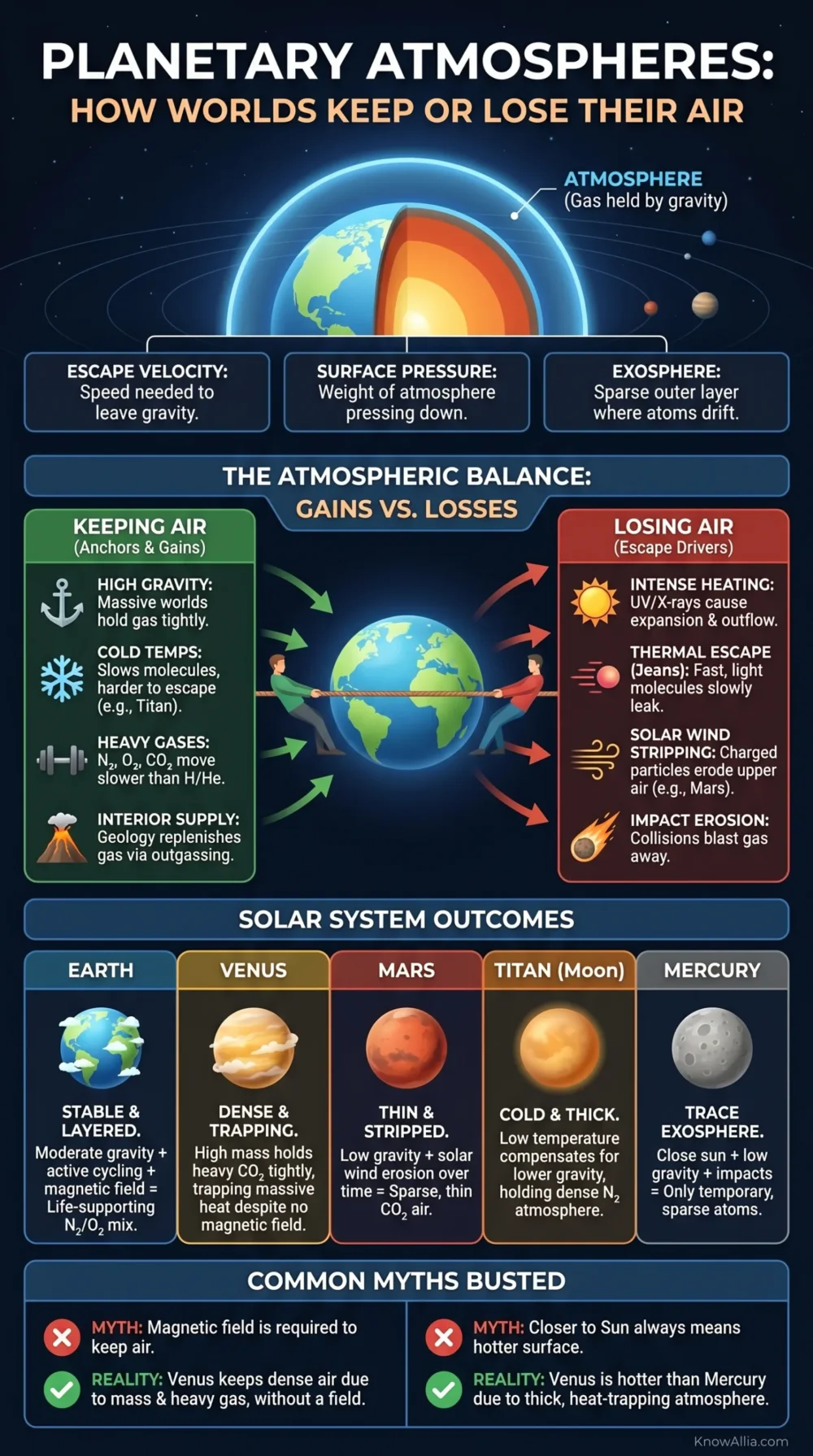
A planetary atmosphere is the layer of gas held around a planet, moon, or small world by gravity. Some worlds keep thick air for billions of years. Others hold only a thin exosphere, where atoms barely collide before drifting away. The difference comes from a balance between gravity, temperature, gas chemistry, sunlight, solar wind, impacts, and the way a world’s interior releases or absorbs gases.
The Basic Idea
Worlds keep air when gas molecules usually move slower than the speed needed to escape into space. They lose air when heating, charged particles, impacts, or chemical changes give gas enough energy to leave or remove it from the atmosphere.
- More gravity helps a world hold gas.
- Hotter upper atmospheres let light gases escape more easily.
- Solar wind and ultraviolet light can erode upper air, especially where magnetic shielding is weak.
You will learn why Earth has breathable air, why Venus has a dense carbon dioxide atmosphere, why Mars has thin air, why Mercury has almost no real atmosphere, and why a cold moon like Titan can still keep a thick nitrogen-rich envelope. The point is not one single rule. Atmospheres survive through a balance of gains and losses.
What an Atmosphere Is
An atmosphere is not a hard shell. It is a gas envelope that becomes thinner with height. Near the surface, gas molecules collide often. Higher up, collisions become rare. At the outer edge, a molecule may travel a long distance before meeting another one.
Earth’s air is familiar because it is dense enough near the ground for weather, breathing, clouds, and sound. By volume, dry air on Earth is mostly nitrogen and oxygen, with smaller amounts of argon and trace gases such as carbon dioxide, methane, nitrous oxide, and ozone.[Source-1]
Other atmospheres can be very different. Venus and Mars are dominated by carbon dioxide. Jupiter and Saturn are mostly hydrogen and helium. Titan, Saturn’s largest moon, has an atmosphere mostly made of nitrogen with methane as the next main gas.[Source-2]
- Atmosphere
- A layer of gas held around a body by gravity.
- Exosphere
- The outermost region where atoms or molecules may travel far before colliding.
- Surface Pressure
- The weight of the atmosphere pressing on a surface area.
- Escape Velocity
- The speed needed for an object or particle to leave a world’s gravity without falling back.
How Worlds Keep Air
A planet keeps an atmosphere when most of its gas stays gravitationally bound over long time periods. The strongest controls are planet mass, upper-atmosphere temperature, gas type, distance from the star, and the supply of new gas from the interior or impacts.
Gravity and Escape Speed
Gravity is the anchor. A more massive world usually has a higher escape velocity, so gas molecules need more energy to leave. This is why the giant planets can keep light gases such as hydrogen and helium, while smaller rocky worlds lose light gases much more easily.
Think of gas molecules like popcorn kernels jumping in a pan. Most kernels hop a little; a few jump high. In an atmosphere, most molecules move near an average speed, but a small share move faster. If the fastest molecules in the upper atmosphere exceed escape speed, they can leave.
Temperature and Molecular Mass
Temperature controls molecular motion. At the same temperature, light molecules move faster than heavy molecules. Hydrogen escapes more easily than nitrogen, oxygen, or carbon dioxide because hydrogen atoms and molecules are light.
This is why atmospheric loss is not only about how strong gravity is. A cold world may keep gases that a hotter world would lose. Titan is a good example: although it is less massive than Earth, its cold environment helps it keep a large nitrogen-rich atmosphere that extends far into space.[Source-3]
Gas Supply From Inside
Atmospheres are not only inherited at birth. They can be rebuilt or altered. Volcanoes, chemical reactions, icy materials, and impacts can add gases. Surface rocks, oceans, ice, and biological processes can remove or store gases. On Earth, much carbon moves between air, oceans, rocks, and living systems rather than staying only in the atmosphere.
A world can lose gas and still have an atmosphere if it gains or recycles gas at a comparable pace. A world can also have strong gravity and still end up with thin air if gas becomes locked in minerals, frozen on the surface, stripped from above, or never supplied in large amounts.
How Air Escapes
Atmospheric escape is the loss of gas to space. It can happen molecule by molecule or through larger upper-atmosphere outflow. Scientists usually separate escape into thermal escape, non-thermal escape, and impact erosion.[Source-4]
Jeans Escape
Jeans escape is slow thermal leakage from the upper atmosphere. A small number of fast-moving particles in the outer atmosphere travel faster than escape velocity and do not return. It is most effective for light gases such as hydrogen and helium.
Jeans escape does not mean the whole atmosphere suddenly flies away. It is more like the fastest runners gradually leaving a stadium through the top exit, while the slower crowd remains below.
Hydrodynamic Escape
Hydrodynamic escape is a stronger form of thermal escape. In this case, intense heating makes upper gas expand outward as a flowing wind. This can happen when a young star emits strong ultraviolet and X-ray radiation, or when a planet orbits very close to its star.
Hydrodynamic escape can drag heavier atoms along with lighter hydrogen. It is often discussed for early planets and for close-in exoplanets whose upper atmospheres are heated strongly by their host stars.
Solar Wind Stripping
The solar wind is a stream of charged particles from the Sun. It can interact with upper atmospheres, especially where a world lacks a global magnetic field. NASA describes the solar wind as able to create auroras and strip planetary atmospheres.[Source-5]
Mars is a clear case study. Its thin atmosphere is made mostly of carbon dioxide, nitrogen, and argon, and its sparse air offers little protection from impacts.[Source-6] NASA’s MAVEN mission directly observed sputtering at Mars, a process in which energetic charged particles knock atoms out of the atmosphere.[Source-7]
Magnetic Fields Are Helpful but Not Magic
A magnetic field can deflect many charged particles before they reach the upper atmosphere. Earth’s magnetosphere does this for much of the solar wind. But magnetic shielding is not a perfect lid. Some particles enter near the poles, and some charged particles can escape along magnetic paths.
This is where many short explanations oversimplify the story. A magnetic field often helps protect air, but atmospheric survival is not decided by magnetism alone. Venus has no Earth-like global magnetic field, yet it still has an extremely dense atmosphere because it is massive enough to hold heavy carbon dioxide well. ESA notes that Venus and Mars, unlike Earth, interact with solar wind through their ionized upper atmospheres.[Source-8]
Impact Erosion
Large impacts can remove part of an atmosphere, especially on small bodies. The same impact can also add gases if the incoming material contains volatile compounds. The result depends on impact speed, impact angle, planet gravity, atmosphere thickness, and the composition of the impactor.
Useful way to think about it: atmospheres are not either “kept” or “lost” in one step. A planet is always exchanging material with space, the surface, and sometimes its interior. What matters is the long-term balance.
Why Some Worlds Keep Air and Others Lose It
Atmosphere survival depends on the push and pull between gravity, heat, gas type, stellar energy, magnetic interaction, and gas supply.
Higher escape speed makes gas harder to remove, especially heavy molecules.
Hydrogen and helium escape more readily than nitrogen, oxygen, or carbon dioxide.
Hot upper air gives molecules more motion and can expand the atmosphere outward.
Magnetic fields can deflect charged particles, but they do not seal a planet completely.
Collisions can remove air or add volatile materials, depending on the event.
Earth
Enough gravity, active cycling, and moderate temperature help keep a stable, layered atmosphere.
Mars
Low gravity and solar wind interaction helped leave a thin atmosphere over time.
Titan
Cold conditions help a smaller body keep nitrogen-rich air surprisingly well.
Planet Examples
The Solar System shows that atmosphere retention is not a simple ranking by size. Temperature, chemistry, and gas supply change the outcome.
| World | Atmosphere Type | Main Lesson |
|---|---|---|
| Earth | Nitrogen-oxygen atmosphere with trace greenhouse gases. | Moderate gravity, active surface cycling, liquid water, and a protected but leaky upper atmosphere support long-term stability. |
| Venus | Very dense carbon dioxide atmosphere. | Heavy gas, strong gravity, and long-term greenhouse heating can produce dense air even without an Earth-like global magnetic field. |
| Mars | Thin carbon dioxide-rich atmosphere. | Low gravity and upper-atmosphere erosion help explain why its surface pressure is low today. |
| Mercury | Thin exosphere, not a dense atmosphere. | Close solar exposure, low gravity, and surface sputtering leave only a trace outer layer. |
| Titan | Nitrogen-rich atmosphere with methane. | Cold temperature can help a smaller world keep a thick atmosphere. |
| Jupiter | Hydrogen-helium giant atmosphere. | Very high mass helps retain light gases that smaller rocky planets lose. |
Earth: A Layered Atmosphere Held by Gravity
Earth’s atmosphere clings to the planet by gravity and fades gradually into space. NASA describes it as thin when seen from orbit, even though it feels enormous from the ground.[Source-9] Its lower layers support weather, while the upper atmosphere is where many escape processes begin.
Earth still loses some light gases to space. Hydrogen can escape from the upper atmosphere, and helium also leaks away. Yet Earth keeps a dense atmosphere because heavy gases are harder to remove, the planet has enough gravity, and surface-interior cycles keep many gases moving through reservoirs rather than simply disappearing.
Venus: Dense Air Without Earth-Like Conditions
Venus is close to Earth in size, but its atmosphere is very different. NASA lists Venus as having a surface temperature of about 872 degrees Fahrenheit, or 467 degrees Celsius, and surface pressure about 93 times Earth’s sea-level pressure.[Source-10]
This shows why “closer to the Sun” is not enough to explain temperature. Mercury is closer to the Sun, but Venus is hotter because its thick carbon dioxide atmosphere traps heat very effectively. Atmospheric amount matters as much as atmospheric composition.
Mars: Thin Air and a Long Record of Loss
Mars has much less gravity than Earth and Venus. Its atmosphere is thin, and heat escapes from the surface easily. Evidence from missions such as MAVEN shows that solar wind interaction and sputtering are part of the planet’s atmospheric history.
Mars did not simply “run out of air” in one moment. Its atmosphere changed through a long mix of escape to space, surface chemistry, cooling, dust activity, seasonal carbon dioxide frost, and the loss of conditions that once allowed more stable liquid water at the surface.
Mercury: An Exosphere Rather Than True Air
Mercury is small and close to the Sun, so it cannot hold a dense atmosphere like Earth’s. NASA describes Mercury as having a thin exosphere made of atoms blasted from the surface by solar wind and meteoroid impacts; its exosphere includes oxygen, sodium, hydrogen, helium, and potassium.[Source-11]
An exosphere is not breathable air. It is a sparse outer layer where particles are so spread out that the surface and space are closely connected.
Titan: Cold Conditions Change the Rules
Titan is smaller than Earth, yet it has a thick atmosphere. The reason is not one feature alone. Its cold location around Saturn slows molecular motion, and its nitrogen-rich atmosphere can remain extended without being lost as rapidly as the same gases would be in a hotter setting.
Titan also has methane chemistry. Sunlight and energetic particles break apart methane and nitrogen high in the atmosphere, producing haze and organic compounds. Because methane is destroyed over time, scientists study how it may be replenished from reservoirs on or within Titan.
What Controls Atmosphere Retention
| Control | How It Helps Keep Air | How It Can Lead to Loss |
|---|---|---|
| Planet Mass | Higher mass usually raises escape velocity. | Low mass makes gas easier to remove. |
| Temperature | Cold upper air slows molecular motion. | Hot upper air lets light particles escape more readily. |
| Gas Molecule Mass | Heavy molecules such as CO2 move more slowly at the same temperature. | Light gases such as H and He escape more easily. |
| Star Distance | Farther worlds may receive less heating from stellar radiation. | Close-in worlds may face stronger heating and upper-air expansion. |
| Magnetic Field | Can deflect much of the charged-particle flow. | Does not stop every escape path; polar and upper-atmosphere loss can continue. |
| Geology | Outgassing can supply new atmospheric gases. | Surface reactions can lock gases into rocks or ice. |
The Role of Pressure
Surface pressure tells how much atmosphere sits above a surface area. High pressure often means a thick atmosphere, but pressure alone does not tell composition. Venus has high pressure and is carbon dioxide-rich. Earth has lower pressure and a nitrogen-oxygen mix. Mars has low pressure and carbon dioxide-rich air.
Pressure also affects whether liquids can remain stable on the surface. Thin air makes liquid water less stable because it can evaporate, boil, or freeze more easily depending on local temperature and pressure.
The Role of Chemistry
Atmospheric gases react with sunlight, surface minerals, oceans, ice, and other gases. Carbon dioxide can dissolve into water or become stored in rocks. Methane can be broken apart by sunlight. Oxygen can react with surface materials. These reactions can change the atmosphere without requiring direct escape to space.
For exoplanets, this matters because an observed gas may not mean the same thing in every environment. Oxygen, methane, carbon dioxide, water vapor, haze, and clouds must be interpreted together with planet size, star type, orbit, and temperature.
Exoplanet Atmospheres
An exoplanet is a planet orbiting a star beyond the Sun. Scientists can study some exoplanet atmospheres when the planet passes in front of its star. A small share of starlight filters through the planet’s atmosphere, and different molecules absorb different colors of light.
This method is powerful, but it is not a simple photograph of the air. Clouds, haze, star activity, instrument limits, and model choices can change what scientists infer. For rocky exoplanets, detecting and confirming thin atmospheres remains harder than studying large gas-rich planets.
A careful reading point: when a study reports water vapor, carbon dioxide, methane, or a possible atmosphere on an exoplanet, it usually means the data support a model. It does not always mean the planet has Earth-like air or surface conditions.
Common Confusion About Planetary Atmospheres
“A Magnetic Field Always Saves an Atmosphere”
Not always. A magnetic field can reduce direct solar wind stripping, but atmosphere loss also depends on gravity, gas type, temperature, chemistry, and supply. Venus shows that a planet can keep a dense atmosphere without an Earth-like global magnetic field.
“A Bigger Planet Always Has Better Air”
More mass helps retention, but it does not decide composition. A large planet may hold hydrogen and helium. A rocky planet may outgas carbon dioxide. A moon may keep nitrogen if it is cold enough.
“Thin Air Means No Atmosphere”
Thin air is still an atmosphere if gas is bound around the body. Mars has an atmosphere, but it is sparse compared with Earth’s. Mercury has an exosphere, which is much thinner than a weather-making atmosphere.
“Greenhouse Gas Percentage Tells the Whole Story”
Percentage can mislead. Mars and Venus are both carbon dioxide-rich, but Venus has far more atmosphere overall. The amount of gas, pressure, clouds, distance from the Sun, and surface interactions all matter.
Terms That Make the Topic Clear
- Atmospheric Escape
- The loss of atmospheric gas to space through thermal motion, charged-particle interaction, impacts, or other processes.
- Jeans Escape
- A slow loss process where the fastest particles in the upper atmosphere exceed escape speed.
- Hydrodynamic Escape
- A stronger outflow where heated upper gas expands and streams away.
- Sputtering
- A non-thermal escape process where energetic particles knock atoms or molecules out of the upper atmosphere.
- Solar Wind
- A flow of charged particles from the Sun that interacts with magnetic fields and upper atmospheres.
- Outgassing
- The release of gases from a planet’s interior, often through volcanic or geothermal activity.
- Volatiles
- Substances such as water, carbon dioxide, nitrogen, methane, and ammonia that can exist as gases or easily change state under planetary conditions.
What Scientists Still Treat Carefully
Planetary atmospheres leave many clues, but not every clue gives a single answer. Scientists can measure present conditions more easily than ancient conditions. Reconstructing an atmosphere from billions of years ago requires models, isotope measurements, geology, and mission data.
- Ancient escape rates are estimated from present data and models, not directly watched over billions of years.
- Magnetic history is hard to reconstruct because a planet’s interior can change over time.
- Surface reservoirs can hide gases in rocks, ice, oceans, or subsurface layers.
- Exoplanet atmospheres are often inferred from limited light signals, especially for small rocky planets.
- Clouds and haze can mask gases and make atmospheric spectra harder to interpret.
The best explanations are usually layered: gravity sets the difficulty of escape, temperature sets molecular motion, the star supplies energy, chemistry changes gases, and geology can add or store them.
The Pattern Behind Air-Rich and Air-Poor Worlds
A planet’s atmosphere is a running balance sheet. Gas is added, changed, stored, and lost. Earth keeps a life-friendly mixture because its size, temperature, chemistry, oceans, magnetic environment, and geologic cycling work together. Venus shows what a dense carbon dioxide atmosphere can become under very different conditions. Mars shows how a small rocky planet can hold only thin air after long-term loss. Titan shows that cold can change the rules.
The useful question is not simply, “Does this world have an atmosphere?” A better question is: what gases are present, how much air is there, how fast is it escaping, and what is replacing or storing it? That is how scientists read the story of a world’s air.
FAQ
Why does Earth keep its atmosphere?
Earth keeps most of its atmosphere because its gravity is strong enough to hold heavy gases such as nitrogen and oxygen, its upper atmosphere is not hot enough to remove them rapidly, and its surface systems recycle many gases. Earth still loses some light gases, especially hydrogen, but not enough to remove the whole atmosphere over human or ordinary historical time scales.
Why did Mars lose so much of its atmosphere?
Mars has lower gravity than Earth and lacks a strong global magnetic field today. Solar wind interaction, sputtering, thermal escape, impacts, and surface chemistry all play roles in its atmospheric history. The loss happened over long periods, not in a single event.
Does a planet need a magnetic field to have an atmosphere?
No. A magnetic field can help reduce some charged-particle erosion, but it is not the only control. Venus does not have an Earth-like global magnetic field, yet it has a very dense atmosphere. Gravity, gas type, temperature, and gas supply also matter.
Why does Mercury have almost no atmosphere?
Mercury is small, close to the Sun, and exposed to strong solar heating and solar wind interaction. Instead of a dense atmosphere, it has a very thin exosphere made from atoms knocked from its surface by solar wind and meteoroid impacts.
Can small worlds have atmospheres?
Yes, but conditions must help. Titan is smaller than Earth yet has a thick nitrogen-rich atmosphere, partly because it is very cold. Cold temperatures slow gas molecules, making escape harder than it would be in a warmer setting.
Can an atmosphere come back after being lost?
Some gas can be added again through outgassing, impacts, sublimation of surface ice, or chemical release from rocks. Whether that creates a lasting atmosphere depends on the balance between new gas supply and ongoing loss.
Sources
- [Source-1] NASA Science – The Atmosphere: Getting a Handle on Carbon Dioxide — used for Earth’s dry-air composition and trace-gas context.
- [Source-2] NASA Science – 10 Things: Planetary Atmospheres — used for broad planetary atmosphere comparison across Solar System worlds.
- [Source-3] NASA Science – Titan: Facts — used for Titan’s nitrogen-methane atmosphere and extended atmospheric structure.
- [Source-4] Cambridge Core – Escape of Atmospheres to Space — used for atmospheric escape categories and planetary atmosphere evolution context.
- [Source-5] NASA Science – What Is the Solar Wind? — used for solar wind interaction with atmospheres and magnetospheres.
- [Source-6] NASA Science – Mars: Facts — used for Mars atmosphere composition and thin-atmosphere context.
- [Source-7] NASA Science – MAVEN Makes First Observation of Atmospheric Sputtering at Mars — used for sputtering and Mars atmospheric escape evidence.
- [Source-8] European Space Agency – Interaction Between Venus and the Solar Wind — used for solar wind interaction with Venus and Mars upper atmospheres.
- [Source-9] NASA Science – The Atmosphere: Earth’s Security Blanket — used for Earth’s atmosphere as a thin gravitationally held layer.
- [Source-10] NASA Science – Venus: Facts — used for Venus surface temperature and pressure.
- [Source-11] NASA Science – Mercury: Facts — used for Mercury’s exosphere composition and origin.