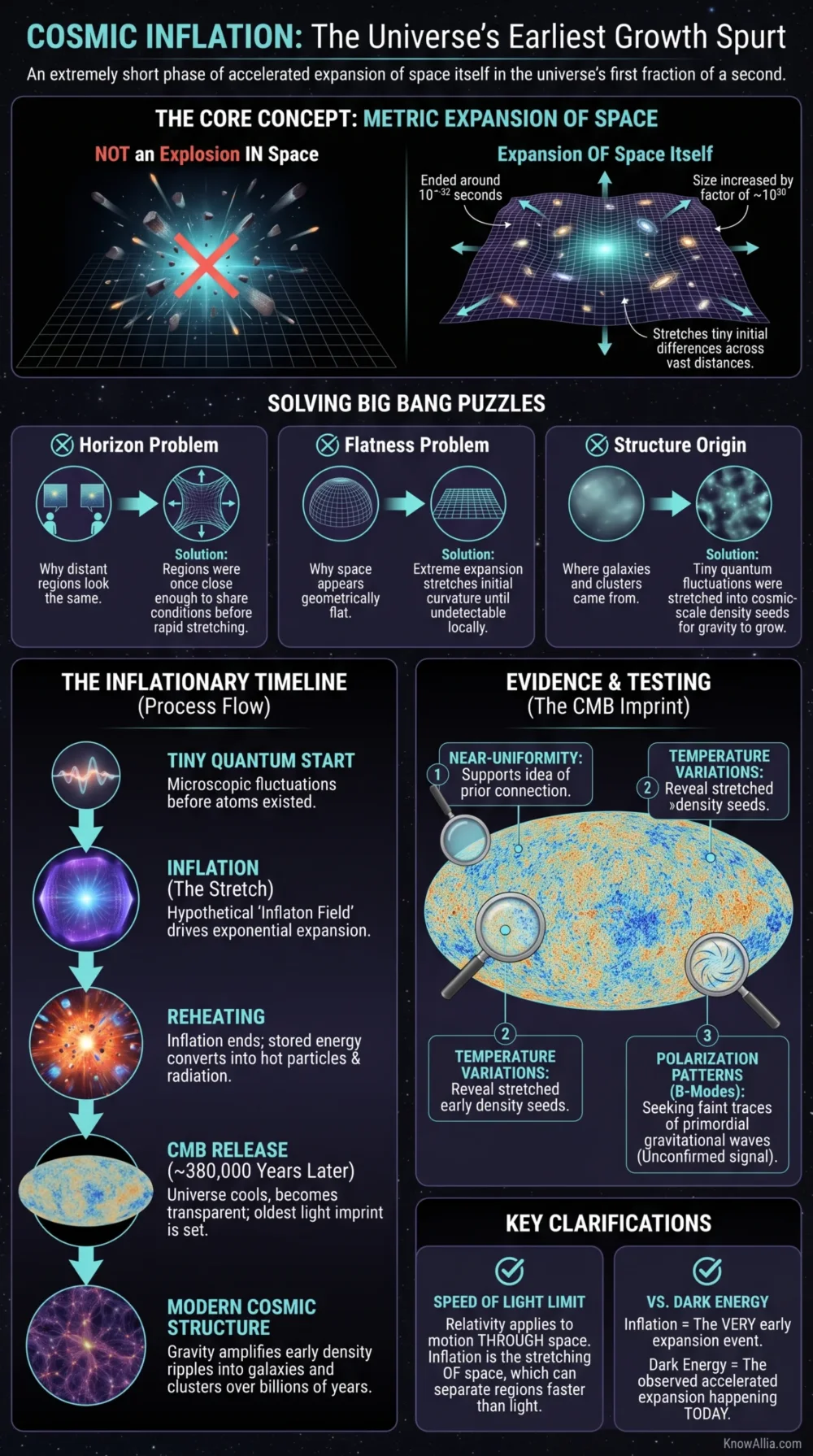
Cosmic inflation is the idea that the very early universe went through an extremely short phase of accelerated expansion. It did not describe galaxies flying through space like pieces of debris. It described space itself expanding so rapidly that tiny early differences could be stretched across vast cosmic distances.
The Simple Version
Inflation is used to explain why the universe looks so even in every direction, why space appears so close to flat, and how tiny early ripples could later grow into galaxies and galaxy clusters.
- When it happened: in the universe’s first tiny fraction of a second, before atoms, stars, or galaxies existed.
- What it changed: the scale of space, the pattern of early density ripples, and the starting conditions for later structure.
- What is not settled: the exact physical cause of inflation and whether primordial gravitational waves from that era will be detected.
This article explains what inflation means, why cosmologists use it, how it connects to the cosmic microwave background, and where the evidence is strong versus where the science remains open. The aim is to make the idea clear without turning a model into a certainty.
What Cosmic Inflation Means
In ordinary language, inflation means growth. In cosmology, cosmic inflation means a proposed early episode in which the scale of space grew at an extraordinary rate. ESA describes this early inflationary period as ending around 10-32 seconds in a common inflation picture, with the universe’s size increasing by about 1030 during that phase.[Source-1]
The phrase can sound as if the universe exploded into a pre-existing empty room. That is not the idea. The better way to picture it is this: distances inside space grew. No edge had to expand into an outside. Inflation is about the metric expansion of space, not a blast from a central point.
A helpful analogy: imagine a wrinkled sheet being pulled tight. The sheet does not need to move into a new sheet-shaped container. Its own surface stretches, and small wrinkles become spread out. Inflation works in a similar teaching sense: early curvature and tiny irregularities can be stretched across a much larger region.
Inflation Is Not the Whole Big Bang Model
Inflation is usually treated as an extension to the Big Bang model, not a replacement for it. The Big Bang model describes a hot, dense early universe that expanded and cooled. Inflation is added to explain the universe’s earliest starting conditions: why it looks so smooth, why its geometry is close to flat, and why matter later formed patterns rather than staying perfectly even.
Why Inflation Was Proposed
The early Big Bang model explained many observations, including cosmic expansion and the background glow left from the young universe. Yet it left some uncomfortable questions. Inflation was designed to make those questions less mysterious by changing the conditions before the universe became transparent.
The Horizon Problem
The universe looks nearly the same in opposite directions, even though those regions seem too far apart to have exchanged light or heat in the standard non-inflation picture. Inflation solves this by suggesting that those regions were once close enough to share similar conditions before being stretched far apart.
The Flatness Problem
Measurements show that space is very close to geometrically flat on large scales. Inflation can stretch any early curvature until it becomes hard to detect, much like a small patch of a huge sphere can look flat from nearby.
The Structure Problem
The universe is not perfectly smooth. It contains galaxies, clusters, and vast filaments. Inflation gives a way for tiny quantum fluctuations to become early density differences that gravity could later enlarge.
The Monopole Problem
Some high-energy theories suggested that heavy magnetic monopoles might have formed in the early universe. Inflation would dilute such relics so strongly that finding none today becomes less surprising.
Alan Guth’s 1981 paper presented inflation as a possible solution to the horizon and flatness problems, making it one of the best-known early statements of the idea in modern cosmology.[Source-5]
How Inflation May Have Worked
Many inflation models use a hypothetical field often called the inflaton field. The details vary, but the basic idea is that this field had an energy condition that made space expand in an accelerated way for a very short time. When inflation ended, that stored energy would have been converted into particles and radiation in a process called reheating.
This is one reason careful wording matters. Inflation is not directly watched like a nearby event. It is inferred from patterns in the universe, especially the cosmic microwave background. The proposed field, its energy scale, and its exact behavior are still active research topics.
Inflation in Plain View
A short burst of accelerated expansion can connect the smoothness of the sky, the flatness of space, and the first seeds of cosmic structure.
From Tiny Ripples to Large-Scale Structure
What the Model Connects
Distant regions can share a common early origin before being stretched apart.
Rapid expansion can make large-scale curvature hard to detect.
Tiny early ripples can become the starting pattern for later galaxies.
Not an Explosion
Inflation expands distances inside space; it is not matter flying outward from one center.
Not Directly Seen
The evidence comes from later traces, especially the cosmic microwave background.
Still Being Tested
Different inflation models predict slightly different patterns in the sky.
Evidence From the Cosmic Microwave Background
The cosmic microwave background, often shortened to CMB, is the oldest light we can observe directly. It was released when the universe cooled enough for light to travel freely, roughly 380,000 years after the Big Bang in standard cosmology. Harvard-Smithsonian describes the CMB as a relic from that early transparent phase and notes that scientists search it for traces of inflation.[Source-3]
The CMB is not a photograph of inflation itself. It is more like a later imprint. The small temperature variations in this radiation reveal slight density differences in the young universe. Inflation offers a natural way to create those differences: tiny quantum fluctuations were stretched to cosmic sizes.
NASA’s WMAP material explains that inflation predicts specific peaks in CMB temperature fluctuations and that these patterns can be tested through detailed microwave sky measurements.[Source-2]
| Observation | What Scientists See | How Inflation Helps Explain It | Certainty Level |
|---|---|---|---|
| CMB Smoothness | The microwave background has nearly the same temperature in all directions. | Regions now far apart may have shared conditions before inflation stretched them away from each other. | Well supported as a pattern; exact inflation model remains open. |
| Tiny CMB Fluctuations | Small temperature differences appear across the sky. | Quantum fluctuations could have been enlarged into early density ripples. | Strongly studied through WMAP, Planck, and ground-based telescopes. |
| Large-Scale Flatness | Space is measured to be very close to flat on cosmic scales. | Rapid expansion can stretch curvature until it becomes very small across the observable region. | Well measured; interpretation depends on the model. |
| Galaxy Formation | Galaxies and clusters follow a patterned cosmic web. | Early density ripples can act as starting points that gravity later grows. | Consistent with inflation and structure formation models. |
| Primordial Gravitational Waves | No confirmed primordial tensor signal has been detected. | Some inflation models predict a faint B-mode polarization signal in the CMB. | Not confirmed; upper limits already rule out some models. |
Numbers in Context
Inflation deals with numbers that are hard to imagine. The point is not to memorize them. The point is to see the scale difference between the inflationary phase, the later release of the CMB, and the slow growth of stars and galaxies.
| Stage | Approximate Time | Plain Meaning |
|---|---|---|
| Inflationary Phase | Far less than one second after the beginning of hot cosmic expansion | Space expands extremely fast; exact duration and mechanism depend on the model. |
| Reheating | After inflation ends | Energy connected with inflation becomes hot particles and radiation. |
| CMB Release | About 380,000 years after the Big Bang | Light begins traveling freely as atoms form and the universe becomes transparent. |
| Stars and Galaxies | Much later | Gravity slowly amplifies early density differences into large cosmic structures. |
NASA’s WMAP overview describes the early inflationary period as the first stage in a process that later leads to clumping matter, stars, and galaxies. It also reports WMAP’s fine-resolution CMB mapping and notes that the observed fluctuation properties support the inflation idea.[Source-4]
Core Terms Used in Inflation Science
- Cosmic Inflation
- A proposed short era of accelerated expansion in the very early universe.
- Inflaton
- A hypothetical field used in many inflation models to drive accelerated expansion.
- Reheating
- The stage after inflation when inflation-related energy becomes hot particles and radiation.
- Cosmic Microwave Background
- The oldest directly observable light, released when the universe became transparent.
- Density Fluctuation
- A small difference in matter density that can later grow under gravity.
- Scalar Perturbation
- A type of early density ripple linked to later structure formation.
- Tensor Perturbation
- A ripple in spacetime that could appear as primordial gravitational waves in some inflation models.
- B-Mode Polarization
- A twisting pattern in CMB polarization that scientists study as a possible trace of primordial gravitational waves.
Frequent Points of Confusion
Inflation Does Not Mean Everything Moved Faster Than Light Through Space
In relativity, objects cannot locally travel through space faster than light. Inflation does not break that rule because it is not ordinary motion through space. It is the stretching of space itself, which can increase distances between faraway regions faster than light could cross them.
The CMB Is Not the First Instant of the Universe
The CMB formed much later than inflation. It is still extremely old, but it is not light from the exact beginning. Its value comes from preserving information about earlier density patterns.
Inflation Is Not the Same as Dark Energy
Both involve accelerated expansion, but they belong to very different cosmic eras. Inflation refers to a proposed event in the universe’s first tiny fraction of a second. Dark energy refers to the observed accelerated expansion of the universe today.
Inflation Is Not Proven in Every Detail
Many observations fit the broad inflation picture, but there is no single confirmed inflation model. Scientists still test which versions survive new CMB measurements, galaxy surveys, and polarization data.
How Scientists Test Inflation
Inflation is tested by comparing model predictions with measurable patterns in the universe. The most used tests involve the CMB, the large-scale distribution of galaxies, and the search for faint polarization patterns.
- Measure CMB temperature variations. The size and spacing of the fluctuations reveal early-universe physics.
- Study CMB polarization. Polarization can carry extra information about early density ripples and possible gravitational waves.
- Compare galaxy clustering with early ripples. The cosmic web should grow from the same starting pattern seen in the CMB.
- Limit or detect primordial gravitational waves. A detection would strongly shape which inflation models remain possible.
- Check whether fluctuations are nearly scale-invariant and nearly Gaussian. These are natural expectations in many simple inflation models.
The Planck Collaboration’s 2018 inflation analysis found a scalar spectral index below exact scale invariance and placed tight limits on the tensor-to-scalar ratio when combined with BICEP/Keck data. In plain language, the measured density ripple pattern fits many inflation expectations, while no confirmed primordial gravitational-wave signal has been found yet.[Source-6]
What Scientists Still Do Not Know
Inflation is powerful, but not finished science. The broad idea explains several observed patterns, yet the physical engine behind it is not known. The inflaton field has not been directly detected, the energy scale is still constrained indirectly, and different models can sometimes produce similar observable results.
- The exact cause: scientists do not yet know what field or physical process drove inflation, if inflation occurred.
- The exact duration: common summaries give tiny timescales, but the full duration depends on the model.
- The gravitational-wave signal: some inflation models predict one, but current observations have not confirmed a primordial signal.
- The beginning before inflation: inflation may describe an early phase, but it does not automatically explain the absolute origin of everything.
- The best model: there are many inflation models, and observations continue to narrow the field.
Why Cosmic Inflation Matters
Cosmic inflation matters because it links the smallest and largest scales in physics. Quantum fluctuations, tiny enough to belong to particle physics, may have become the pattern behind galaxies and clusters. That connection is one of the main reasons inflation remains central in early-universe research.
It also teaches a careful lesson about scientific knowledge. A model can be useful and strongly supported by patterns without every detail being settled. Inflation is not a finished story carved into stone. It is a tested explanation that keeps facing sharper measurements.
FAQ About Cosmic Inflation
Questions Readers Often Ask
What Is Cosmic Inflation in One Sentence?
Cosmic inflation is a proposed early phase when space expanded extremely fast, setting up the smoothness, flatness, and early density ripples seen in the universe today.
Did Inflation Happen Before the Big Bang?
In many explanations, inflation happened just after the earliest hot beginning described by the Big Bang model. Some advanced models place inflation in a deeper origin story, but that is not settled.
Is Cosmic Inflation Proven?
The broad inflation idea is strongly supported by several observed patterns, especially in the cosmic microwave background. The exact physical model behind inflation is not proven.
What Evidence Supports Inflation?
The main evidence comes from the CMB’s smoothness, its tiny temperature variations, the near-flat geometry of space, and the way early density ripples match later cosmic structure.
What Are Primordial Gravitational Waves?
They are hypothetical spacetime ripples from the very early universe. Some inflation models predict them, but no confirmed primordial gravitational-wave signal has been detected.
Why Is the Cosmic Microwave Background So Important?
The CMB is the oldest directly observable light. Its small temperature and polarization patterns preserve clues about conditions long before stars and galaxies formed.
Sources
- ↩ Source-1 ESA – The Cosmic Microwave Background and Inflation — Used for the inflation timescale, expansion factor, and CMB fluctuation explanation.
- ↩ Source-2 NASA Imagine the Universe – Testing Inflation Theory — Used for WMAP testing, CMB fluctuation peaks, and inflation as an extension of the Big Bang model.
- ↩ Source-3 Center for Astrophysics | Harvard & Smithsonian – What Happened in the Early Universe? — Used for CMB age context and observational searches for inflation traces.
- ↩ Source-4 NASA Science – WMAP Overview — Used for WMAP mission context, early-universe timeline, flatness, and fluctuation findings.
- ↩ Source-5 Physical Review D – Alan H. Guth, Inflationary Universe — Used for the original horizon and flatness problem context.
- ↩ Source-6 Astronomy & Astrophysics – Planck 2018 Results. X. Constraints on Inflation — Used for scalar spectral index, flatness, and tensor-to-scalar ratio constraints.