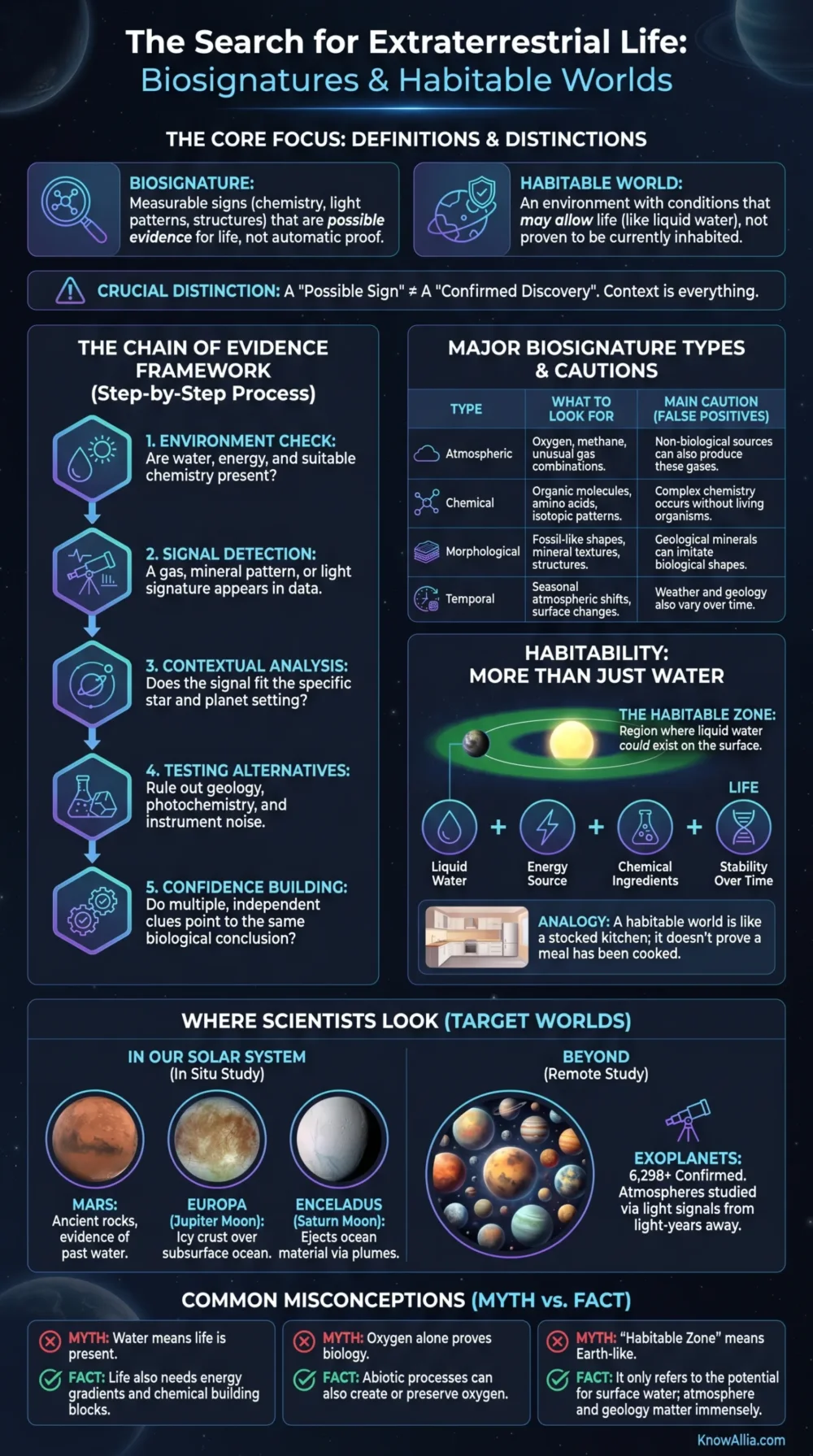
Extraterrestrial life is life that may exist beyond Earth, from simple microbes in a buried ocean to possible organisms on planets around other stars. Scientists do not start by assuming aliens are present. They look for measurable signs: chemistry, minerals, light patterns, environmental conditions, and repeated observations that are hard to explain without biology.
What This Search Is Really About
The search for life beyond Earth is not mainly a search for creatures, cities, or dramatic signals. It is a careful search for biosignatures, habitable environments, and patterns that match what life can do to rocks, oceans, ice, and atmospheres.
- A biosignature is possible evidence for past or present life, not automatic proof.
- A habitable world has conditions that may allow life, but it is not proven to be inhabited.
- Confidence rises when several independent clues point in the same direction and non-living explanations become less likely.
This article explains how scientists think about alien life, what counts as a biosignature, why water matters, how telescopes read exoplanet atmospheres, and why caution is part of good science. It also separates strong evidence from attractive but uncertain claims, especially when a distant planet is too far away to visit.
What Scientists Mean by the Search for Life
The phrase search for extraterrestrial life covers several different searches. A Mars rover can study rocks directly. A spacecraft can fly past an icy moon and analyze material from its ocean. A telescope can look at starlight filtered through an exoplanet atmosphere. A radio telescope can listen for possible technological signals.
These approaches share one idea: life changes its surroundings. On Earth, microbes alter minerals, plants and microbes affect atmospheric gases, and organisms leave organic molecules behind. NASA defines a biosignature as a characteristic, molecule, substance, structure, or feature that can be used as evidence for past or present life.[Source-b]
Important distinction: a possible sign of life is not the same thing as a confirmed discovery of life. In astrobiology, careful wording matters because many non-living processes can make organic molecules, gases, minerals, and patterns that look interesting at first.
Life as We Know It
Earth is still the only confirmed example of life. That makes Earth both useful and limiting. It gives scientists a real reference for biology, water chemistry, metabolism, fossils, oxygen, methane, and photosynthesis. It also reminds us that alien life may not match every Earth pattern.
NASA notes that there is no universally accepted definition of life, but scientists can still search for telltale signs in atmospheres and environments.[Source-a] This is why modern life detection is less about one perfect definition and more about evidence that can be tested.
Biosignatures: The Evidence Life Might Leave
A biosignature is not always a fossil. It can be a gas in an atmosphere, a chemical imbalance, a mineral texture, an organic molecule, a pattern in light, or a set of changes that repeats with seasons. The stronger cases are not built on one clue. They come from several clues that fit the same environment.
| Biosignature Type | What Scientists Look For | Why It Matters | Main Caution |
|---|---|---|---|
| Chemical | Organic molecules, lipids, amino acids, isotopic patterns, or reaction products | Life uses and reshapes chemistry in patterned ways | Organic chemistry can also happen without living organisms |
| Atmospheric | Oxygen, ozone, methane, carbon dioxide, sulfur gases, or unusual gas pairings | Living systems can change an atmosphere over time | A gas may have a non-biological source |
| Morphological | Fossil-like shapes, layered structures, mineral textures, or micro-scale patterns | Some life leaves shapes or structures in rocks | Minerals can form shapes that imitate biology |
| Environmental | Liquid water, usable energy, stable chemistry, and nutrient cycles | Habitability gives possible life a place to operate | A suitable setting does not prove life is present |
| Temporal | Seasonal gas changes, repeated atmospheric shifts, or surface color changes | Some living systems vary with light, temperature, or cycles | Weather and geology can also vary with time |
In exoplanet science, almost every possible biosignature must be treated as a potential biosignature first. A review in Astrobiology explains that biosignature gases can have non-living explanations, so the real task is to test whether a biological origin is more likely than the alternatives.[Source-h]
Life Detection Is a Chain of Evidence
A strong case does not rest on a single molecule. It connects the planet, its environment, the signal, and the possible non-living explanations.
From Signal to Interpretation
Water, energy, chemistry, and time define whether the target is worth deeper study.
A gas, mineral, organic compound, texture, or light pattern appears in the data.
The star, orbit, surface, ocean, and atmosphere are checked against the signal.
Geology, radiation, photochemistry, contamination, and instrument noise are tested.
The case strengthens only when repeated tests point in the same direction.
What Raises Confidence
A gas, surface clue, and environmental setting point toward the same story.
Geology, photochemistry, radiation, and instrument effects are examined first.
New data and separate analysis reduce the chance that one method shaped the result.
Best Case
A habitable setting plus multiple signals that fit biology and resist non-living explanations.
Weak Case
One interesting molecule, low signal strength, or a result that changes with data processing.
Honest Label
“Potential biosignature” means worth studying, not confirmed alien life.
Oxygen, Methane, and Context
Oxygen is often discussed because much of Earth’s oxygen comes from photosynthetic life. Methane also matters because it can be linked to biological activity. Yet neither gas should be read alone. Oxygen can build up through non-living processes in some conditions, and methane can come from geology. A more interesting case may involve gas combinations that are hard to keep in balance without active replenishment.
Think of a biosignature like a footprint on a beach. A footprint suggests someone walked there, but wind, water, and lighting can distort what you see. The print becomes more convincing when you also find a path of matching prints, fresh sand movement, and no better explanation.
Habitable Worlds Are Candidates, Not Confirmed Homes
A habitable world is a place where conditions may allow life as we know it. The word does not mean life exists there. It means the environment has features worth studying: liquid water or evidence for it, usable energy, suitable chemistry, and enough stability over time for biology to operate.
The most familiar idea is the habitable zone: the distance from a star where liquid water could exist on a planet’s surface under the right atmospheric conditions.[Source-c] This zone changes with the star’s brightness, age, and radiation output. It is a starting filter, not a final answer.
Habitable Does Not Mean Inhabited
A planet can sit in the habitable zone and still be dry, airless, too active, or chemically unsuitable. A moon outside the classic zone can still have a buried ocean warmed by tidal flexing.
Life Needs More Than Water
Water helps chemistry move, but life also needs energy and useful chemical ingredients. On Earth, life runs on gradients: light and dark, hot and cold, oxidized and reduced chemistry.
| Clue | What It Can Tell Us | Why It Is Not Enough Alone |
|---|---|---|
| Liquid Water | Water can dissolve and transport chemicals needed by Earth-like life | Water can exist without life |
| Energy Source | Sunlight, chemical reactions, or internal heat may power metabolism | Energy may be too weak, too brief, or not usable by biology |
| Organic Molecules | Carbon-rich chemistry may support prebiotic or biological processes | Organic molecules can form through non-living chemistry |
| Atmosphere | Can protect a surface, move heat, and hold detectable gases | Atmospheres can hide or imitate possible biological signs |
| Long-Term Stability | Stable conditions give life more time to begin and persist | Stability is hard to reconstruct for distant exoplanets |
A useful analogy is a kitchen. A habitable world is like a kitchen with water, ingredients, heat, and time. That does not prove a meal has been cooked. It only tells us the place may be able to support the process.
How Biosignatures Are Detected
There is no single life-detection tool. Scientists choose the method based on distance, target type, and what can be measured. Nearby targets can be sampled more directly. Exoplanets usually require reading light from far away.
Transit Spectroscopy
When a planet passes in front of its star, a tiny amount of starlight filters through the planet’s atmosphere. Molecules absorb certain wavelengths, leaving spectral marks. This method can reveal gases such as water vapor, carbon dioxide, methane, and other atmospheric molecules when the signal is strong enough.
Direct Imaging
Direct imaging tries to separate the faint light of a planet from the much brighter light of its star. This is technically hard, but it can let researchers study reflected light and search for atmospheric or surface patterns. NASA’s planned Habitable Worlds Observatory is designed to directly image 25 potentially habitable worlds and search their atmospheres for chemical biosignatures such as oxygen and methane.[Source-i]
In Situ Analysis
In situ means instruments study material at the target itself. Rovers, landers, flybys, and orbiters can analyze rocks, ice, gases, dust, or plume material. This gives richer local detail than a distant telescope, but it is available only for bodies within our solar system.
Sample Return
Returned samples can be studied with laboratory instruments that are too large or delicate to send to another world. For life detection, this can help separate a true biological pattern from a mineral or chemical process that only looks biological at first.
Technosignatures
Most life-detection work focuses on non-technological life, but scientists also consider technosignatures: possible traces of technology, such as narrow radio signals, laser pulses, unusual artificial chemicals, or other patterns that would be hard to explain naturally.[Source-l] Technosignatures are a separate branch of the search, not a replacement for biosignature science.
Where Scientists Look for Habitable Worlds
The search has two main arenas: nearby worlds in our own solar system and planets orbiting other stars. Solar system targets can be studied in detail. Exoplanets are far away, but there are many more of them.
Mars
Mars is a natural target because it preserves ancient rocks and has clear evidence that water shaped parts of its surface in the past. In 2025, NASA reported that a Perseverance rover sample from an ancient dry riverbed contains potential biosignatures, while also stressing that non-biological explanations still must be tested.[Source-m]
The value of Mars is not only the possibility of past life. It is also a laboratory for learning how minerals, water, radiation, and organic chemistry behave on a rocky planet beyond Earth.
Europa
Europa, a moon of Jupiter, is important because evidence points to a salty ocean beneath its icy crust. NASA lists three main ingredients scientists look for in life-friendly settings: liquid water, chemistry, and energy. Europa may have all three, and the Europa Clipper mission is designed to investigate whether places below the surface could support life.[Source-e]
Enceladus
Enceladus, a moon of Saturn, ejects material from a global ocean into space. That makes it especially interesting: spacecraft can study ocean-linked material without drilling through the ice. NASA notes that Enceladus has a global ocean, unusual chemistry, and internal heat, making it a strong lead in the search for places where life could exist.[Source-f]
Exoplanets
Exoplanets are planets beyond our solar system. As of June 4, 2026, the NASA Exoplanet Archive listed 6,298 confirmed planets, with many more candidates still under study.[Source-d] Most confirmed planets are not Earth twins, but the growing catalog helps scientists compare planet sizes, orbits, star types, and possible atmospheres.
Some exoplanets orbit within their stars’ habitable zones, but distance makes the evidence harder to read. A planet can be the right size and receive the right amount of starlight while still lacking a friendly surface, a stable atmosphere, or long-lived water.
K2-18 b as a Cautionary Example
K2-18 b shows why careful wording matters. In 2025, a University of Cambridge-led team reported possible chemical fingerprints of dimethyl sulfide or dimethyl disulfide in the planet’s atmosphere, while saying more data were needed before claiming life.[Source-j] A later independent analysis argued that the same target does not yet meet the evidence standard for life and that some signals may be shaped by instrument and data-processing issues.[Source-k]
Why this matters: an exciting molecule in a distant atmosphere is a starting point. It becomes stronger only after repeated observations, better models, and careful checks against non-living chemistry and instrument effects.
How Evidence Is Weighed
Life detection is careful because the claim is large and the measurements are difficult. A good case usually has these features:
- Clear signal quality: the measurement must be strong enough to separate from noise.
- Environmental fit: the signal should make sense with the star, planet, atmosphere, surface, or ocean setting.
- Non-living checks: geology, photochemistry, radiation, and contamination must be considered.
- Independent confirmation: other teams, instruments, or observations should be able to test the claim.
- Multiple evidence lines: chemistry, context, and physical conditions should support each other.
The National Academies has emphasized that biosignature studies must examine how signs are produced, preserved, destroyed, and confused with false positives or false negatives.[Source-g] That is why responsible astrobiology often sounds cautious. The caution is not weakness; it is how the search stays reliable.
False Positives
A false positive happens when a non-living process imitates a possible sign of life. Examples include oxygen made by atmospheric processes, methane from geology, or mineral textures that resemble biological patterns. False positives do not make biosignatures useless. They make context essential.
False Negatives
A false negative happens when life exists but does not create a detectable signal. Earth itself warns us about this. For much of Earth’s history, life existed without an oxygen-rich atmosphere that would be easy to detect from far away. A quiet biosphere may be real but hidden.
Common Misconceptions About Alien Life Searches
“Water Means Life”
Water is one of the best places to start, but water alone is not life. A world also needs usable energy, chemistry, and conditions that allow organized biological processes to persist.
“Oxygen Alone Proves Life”
Oxygen can be a strong clue in the right setting, especially with other gases. Alone, it is not enough because some non-living processes can also produce or preserve oxygen.
“Organic Molecules Are Living Material”
Organic molecules contain carbon and can be related to biology, but they can also form through non-living chemistry. They are promising clues, not proof by themselves.
“A Habitable-Zone Planet Is Earth-Like”
The habitable zone only describes a possible range for surface liquid water. Planet size, atmosphere, star activity, geology, and history still matter.
Useful Terms
- Biosignature
- A possible sign of past or present life, such as a molecule, structure, pattern, or environmental change.
- Potential Biosignature
- A clue that may have a biological origin but needs more study before any life claim is made.
- Habitable Zone
- The orbital region where liquid water could exist on a planet’s surface under suitable atmospheric conditions.
- Habitable World
- A planet or moon with conditions that may allow life as we know it.
- Inhabited World
- A world where life actually exists. No world beyond Earth has been confirmed as inhabited.
- Abiotic
- Made by non-living physical or chemical processes.
- Transit Spectroscopy
- A method that studies starlight passing through a planet’s atmosphere during a transit.
- Technosignature
- A possible sign of technology from intelligent life, such as a narrow radio signal or artificial atmospheric compound.
What We Do Not Know Yet
Several limits remain. We do not know how often life begins when conditions are suitable. We do not know whether life elsewhere must use the same chemistry as Earth life. We do not know how many habitable-zone planets keep stable atmospheres for long periods. We also do not know which biosignatures are most reliable for planets around red dwarfs, ocean worlds, or worlds unlike Earth.
There is also a measurement limit. A telescope may detect the atmosphere of a distant planet, but it cannot scoop up its ocean or inspect its rocks. For exoplanets, scientists often work with thin light signals from many light-years away. That makes careful uncertainty part of the answer.
Why the Search Matters Scientifically
The search for extraterrestrial life helps scientists understand planets, stars, atmospheres, oceans, chemistry, and Earth itself. Even a result that finds no life can be useful if it shows which environments stay sterile, which biosignatures fail, or which planets lose habitability over time.
The most reliable path is patient: find possible habitats, identify possible biosignatures, test the alternatives, gather more data, and let the evidence improve. That is how a distant hint can become either a better natural explanation or one of the strongest discoveries in science.
FAQ
Have scientists found extraterrestrial life?
No. As of now, Earth is the only confirmed place with life. Scientists have found possible habitats and potential biosignatures, but none has confirmed life beyond Earth.
What Is the Best Biosignature for Alien Life?
There is no single best biosignature in every setting. Oxygen, methane, organic molecules, isotopic patterns, mineral textures, and seasonal changes can all matter, but each must be judged with its environment.
Does a Planet in the Habitable Zone Have Life?
No. The habitable zone only means liquid water could exist on the surface under suitable conditions. The planet still needs the right atmosphere, chemistry, energy, and history.
Why Are Europa and Enceladus Important?
Both are icy moons with evidence for subsurface oceans. Europa is being studied because it may have water, chemistry, and energy. Enceladus releases ocean-linked material into space, making its chemistry easier to sample from a spacecraft flyby.
Why Do Scientists Avoid Saying “Alien Life Found”?
Because many possible signs of life can be made by non-living processes or affected by instrument noise. Scientists need repeated observations and tests against alternative explanations before making a life claim.
Sources
- [Source-a] NASA Science – Can We Find Life? — Used for the current status of the search and the note that life has no single universally accepted definition.
- [Source-b] NASA Astrobiology – What Is a Biosignature? — Used for the definition and examples of biosignatures.
- [Source-c] NASA Science – The Habitable Zone — Used for the meaning of the habitable zone and its link to surface liquid water.
- [Source-d] NASA Exoplanet Archive – Exoplanet and Candidate Statistics — Used for the confirmed exoplanet count and discovery-method statistics.
- [Source-e] NASA Science – Europa: Ingredients for Life — Used for Europa’s water, chemistry, and energy conditions.
- [Source-f] NASA Science – Enceladus — Used for Enceladus’ global ocean, chemistry, internal heat, and plume relevance.
- [Source-g] National Academies – Search for Life Elsewhere — Used for how biosignature evidence should be tested, preserved, and interpreted.
- [Source-h] NIH PubMed Central – Exoplanet Biosignatures: A Review of Remotely Detectable Signs of Life — Used for the caution that exoplanet biosignatures can have non-biological explanations.
- [Source-i] NASA Science – Habitable Worlds Observatory — Used for the planned goal of imaging potentially habitable worlds and searching atmospheres for biosignatures.
- [Source-j] University of Cambridge – Strongest Hints Yet of Biological Activity Outside the Solar System — Used for the reported K2-18 b DMS/DMDS finding and the need for more data.
- [Source-k] arXiv – K2-18 b Does Not Meet the Standards of Evidence for Life — Used for the independent caution around K2-18 b interpretation.
- [Source-l] NASA Science – Searching for Signs of Intelligent Life: Technosignatures — Used for the distinction between biosignatures and technosignatures.
- [Source-m] NASA – Mars Rover Discovered Potential Biosignature Last Year — Used for the Perseverance rover example and NASA’s caution about alternative explanations.