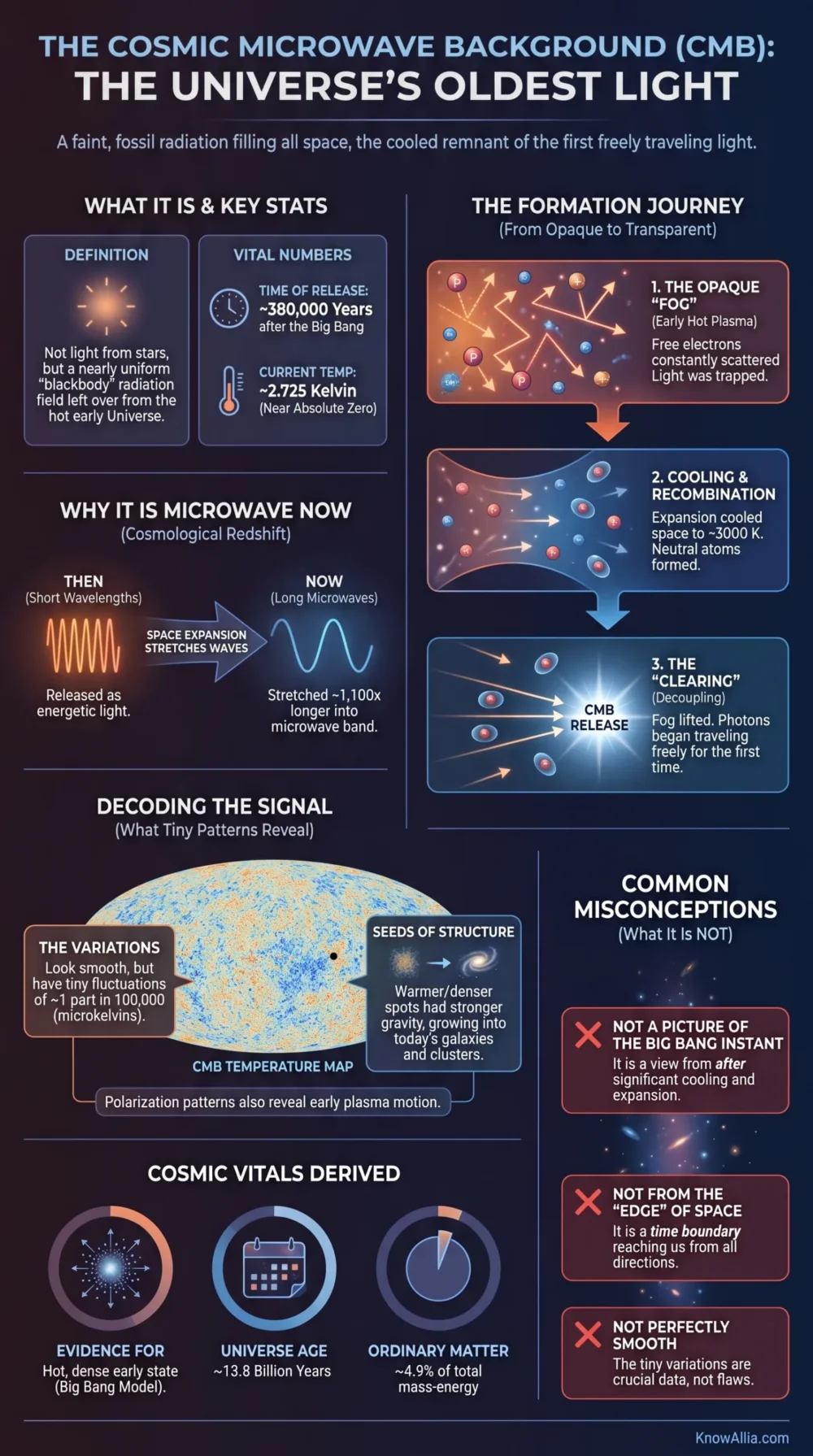
The cosmic microwave background, often shortened to CMB, is the cooled remnant of the first light that could travel freely through the Universe. It is not light from a star, galaxy, or nebula. It is a faint microwave glow that fills space in every direction, carrying information from a time when the Universe was still very young.[Source-a]
A Clear Starting Point
The CMB is often called the oldest light in the Universe because it comes from the earliest time ordinary light can directly show us. Before that moment, space was filled with hot charged particles that scattered photons again and again, so light could not move freely across long distances.
- Age of the light: released about 380,000 years after the Big Bang.
- Temperature today: about 2.725 K, only a little above absolute zero.
- Why it matters: tiny temperature patterns in it record the early density differences that later grew into galaxies and galaxy clusters.
This article explains what the CMB is, why it is microwave radiation today, how scientists measure it, what its tiny patterns reveal, and where its limits are. The goal is simple: to make the oldest observable light feel less abstract without losing the science.
What Is the Cosmic Microwave Background?
The cosmic microwave background is radiation left over from the hot early Universe. It reaches us from all directions, not because Earth sits at a special center, but because every observer in the observable Universe is surrounded by this ancient radiation field.
In ordinary language, it is the Universe’s early glow after it cooled enough for light to stop bouncing constantly off free electrons. In physics language, it is a nearly perfect blackbody radiation field with very small temperature variations.
The CMB is not a picture of the Big Bang itself. It is a view of the Universe after it had already expanded and cooled for hundreds of thousands of years. Light from earlier times could not travel freely in the usual way, so telescopes cannot directly see beyond this light barrier.
Why It Is Called the Oldest Light
The phrase oldest light can be misunderstood. The CMB is not the oldest event in cosmic history. It is the oldest freely traveling light we can observe with telescopes. ESA describes it as the farthest and oldest light any telescope can detect because the earlier Universe was opaque to light.[Source-b]
That makes the CMB a boundary for direct light-based observation. Scientists can still study earlier periods using theory, particle physics, gravitational waves, and indirect evidence, but not by simply looking farther with a more powerful optical telescope.
How the CMB Formed
For roughly the first 380,000 years, the Universe was filled with hot plasma: photons, electrons, protons, and other particles. Photons were present, but they did not get far. Free electrons scattered them so often that the Universe behaved like a glowing fog.
As space expanded, the plasma cooled. When the temperature fell to around 3000 K, electrons could join with protons to form neutral hydrogen atoms. With far fewer free electrons in the way, photons began to travel across space. That release of light is what we now detect as the CMB.[Source-c]
Recombination, Decoupling, and Last Scattering
Several terms describe this same era from different angles. Recombination refers to electrons and nuclei forming neutral atoms. Decoupling means light and matter stopped interacting so tightly. Last scattering points to the last time many CMB photons scattered off free electrons before traveling onward.
These words are not interchangeable in every technical setting, but for a general reader they describe one linked change: the Universe shifted from opaque to transparent.
| Term | Plain Meaning | Why It Matters |
|---|---|---|
| Recombination | Electrons joined atomic nuclei to form mostly neutral hydrogen. | Neutral atoms scattered photons much less than free electrons did. |
| Decoupling | Light and matter stopped behaving like one tightly linked fluid. | Photons could move freely through space. |
| Last Scattering | The final major scattering event for many CMB photons. | It gives us the “surface” we observe as the CMB. |
| Surface of Last Scattering | A distant shell-like view of where those photons last interacted. | It is not a solid surface; it is a light-travel boundary. |
Why Ancient Light Reaches Us as Microwaves
When CMB photons began traveling freely, their wavelengths were much shorter than they are now. As the Universe expanded, space stretched the wavelengths of those photons. This process is called cosmological redshift.
A useful analogy is a musical note played on a string. If the string is stretched while the wave is moving, the wave becomes longer and the note shifts lower. Light is not sound, but the idea helps: stretch the wave, lower the energy. Over cosmic time, the early glow was stretched until we now detect it mainly in the microwave part of the electromagnetic spectrum.
NASA explains that the continued expansion of space has redshifted this glow by about 1,100 times, placing it in the microwave range and making it brightest near a wavelength of about 1.9 mm today.[Source-d]
Cosmic Microwave Background: From Hot Plasma to Faint Microwaves
A text-based view of how the oldest observable light changed as the Universe expanded and cooled.
Light Release Sequence
Photons, electrons, and nuclei were tightly mixed. Light scattered often and could not travel far.
Expansion lowered the temperature enough for electrons and protons to form neutral hydrogen.
Photons began moving freely. Those photons are the CMB we detect today.
Cosmic expansion stretched the light into microwave wavelengths.
Numbers Attached to the CMB
Approximate time after the Big Bang when CMB light was released.
Average temperature measured today.
Scale of the tiny temperature differences that trace early density patterns.
What It Is
Ancient radiation, now cooled into microwaves.
What It Shows
Early density patterns that later shaped cosmic structure.
What It Cannot Show
The Big Bang itself as a direct visual image.
What the CMB Reveals About the Universe
The CMB looks nearly uniform, but nearly is doing a lot of work. Its average temperature is almost the same in every direction, yet sensitive instruments detect tiny differences measured in microkelvins. These small variations are not random decoration. They are traces of early density differences.
NASA’s COBE mission measured the CMB spectrum as a nearly perfect blackbody with a temperature of 2.725 ± 0.002 K and detected intrinsic temperature anisotropy at about one part in 100,000.[Source-e]
Temperature Patterns
Slightly warmer and cooler patches in CMB maps correspond to tiny differences in density and motion in the early Universe. Over billions of years, gravity amplified those early differences, helping matter gather into the large-scale pattern of galaxies and galaxy clusters.
Blackbody Spectrum
A blackbody spectrum is the radiation pattern expected from matter and radiation in thermal balance. The CMB’s near-perfect blackbody shape is one reason it is such strong evidence for a hot, dense early phase of the Universe. Ordinary starlight mixed together would not naturally produce the same clean spectrum.
Polarization
The CMB is also faintly polarized, meaning some of its light waves have a preferred orientation. Polarization helps scientists study motion in the early plasma, the later period when the first stars ionized gas again, and possible traces from very early cosmic processes.
Geometry and Contents of the Universe
Detailed CMB measurements help estimate the Universe’s age, geometry, expansion history, and matter-energy content. ESA’s Planck science results give a Universe age near 13.8 billion years and place ordinary matter at about 4.9% of the total mass-energy budget within the Planck model results.[Source-f]
| CMB Feature | What Scientists Measure | What It Helps Explain |
|---|---|---|
| Average Temperature | About 2.725 K today. | The cooling history of the Universe. |
| Blackbody Spectrum | A thermal spectrum with extremely small departures. | Why the CMB fits a hot early Universe better than ordinary mixed light sources. |
| Anisotropies | Microkelvin-level hot and cold patches. | Early density differences that grew into cosmic structure. |
| Polarization | Preferred orientation patterns in the radiation. | Early plasma motion, reionization history, and tests of early-Universe ideas. |
| Gravitational Lensing | Slight bending of CMB paths by matter between then and now. | The distribution of matter across cosmic time. |
How Scientists Have Mapped the CMB
The CMB was first detected in the 1960s, but later space missions turned it from a faint all-sky signal into a detailed data set. Each mission added better sensitivity, sharper maps, or wider frequency coverage.
| Mission or Discovery | Main Role | Plain Result |
|---|---|---|
| Penzias and Wilson Detection | Detected a persistent microwave signal coming from all directions. | Helped identify the CMB as a real cosmic signal. |
| COBE | Measured the spectrum and first mapped large-scale tiny variations. | Showed the CMB is a near-perfect blackbody and not perfectly smooth. |
| WMAP | Mapped temperature differences across the full sky in finer detail. | Improved estimates of cosmic age, contents, and geometry. |
| Planck | Observed the microwave sky with wider frequency coverage and high sensitivity. | Produced very detailed CMB maps and refined cosmological model values. |
NASA’s WMAP page notes that WMAP measured small temperature variations across the full sky and used them to reveal the Universe’s size, matter content, age, geometry, and early structure.[Source-g]
The Planck Collaboration’s final cosmology paper reports that the six-parameter Lambda-CDM model remains a strong fit to Planck CMB data, while also noting limits, tensions, and places where extra model assumptions matter.[Source-h]
Common Confusions About the CMB
“The CMB Is the Big Bang Explosion”
Not Quite
The CMB is not an image of a single explosion point. It is radiation released when the early Universe became transparent. The Big Bang model describes the expansion of space from a hot dense state, not debris flying outward from a center.
“The CMB Comes From the Edge of Space”
Misleading
The CMB reaches us from the farthest light-visible region in every direction. It is better to think of it as a time boundary for light, not a physical wall at the edge of the Universe.
“Microwave Means Artificial Radio Noise”
Incorrect
Microwave describes a range of wavelengths. The CMB is natural cosmic radiation, detected with sensitive instruments after foreground signals are carefully separated.
“The CMB Is Perfectly Smooth”
Incorrect
The average glow is extremely uniform, yet tiny variations are present. Those small differences are scientifically rich because they trace early structure.
Useful Terms for Understanding the CMB
- Photon
- A particle of light. CMB photons have been traveling freely for most of cosmic history.
- Plasma
- A hot state of matter with free charged particles. The early Universe was plasma before neutral atoms formed.
- Blackbody
- An ideal thermal radiation pattern. The CMB follows this pattern very closely.
- Anisotropy
- A difference depending on direction. CMB anisotropies are tiny temperature variations across the sky.
- Redshift
- The stretching of light to longer wavelengths as space expands.
- Lambda-CDM
- The standard cosmological model using dark energy, cold dark matter, ordinary matter, radiation, and initial fluctuation patterns.
- Polarization
- A preferred orientation in light waves. CMB polarization gives extra information beyond temperature maps.
What the CMB Cannot Tell Us by Itself
The CMB is one of the best measured signals in cosmology, but it is not a complete answer to every question about the Universe. Some values derived from it depend on the model used to interpret the data. The CMB also does not directly show the first instant of cosmic history, because it was released much later.
- It does not directly image the Big Bang itself. It shows the Universe at the time light became free to travel.
- It does not explain dark matter or dark energy by itself. It helps measure their effects, but their deeper nature remains unknown.
- It needs foreground cleaning. Emission from our galaxy and other sources must be modeled and separated.
- Some tensions remain. For example, measurements of the present expansion rate from the early Universe and from nearby cosmic distance methods do not fully match in all analyses.
A careful way to read CMB claims: the raw microwave signal is observed, but many headline numbers come from fitting that signal within a cosmological model. That does not make them weak; it means the assumptions should be named clearly.
Why the Oldest Light Still Matters
The CMB matters because it connects the very young Universe with the Universe we see now. Its average temperature records cosmic cooling. Its blackbody spectrum points to a hot early state. Its tiny temperature and polarization patterns preserve information about early density, motion, composition, and geometry.
It is also a reminder that astronomy is not only about bright objects. Some of the most useful information in the sky comes from a faint background glow, almost the same everywhere, carrying a pattern so subtle that it took space missions and careful analysis to read it.
FAQ About the Cosmic Microwave Background
Questions Readers Often Ask
Is the Cosmic Microwave Background Really Light?
Yes. It is electromagnetic radiation, the same broad family as visible light, infrared, radio waves, and X-rays. Today the CMB is mostly detected as microwave radiation because cosmic expansion stretched its wavelengths.
Why Can’t We See the CMB With Our Eyes?
Human eyes detect a narrow range of visible wavelengths. The CMB has been redshifted into microwave wavelengths, so it requires specialized detectors rather than ordinary vision or optical cameras.
How Old Was the Universe When the CMB Was Released?
The CMB was released about 380,000 years after the Big Bang, when the Universe cooled enough for neutral atoms to form and light could travel freely.
Does the CMB Prove Everything About the Big Bang Model?
The CMB is strong evidence for a hot early Universe, especially because of its blackbody spectrum and all-sky pattern. It does not answer every question by itself, and scientists still test model details with many kinds of observations.
What Are the Hot and Cold Spots in CMB Maps?
They are tiny temperature differences, not large flames or cold holes. These variations trace early density and motion patterns that later helped shape galaxies and galaxy clusters.
Is the CMB Still Changing?
The photons continue traveling through an expanding Universe, so their wavelengths keep stretching and their effective temperature keeps dropping over cosmic time.
Sources
The links below point to topic-specific pages from space agencies, academic publishers, and long-standing reference institutions used for the factual claims in this article.
- [Source-a] ESA – Cosmic Microwave Background (CMB) Radiation — Used for the definition of the CMB as cooled first light and for the oldest-light explanation.
- [Source-b] ESA – Cosmic Microwave Background (CMB) Radiation — Used for the light-observation boundary and the opaque early Universe.
- [Source-c] ESA – Planck and the Cosmic Microwave Background — Used for the 380,000-year formation period, cooling, and transparent-Universe explanation.
- [Source-d] NASA Science – Universe Glossary — Used for redshift, microwave wavelength, and present CMB temperature details.
- [Source-e] NASA LAMBDA – Cosmic Background Explorer — Used for COBE’s blackbody temperature and anisotropy measurements.
- [Source-f] ESA – Planck Science Highlights — Used for Planck-derived age and matter-energy composition values.
- [Source-g] NASA Science – WMAP Overview — Used for WMAP’s full-sky CMB mapping and cosmological measurement role.
- [Source-h] Astronomy & Astrophysics – Planck 2018 Results VI: Cosmological Parameters — Used for final Planck model interpretation and model-limit context.
- Nobel Prize – Tuning in to Big Bang’s Echo — Background source for the Penzias and Wilson discovery history.