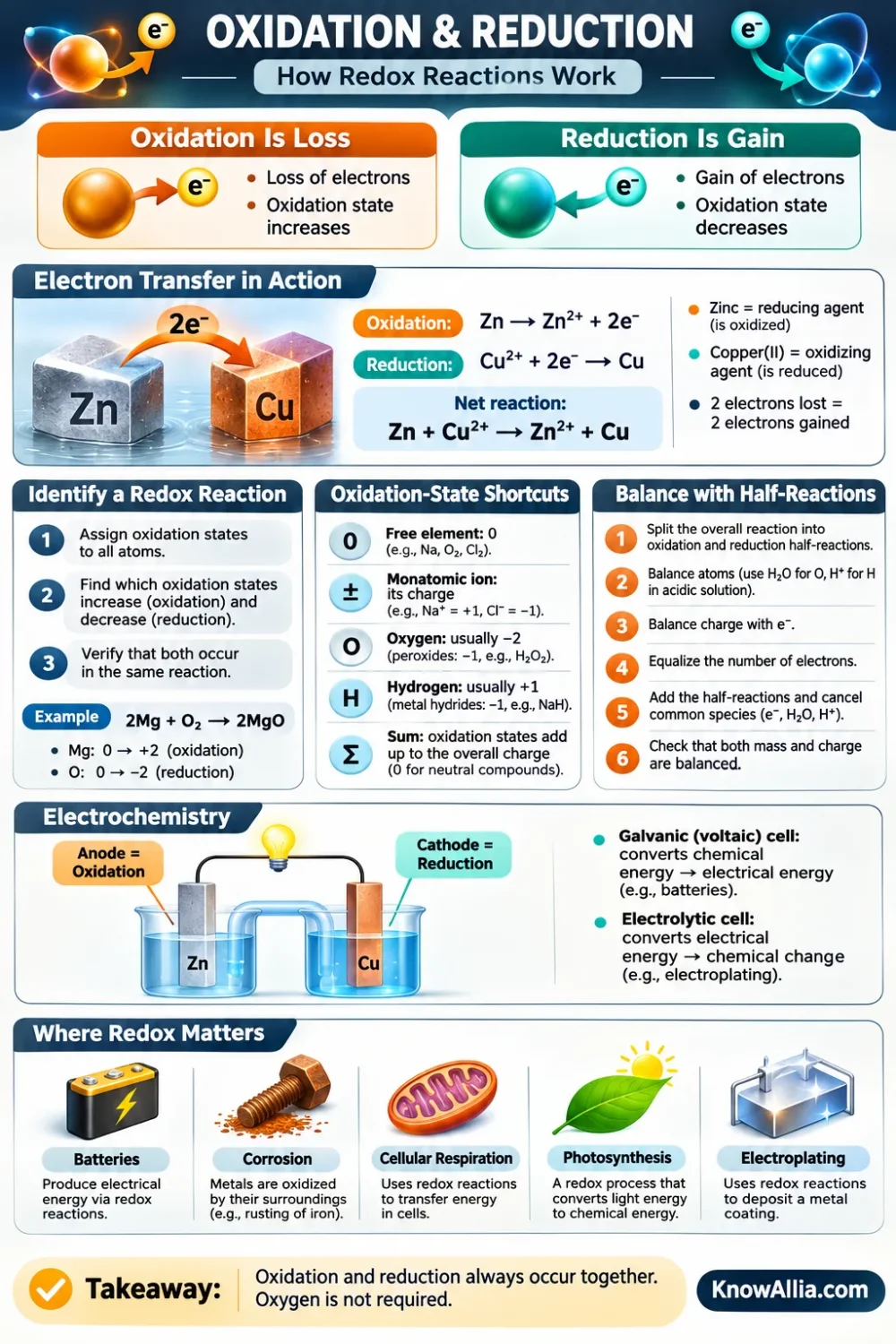
Oxidation and reduction are two linked chemical processes in which electrons are transferred or their distribution changes. Oxidation involves the loss of electrons or an increase in oxidation state, while reduction involves the gain of electrons or a decrease in oxidation state. A chemical reaction involving both processes is called an oxidation-reduction reaction, usually shortened to a redox reaction.
Redox reactions explain how batteries deliver electrical energy, how metals react with their surroundings, and how living cells transfer energy. They also describe many chemical changes that occur without oxygen. Understanding redox chemistry begins with identifying which atoms are oxidized, which are reduced, and how their oxidation states change.
The Essential Chemistry
Oxidation and reduction are paired changes in electron accounting. In a complete redox reaction, electrons lost through oxidation are balanced by electrons gained through reduction. The two processes can be represented separately as half-reactions, then combined into one balanced equation.
- Oxidation: Loss of electrons; oxidation state increases.
- Reduction: Gain of electrons; oxidation state decreases.
- Redox reaction: Both changes occur within the overall reaction.
What Are Oxidation and Reduction?
Oxidation and reduction describe opposite changes in the electronic state of atoms, ions, or molecules. The definitions are closely related, but each identifies a different part of the same chemical process.
Oxidation: Electron Loss
Oxidation occurs when a chemical species loses electrons or when an atom’s oxidation state increases. An atom can become more positively charged after losing electrons, although a change in actual ionic charge is not required in every oxidation reaction.
Consider the oxidation of a neutral zinc atom:
Oxidation half-reaction
Zn → Zn2+ + 2e−
Zinc loses two electrons. Its oxidation state increases from 0 to +2.
The electrons appear on the product side of the oxidation half-reaction because they are released by zinc.
The International Union of Pure and Applied Chemistry (IUPAC) defines oxidation using electron removal and increases in oxidation number. In organic chemistry, oxidation can also be associated with changes such as increased bonding to oxygen or decreased bonding to hydrogen. [a] ↗
Reduction: Electron Gain
Reduction occurs when a chemical species gains electrons or when an atom’s oxidation state decreases. Electrons appear on the reactant side of a reduction half-reaction because they are accepted.
Reduction half-reaction
Cu2+ + 2e− → Cu
A copper(II) ion gains two electrons and becomes neutral copper. Its oxidation state decreases from +2 to 0.
The familiar memory aid OIL RIG expresses the electron-transfer definitions: Oxidation Is Loss, Reduction Is Gain.
Why They Always Occur Together
Electrons are conserved during chemical reactions. If one species loses electrons, another species must accept them within the complete reaction system.
Combining the zinc oxidation and copper reduction half-reactions gives:
Overall redox reaction
Zn + Cu2+ → Zn2+ + Cu
- Zinc is oxidized: It loses two electrons.
- Copper(II) is reduced: It gains two electrons.
- Electron balance: Two electrons are released and two are accepted.
The electrons cancel when the half-reactions are combined, so they do not appear in the overall equation.
Oxidation States and How to Calculate Them
An oxidation state, also called an oxidation number, is an assigned value used to describe the electron distribution associated with an atom in a chemical species. It provides a consistent way to recognize oxidation and reduction, including reactions involving covalent compounds.
An oxidation state is not necessarily the atom’s actual electrical charge. The assignment follows an agreed method of allocating bonding electrons. IUPAC describes this using an ionic approximation of chemical bonds. [b] ↗
Rules for Assigning Oxidation Numbers
| Element or Situation | Oxidation State | Examples and Exceptions |
|---|---|---|
| Element in its elemental form | 0 | Fe, O2, H2, and S8 |
| Monatomic ion | Equal to its ionic charge | Na+ = +1; Fe3+ = +3; Cl− = −1 |
| Group 1 metals | +1 in compounds | NaCl and K2O |
| Group 2 metals | +2 in compounds | MgO and CaCl2 |
| Fluorine | −1 in compounds | HF and OF2 |
| Oxygen | Usually −2 | −1 in peroxides; −1/2 as an average in superoxides; positive in compounds with fluorine |
| Hydrogen | Usually +1 | −1 in common metal hydrides such as NaH |
| Chlorine, bromine, and iodine | Often −1 | Can have positive oxidation states when bonded to oxygen or certain other halogens |
| Neutral compound | Sum of oxidation states = 0 | H2O: 2(+1) + (−2) = 0 |
| Polyatomic ion | Sum equals the ion’s charge | SO42−: total = −2 |
These are practical assignment rules for introductory chemistry. Some molecules and extended solids require a more detailed treatment of bonding and oxidation states. The OpenStax chemistry textbook explains the common rules and their exceptions. [c] ↗
Worked Example: Sulfur in Sulfate
Find the oxidation state of sulfur in the sulfate ion, SO42−.
- Oxygen has an oxidation state of −2 in sulfate.
- Four oxygen atoms contribute 4 × (−2) = −8.
- The total oxidation-state sum must equal the ion’s charge, −2.
- Let sulfur’s oxidation state be x: x − 8 = −2.
- Solving gives x = +6.
Sulfur therefore has an oxidation state of +6 in sulfate.
Oxidation Number Versus Ionic Charge
For a monatomic ion, oxidation number and ionic charge have the same numerical value. They are written differently: a copper(II) ion is Cu2+, while its oxidation state is written +2.
In covalent molecules, oxidation states are formal assignments. For example, carbon has an oxidation state of +4 in CO2, but carbon dioxide does not contain a free C4+ ion. This distinction matters when interpreting electron movement in covalent redox reactions.
How to Identify a Redox Reaction
The most reliable method is to compare the oxidation states of corresponding elements in the reactants and products.
- Write the chemical equation with the correct formulas for all reactants and products.
- Assign oxidation numbers to the relevant atoms on both sides.
- Find increases: An increase in oxidation state identifies oxidation.
- Find decreases: A decrease identifies reduction.
- Confirm both processes: If oxidation states rise and fall, the reaction is redox.
Examples of Redox and Non-Redox Reactions
| Chemical Reaction | Redox? | Explanation |
|---|---|---|
| Zn + Cu2+ → Zn2+ + Cu | Yes | Zinc changes from 0 to +2; copper changes from +2 to 0. |
| 2Mg + O2 → 2MgO | Yes | Magnesium changes from 0 to +2; oxygen changes from 0 to −2. |
| H2 + Cl2 → 2HCl | Yes | Hydrogen changes from 0 to +1; chlorine changes from 0 to −1. |
| HCl + NaOH → NaCl + H2O | No | Acid-base neutralization occurs without a change in oxidation states. |
| AgNO3 + NaCl → AgCl + NaNO3 | No | A precipitation reaction occurs; the oxidation states remain unchanged. |
| 2H2O2 → 2H2O + O2 | Yes | Oxygen changes from −1 to −2 in water and from −1 to 0 in oxygen gas. |
The examples show why reaction appearance alone is insufficient. A compound may break apart or exchange ions without any oxidation-state change. Conversely, a reaction involving two nonmetals can be redox even when no separate metal ions are present.
Oxidizing Agents and Reducing Agents
Redox reactions involve chemical species that promote oxidation or reduction in their reaction partners. These species are called oxidizing agents and reducing agents.
Oxidizing Agent
Accepts electrons from another species.
- Causes another species to be oxidized.
- Undergoes reduction itself.
- Its relevant oxidation state decreases.
Example: Cu2+ in the zinc-copper reaction.
Reducing Agent
Donates electrons to another species.
- Causes another species to be reduced.
- Undergoes oxidation itself.
- Its relevant oxidation state increases.
Example: Zn in the zinc-copper reaction.
The names describe what the agents do to other substances. An oxidizing agent is reduced during the reaction, and a reducing agent is oxidized.
A substance’s role also depends on its reaction partner. Hydrogen peroxide, H2O2, for instance, can act as an oxidizing agent in some reactions and a reducing agent in others.
How Electrons Balance in Redox Reactions
Each oxidation half-reaction accounts for released electrons, while its paired reduction half-reaction accounts for accepted electrons. The number of electrons must match when the reactions are combined.
REDOX | ELECTRON BALANCE
The zinc–copper reaction separates into two complementary changes.
Oxidation: Electron Release
Zinc changes from oxidation state 0 to +2.
Electron loss identifies oxidation.
Reduction: Electron Acceptance
Copper changes from oxidation state +2 to 0.
Electron gain identifies reduction.
Electron Conservation
Electrons lost: 2
Electrons gained: 2
Net Chemical Equation
Zn + Cu²⁺ → Zn²⁺ + Cu
Chemical Roles
Zn: reducing agent
Cu²⁺: oxidizing agent
Electron accounting works like a ledger: every electron recorded as lost in the oxidation half-reaction must be matched by an electron recorded as gained in the reduction half-reaction. The total number of electrons is conserved even when a reaction involves several atoms or multiple electron-transfer steps.
Electron Transfer in Covalent Reactions
The half-reaction model is especially direct for ions that gain or lose electrons. In covalent reactions, however, electrons can remain shared between atoms while the bonding environment changes.
For example:
H2 + Cl2 → 2HCl
Hydrogen: 0 → +1, oxidized.
Chlorine: 0 → −1, reduced.
Hydrogen chloride has polar covalent bonds. Its redox classification follows the formal assignment of bonding electrons to chlorine, the more electronegative atom. The equation does not require the formation of separate H+ and Cl− ions in the gaseous product.
How to Balance Redox Equations
Balancing a redox equation requires conservation of both atoms and electrical charge. The half-reaction method handles oxidation and reduction separately before combining them.
The Half-Reaction Method
- Separate the reaction into oxidation and reduction half-reactions.
- Balance atoms other than oxygen and hydrogen.
- Balance oxygen by adding H2O where needed.
- For acidic solution, balance hydrogen by adding H+.
- Balance the electrical charge by adding electrons, e−.
- Multiply one or both half-reactions so that equal numbers of electrons appear on opposite sides.
- Add the half-reactions and cancel electrons and other identical species on both sides.
- For basic solution, neutralize any H+ using OH−, form water, and simplify.
- Check that every element and the net charge are balanced.
OpenStax presents the half-reaction method for aqueous redox reactions in acidic and basic media, including charge balancing and cancellation of electrons. [d] ↗
Worked Example: Acidic Solution
Consider iron(II) ions reacting with permanganate ions to produce iron(III) and manganese(II) ions under acidic conditions.
Unbalanced ionic equation:
MnO4− + Fe2+ → Mn2+ + Fe3+
Step 1: Write the Half-Reactions
Oxidation
Fe2+ → Fe3+ + e−
Reduction
MnO4− + 8H+ + 5e− → Mn2+ + 4H2O
In the reduction half-reaction, manganese decreases from +7 in MnO4− to +2 in Mn2+. Five electrons are required. Water balances oxygen, while hydrogen ions balance hydrogen.
Step 2: Equalize the Electrons
Each Fe2+ ion loses one electron. Multiplying its half-reaction by five provides the five electrons required by permanganate.
5Fe2+ → 5Fe3+ + 5e−
Step 3: Combine the Equations
Add the two half-reactions and remove the five electrons from both sides.
Balanced reaction in acidic solution
MnO4− + 8H+ + 5Fe2+ → Mn2+ + 4H2O + 5Fe3+
| Quantity | Reactants | Products |
|---|---|---|
| Manganese atoms | 1 | 1 |
| Iron atoms | 5 | 5 |
| Oxygen atoms | 4 | 4 |
| Hydrogen atoms | 8 | 8 |
| Total charge | +17 | +17 |
Every element and the net electrical charge are balanced, confirming that the final ionic equation is consistent.
Balancing in Basic Solution
In basic media, OH− ions and H2O are used to account for hydrogen and oxygen. A common procedure is to balance the half-reaction using the acidic method, add OH− to both sides to neutralize H+, and simplify the resulting water molecules.
For example, reduction of permanganate to manganese dioxide in basic solution can be written as:
MnO4− + 2H2O + 3e− → MnO2 + 4OH−
Manganese changes from +7 to +4 and accepts three electrons. Both sides contain one manganese atom, six oxygen atoms, four hydrogen atoms, and a net charge of −4.
This is a reduction half-reaction; a complete redox equation also requires a matching oxidation half-reaction. The reaction products of permanganate can differ with the chemical medium and the substances present.
Common Types of Redox Reactions
Redox reactions appear in several familiar categories of chemical change. The categories describe different reaction patterns, but all involve oxidation-state changes.
Combination Reactions
Two or more reactants can combine into one product through a redox reaction.
2Mg + O2 → 2MgO
Magnesium is oxidized from 0 to +2, while oxygen is reduced from 0 to −2. This is an example of an oxidation reaction involving oxygen, although oxygen is not required for every redox process.
Single-Displacement Reactions
In a metal-displacement redox reaction, one elemental metal is oxidized while ions of another metal are reduced.
Zn + CuSO4 → ZnSO4 + Cu
Zinc is oxidized to Zn2+; Cu2+ is reduced to metallic copper. The sulfate ion acts as a spectator ion in the net ionic redox equation.
Combustion Reactions
Combustion often involves a fuel undergoing oxidation while an oxidizing substance is reduced. In ordinary combustion in air, molecular oxygen commonly serves as the oxidizing agent.
A balanced example using methane is:
CH4 + 2O2 → CO2 + 2H2O
- Carbon changes from −4 to +4 and is oxidized.
- Oxygen changes from 0 to −2 and is reduced.
- The reaction transfers chemical energy to its surroundings, including through heat.
Disproportionation Reactions
A disproportionation reaction occurs when the same element in one reactant undergoes both oxidation and reduction, forming products in different oxidation states.
Hydrogen peroxide provides a familiar example:
2H2O2 → 2H2O + O2
Oxygen has an oxidation state of −1 in hydrogen peroxide. Some oxygen atoms are reduced to −2 in water, while others are oxidized to 0 in molecular oxygen.
Hydrogen peroxide therefore acts as both an oxidizing and a reducing agent in this reaction.
Comproportionation Reactions
Comproportionation is the reverse pattern: the same element begins in different oxidation states and forms a product with an intermediate oxidation state.
For example:
Fe + 2Fe3+ → 3Fe2+
Elemental iron is oxidized from 0 to +2, while iron(III) is reduced from +3 to +2. Both changes produce iron(II).
Redox Reactions in Batteries and Electrolysis
Electrochemistry examines the relationship between electrical energy and chemical change. Redox reactions are central to electrochemical cells because electrons can move through an external electrical circuit when oxidation and reduction occur at separate electrodes.
Galvanic Cells
A galvanic cell, also called a voltaic cell, uses a spontaneous redox reaction to supply electrical energy. The oxidation and reduction processes occur at separate electrodes.
- Anode: Oxidation occurs and electrons enter the external circuit.
- Cathode: Reduction occurs and electrons are accepted from the external circuit.
- Electrolyte: Ions carry electrical charge inside the cell.
- Salt bridge or separator: In suitable cell designs, it permits ionic charge transport while limiting direct mixing of the reacting materials.
For a discharging galvanic cell, electrons travel through the external circuit from the negative anode to the positive cathode. The ionic conduction inside the cell helps maintain electrical neutrality as the reaction proceeds.
OpenStax explains galvanic cell operation using separate oxidation and reduction half-cells and the role of ion movement in completing the electrical circuit. [e] ↗
Electrolytic Cells
An electrolytic cell uses an external source of electrical energy to drive a redox reaction that would not proceed spontaneously in the specified direction under the operating conditions.
Electrolysis is used in metal deposition, chemical manufacturing, and other processes where electrical energy produces chemical change.
| Property | Galvanic Cell | Electrolytic Cell |
|---|---|---|
| Energy conversion | Chemical → electrical | Electrical → chemical |
| Reaction direction | Spontaneous as written | Driven by applied electrical energy |
| Anode process | Oxidation | Oxidation |
| Cathode process | Reduction | Reduction |
| Anode polarity | Negative | Positive |
| Cathode polarity | Positive | Negative |
| Typical example | A battery supplying current | Electroplating with an external power supply |
Electrode names are defined by the reactions they support, not by their electrical signs. Oxidation always occurs at the anode, and reduction always occurs at the cathode.
A rechargeable battery operates as a galvanic system while discharging and as an electrolytic system while being charged. Accordingly, the direction of its net reaction reverses, provided the battery chemistry permits reversible operation. In rechargeable-battery terminology, electrode names are also commonly assigned according to the discharge process.
Cell Potential and Reaction Direction
The electrical potential difference between two electrodes is called the cell potential, measured in volts (V). Standard reduction potentials allow the standard cell potential to be calculated:
E°cell = E°cathode − E°anode
Both electrode values are taken from tables of standard reduction potentials.
For a zinc-copper galvanic cell at standard conditions, commonly tabulated reduction potentials are approximately −0.76 V for Zn2+/Zn and +0.34 V for Cu2+/Cu.
E°cell = (+0.34 V) − (−0.76 V) = +1.10 V
A positive standard cell potential indicates that the reaction is thermodynamically spontaneous in the written direction under standard-state conditions. It does not establish how quickly the reaction proceeds.
Actual operating voltages can differ because of reactant activities, temperature, internal resistance, and electrode processes. OpenStax provides standard electrode-potential tables and explains how cell potentials are used to predict reaction direction. [f] ↗
Electrolysis of Water
Water electrolysis provides an example of electrical energy driving a chemical reaction. The overall balanced equation is:
2H2O → 2H2 + O2
Hydrogen in water is reduced from +1 to 0, while oxygen is oxidized from −2 to 0. The exact electrode half-reactions depend on whether the electrolyte is acidic, alkaline, or uses another suitable electrochemical arrangement.
Thermodynamics gives a reversible voltage of approximately 1.23 V for water splitting at 25°C under appropriate standard conditions. Practical electrolysis normally requires a higher applied voltage to overcome additional losses and reaction-rate limitations. OpenStax describes water electrolysis and the distinction between theoretical and operating conditions. [g] ↗
Redox Reactions in Living Systems and Materials
Oxidation and reduction are involved in energy conversion, material production, environmental chemistry, and biological metabolism. These applications often involve several linked redox reactions rather than one isolated electron-transfer event.
Cellular Respiration
During aerobic cellular respiration, cells extract usable energy through a series of chemical reactions involving oxidation and reduction.
The overall reaction for the complete oxidation of glucose can be summarized as:
C6H12O6 + 6O2 → 6CO2 + 6H2O
- Carbon in glucose is oxidized as it is converted to carbon dioxide.
- Molecular oxygen is reduced as electrons ultimately reach oxygen during aerobic respiration.
- The cell captures part of the available energy through linked biochemical processes, including ATP production.
Actual cellular respiration proceeds through many enzyme-controlled reactions. The overall equation summarizes the starting materials and final products without showing the intermediate steps.
Biological Electron Carriers
Living cells use specialized molecules to transport electrons between reactions. One important example is nicotinamide adenine dinucleotide, which occurs in oxidized and reduced forms:
NAD+ + 2e− + H+ → NADH
NAD+ accepts two electrons and one proton to form NADH. The reduced carrier can later participate in other reactions that transfer electrons onward.
Other biological carriers include FAD/FADH2 and NADP+/NADPH. Different pathways use these carriers to move reducing equivalents between metabolic reactions. OpenStax Biology describes their roles in cellular energy transfer. [h] ↗
Photosynthesis
Photosynthesis also depends on redox chemistry. In oxygen-producing photosynthesis, light-driven reactions extract electrons from water, releasing molecular oxygen. Electron carriers help deliver reducing equivalents to reactions that convert carbon dioxide into organic compounds.
Water undergoes oxidation, while carbon from carbon dioxide undergoes reduction during the formation of carbohydrates. The process includes coordinated light-dependent and carbon-fixation reactions.
Metal Corrosion and Surface Oxidation
Metal corrosion commonly involves oxidation of metal atoms and a corresponding reduction reaction at another location or interface.
Iron corrosion in a moist environment can include the anodic half-reaction:
Fe → Fe2+ + 2e−
In an aerated neutral or alkaline environment, a possible cathodic reaction is:
O2 + 2H2O + 4e− → 4OH−
Subsequent reactions may produce hydrated iron oxides and iron oxyhydroxides commonly associated with rust. Rust therefore does not have one universal chemical formula; its composition depends on the conditions and the products formed.
Some metal oxides form adherent surface layers that slow further oxidation. Aluminum, for example, develops a thin oxide film that can provide protection under suitable environmental conditions. Protective coatings, controlled material selection, and electrochemical protection are among the methods used to manage corrosion.
Metal Refining and Electroplating
Redox processes are used to produce, purify, and deposit metals. In electroplating, metal ions in an electrolyte gain electrons at a cathode and become part of a metallic surface layer.
For copper deposition, the reduction half-reaction is:
Cu2+ + 2e− → Cu
The coating thickness and deposited mass depend on factors including charge passed, current efficiency, electrode conditions, and the available metal ions.
Common Points of Confusion About Redox
Confusion 1 Does oxidation always involve oxygen?
No. Oxidation is identified by electron loss or an increase in oxidation state. Oxygen may be absent from the reaction entirely.
Confusion 2 Does reduction always remove oxygen?
No. Reduction means electron gain or a decrease in oxidation state. Removal of oxygen describes certain reductions, but it is not the general definition.
Confusion 3 Are oxidizing agents themselves oxidized?
No. An oxidizing agent causes oxidation of another species and undergoes reduction itself.
Confusion 4 Does every chemical reaction involve redox?
No. Many acid-base reactions and precipitation reactions occur without changes in oxidation states.
Confusion 5 Are oxidation states the same as actual atomic charges?
Not generally. Oxidation states are assigned through an electron-counting convention. They equal actual ionic charges for monatomic ions but do not necessarily describe the true charge distribution in a covalent molecule.
Confusion 6 Does a positive cell potential mean a reaction will be fast?
No. A positive cell potential indicates a thermodynamic tendency in the specified direction. The observable rate also depends on activation barriers, concentrations, temperature, and electrode behavior.
Redox Terminology
- Oxidation
- Electron loss or an increase in oxidation state.
- Reduction
- Electron gain or a decrease in oxidation state.
- Redox Reaction
- A reaction involving complementary oxidation and reduction processes.
- Oxidation State
- A formally assigned value describing an atom’s degree of oxidation.
- Oxidizing Agent (Oxidant)
- A species that causes oxidation by accepting electrons or an equivalent change in electron distribution.
- Reducing Agent (Reductant)
- A species that causes reduction by donating electrons or an equivalent change in electron distribution.
- Half-Reaction
- An equation showing the oxidation or reduction portion of a redox process, including electrons needed for charge balance.
- Redox Couple
- The oxidized and reduced forms of a chemical species, such as Fe3+/Fe2+.
- Anode
- The electrode where oxidation occurs.
- Cathode
- The electrode where reduction occurs.
- Electrode Potential
- A potential defined relative to a reference electrode for an electrode reaction.
- Disproportionation
- A redox reaction in which the same element is simultaneously oxidized and reduced.
- Comproportionation
- A reaction in which different oxidation states of the same element form an intermediate oxidation state.
- Electrolysis
- The use of applied electrical energy to drive an electrochemical reaction.
Where Simple Redox Rules Have Limits
The familiar electron-loss and electron-gain definitions are especially clear for reactions involving ions and electrodes. In molecules with covalent bonds, oxidation states often provide a more useful description than assuming complete physical transfer of electrons between individual atoms.
Oxidation-state assignment can also require more care in compounds with unusual bonding, mixed-valence structures, or atoms of the same element in different chemical environments. A calculated average oxidation state does not necessarily represent the oxidation state of every individual atom.
Thermodynamic predictions do not fully describe reaction behavior. A favorable cell potential cannot independently predict reaction speed, observed yield, or long-term stability. Reaction mechanisms, concentration, pH, temperature, catalysts, and electrode surfaces may influence the outcome.
Likewise, knowing only the reactants may be insufficient to identify every product. Some redox systems can follow different pathways depending on their surroundings. Reliable chemical predictions require the relevant reaction conditions as well as correctly balanced equations.
Frequently Asked Questions
What Is the Main Difference Between Oxidation and Reduction?
Oxidation involves the loss of electrons or an increase in oxidation state. Reduction involves the gain of electrons or a decrease in oxidation state. They occur together within an overall redox reaction.
How Can You Tell Which Element Is Oxidized?
Compare its oxidation state before and after the reaction. An increase identifies oxidation. For example, Fe2+ becoming Fe3+ represents oxidation because the oxidation state rises from +2 to +3.
Can a Reaction Be Redox Without Oxygen?
Yes. Oxygen is not required. The reaction H2 + Cl2 → 2HCl is redox because hydrogen’s oxidation state increases from 0 to +1 while chlorine’s decreases from 0 to −1.
Is Oxidation Always Accompanied by Reduction?
Yes, when considering the complete electron-balanced reaction system. A half-reaction can represent oxidation alone, but the overall process must include a corresponding reduction that accounts for the electrons released.
What Is an Oxidizing Agent in Simple Terms?
An oxidizing agent is a chemical species that causes another species to undergo oxidation. It accepts electrons or undergoes an equivalent reduction in its formal oxidation state. The oxidizing agent is itself reduced.
Why Is Reduction Called Reduction?
The name comes from older chemical terminology, when reduction often referred to removing oxygen from a compound, particularly in metal extraction. The modern definition covers a broader set of reactions and is based on electron gain or a decrease in oxidation state.
Are All Combustion Reactions Redox Reactions?
Combustion reactions are generally redox processes. A fuel undergoes oxidation while an oxidizing substance is reduced. Molecular oxygen is a common oxidizing agent, although combustion chemistry is not restricted to reactions with atmospheric oxygen.
What Happens to Electrons When a Redox Equation Is Balanced?
The oxidation and reduction half-reactions are multiplied when necessary so that the electrons released equal the electrons accepted. When the half-reactions are added, these electrons cancel from the overall equation.
What Is the Difference Between Redox and Acid-Base Reactions?
Redox reactions involve changes in oxidation states. Acid-base reactions involve acid-base interactions, often described through proton transfer. A typical neutralization reaction can occur without redox, although some chemical systems involve both acid-base and redox processes.
Why Are Redox Reactions Important in Batteries?
Batteries rely on oxidation and reduction occurring at electrodes. During discharge, the chemical reactions create conditions that allow electrons to move through an external circuit, providing electrical energy. Rechargeable batteries can use applied electrical energy to reverse suitable chemical reactions during charging.
Sources
The definitions, oxidation-state rules, balancing methods, electrochemical descriptions, and biological examples are supported by terminology standards and established university-level chemistry and biology textbooks.
- [a] IUPAC Gold Book – Oxidation. Official chemical terminology defining oxidation through electron removal and oxidation-number changes.
- [b] IUPAC Gold Book – Oxidation State. Formal definition of oxidation state and its relationship to chemical bonding and electron assignment.
- [c] OpenStax, Chemistry 2e – Classifying Chemical Reactions. Oxidation-number rules, redox classification, disproportionation, and the distinction between redox and other reaction types.
- [d] OpenStax, Chemistry 2e – Review of Redox Chemistry. Electron conservation, oxidizing and reducing agents, and balancing equations through half-reactions.
- [e] OpenStax, Chemistry 2e – Galvanic Cells. Electrochemical cell operation, electrode reactions, electron flow, and salt bridges.
- [f] OpenStax, Chemistry 2e – Electrode and Cell Potentials. Standard reduction potentials, cell voltage calculations, and reaction spontaneity.
- [g] OpenStax, Chemistry 2e – Electrolysis. Electrically driven redox reactions, water electrolysis, and electrolytic cells.
- [h] OpenStax, Biology 2e – Energy in Living Systems. Redox chemistry in metabolism and biological electron carriers including NAD+, NADH, and FAD.